The team that decides fastest usually beats the team with the better plan.
Every product leader claims to move fast. Ask what decision they reversed last quarter, with a number attached to why, and most go quiet.
I have run the sprint that forces a decision instead of debating one, watched a $0 product cross $10M ARR in five months, and turned fifteen customer interviews into five funded features by saying no to the other forty. This post is what three years of deciding under pressure at Pixis, and now at InMobi, taught me about moving fast without moving carelessly.
So that’s today’s post.
Today’s Post
How calculated risk and rapid decisions actually work, in five sections.
- Why tactical impatience beats a perfect plan
- Calculated risk needs a drawn line, not a leap of faith
- Anchor the decision in a number, not an opinion
- Prioritizing the handful of decisions that matter
- Keeping the team aligned while you move fast
1. Tactical impatience beats a perfect plan
Tactical impatience: forcing a real deadline onto an untested hypothesis instead of researching it into certainty.
At Pixis, the story around AdRoom was that AI makes ad creation faster. I did not think speed was the real constraint. The actual bottleneck was the approval queue, a designer and a brand check standing between a marketer and a live ad. So instead of debating that theory in a roadmap review, we ran an experiment with a deadline attached. Every new brand went through a two-week onboarding sprint with one goal: get the brand self-serving live, on-brand ads inside that window, no designer ticket required.
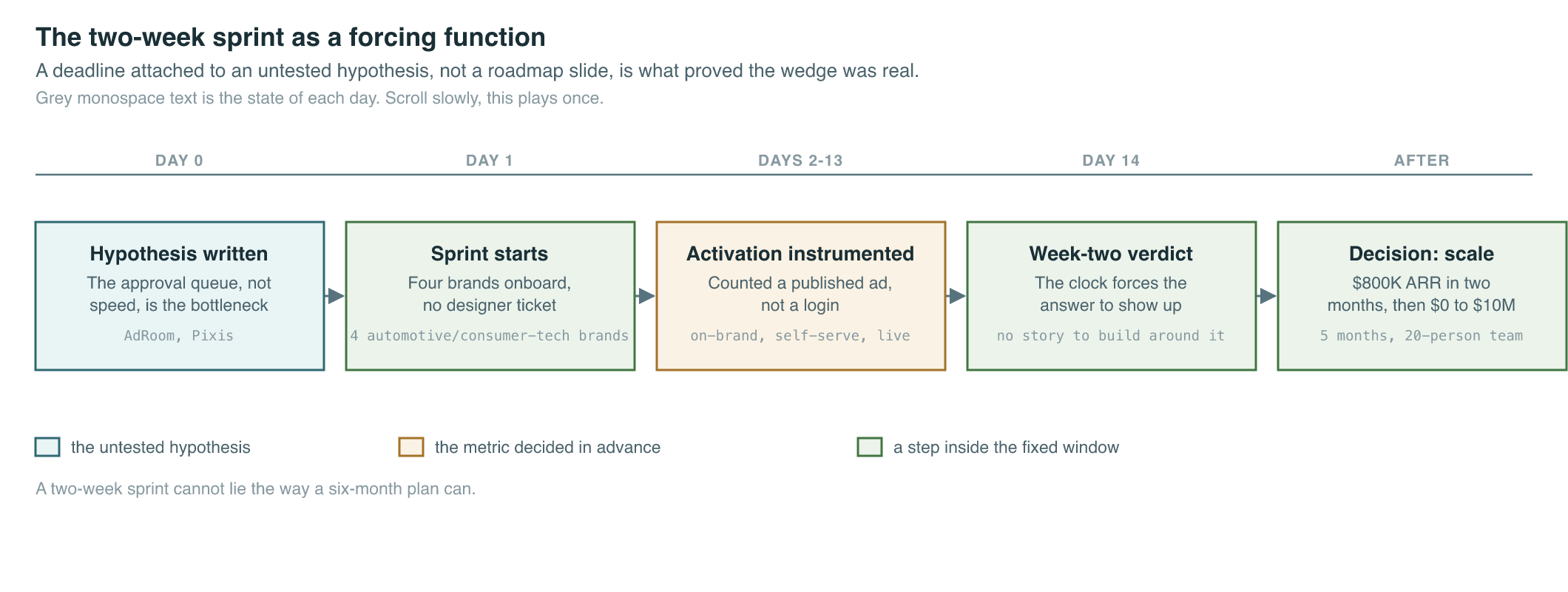
We instrumented activation, meaning a published on-brand ad, and ignored logins entirely. Four automotive and consumer-tech brands ran through the sprint. The two-week window turned into $800K ARR in two months, and the full motion went from $0 to $10M ARR in five months with a 20-person team.
That is what tactical impatience buys you. A two-week sprint cannot lie to you the way a six-month plan can, because the clock forces the answer to show up before anyone has time to build a story around it.
2. Calculated risk needs a drawn line, not a leap of faith
Calculated risk is not the absence of caution. It is deciding in advance exactly how much control you are willing to hand over, and holding that line even when the demo looks good.
Prism, the AI co-pilot we built at Pixis, could recommend a campaign change and execute it in one click. That is the entire pitch of an AI co-pilot, and it is also the entire risk. The hardest call on that product was never whether the natural-language layer understood the question. It was how much autonomy to give the system once it had the answer.
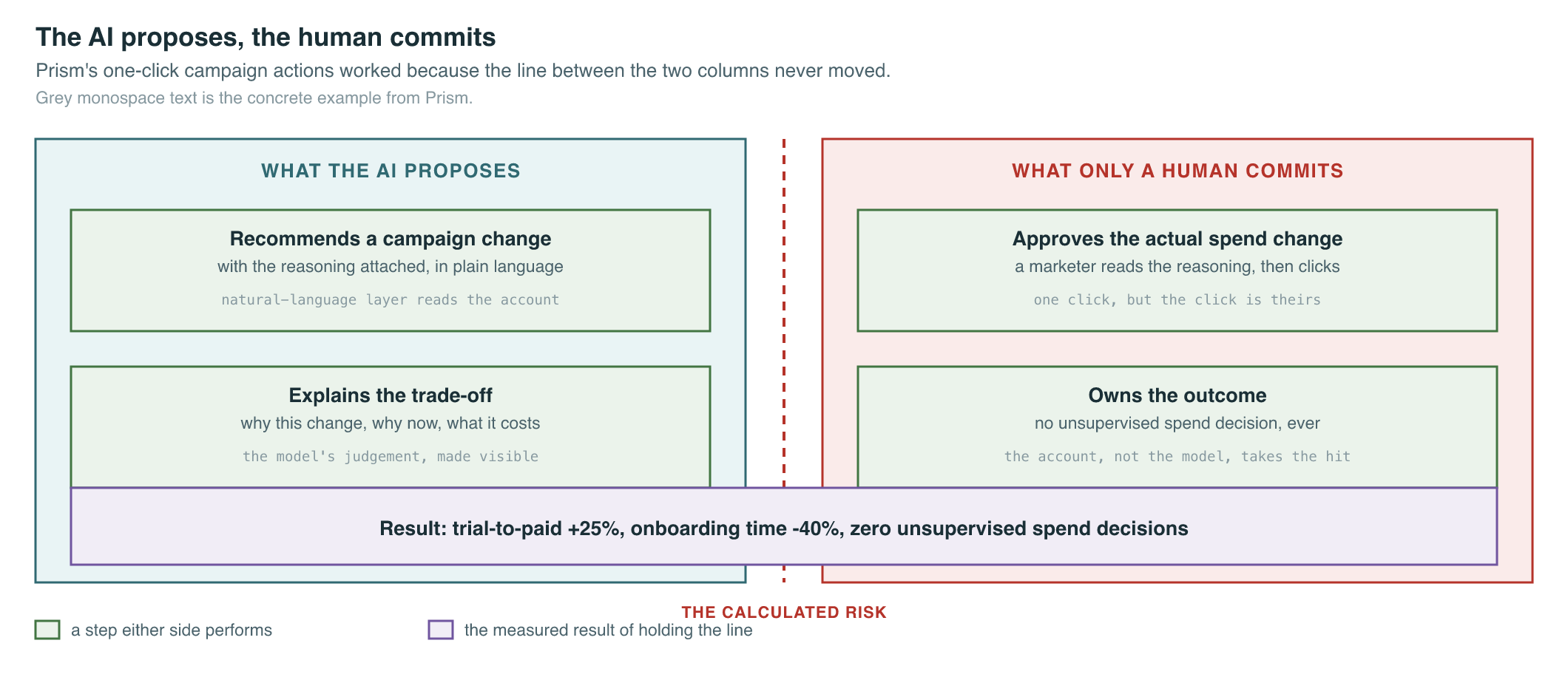
The line we drew was simple: the AI proposes and explains, the human commits. That single rule let us ship one-click actions without ever betting the account on a model’s judgment alone. Prism’s launch still moved the numbers that mattered, trial-to-paid up 25% and onboarding time down 40%, and it moved them without a single unsupervised spend decision.
Calculated risk, done right, looks boring from the outside. The interesting part is upstream, in the boundary you decided not to cross.
3. Anchor the decision in a number, not an opinion
Data-driven intuition is a real thing, but it only works when the data is close enough to trust and fast enough to act on before the decision window closes.
At InMobi, I own the system of record under a demand-side platform and an ad exchange that process 200M+ devices’ worth of ad events a day. The month-end revenue close on that data used to take five days. It now takes twelve hours. That change did not happen because someone decided to “move faster.” It happened because the team decided, in advance, which number the close depended on and instrumented that number directly instead of reconstructing it after the fact each month.
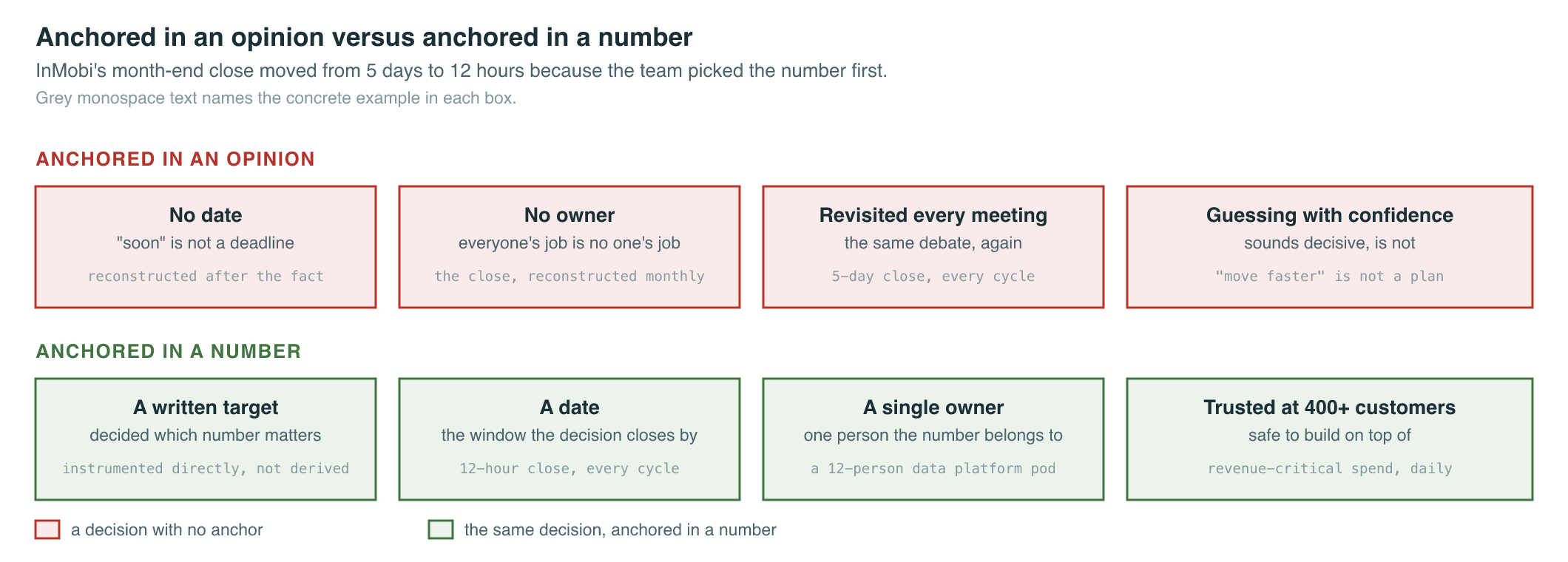
The same discipline shaped my first mandate at Pixis, before any AI feature shipped: a 12-person pod rebuilding the data platform underneath the AI layer, because none of the optimization or personalization logic on top meant anything if the data feeding it was late or wrong. That platform now underpins a system 400+ enterprise customers trust with revenue-critical spend. It never demoed well. It is the reason everything that did demo well was safe to ship.
Speed without a trustworthy number is not decisiveness. It is guessing with confidence.
4. Prioritizing the handful of decisions that matter
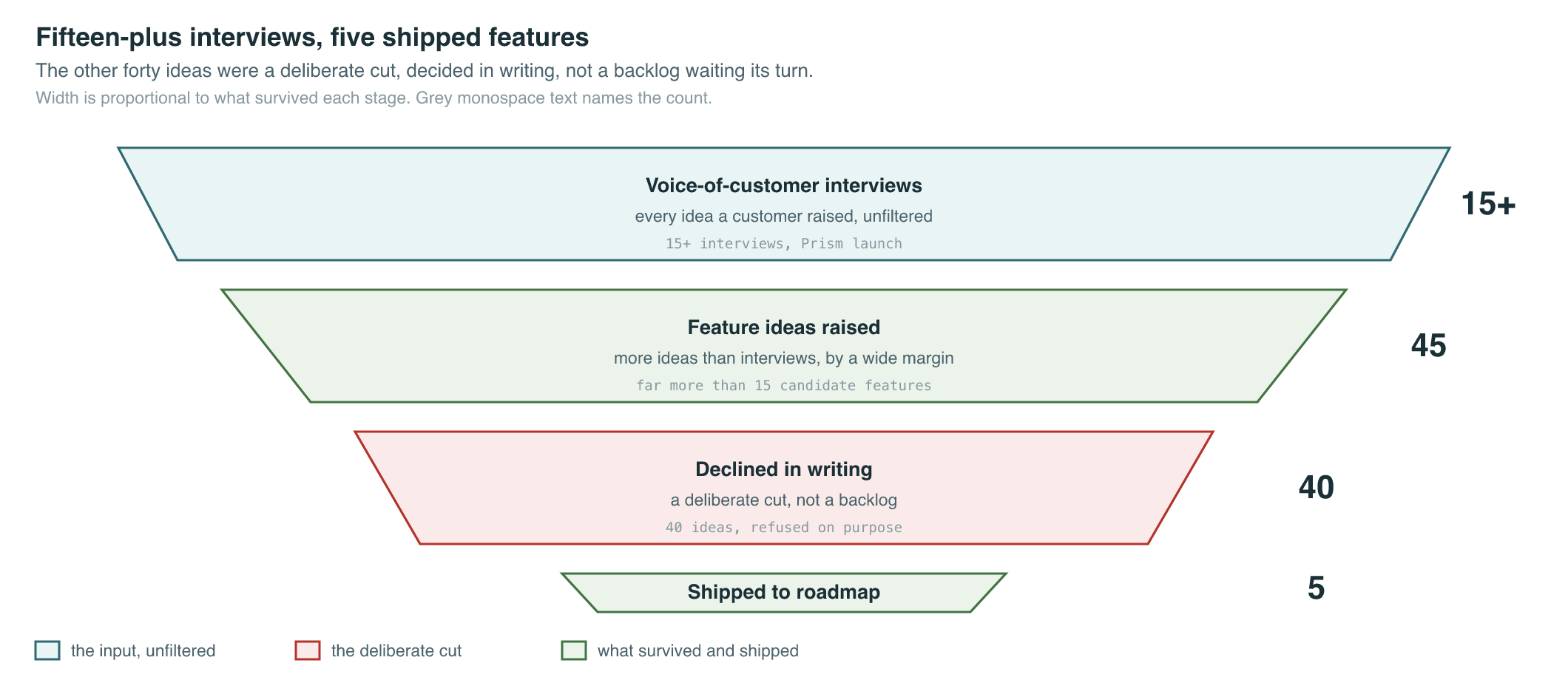
Every roadmap has more good ideas than a team can fund. The strategic decision is not picking the best idea. It is refusing almost all of them on purpose.
On the Prism launch, we ran fifteen-plus voice-of-customer interviews. Fifteen conversations produced far more than fifteen feature ideas, and we shipped exactly five. The other forty were not forgotten, they were declined, in writing, because funding all of them would have meant funding none of them well.
The same logic showed up on the editor side of AdRoom. Killing the manual QA gate only worked because we made one narrow, prioritized bet first: enforce brand guidelines at the moment of generation, not after. That single constraint is what let us cut designer workload on the editor by 80% without ever shipping an off-brand ad. Prioritizing the right decision, and only that one, did the work that a longer feature list could not.
5. Keeping the team aligned while you move fast
None of the speed above works if the team does not trust why a call was made. Cross-functional collaboration is not a meeting cadence, it is the habit of making the reasoning visible to the people who have to execute it.
The Prism team spanned fifteen people across the natural-language and voice surfaces, plus the engineers and designers building AdRoom underneath it. Moving that many people at sprint speed required a rule I still use: unwritten means undecided. A decision that lives only in someone’s head is a decision the team has to re-litigate the next time it comes up, which is slower than writing it down once.
Transparent communication, in practice, means a decision memo that a designer, an engineer, and a marketer can each read and understand why the call went the way it did, even the ones who disagreed with it. That is what makes fast decisions durable instead of just fast.
Takeaways
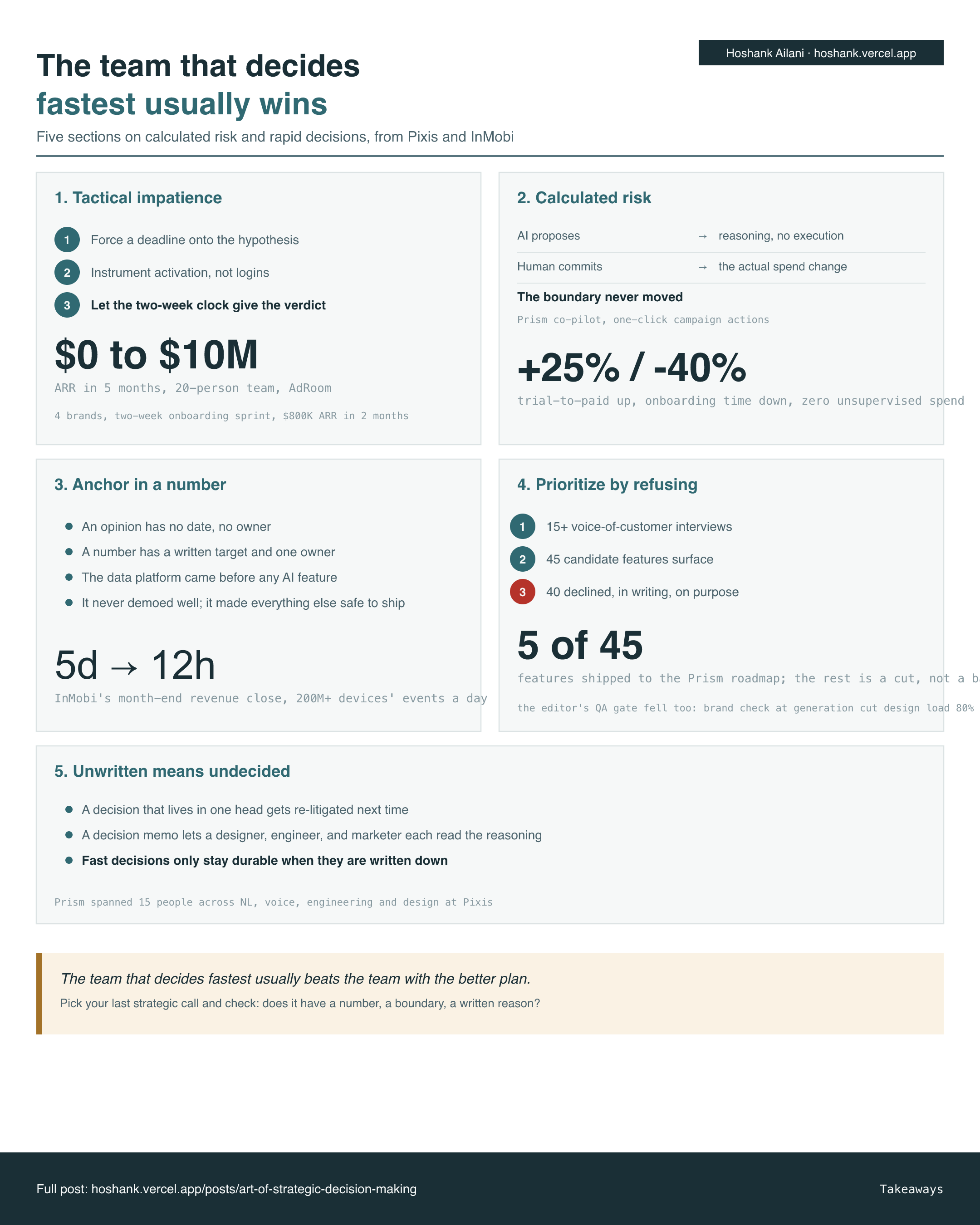
Five panels, one per section. The test to run: pick your last strategic call and check whether it has a number, a boundary and a written reason behind it.
Final Words
Strategic decision-making in product management is not about being fearless. It is about deciding in advance what you are willing to risk, anchoring the call in a number you trust, and writing the reasoning down so the team can move at the same speed you did.
Pick the next decision on your roadmap that feels big. Write the boundary before you make the call, not after.
Cheers, Hoshank