The same dollar walks the same six-box chain every time, and it comes out the other end worth 30 times more on one surface than another.
I own the data behind a DSP and an ad exchange that clear billions of ad events a day across 200M+ devices, and I also work on Glance, which monetizes lock screens and CTV surfaces. So I watch one dollar arrive dressed as completely different money depending on where it lands. This post traces four real impressions end to end, a Prime Video slot, an Economic Times page, a Candy Crush screen, and a nod to the premium end of TV, so you can see exactly what stays fixed and what mutates.
So that’s today’s post.
Today’s Post
Four impressions, one equation, and the three things you have to diagnose before you touch a lever.
- The one equation and the one supply chain that travel into every example
- Prime Video: the closed loop wearing a TV ad
- The Economic Times: the open web, doing it the hard way
- Candy Crush: the app that mostly doesn’t want your ad dollar
- The premium end, and the synthesis table that ties all four together
1. The equation and the supply chain everyone shares
Two things travel with you into every example on this list.
RPM = eCPM x fill rate. RPM is revenue per thousand impressions of inventory you actually have. eCPM is the effective price per thousand impressions that sold. Fill is the share of your available slots that found a buyer. You can post a gorgeous eCPM and still starve if half your inventory goes unsold, and you can fill 100% at prices so low you would have been better off showing nothing.
The supply chain is just as fixed. An advertiser hands money to an agency or a trading desk, which runs a DSP that decides, per impression, whether to bid and how much. On the sell side, a publisher exposes inventory through an SSP or ad server, which offers it to an exchange where DSPs bid. The auction clears in roughly the time it takes the page or player to load. The dollar leaks a little to each intermediary on the way through, and what survives is the publisher’s revenue.
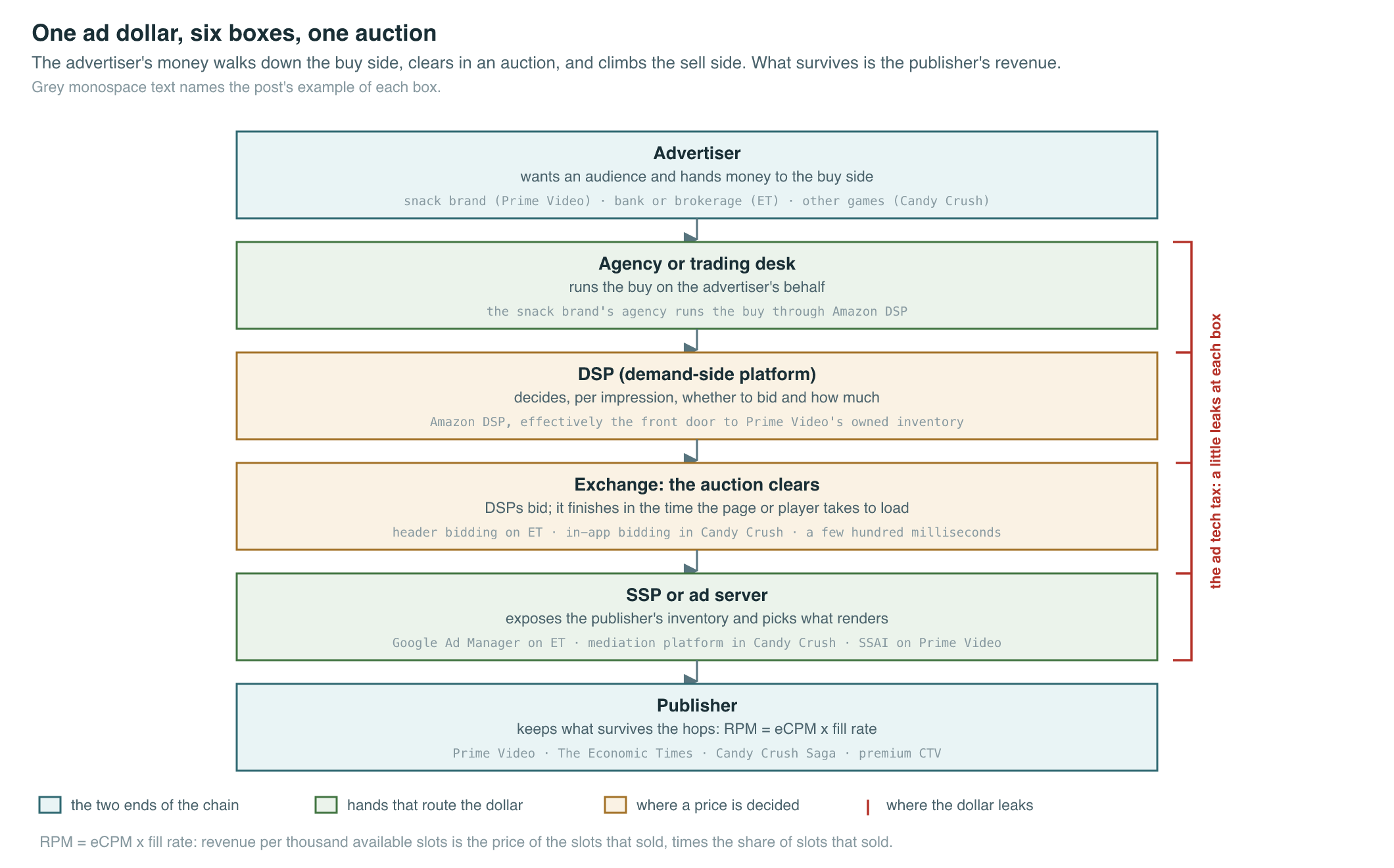
Advertiser to DSP to exchange to SSP to publisher, priced by an auction, measured afterward. That is the whole skeleton. Now watch it wear four different skins.
2. Prime Video: the closed loop wearing a TV ad
Start with the surface that looks most like old television and behaves least like it.
In early 2024, Amazon made a move the rest of streaming had been too cautious to try. Netflix and Disney+ launched their ad tiers as opt-in, a cheaper plan you chose. Amazon made Prime Video ads opt-out. Every existing Prime member got ads by default, and going ad-free cost an extra $2.99 a month in the US. That single switch turned a subscription base into the largest premium ad-supported streaming audience almost overnight, with reach reported in the range of 130M+ monthly ad-supported US viewers.
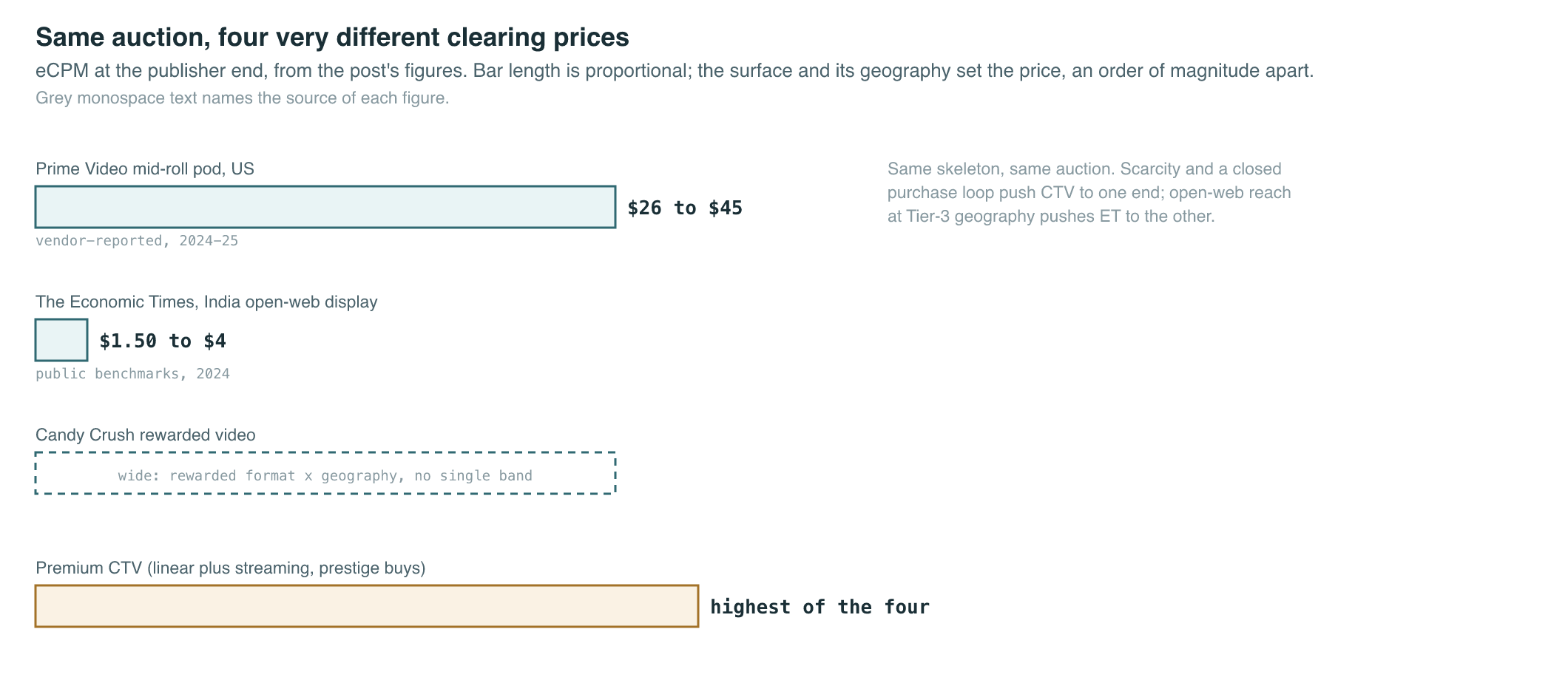
Trace one slot. You are a mid-roll ad break inside a show someone is streaming on a smart TV. Vendor guides describe base CPMs around a $26 preferred-deal floor up to about $34 for guaranteed buys, with real clearing prices commonly quoted from the high $20s into the $40s once targeting is layered on. Compare that to the couple of dollars a commodity web banner clears, and the surface is already asserting itself: same auction, an order of magnitude more money per thousand.
Two reasons explain the premium, and the second one is the whole game. The first is format and context. This is full-screen, sound-on, unskippable video against premium content on the biggest screen in the house, and Amazon runs a deliberately light ad load to protect that experience. The second is the closed loop. Amazon is not just a streamer, it is a retailer that knows what you bought, so it can connect exposure inside its own walls to a purchase inside its own walls, no third-party cookie and no fragile cross-site stitching required.
The ad itself arrives through server-side ad insertion, stitched into the content stream on Amazon’s servers so the viewer gets one seamless feed with nothing for an ad blocker to strip. On this surface, measurement is the strength and the constraint is inventory discipline. Amazon protects yield by keeping ad load low, so the fight here is eCPM, not fill.
3. The Economic Times: the open web, doing it the hard way
Now swing to the opposite corner. The Economic Times, India’s leading business daily published by the Times Group since 1961, lives on the open web. Where Amazon owns the pipe end to end, ET assembles revenue out of many demand sources it does not control, on inventory anyone with an ad blocker can degrade.
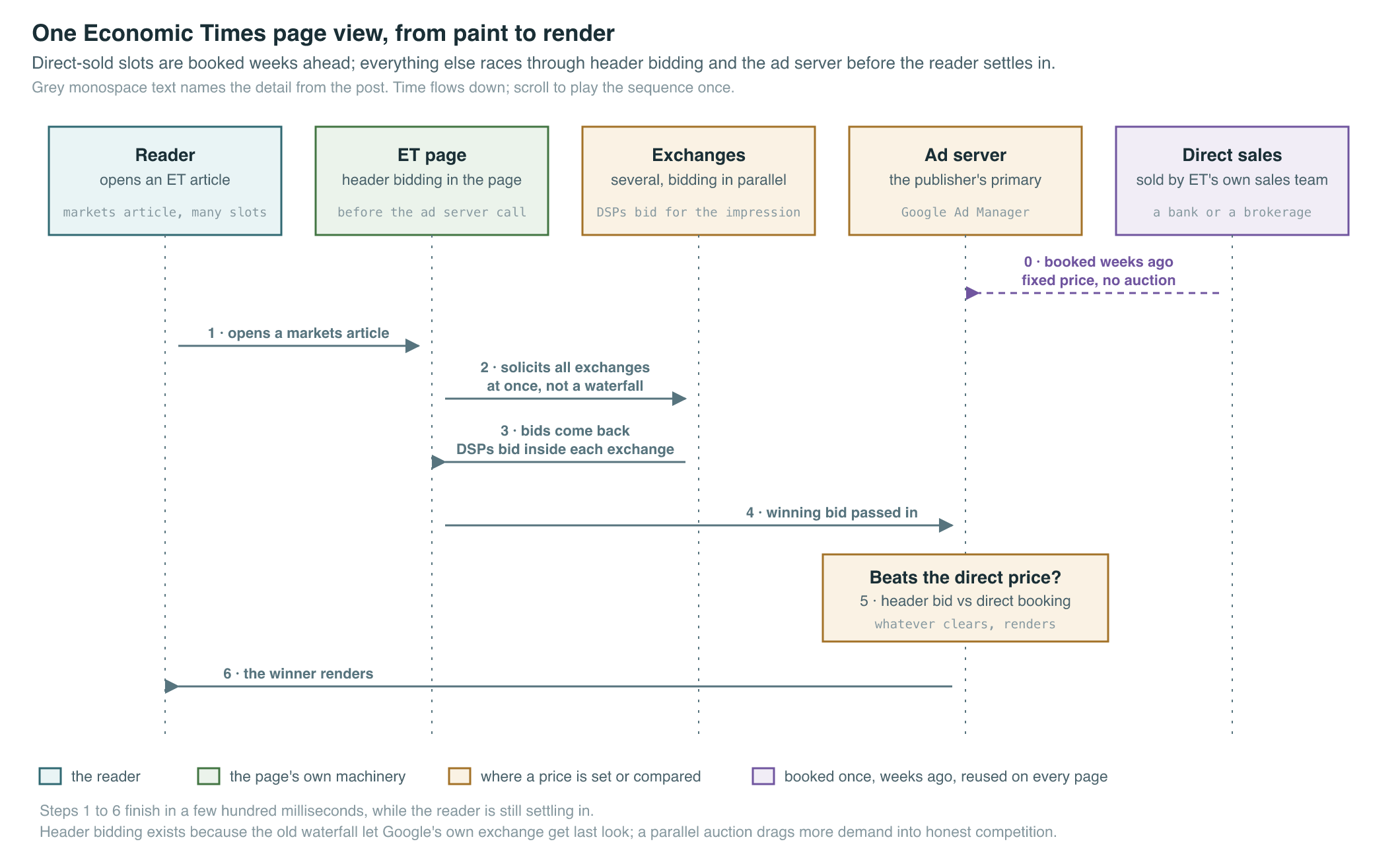
Trace one page view. A reader opens an ET article on the markets, and before the page finishes painting, several things race at once. Some slots are directly sold, a bank or a brokerage bought a placement weeks ago through ET’s sales team, at a known price with no auction leakage. Everything the sales team did not sell falls to programmatic, and ET runs header bidding: the page solicits bids from multiple exchanges simultaneously instead of waterfalling through them one at a time. The winning bid gets passed to the ad server, which compares it against any remaining direct commitment, and whatever clears, renders, all inside a few hundred milliseconds.
Then the economics bite, and they bite differently than on Prime Video in three ways. Geography sets the ceiling: India is a Tier-3 CPM market, and open web display commonly sits in the low single dollars, roughly $1.50 to $4.00, against $10 to $23 for comparable Tier-1 US inventory on the same header-bidding technology. Subscriptions fight ads for the same reader: ET runs ETPrime, a paywall, and every reader converted to a paying subscriber sees fewer ads, trading low-CPM impressions for subscription revenue and a logged-in relationship. And the signal is decaying, so the login wall doubles as a data play: third-party cookies are already gone in Safari and Firefox, Chrome’s deprecation keeps slipping, and the direction is unambiguous either way, so a known logged-in reader is an audience ET can target and sell directly with or without a cookie.
ET’s yield fight is the mirror image of Amazon’s. Fill is relatively easy, programmatic clears almost anything at some price, so the war is on eCPM, pushing more inventory into direct sales and first-party segments to escape the commodity floor. Measurement here is the hard part, not the moat. Without a closed purchase loop, ET proves value with viewability, attention metrics, and whatever first-party signal it can assemble.
4. Candy Crush: the app that mostly doesn’t want your ad dollar
Here is the surface closest to my own turf, in-app mobile, where the exchange I work on lives, and the one that breaks the most assumptions.
Candy Crush Saga is made by King, which Activision Blizzard bought for $5.9B in 2016 and which became part of Microsoft when the Activision acquisition closed in 2023. It is one of the most durable money machines in mobile, with reported revenue around $1B in 2024 and still roughly 200M monthly players more than a decade in. And here is the twist that makes it a great example: Candy Crush makes most of its money by not running ads. King’s core model is in-app purchases, gold bars, boosters, extra lives, so every ad you show risks pulling a would-be spender out of the flow.
The format that survives contact with a strong purchase economy is rewarded video: the player opts in, watches a 15 to 30 second ad, and gets an extra life or a booster in return. Interstitials and offerwalls exist too, but rewarded video is the one players tolerate and often want, because the value exchange is explicit.
Trace one rewarded impression. A player fails a level and taps to continue, and the game’s SDK needs to fill that single slot for the highest price it can get, right now. The old approach was a mediation waterfall, calling ad network A, then B, then C, ranked by historical average eCPM rather than what each network would pay for this specific impression. The industry’s answer is in-app bidding, mobile’s version of header bidding: every demand source bids on the impression in one live auction, and the true highest bid wins.
But the thing that actually reshaped this surface was not the auction, it was Apple’s App Tracking Transparency. Before 2021, mobile user acquisition ran on the IDFA, a per-device ID that let a game measure, deterministically, that a specific install came from a specific ad. ATT let users deny access to that ID, most did, and the closed loop collapsed on iOS. Attribution moved to SKAdNetwork, Apple’s aggregated and deliberately delayed framework, mediated by mobile measurement partners who now stitch together a blurrier picture.
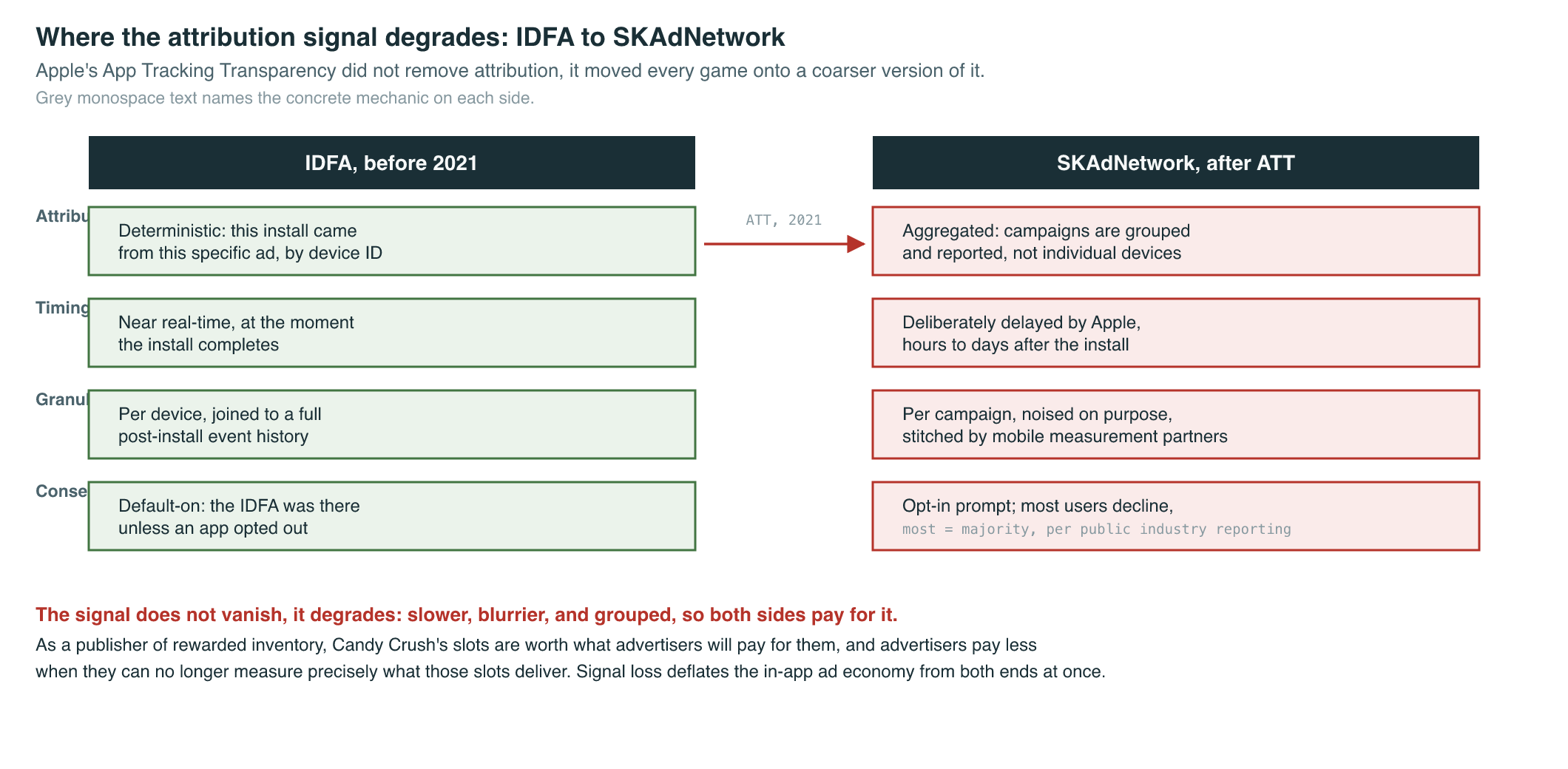
The consequence is easy to miss: ATT did not just make buying users harder, it changed the value of the ad dollar on both sides. As a publisher of rewarded inventory, Candy Crush’s slots are worth what advertisers, mostly other games, will pay, and advertisers pay less when they can no longer measure precisely what those slots deliver. Signal loss deflates the whole in-app ad economy from both ends at once, and the surface where I sit felt this hardest of anywhere.
5. The premium end, and what stays fixed across all four
Prime Video is the mass-scale version of the CTV story. There is a premium end worth naming too: traditional media companies whose ad-supported streaming and networks represent the highest-value, most brand-safe end of converged TV, increasingly planned and bought across linear and streaming as one buy. It is the same equation as Prime Video, scarce premium video and inventory discipline over fill, sold to advertisers who care about prestige adjacency and cross-screen reach as much as targeting.
Line the four up and the pattern holds: the equation never changes, but every term in it is dominated by something different depending on the surface.
| Prime Video (CTV) | Economic Times (news web) | Candy Crush (mobile game) | Premium CTV | |
|---|---|---|---|---|
| Who pays | Brand and performance advertisers via Amazon DSP | Direct-sold brands plus programmatic demand | Mostly players via in-app purchase, ads secondary | Brands, at a premium |
| Primary format | Full-screen video pods (SSAI) | Display and programmatic banners | Rewarded video, interstitials | Premium video, linear plus streaming |
| The data moat | Closed retail purchase loop | First-party logged-in audience | In-app purchase behavioral data | Premium content and cross-screen reach |
| Typical CPM band | Roughly $26 to $45 | Roughly $1.50 to $4 | Wide, rewarded high, geography-dependent | Highest of the four |
| Key measurement pain | Least, the closed loop is the strength | No purchase loop, viewability and attention only | ATT and SKAN signal loss dominates | Cross-screen dedup and reach measurement |
Three things move with the surface, and you have to diagnose which one you are actually fighting before you touch a lever: the economics, where the money comes from and what the geography lets it cost, the signal, whether you have a closed loop, a decaying cookie, or a shattered device ID, and the format, what the surface will physically tolerate before the experience breaks.
Three things never move. The equation is always RPM = eCPM x fill, and you are always trading one term against the other. The supply chain always leaks a tax between advertiser and publisher, and the winners are the ones who own more of the pipe. And every player on every surface is incentivized to over-claim, the impression that maybe did not render, the view that was one pixel for one second, the conversion that would have happened anyway. The privacy squeeze is the one force tightening across all four surfaces at once, and it makes over-claiming both harder to get away with and more tempting to attempt.
Takeaways
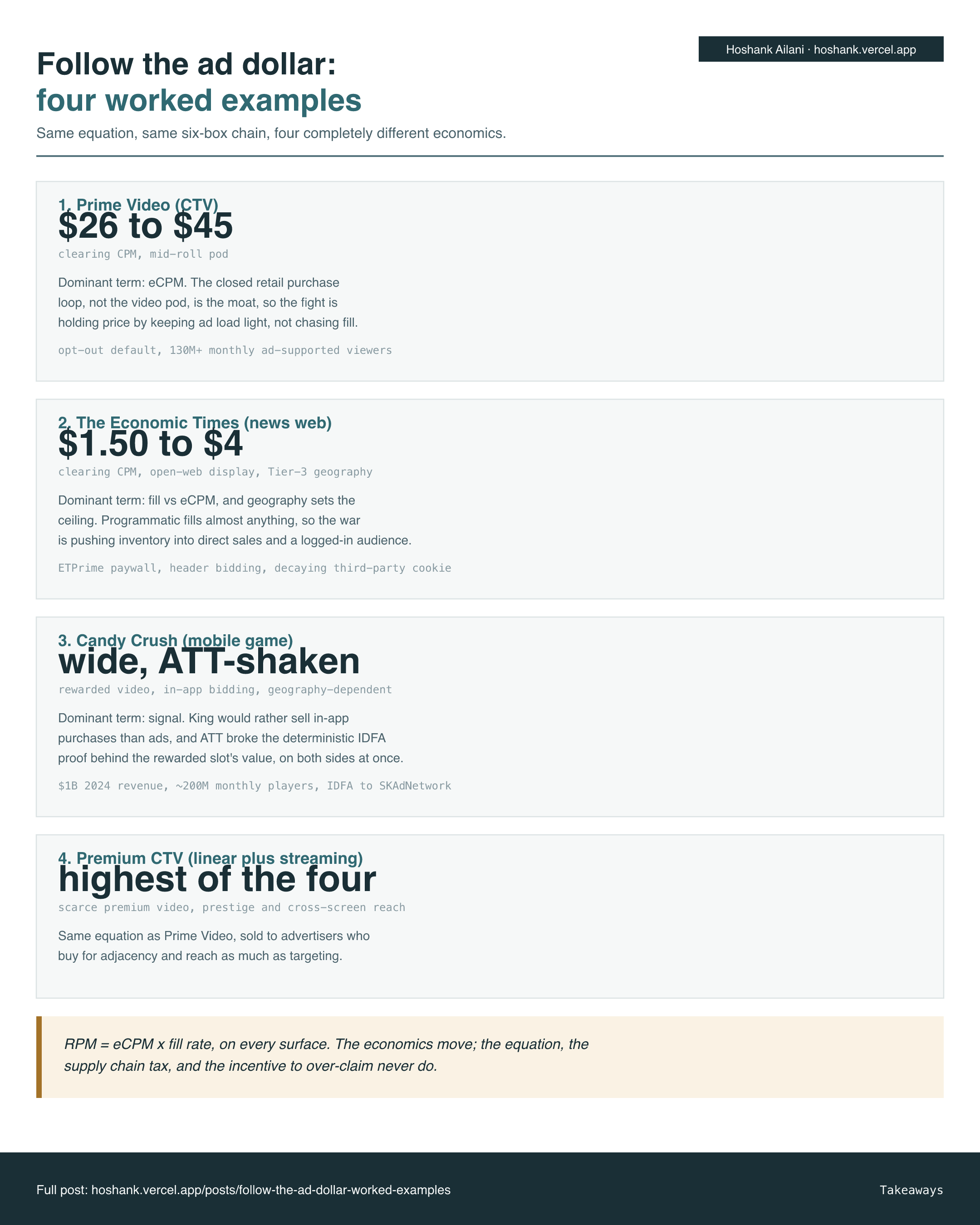
Four surfaces, one equation. Learn the physics so you are never fooled, and learn the economics so you are never useless.
Final Words
The physics of advertising are boring and universal, the same six boxes and the same equation on every surface you will ever look at. The economics are wild and specific, and mistaking one surface’s quirks for eternal laws is how you get fooled in the opposite direction. Before you touch a lever on your own inventory, name which of the three moving parts you are actually fighting, the economics, the signal, or the format, because the fix for one does nothing for the other two.
Reply and tell me which surface you work on. I want to know what the equation looks like from where you sit.
Cheers, Hoshank