When an AI feature hurts someone, the reporter does not ask which engineer wrote the loss function. They ask who shipped it.
That question lands on product, every time. I own the system of record under a DSP and an ad exchange at InMobi that processes 200M+ devices’ worth of ad events a day, and before that I led the AI creative platform at Pixis that took AdRoom from $0 to $10M ARR in five months. Neither job let me hand the ethics of the feature to someone else’s team. The guardrail, the human review step, the number a user saw on screen, those were product calls, mine to make.
So that’s today’s post.
Today’s Post
The five decisions that determine whether an AI feature stays safe as it scales, in order.
- Where bias enters before the model ever sees your roadmap
- Why an audit has to be a release habit, not a report
- Ship criteria you can test, written down before launch
- Guardrails, governance, and human review, built from a real product
- Privacy and legal risk, which are the same job as content policy
- Why narrowing a launch is the safest bet you have
1. Bias enters before the model sees your roadmap
Bias does not start in the model. It starts in decisions your team made months earlier, and it compounds across five stages before a user ever sees the output.
Training data reflects whatever happened before. If the history behind the data was unjust or incomplete, the model repeats it. A hiring tool trained on ten years of one kind of hire keeps recommending that kind of hire.
Labeling encodes a person’s judgment, and people disagree. Annotators drift under quota pressure, rubrics get reinterpreted late at night, and the “ground truth” you train against is really one team’s best guess on a Tuesday.
Feature selection decides what the model is allowed to notice. Drop a variable to avoid discrimination and the model often finds a proxy for it anyway, a zip code standing in for the thing you tried to hide.
Evaluation hides the same bias when your test set looks like your majority users and the metric never breaks out by subgroup. A 96% accuracy score can still be a 60% score for the group nobody sliced out.
Deployment is where whatever you missed finally shows up. A model that looked fair in a notebook can skew the moment it gets routed by geography, language, or which support tier the account sits in.
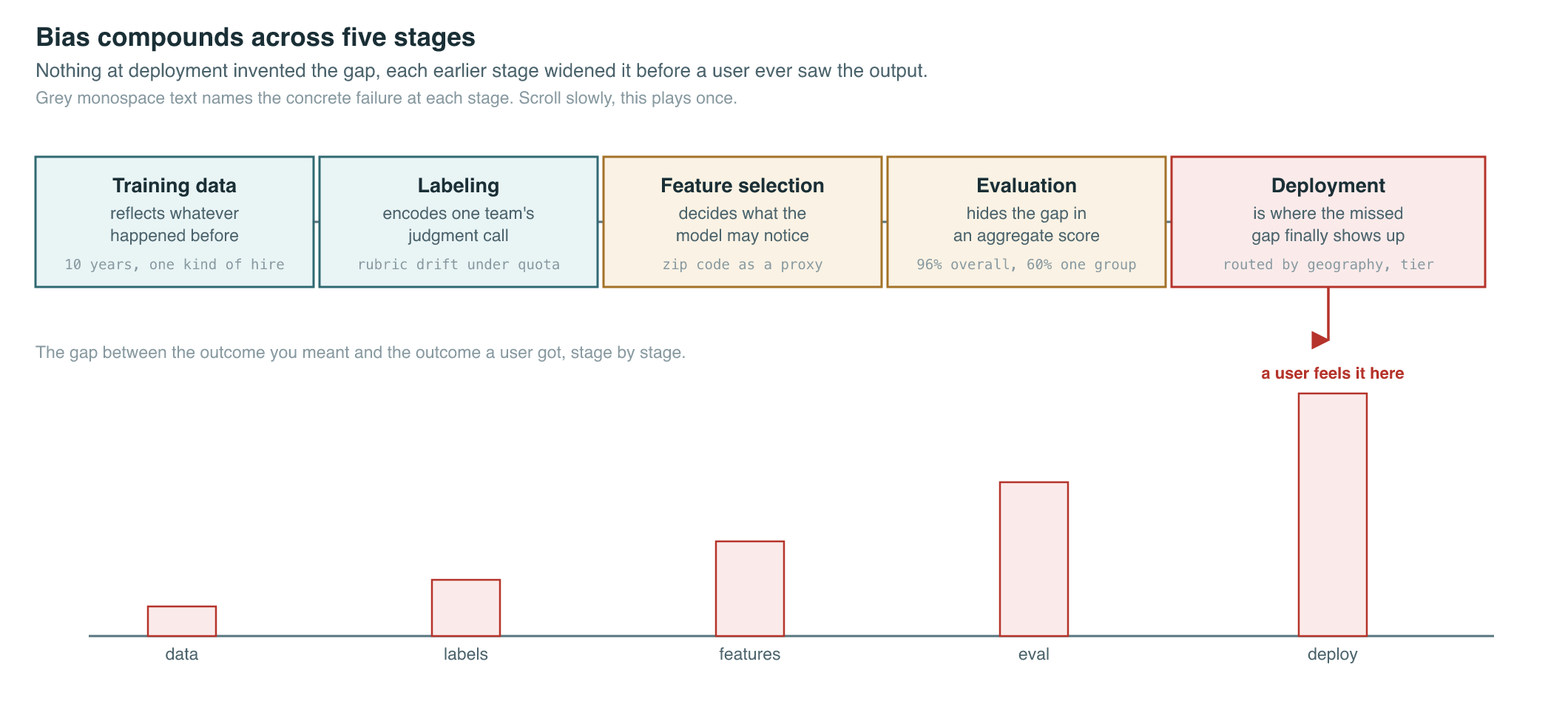
Your job across all five stages is the same. Name where a decision embeds a value, and make sure someone besides you can point to it later.
2. An audit is a release habit, not a report
An audit is not a document you write once before launch. It has to run every time you ship, the same way a security scan runs on every deploy.
Start with the subgroups that matter for your product and your market, not every slice a spreadsheet can produce.
Measure disparity on the outcomes people actually feel: error rates, approval rates, how often a ranking buries one group below another, how often a case escalates to a human. Aggregate accuracy hides all of that.
Stress-test with red-team scenarios before a stranger runs them for you, for free. Log every override, every appeal, every human correction. Disagreement between what the model said and what a human decided is the highest-signal data you own, and most teams throw it away.
If you cannot measure how the system behaves on a subgroup, you cannot claim you checked for bias. “We mean well” is not an audit.
3. Ship criteria you can test
Fairness, safety, and privacy deserve the same treatment as any other release requirement: a short list of things that must be true before you widen exposure, each one testable, each one signed by a name.
A criterion that says the model should be fair is not a criterion. A criterion that says the false positive rate for a named subgroup does not exceed a stated ceiling on the held-out set is one you can pass or fail. If you cannot write it in that shape, you are still discovering the risk, not managing it.
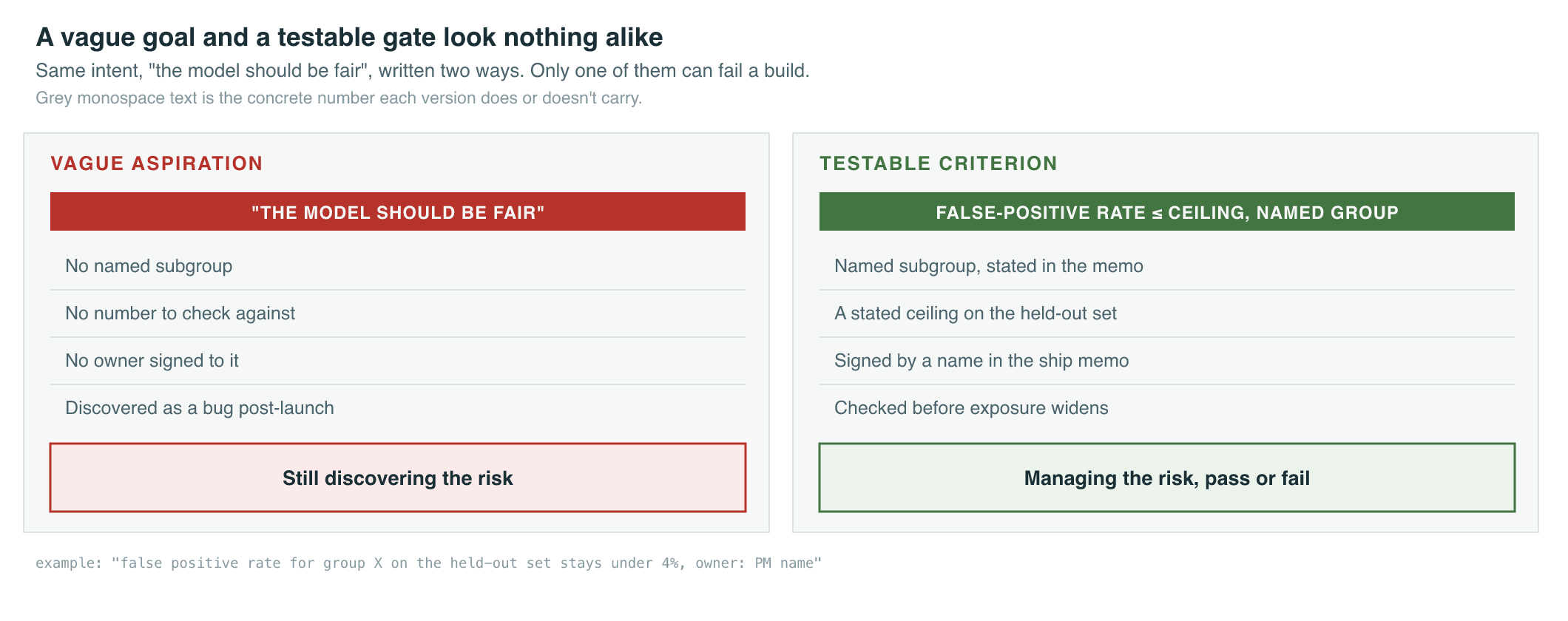
The PM mistake is handing this list to ML and legal separately and finding out on launch week that nobody agreed on the same bar. You convene that conversation early, write the memo people argue with, and put the residual risk in the ship decision where everyone can see it.
Sometimes raising fairness for one group lowers a headline accuracy number, or moves errors somewhere a stakeholder dislikes. That is not proof the fairness fix was wrong. It is proof the objective was never written down as a choice, just left as a default nobody chose. Decide which errors you can least afford, set the floor you will enforce for the group with the least power in the room, and write down what triggers a stop-ship before the metric ever crosses it.
4. Guardrails, governance, and human review, built from a real product
Guardrails stop being an abstraction once you have shipped one. At Pixis, AdRoom generates on-brand ads inside a system that enforces fonts, color, logo rules, and voice at generation time, not after the fact. That one decision let the team retire the manual QA gate that used to sit between a marketer and a live ad, and designer workload dropped 80% because the constraint moved earlier in the pipeline instead of disappearing.
Prism, the AI co-pilot I later led at Pixis, drew a harder line: the AI proposes and explains, the human commits. One-click campaign changes were the whole value of that product and the whole risk of it, so the team never let the model execute a spend change on its own.
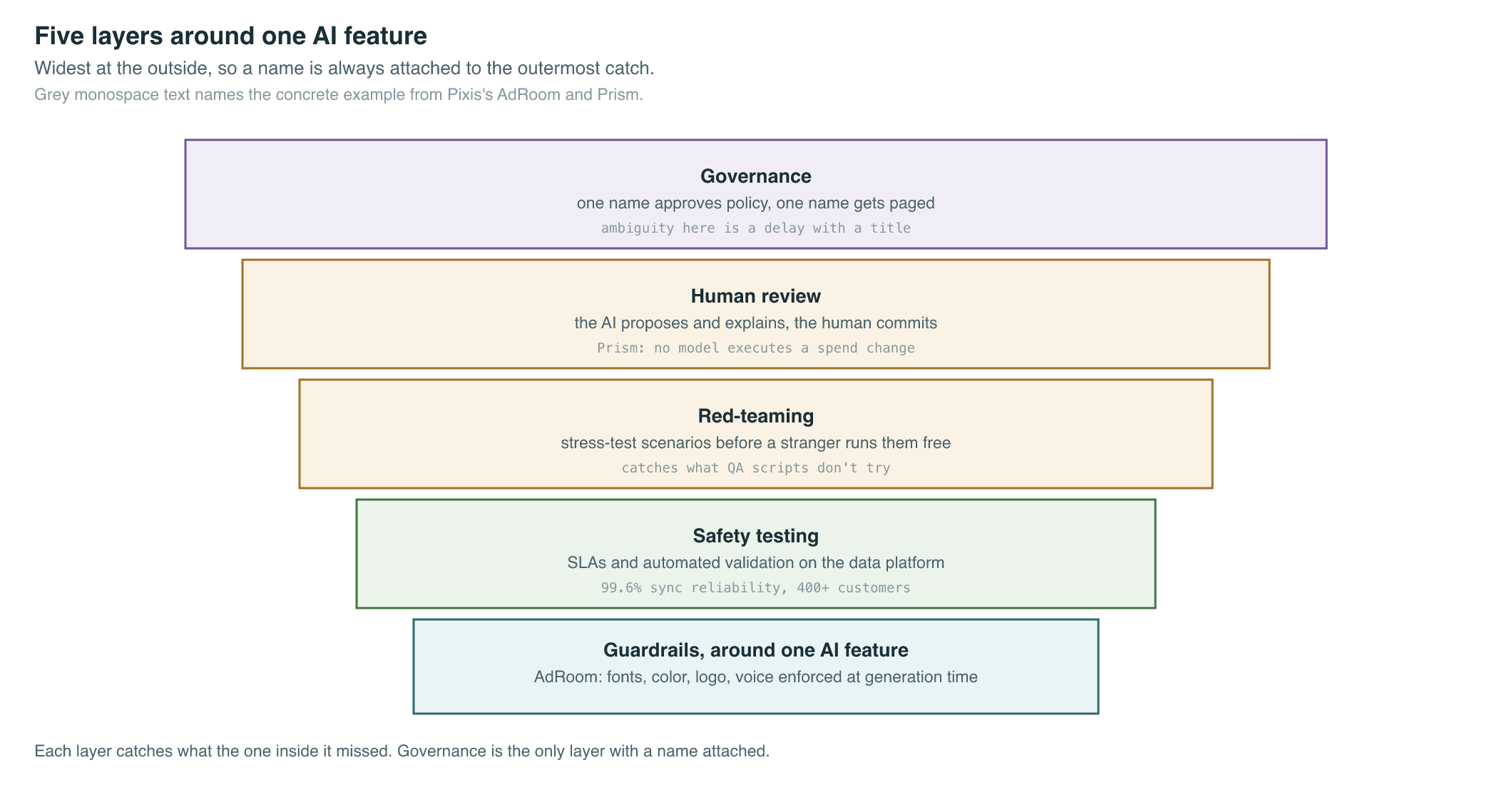
Underneath both products, the data platform I built first ran on SLAs and automated validation, catching failures before a downstream feature acted on bad data. That platform held 99.6% end-to-end sync reliability across 400+ enterprise customers, and it is the reason a recommendation on top of it was worth trusting with real budget.
None of this works without governance in the plain sense: one name for who approves a policy change, one name for who gets paged when an incident spikes. Ambiguity here is not neutral. It is a delay with a title.
5. Privacy and legal risk are the same job as content policy
Users ask three questions about anything you build with their data. What did you do with my input. Will it train a future model. Who can see it. Answer all three in plain language, inside the product, not in paragraph 47 of a policy page.
Minimize what you collect, set a retention window, and default to deleting what you no longer need. Enterprise buyers will ask about data isolation and zero-retention options directly, so know your vendor story to the sentence, because overclaiming here turns into a legal problem fast.
Legal risk lands on your brand even when a vendor’s contract says otherwise. Public memory does not read contracts. A biased output becomes a discrimination claim, unsafe advice becomes a negligence argument, and a deceptive generation becomes a regulatory inquiry, regardless of whose model produced it.
Content policy is not a PR document, it is a product surface. What your assistant refuses, and how it refuses, is the experience for the person who hit that wall. An inconsistent refusal feels arbitrary. An over-broad one frustrates a legitimate use. An under-broad one becomes a headline.
Transparency is not a model card nobody reads. It is telling a user what they need to decide how much to trust an answer: sources, how current the data is, how to report a bad result. My own Pixis case study on this site marks the vendor’s product numbers as vendor-reported and my own outcomes as mine, every time, in the text itself rather than a footnote. That is the same habit at a much smaller scale: say which numbers are yours and which ones are not.
6. Narrow launches are the ethical move
When you are not sure a feature is safe at scale, the safer move is to shrink the launch, not the ambition.
Prism did not launch to every account. My team ran 15+ voice-of-customer interviews before the GTM push, and the discipline was saying no to forty of those requests to ship exactly five roadmap features. Declining the other forty is what kept the co-pilot’s one-click actions trustworthy instead of a wide, unproven bet.
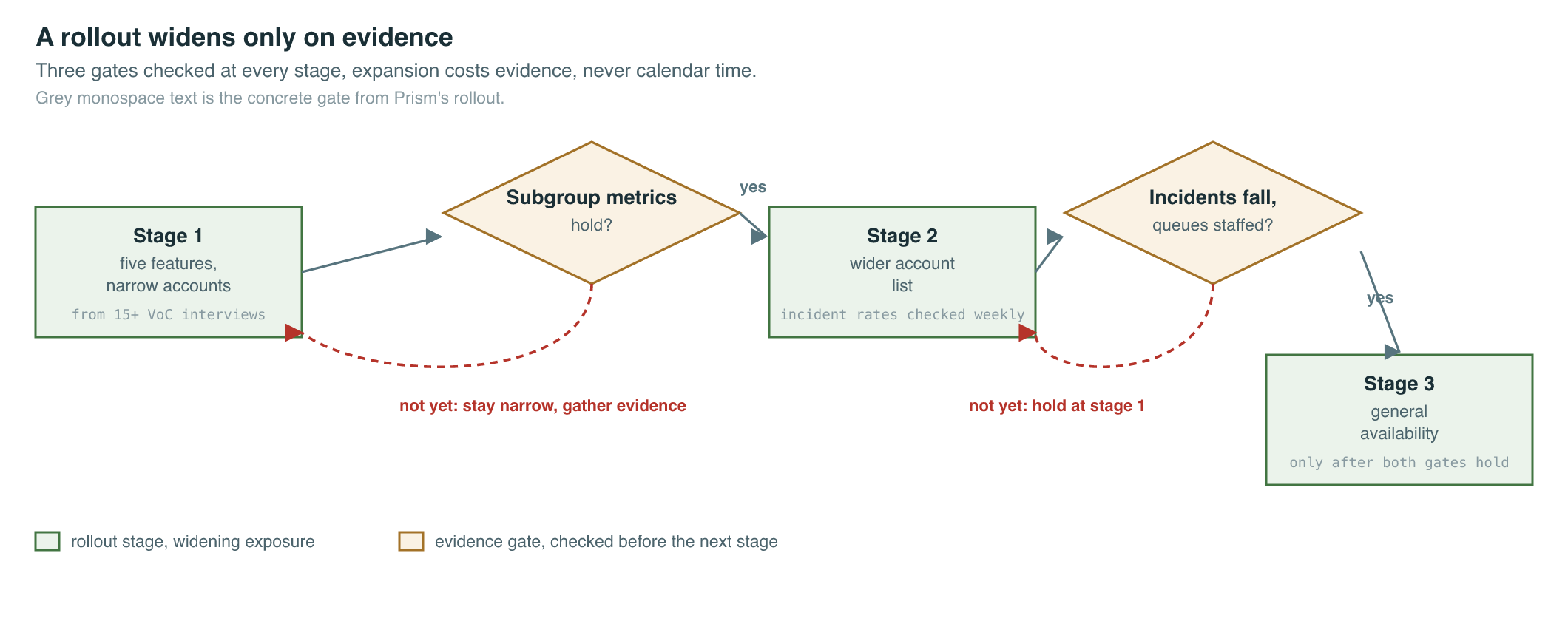
Expansion should cost you evidence, not calendar time. Subgroup metrics hold, incident rates fall, review queues stay staffed, before you widen who can use the feature.
If leadership pushes to go wide before that evidence exists, translate the risk into terms a budget owner feels: brand exposure, support load, and the cost of walking back a bad public moment. That sentence has moved more roadmaps than any ethics deck I have written.
Takeaways
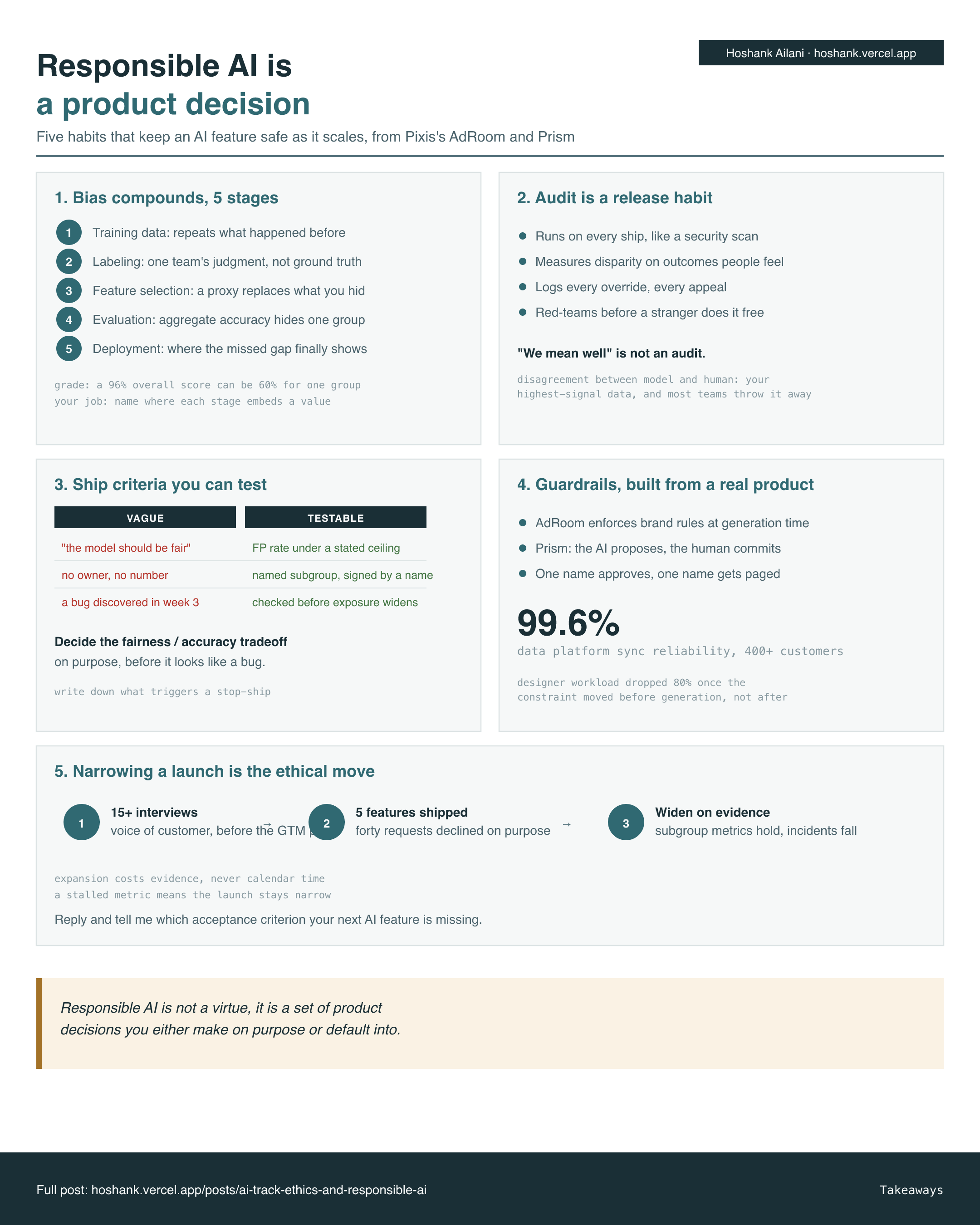
Six sections, one habit each. The test to run on the next AI feature your team ships: which of these six do you already have written down, and which one only lives in your head.
Final Words
Responsible AI is not a virtue. It is a set of product decisions you either make on purpose or default into, the same way you decide reliability and cost. Pick the AI feature closest to shipping right now, and write the one acceptance criterion it is missing.
Reply and tell me which one it was. I am collecting the gaps for a follow-up.
Cheers, Hoshank