A prioritization framework has never once resolved a roadmap fight. It only tells you which fight you are actually having.
Every scoring template promises the same thing: feed in a few numbers, get an objective rank. I have sat in the room at Dell, at Pixis, and now at InMobi where that promise breaks. The spreadsheet says one thing. The QBR argues about something else entirely, usually who owns the risk if the bet is wrong.
That gap is what this post is about. Not “which framework is best,” but what each one is actually built to do, where it quietly fails, and the two habits, cost of delay and saying no with reasoning, that carry more weight than any of them.
So that’s today’s post.
Today’s Post
Five scoring frameworks graded honestly, then the two skills that outperform all of them.
- What RICE, ICE, MoSCoW, Kano, and WSJF are each good for, and where they break
- Why cost of delay beats a static score
- The prioritization call that turned 15 interviews into 5 features
- How to sequence a roadmap as a story instead of a ranked list
- Portfolio thinking, so hygiene and growth stop competing on the same rubric
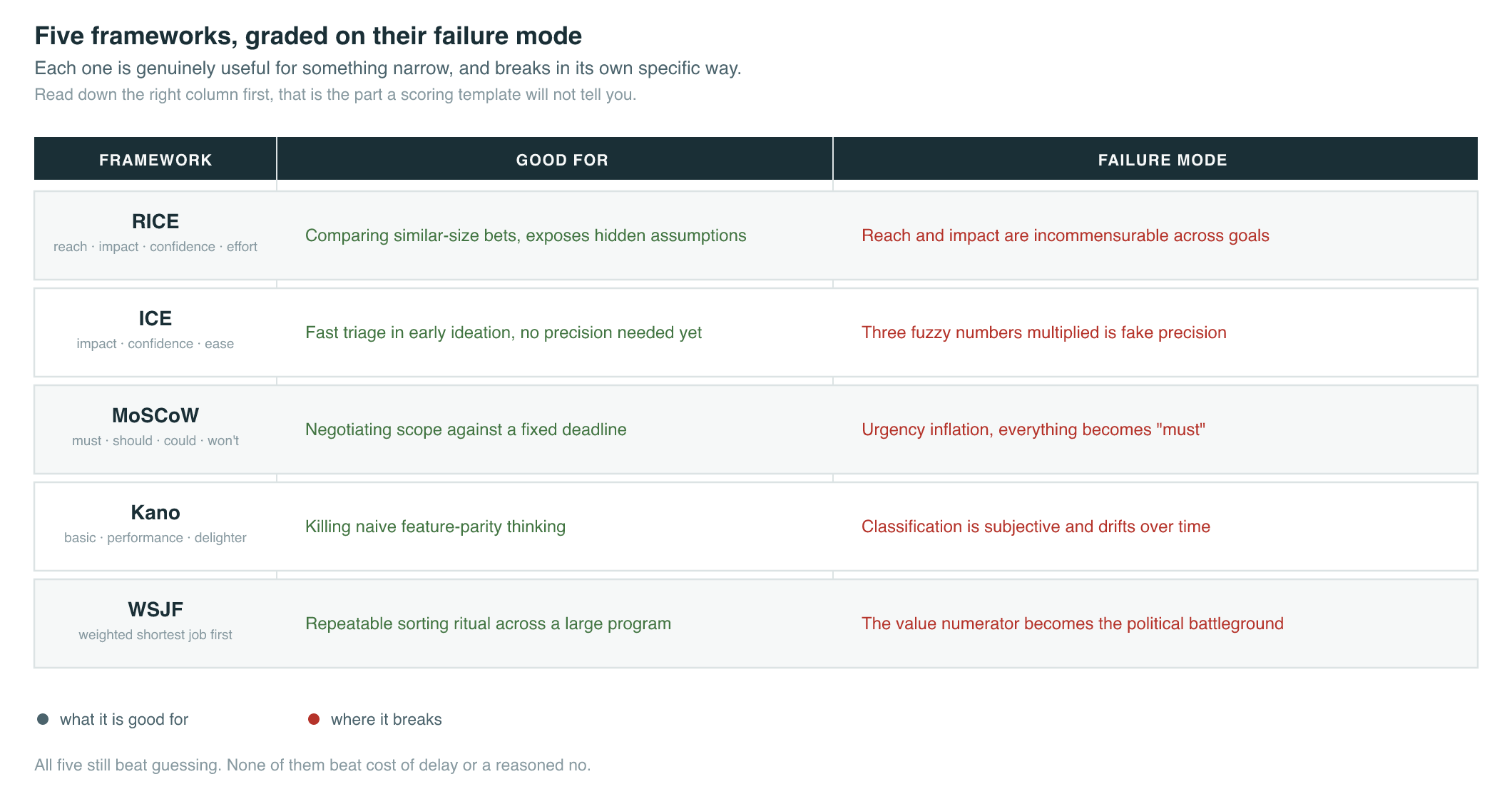
1. RICE is useful once you accept the inputs are guesses
RICE, reach, impact, confidence, effort, forces a team to separate how many people are affected, how much it matters, how sure anyone is, and what it costs to build.
What it is good for: a common worksheet. It exposes hidden assumptions and lets you compare a batch of similar-sized bets in one product area.
Where it breaks: reach and impact are often incommensurable across goals. Is reach monthly active users or accounts? Is impact revenue, retention, or strategic optionality? Without a shared denominator, teams optimize whichever metric is easiest to inflate. Confidence gets fudged to back-solve a rank someone already wanted. Effort estimates come in wrong by multiples on anything novel.
Use RICE as a conversation scaffold. If the debate after the scoring is shallow, the number is theater.
2. ICE is faster, and easier to game
ICE, impact, confidence, ease, is RICE with two fewer inputs. Speed is the whole feature.
What it is good for: triage in early ideation, when precision is impossible and the goal is only to avoid the obviously low-leverage work.
Where it breaks: multiplying three fuzzy numbers together produces fake precision. A one-point shift in a subjective score can reorder the whole list, and confidence and ease both skew toward whoever is most optimistic in the room that day.
Treat ICE like sticky-note sorting. Directionally useful, not evidence of an optimal answer.
3. MoSCoW is a negotiation tool wearing a prioritization costume
MoSCoW, must, should, could, won’t, shows up wherever there is a fixed deadline and contract language.
What it is good for: negotiating scope when a release date cannot move and stakeholders need shared labels to argue with.
Where it breaks: once an executive joins the meeting, everything becomes “must.” Without a hard definition, MoSCoW collapses into urgency inflation within one quarter.
If you use it, define “must” with teeth: regulatory exposure, existential breakage, or a signed contractual obligation. Not “important to my OKRs.”
4. Kano separates delight from table stakes, and nothing else
Kano splits features into basics, performance attributes, and delighters.
What it is good for: killing naive feature-parity thinking. Sometimes the basics need fixing before novelty moves anything.
Where it breaks: the classification is subjective and it drifts. A delighter last year is table stakes this year, and Kano gives you no way to rank which basic to fix first when you cannot fix them all.
Use Kano to enrich a discussion, not to rank a backlog.
5. WSJF works when the team already agrees on the numerator
Weighted Shortest Job First and other weighted-scoring methods try to compare value divided by effort, sometimes with a separate time-criticality term.
What it is good for: a repeatable sorting ritual across a large program, when everyone accepts the same variables going in.
Where it breaks: the value numerator becomes the battleground. Unanchored to a strategy and a metric, WSJF is just a second way to smuggle politics into a formula.
If you use a weighted score, spend more time calibrating the weights than debating individual tickets. A team that has not agreed whether retention outweighs expansion this quarter should not pretend a spreadsheet settled it for them.
6. Cost of delay is the lens most teams forget
Cost of delay asks a plain question. What do you lose per week if this waits?
Not emotionally. Economically. Sometimes the answer is small, and a nice-to-have can sit for a quarter with no cost at all. Sometimes it is steep: a compliance deadline, a renewal cycle, a competitor’s launch window, a reliability threshold you are already close to breaching.
Teams overweight effort and underweight time-based loss. A medium project with a real deadline can beat a large project with no urgency at all, and you do not need a formal model to ask the question. If we ship this four weeks later, what actually happens?
Pair cost of delay with a capacity check. The right call changes depending on whether the alternative to doing this now is doing nothing, or doing another high-leverage bet instead.
7. No framework replaces judgment, because the job is tradeoffs under uncertainty
Frameworks imply everything on the list is comparable. Real prioritization usually compares things that are not: short-term revenue against platform health, a strategic bet against a retention patch, legal exposure against growth.
A number can structure a debate. It cannot tell you what the company is optimizing for this half. Senior PMs say that part out loud instead of hiding it inside a formula: “we are overweighting retention over new logos this quarter,” or “we are buying down infrastructure risk before we chase expansion.” That is strategy spoken in plain words. Without it, every framework is arbitrary underneath.
8. The highest-leverage skill is saying no with reasoning
Anyone can add work to a roadmap. The PMs worth learning from protect the team’s throughput by ending work, clearly, and with an alternative when one exists.
At Pixis, that discipline had a number attached to it. Prism’s go-to-market ran 15+ voice-of-customer interviews, and those conversations surfaced far more feature requests than the team could build in a year. The output was exactly 5 roadmap features. Not 50. The hard part was not picking the 5. It was writing down, for each of the other 40, the specific reason it was not now.
A weak no sounds like “not a priority.” A strong no names the tradeoff: this affects a narrow segment that already has a workaround, while the feature we chose instead touches weekly active usage and ties to the metric we said we were optimizing for this quarter. If a specific signal changes, here is what would reopen the conversation.
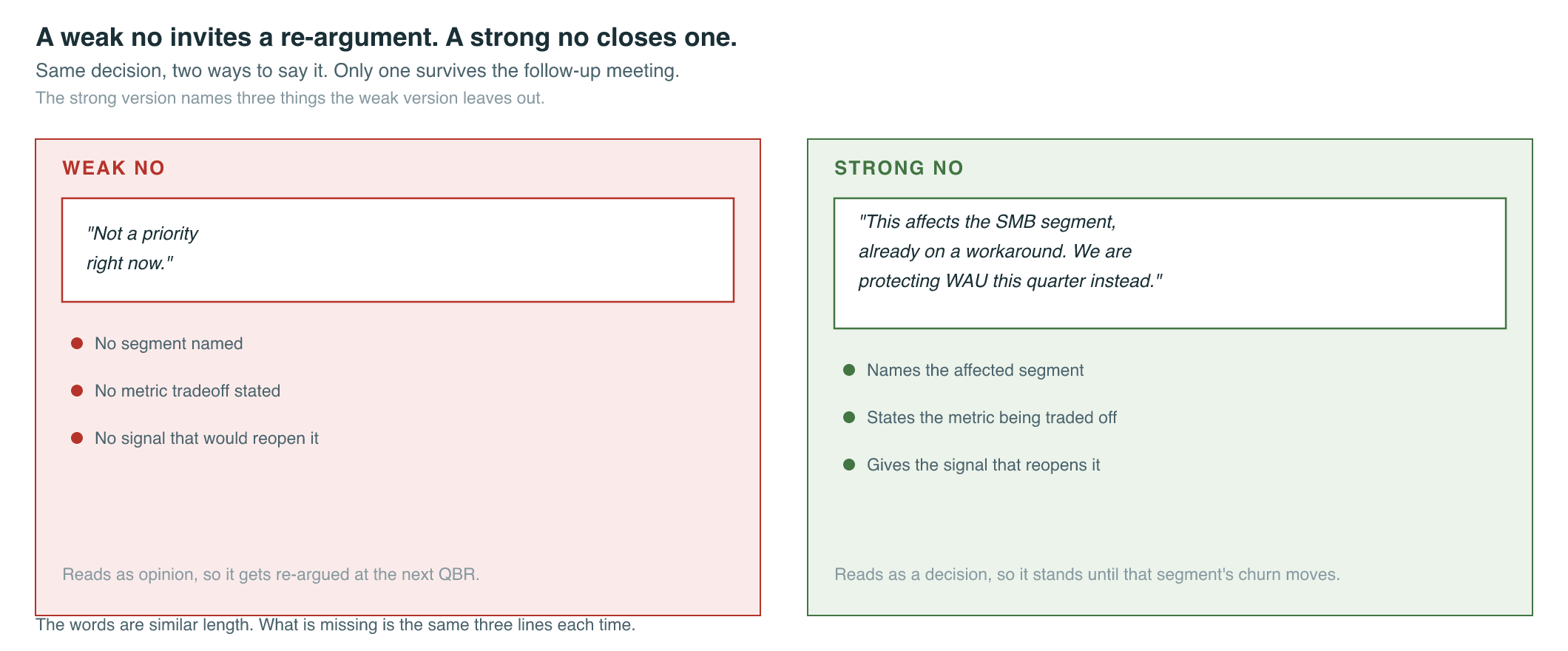
Saying no without a reason trains the organization to route around you. Saying yes to everything trains it to stop listening when you finally say no. Neither ending is good.
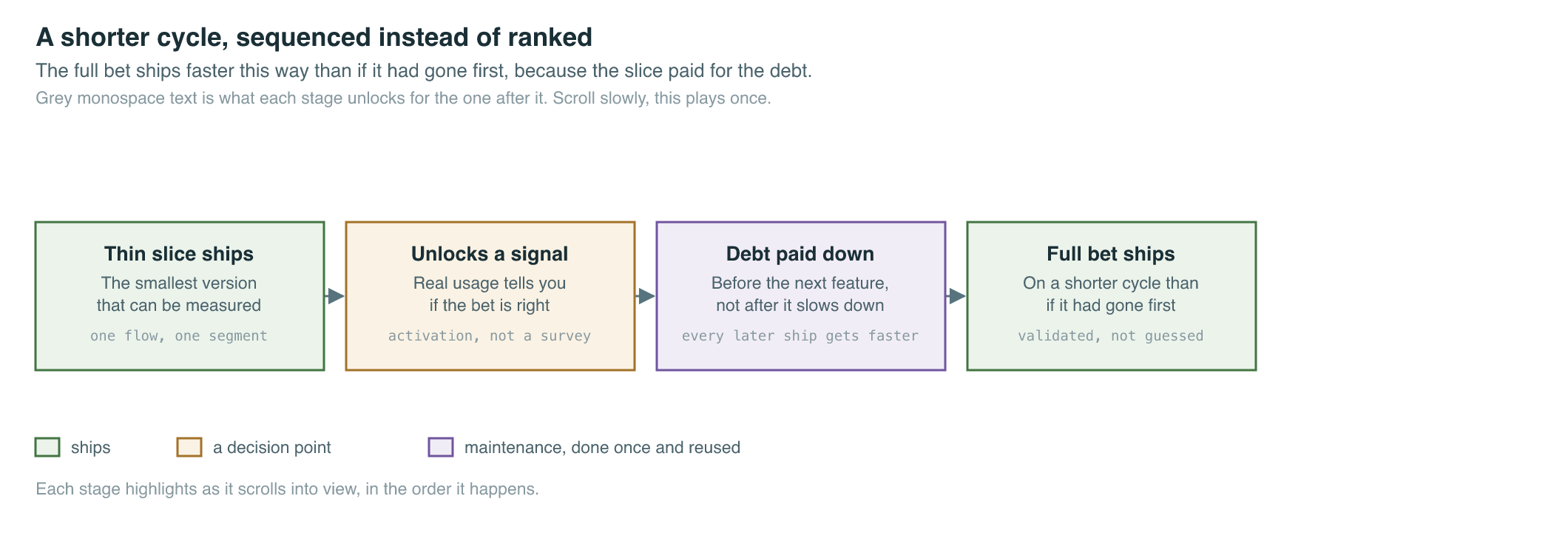
9. A roadmap is a sequencing story, not a ranked list
Even when the backlog itself is right, the order is wrong more often than most teams admit. Dependencies, learning sequences, and compound value all matter, and a scoring template rarely captures any of them.
Sometimes you ship a thin slice first because it unlocks validation for the bigger bet behind it. Sometimes you pay down debt before either, because without it every later feature ships slower and breaks more often. Explain the sequence as a chain: first this, because, then that, because. If you cannot tell that story out loud, the roadmap is a list wearing a strategy’s clothes.
The now, next, later format earns its reputation for a reason. Done well, it forces honesty about what is actually uncertain, and “later” is a commitment to revisit, not a place ideas go to be quietly forgotten. Done poorly, it is exactly that parking lot. Either way, tie the time horizons to who can actually renegotiate them, what leadership can revisit monthly versus what a team should execute without reopening the whole strategy every sprint.
10. Portfolio thinking keeps unlike bets off the same rubric
Not every item on a roadmap belongs on the same scale. Some work is hygiene, compliance, security, reliability. Some is optionality, an exploratory bet with asymmetric upside if it lands. Some is table stakes, parity that prevents churn without creating any love for the product.
Force all three through one scoring template and hygiene reads as low impact right up until it becomes an incident. Optionality reads as low confidence right up until a competitor ships the thing you shelved. Separate the portfolios, or apply different gates to each, so a compliance patch is never scored on the same axis as a growth experiment.
11. How to use a framework without fooling yourself
A short set of rules survives contact with a real backlog.
- Never confuse precision with accuracy. Three decimal places on a guessed impact number is a lie with good formatting.
- Calibrate against past bets. Ask what last year’s big win would have scored on the same template before trusting this quarter’s score.
- Revisit fast when new evidence lands. Sunk cost is not a strategy, and a score written a month ago is not a commitment to ignore what changed since.
- Keep the top-priority list short. If everything on it is top priority, the list has stopped doing its job.
When a stakeholder challenges a rank, answer with mechanism, not defensiveness: which assumption drives the score, what evidence would flip it, and what tradeoff you are actually making. That turns a power struggle into a disagreement you can resolve with data, which is the only kind worth having in a QBR.
Watch for local optimization too. A team can hit every sprint goal while the product drifts off strategy underneath them, because a framework applied only inside engineering improves velocity without checking whether the velocity points at the right hill. Tie prioritization reviews back to outcome metrics and problem discovery on a fixed cadence, not only to throughput.
Takeaways
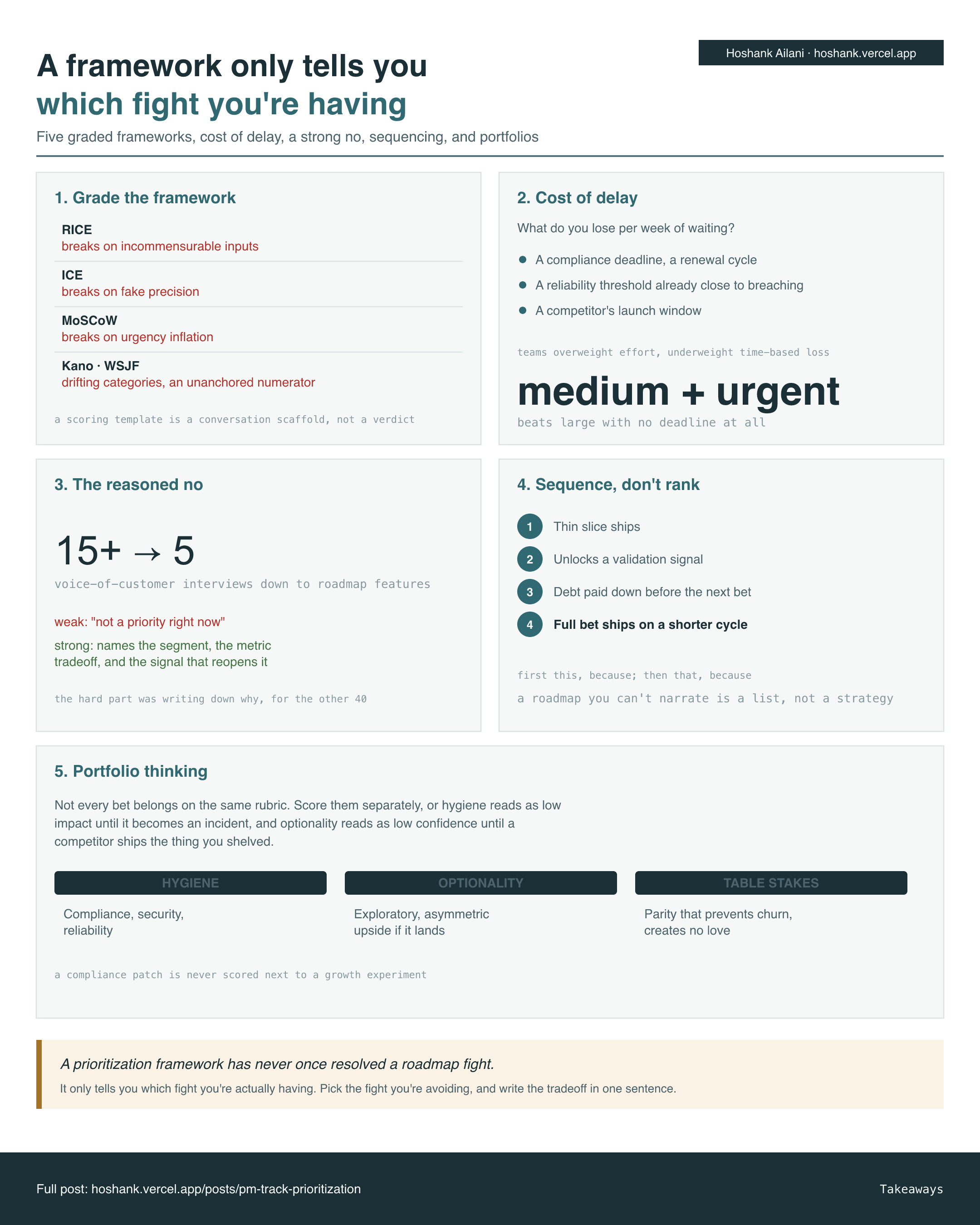
Five panels, one per cluster of sections. The callout is the line worth remembering when the spreadsheet shows up in the next planning meeting.
Final Words
Every framework in this post is a scaffold for a conversation your team is already having about tradeoffs, risk, and who owns the downside. None of them will have that conversation for you. Pick the roadmap fight you are avoiding right now, and write down the tradeoff in one sentence instead of a score.
Reply and tell me which framework your team actually uses, and where it breaks for you.
Cheers, Hoshank