The day two product lines are live under you at once, you stop being an IC whether anyone tells you or not.
I felt that shift at Pixis. AdRoom, the creative generation product, and Prism, the natural-language co-pilot, were running under me at the same time, and the two teams did not need the same thing from me on the same day. That is the whole difference between individual contribution and product leadership in one sentence.
So that’s today’s post.
Today’s Post
The mechanics of the IC-to-leader transition, in seven sections.
- Why running more than one product line changes the job
- The IC habit that quietly caps a team’s growth
- Delegation as a transfer of ownership, not a task list
- Hiring and mentoring for judgment, not for a résumé
- Influence without authority, at portfolio scale
- Portfolio risk: seeing correlation before it compounds
- The operating rhythm that keeps you honest when you cannot be everywhere
1. Running two product lines at once is the real test
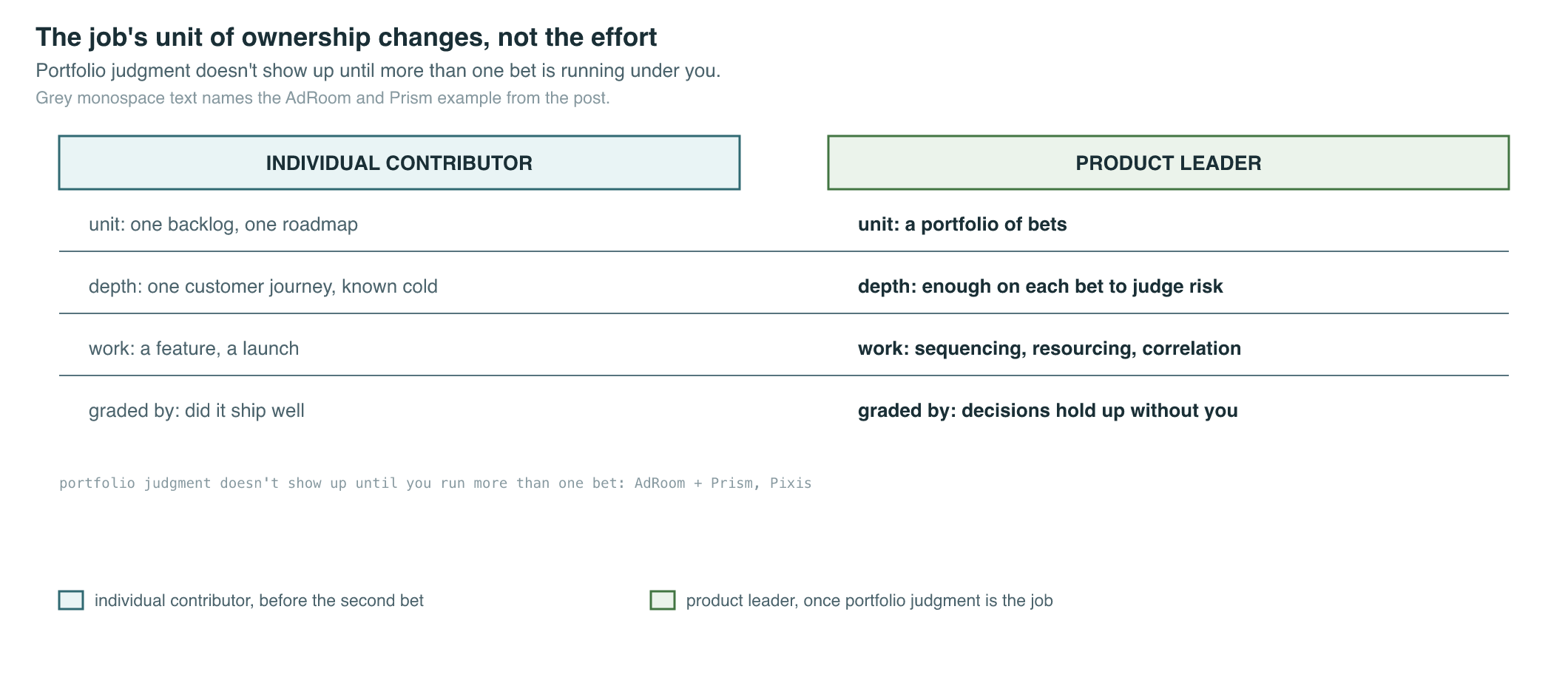
As an individual contributor, you are rewarded for depth. One backlog, one launch rhythm, one customer journey you know cold.
At Pixis I ran AdRoom and Prism under one leadership seat. AdRoom needed a 20-person team focused on one problem, an approval queue that a designer and a brand check made too slow for a marketer to self-serve. Prism needed a 15-person team on a completely different problem, a natural-language interface that had to prove its ROI before a trial ended. Neither team needed me to write their code or their copy. Both needed me to hold the boundary between what they owned and what the other stream owned.
That is portfolio judgment, and it does not show up until you have more than one bet running. Sequencing, resourcing, and risk concentration replace pixel-level ownership as the job.
2. The habit that made you a strong IC caps a team’s growth
Excellence as an IC often comes from ownership. You hold the standard, you catch the edge case, you rewrite the brief at midnight. That reflex scales linearly, one calendar, while a portfolio needs multiplicative leverage.
Watch for the warning sign in yourself: you are the approver on every document, and the team waits for you to bless a prioritization call before it moves. That felt like quality when AdRoom’s designer-review queue was the actual bottleneck we were trying to remove for marketers. Reproducing the same bottleneck inside your own team, with yourself as the queue, is the leadership version of the mistake the whole product was built to fix.
3. Delegation is a transfer of ownership, not a task list
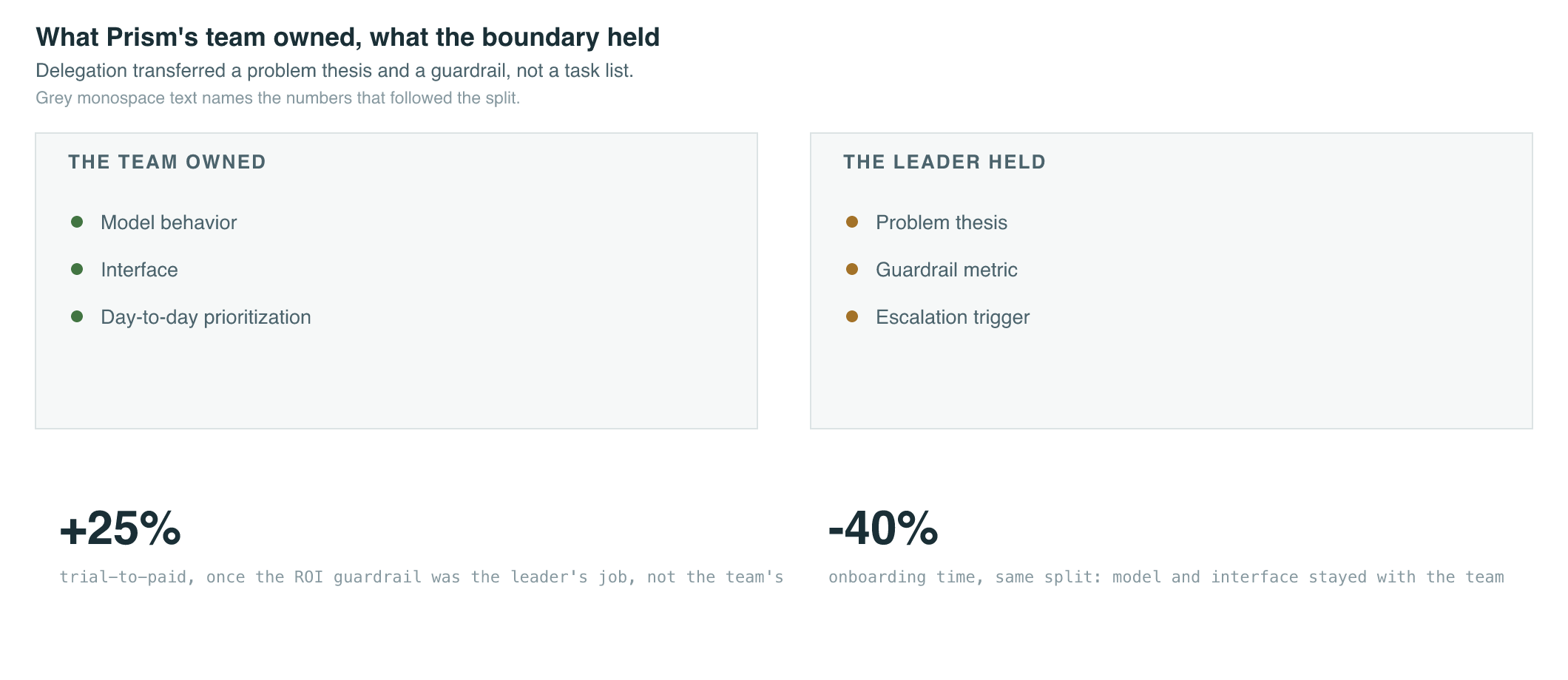
Delegation is not dumping work downstream. It is handing over a problem thesis, the guardrails around it, and the point at which you want to hear from the team again.
On Prism, I led the 15-person team across the natural-language and voice surfaces, but I did not own every prompt or every UI state. I owned the part most AI co-pilot launches skip: proving the value before the trial ended. The team owned the model behavior and the interface. I owned the guardrail that the funnel had to move, not just the demo.
That split produced a real number: trial-to-paid moved up 25% and onboarding time dropped 40%. Neither number came from me writing a line of the product. Both came from a team that knew exactly which decisions were theirs and which one, the ROI proof, was the boundary I was holding.
4. Hiring and mentoring are both about judgment, not résumés
Résumé keywords tell you little about how someone will handle a bet that goes sideways. What tells you more is how a candidate narrates a tradeoff they made with engineering or design, and whether they take ownership language into a story about a miss.
Mentoring works the same way. The discipline I trust most from Pixis is the one that looks like restraint: fifteen-plus voice-of-customer interviews on the Prism launch turned into exactly five roadmap features, not fifty. Teaching a junior PM to say no to the other ten ideas, the same way, is a better lesson than handing them a template.
5. Influence at scale is systems, not meeting wins
Early-career influence is meeting-based: a crisp narrative, a good follow-up email, a stakeholder won over in the room. Portfolio-scale influence is structural: goals that do not conflict across teams, and a cadence that surfaces problems before they need a room at all.
At InMobi, the system that matters is not a meeting. It is the fact that finance runs a month-end revenue close every month whether anyone likes it or not, and the close I own now signs off in 12 hours instead of 5 days. That outcome exists because the review cadence was already unavoidable. You do not win that kind of result by being persuasive in a Tuesday standup. You win it by designing the system so the number gets checked on a date nobody has to remember to schedule.
6. Portfolio risk is correlation, and it is easy to miss from inside one team
Leaders watch for correlated risk: two bets depending on the same platform migration, or every must-win initiative landing in the same quarter. Running AdRoom and Prism at the same time at Pixis meant I had to know when both teams were leaning on the same generation pipeline for a launch window, because a slip there would have hit both numbers at once, not just one.
They also have to say no at a level an IC PM rarely gets asked to. Killing a stream that is fine but not strategic, or reallocating headcount when the thesis changes, feels harsh in the room. It is how a company stays solvent in attention, not just in money.
7. An operating rhythm keeps you honest when you cannot be everywhere
You are not trying to clone your old IC habits at a bigger scope. You are building a lightweight loop instead: a regular portfolio scan across bets and risk, a deeper rotation through individual streams, and an always-on escalation rule so the team knows when to pull you in without waiting for a ceremony.
The InMobi close is the clearest version of that discipline I have run. The review happens because the calendar forces it, twelve times a year, not because I remembered to ask “did it work?” The same principle scales to a portfolio: book the review on the day you ship, and Sprint 13 will not get a chance to swallow it.
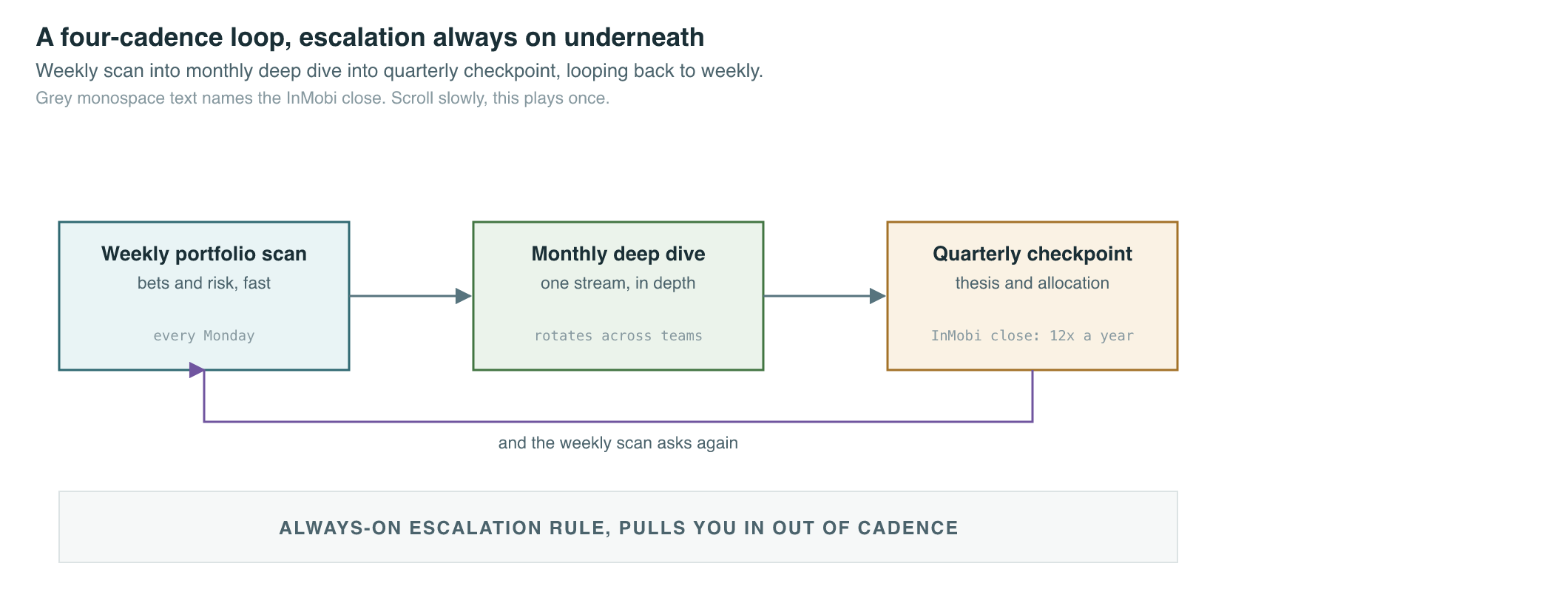
None of this replaces judgment. It just means judgment gets exercised on a schedule instead of only when something is already on fire.
Takeaways
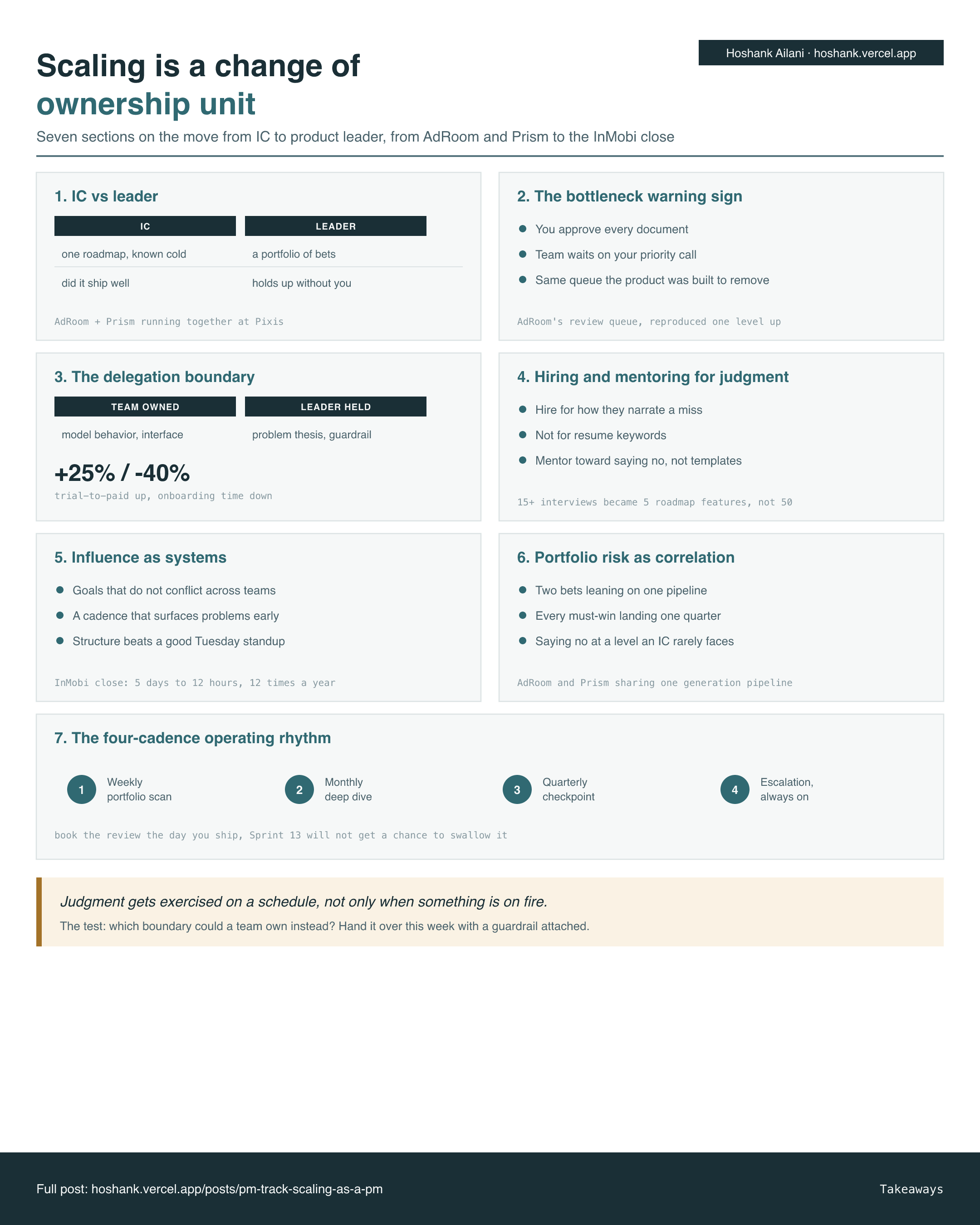
Seven panels, one per section. The callout is the test: are you running one bet, or a portfolio of them?
Final Words
The transition to product leadership is not a promotion to do the same job louder. It is a different craft: multiplier, allocator, and system designer. Pick the boundary you are still holding onto that a team could own instead, and hand it over this week with a guardrail attached, not a task list.
Reply and tell me which boundary you moved. I am collecting the transitions for a follow-up.
Cheers, Hoshank