A roadmap tells you what ships. A strategy tells you why, and what you’re willing to lose.
I have sat in the room where a team ships fourteen features in a quarter and still cannot answer one question: why does the portfolio make sense as a whole. Dell’s supply-chain platforms taught me that first, and InMobi’s demand-side platform and ad exchange, processing 200M-plus devices’ worth of events a day, taught me again. Both times the fix was not a longer roadmap. It was five decisions written down before the first sprint.
So that’s today’s post.
Today’s Post
Five decisions that make a strategy, and one spine you tell three different ways.
- Why a Gantt chart is a plan, not a strategy
- Naming the customer, and who you’re deliberately failing
- The value proposition as a trade, not a slogan
- Positioning against “do nothing,” not just named competitors
- Bets you can kill, and the loop that reviews them
- One spine, three rooms: execs, engineering, sales
1. A roadmap answers “when.” A strategy answers “why”
A roadmap is a schedule. It says what ships and roughly when, and that is genuinely useful for coordination. Ten engineers need to know what to build this sprint.
A strategy answers a different question: why this direction, for this customer, against these alternatives, with this money on the table. A team can hit every date on the roadmap and still have no strategy at all.
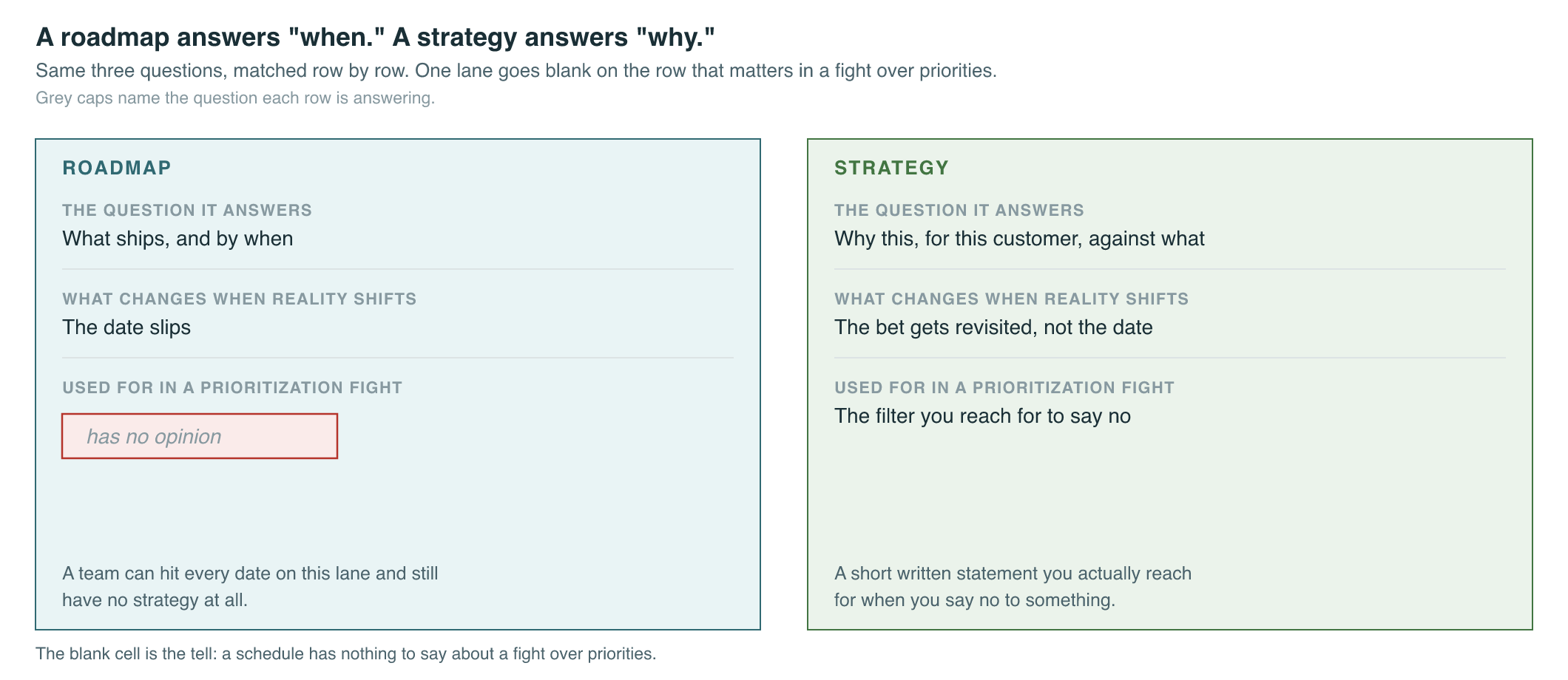
That gap is how a team stays busy and directionless at once. Everyone hits their date. Nobody can defend the portfolio.
The fix is not a better Gantt chart. It’s a short written statement you actually reach for when you say no to something.
2. Name the customer, and who you’re choosing to fail
Strategy starts by naming a customer you’ll serve well, on purpose, knowing other customers get less. “Everyone” is not a segment. Neither is “enterprise” unless you can say what job they hire you for and who you’re deliberately not chasing.
Picture a B2B analytics tool that decides its bet is mid-market RevOps teams drowning in spreadsheet reconciliation, not enterprise data platforms and not solo founders. That one choice ripples into packaging, integrations, and what “good” means on the roadmap.
At Pixis, the bet inside AdRoom was narrower than the company pitch. The obvious story was “AI makes ads faster.” Generation was already cheap. The real constraint was the approval queue, a designer and a brand check standing between a marketer and a live variant. So the customer we chose was the marketer who wanted to self-serve, not the agency that wanted a faster vendor.
We tested that bet with a forcing function instead of a survey. Every new brand ran a two-week onboarding sprint with one goal: get them self-serving live, on-brand ads inside the window. We instrumented activation, meaning a published ad, and ignored logins. Four automotive and consumer-tech brands later, that sprint alone had produced $800K in ARR in two months, on the way to $0 to $10M ARR in five months with a 20-person team.
If you cannot name who loses when your product wins, you have not finished naming your customer.
3. The territory is the problem, not the feature list
Strategy describes the arena you intend to own: the recurring pain, the workflow, the decision your product exists to improve. Features are tactics inside that arena, not the arena itself.
“Help teams collaborate” is not a territory. It is wallpaper. “Get on-brand creative out of a marketer’s hands and into production without a designer ticket” is a territory. You can argue with it, measure it, and say no to work that doesn’t move it.
That’s the sentence behind AdRoom’s editor, and it’s why killing the manual QA gate was safe once brand rules were enforced at generation time instead of after. Designer load dropped 80% because the territory was clear enough to build a real gate around, not because the model got faster.
Good strategy makes someone unhappy. If your strategy document never does, it’s too soft.
4. The value proposition is a trade you can defend on a call
Your value proposition answers “why us, why now, versus what they already do.” It is not a slogan. It’s the chain from the customer’s pain to your mechanism to the outcome they care about.
Weak value props hide in adjectives: seamless, powerful, AI-powered. A strong one names the trade. Pixis’s Prism co-pilot didn’t win by being smarter than a dashboard; it won by trading dashboard literacy for a plain-language question, and it moved trial-to-paid up 25% and onboarding time down 40% because the trade was real enough to measure.
When a rep hears “why not the cheaper competitor,” the value proposition is the script. If it can’t survive that question out loud, it isn’t a strategy yet, it’s marketing copy waiting to be tested.
5. Positioning has to include “do nothing”
Positioning is not a quadrant slide you refresh once a year. It’s the team’s shared model of what customers actually compare you to, including the alternative that never shows up in a competitor deck: doing nothing, or doing it in a spreadsheet.
Pixis’s Advance layer is the clearest version of this I’ve owned. The AI optimization on top was the easy part to demo. What made it trustworthy was the data underneath: 1M-plus keywords a day for 400-plus enterprise customers at 99.6% end-to-end sync reliability, with availability delays cut from 4 hours to under 15 minutes. Enterprises weren’t comparing Advance to a rival optimizer. They were comparing it to a human checking a spreadsheet once a day, and inertia is a real competitor that a feature-parity chart never shows you.
If your positioning only tracks the vendor who shows up in an RFP, “we’ll just keep doing it manually” will blindside you every time.
6. Bets are falsifiable, or they’re decoration
A strategy without bets is a wish list. A bet is a consequential assumption you’re acting on, with an owner, a timeframe, and a signal that tells you to double down, adjust, or kill it.
At Pixis, one explicit bet drove Prism’s launch: fifteen-plus voice-of-customer interviews would surface the handful of features that actually mattered, and the discipline was saying no to the other forty. That bet turned fifteen-plus interviews into exactly five roadmap features, not fifty.
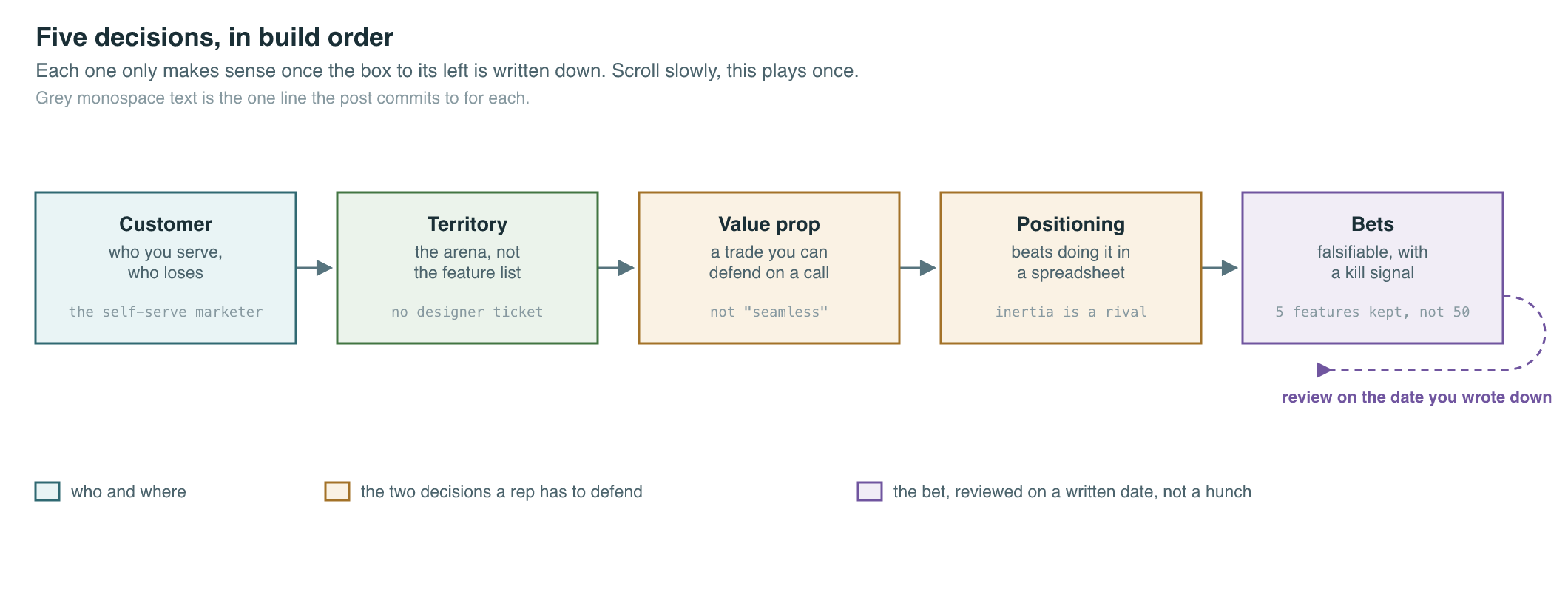
Bets are falsifiable. If you cannot describe what would prove you wrong, you’re not betting, you’re decorating a slide.
7. One spine, three rooms
The underlying strategy is one skeleton: customer, territory, value, positioning, bets. How you tell it changes by room.
Executives want coherence, risk, and where their budget goes, not a features tour. Lead with the bet and the two risks you need cover on. Engineering wants the mechanism and the non-negotiables: latency targets, reliability bars, the invariants that shape architecture. Sales and customer success want qualifying questions: which deals fit the thesis, which ones you’ll politely lose, and the three questions that separate the two on a live call.
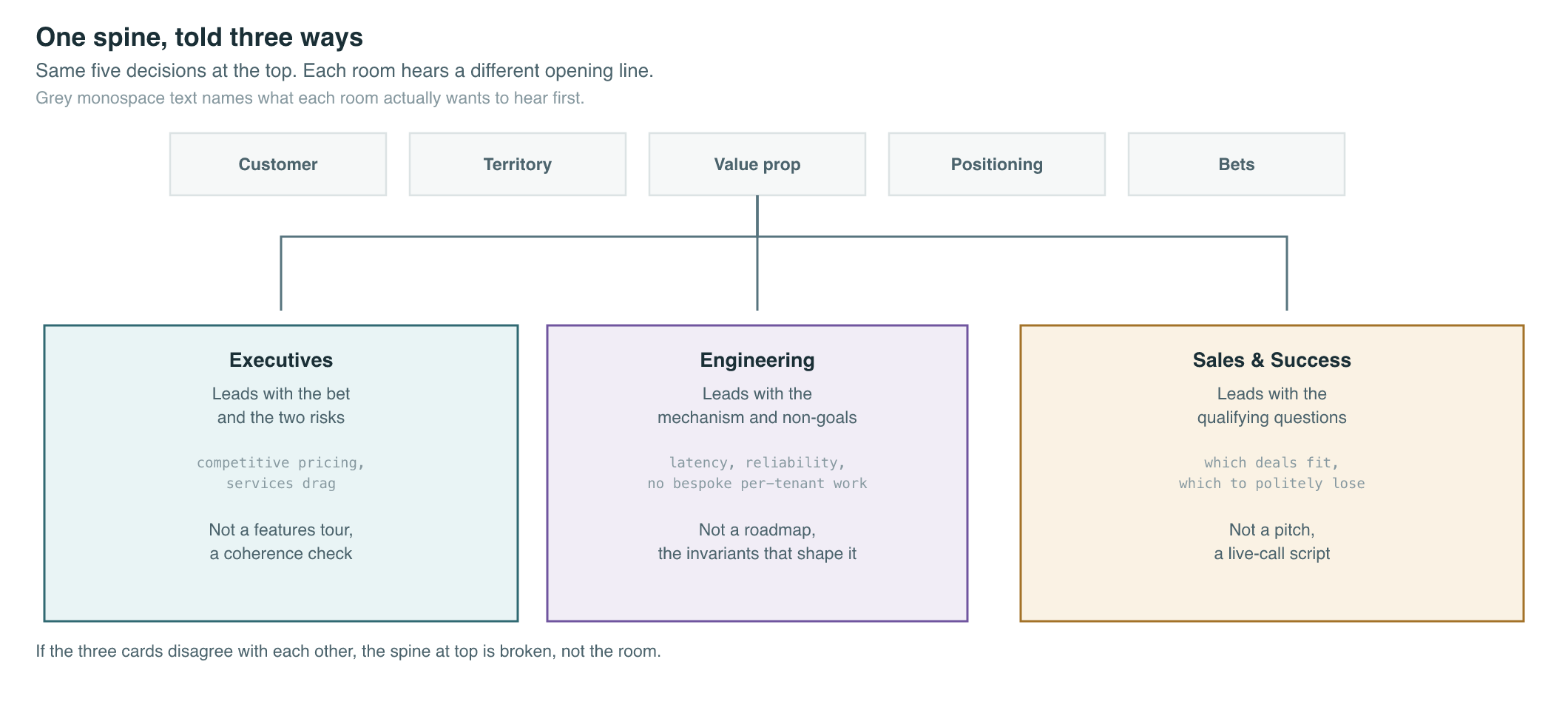
Say the bet is “win mid-market teams where onboarding speed beats enterprise feature depth.” With execs, open with the revenue motion that implies and the two risks: competitive pricing and services drag. With engineering, open with what has to be true for that bet: fast provisioning, safe defaults, no bespoke per-tenant workflows this half. With sales, open with qualification: which deals fit, which ones to politely lose, and the proof points that hold up in a live call.
If those three versions contradict each other, you don’t have a communication problem. You have a strategy problem, and the fix is upstream of the deck.
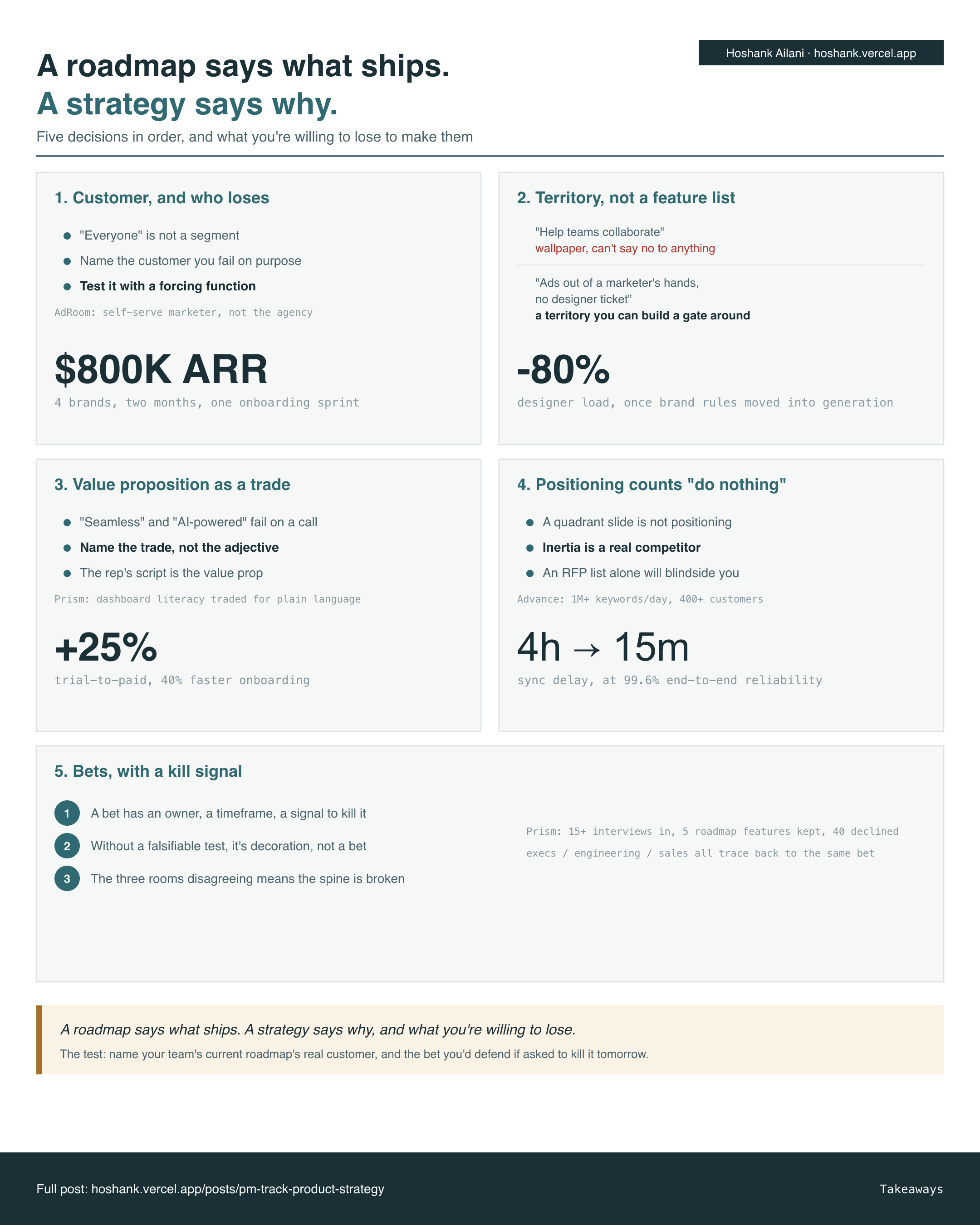
Takeaways
Final Words
A strategy document that nobody uses is worse than no document at all, because it lets the team pretend the questions are already answered. Pick your team’s current roadmap, name the customer it’s really serving, and write the one bet you’d defend if someone asked you to kill it tomorrow.
Reply and tell me which of the five decisions your team has never written down. I’d bet it’s the same one twice in a row.
Cheers, Hoshank