A PM who reviews every mock and every pull request is not thorough. They are the bottleneck the team routes around.
I have watched this pattern on three teams now: a supply-chain platform at Dell, a 20-person AI creative team at Pixis, and the data platform under InMobi’s ad exchange. Same failure each time. The PM writes the spec, design paints the screens, engineering estimates and builds. By the time anyone talks, the assumptions are locked and the arguments are personal instead of technical.
The fix is not more meetings. It is sharing the problem earlier than feels comfortable, and knowing exactly when to defer versus when to hold the line.
So that’s today’s post.
Today’s Post
How to run the triad so it ships fast without becoming a rubber stamp, in six sections.
- Why the spec handoff trains everyone to optimize for the wrong thing
- The two failure modes: bottleneck and order-taker, and why they are the same mistake
- When to defer to engineering, with a real example
- When to push back, and how to tell inertia from a real constraint
- What designers actually need from you, and what they do not
- How trust gets built or destroyed, in specifics
1. The triad is one system, not three handoffs
Every healthy product decision runs through three lenses: desirability, feasibility, and viability. Will anyone want this? Can we build and operate it? Should we, for the user and the business? Split those into a relay, PM to design to engineering, and each function optimizes only for its own lens. Design chases desirability. Engineering chases feasibility. Nobody owns viability until launch week, when it is too late to change anything cheaply.
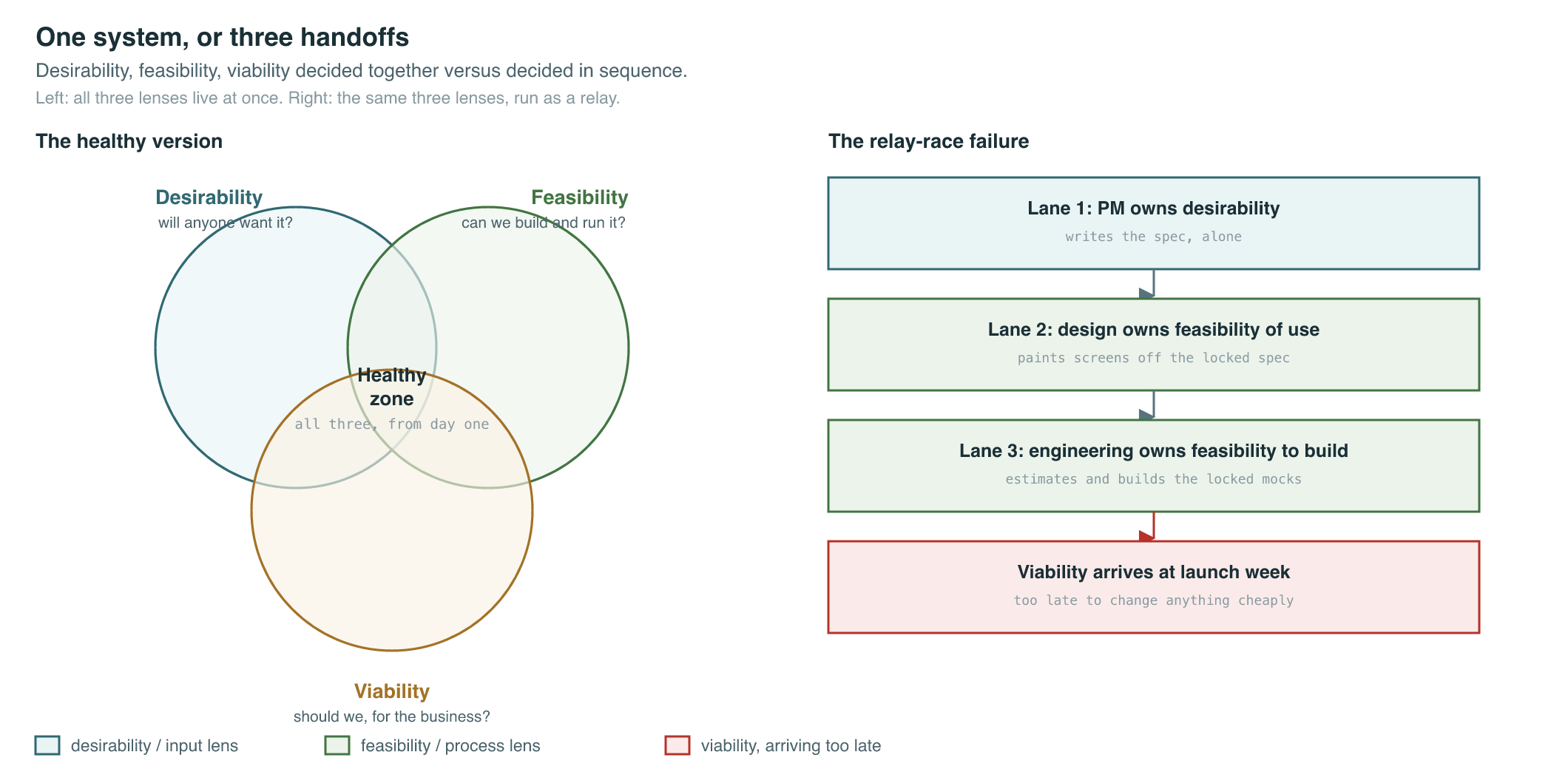
Your job is not to have every answer. It is to hold the problem, the success criteria, and the tradeoffs visible while engineering and design bring craft to the solution.
2. The spec handoff hides discovery until it is expensive
The anti-pattern looks efficient on a roadmap slide: PM writes the doc, design ships mocks, engineering implements. In practice, the first real technical or user objection shows up after the flow is locked, when a rewrite costs a sprint instead of a conversation.
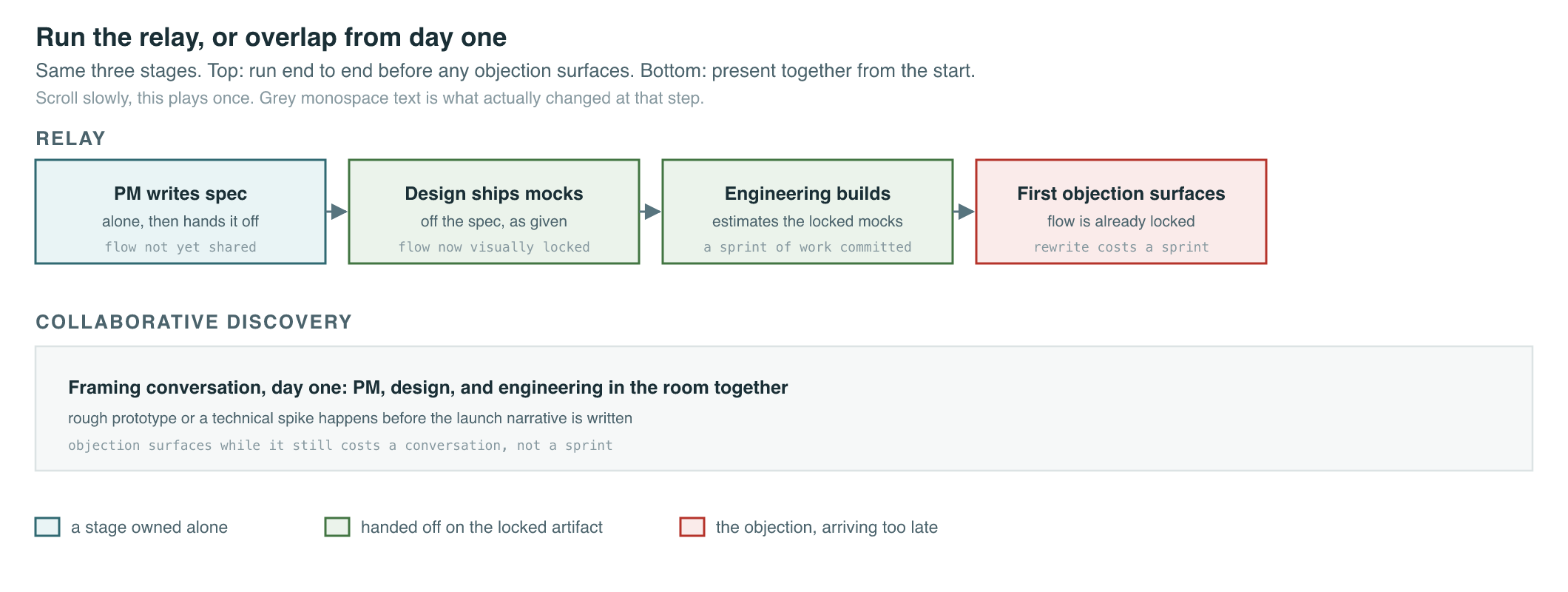
Collaborative discovery means engineers and designers sit in customer conversations at a useful cadence. Not every call. Enough that the “why” is not filtered only through you. It means a rough prototype or a technical spike happens before you commit to a launch narrative. At Pixis, the pods that worked were built this way on purpose: engineers, APMs, and designers in the same discovery loop, not stacked in a queue behind one PM.
3. Bottleneck and order-taker are the same mistake in different directions
A bottleneck PM centralizes every question: design cannot pick a pattern without approval, engineering cannot choose between two implementations without a meeting. Sometimes that caution is earned, brand risk, regulatory language, a commitment already made to a partner. Most of the time it is a failure to delegate clarity.
Fix it by publishing decision rights alongside the goal. Say explicitly that design owns interaction detail within stated guardrails, or that engineering picks between two approaches if both clear the success bar. Withhold that, and you train the team to stop proposing anything, then complain that nobody acts like an owner.
The opposite failure, order-taking, feels collaborative and is actually passive. Whatever engineering estimates becomes the roadmap. Whatever design prefers becomes the vision. Your accountability is the outcome you committed to. If the team drifts toward technical elegance or visual polish without moving that number, staying quiet is not humility, it is abdication.
4. Defer to engineering when the risk is theirs to carry
Engineers live with the operational cost of a shortcut: the incident, the edge case, the migration nobody scoped. When an engineer says a shortcut will produce incidents, believe them unless you have strong evidence otherwise.
Here is the shape of the tradeoff worth deferring on: you want a real-time dashboard. Engineering proposes a five-minute delay with stronger caching instead. If the actual job is a morning review, not a trading floor, take the simpler version. The five minutes costs you nothing the user job needs, and it buys the team a system that does not page anyone at 2 a.m.
At Dell, moving from engineer to product taught me this the slow way: I had already lived the cost of a shortcut from the other side, so I read the code before I read the roadmap. That habit, checking what a proposal actually costs to run before arguing against the simpler version, is the single most useful thing that transition gave me.
5. Push back when the constraint is a habit, not a wall
Not every “that’s hard” is immovable. Sometimes difficulty is protecting inertia: a module nobody wants to touch, a pattern that made sense three years ago, risk aversion wearing the costume of architecture. Push with a question, not a demand: what would need to be true to make the better experience feasible? Often the answer is a phased rollout, a temporary flag, or finally staffing the refactor everyone has been avoiding.
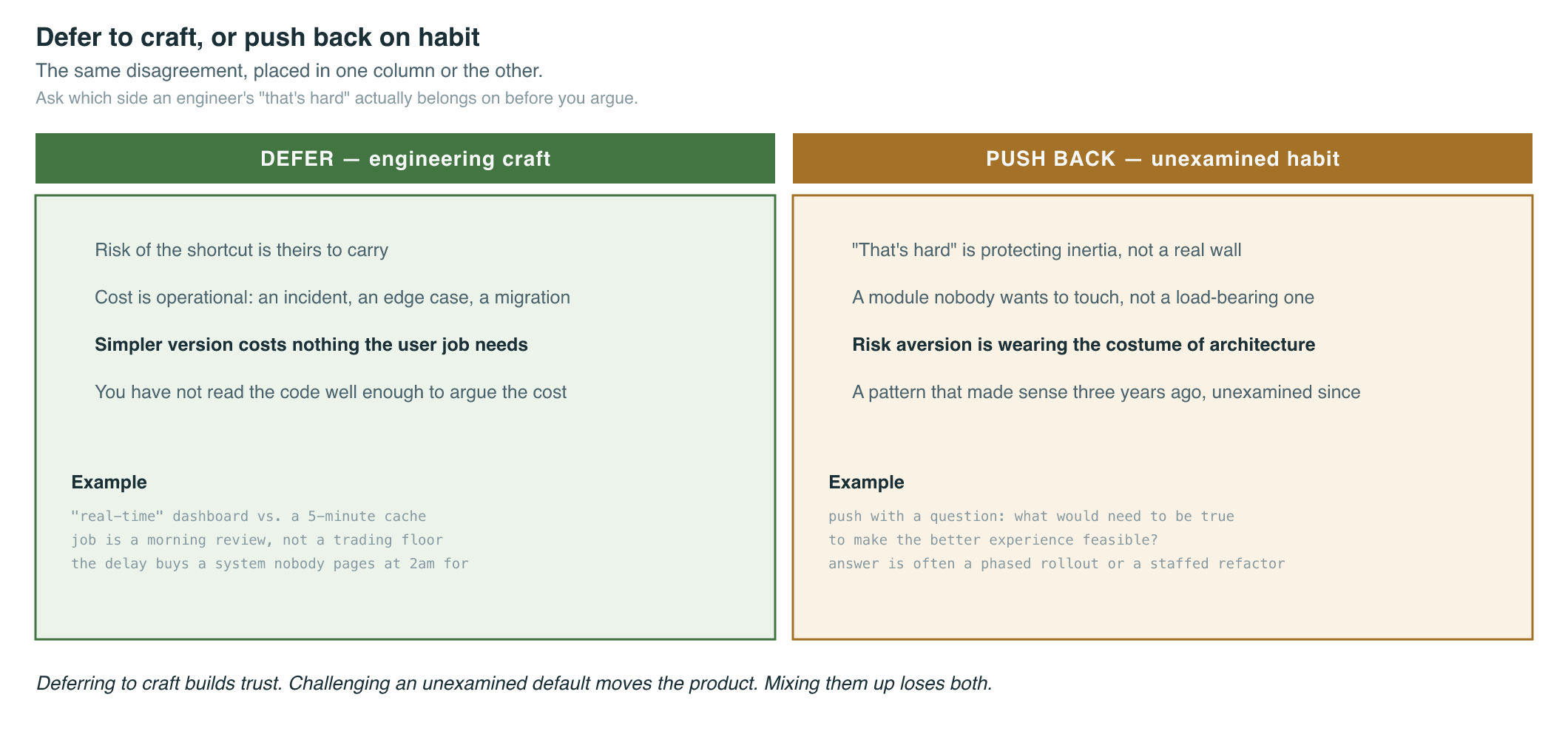
Deferring to craft builds trust. Challenging an unexamined default moves the product. Mix the two up and you are either a pushover or a jerk, and the team stops trusting either read.
6. Designers need partnership from the framing stage, not a flow to skin
Design is not paint on a finished spec. A designer synthesizes the user’s mental model, cuts cognitive load, and holds the surface to brand and accessibility standards you did not have to think about because they already did. Loop them in after the flow is “locked” and you have wasted their highest-leverage work on cosmetics.
Bring designers into the framing conversation itself: who is this for, what are they trying to accomplish, what does failure look like for them? Inside agreed brand and accessibility guardrails, let design own interaction detail, hierarchy, and motion without your sign-off on every spacing choice. Push back only when a visual direction outruns the outcome, when something demos beautifully but fragments engineering or confuses the actual user. Negotiate that with a prototype and a number, not an opinion: if a fancier onboarding measurably lifts activation, prioritize it; if it adds weeks for a marginal gain, scope it down.
7. Trust is a compounding account, and it is funded in specifics
Engineers trust PMs who protect their focus and never pretend an artificial deadline is physics. Share the real business context: why leadership cares, what commercial commitment exists, what is genuinely uncertain. Nothing corrodes faster than a PM who knows a date is soft and broadcasts it as fixed anyway.
Designers trust PMs who engage on user evidence, not personal preference, and who credit the work publicly when it ships. Both trust a PM who follows through: who fights for a sustainable pace, removes a policy blocker before it is asked for, and never treats an estimate as a promise given without the team’s consent.
None of this scales by adding headcount or renaming the standup. It scales when the rituals match the actual risk in front of you, a discovery sync for the ambiguous bet, a technical spike before the launch narrative is written, and nothing heavier than that for the low-risk iteration.
Takeaways
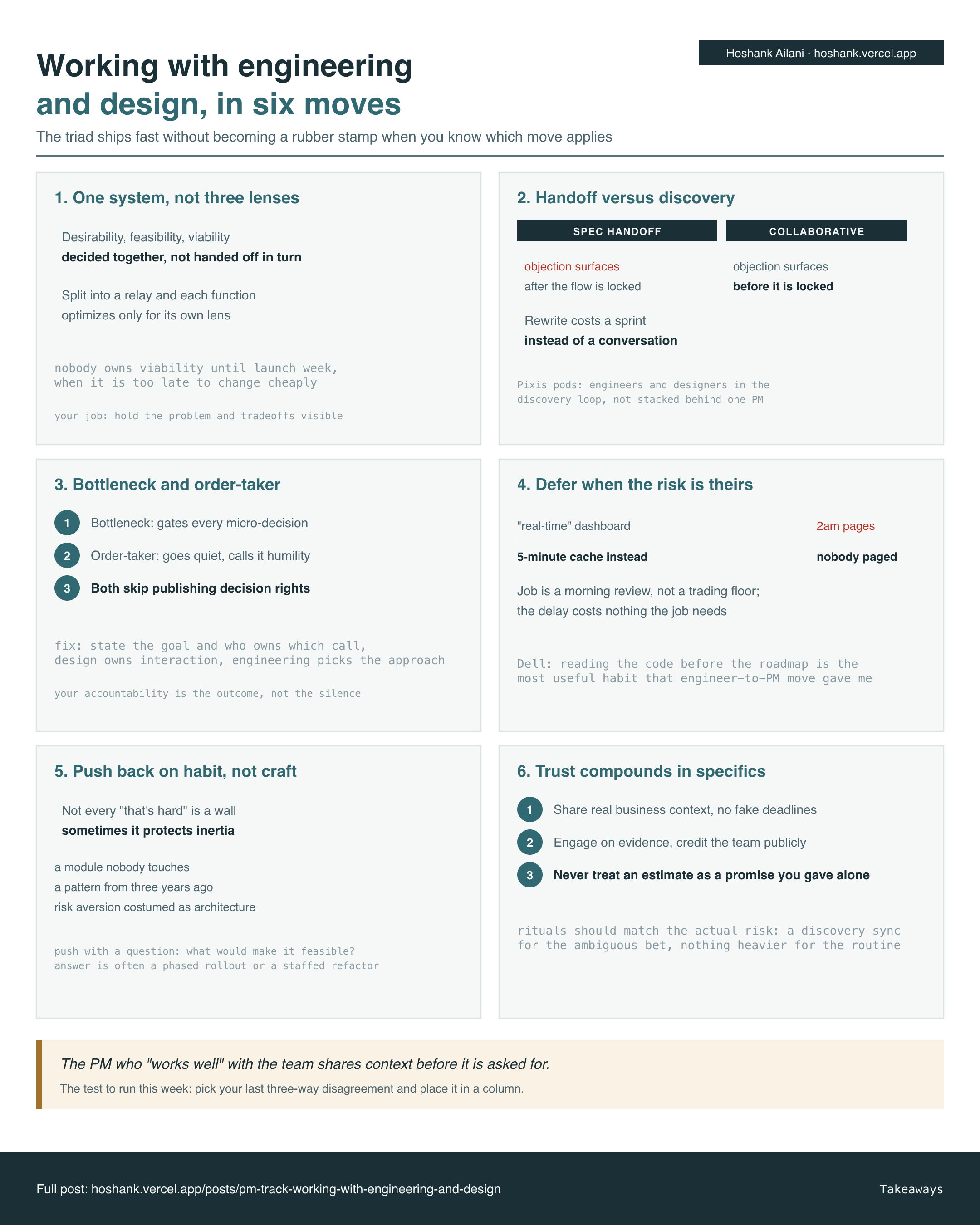
Six panels, one per section. The test to run this week: pick your last three-way disagreement and place it in the defer or push-back column.
Final Words
The PM who “works well with engineering and design” is not the nicest person in the room. It is the one who shares context before it is asked for, holds the outcome clearly, argues tradeoffs with a number instead of a title, and knows exactly when to get out of the way.
Reply and tell me which side of the defer or push-back line your last argument actually belonged on.
Cheers, Hoshank