It is June 2024. OpenAI’s Sora has been a research report for four months, its clips circulating as demos with no sign-up form behind them, and every serious lab in text-to-video has read the same signal: whoever ships a paying product first inherits a market that does not yet have an incumbent. In a single month, Kuaishou, Luma, and Runway each launch one, and by the time Sora itself finally opens to subscribers in December, four other companies already have.
Where We Were
By early 2024, the video generation field had a capability ceiling and a product vacuum sitting side by side. Sora and Spacetime Patches covers what OpenAI actually disclosed in February 2024: a diffusion transformer that tokenizes video into spacetime patches, trains jointly on images and clips of native duration and resolution, and generates up to a minute of coherent footage. What that chapter also establishes is what Sora was not, in February 2024 — a product. OpenAI’s technical report withheld training data, compute budget, and parameter count, and offered no API, no waitlist conversion, and no price. For four months, the most capable video model anyone had publicly described was also the one nobody outside a small group of testers and filmmakers could use.
The best a paying customer could actually buy in early 2024 was still built on the older, bolt-on-U-Net lineage: Stable Video Diffusion, released openly in November 2023, generated 14 or 25 frames from a single conditioning image, a ceiling set by the fixed-resolution, fixed-duration training a convolutional U-Net requires. Runway’s own commercial product, Gen-2, and early entrants like Pika Labs — which had already shipped Pika 1.0 to a waitlist of over half a million users in late November 2023 — sat in the same generation: short, low-resolution clips, useful for storyboarding and social content, nowhere near Sora’s disclosed minute-long, 1080p demos. The gap between what a research report described and what a subscription actually delivered was the opening every other lab with a video model in training was racing to close.
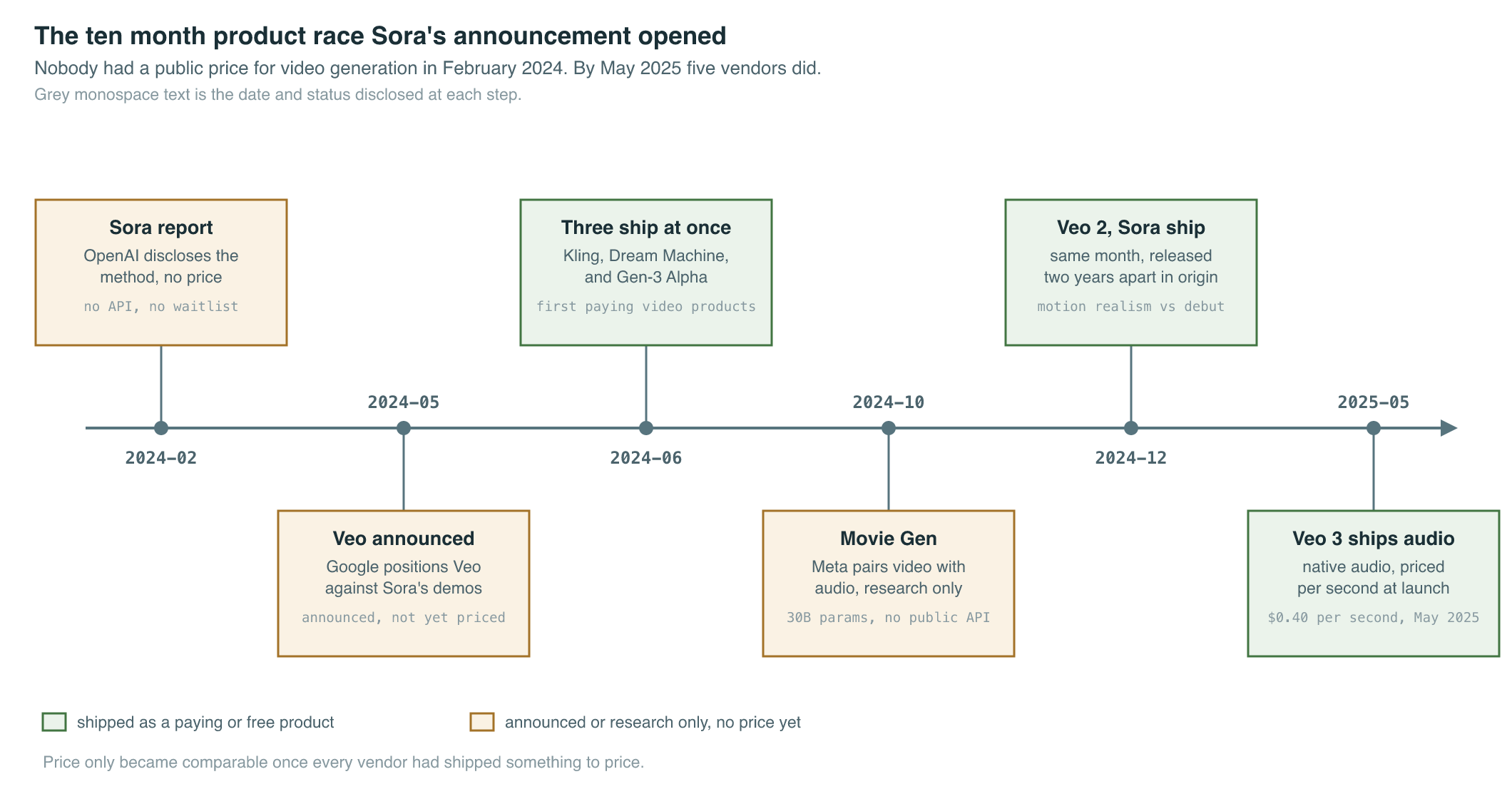
None of the five labs that shipped a product in the ten months after Sora’s announcement had access to OpenAI’s implementation. Each had to arrive at a competitive architecture, and a competitive price, on its own. And none of them, in early 2024, had a public price for video generation quoted in a unit a buyer could put into a spreadsheet — Runway and Pika billed in monthly subscriptions with no disclosed per-second rate, and nobody had yet shipped a metered API for video at all. Price only became something a buyer could compare once the race itself forced it into the open, over the following ten months.
The Breakthrough
The breakthrough this chapter tracks is not a single method — it is a market converging on the same one within months, and then competing on the axis Sora’s report never mentioned: price per second. Google announced Veo at I/O in May 2024, a text-to-video model Google positioned directly against Sora’s disclosed capabilities. Runway followed on June 17 with Gen-3 Alpha, described in its own announcement as “the first of the next generation of foundation models trained by Runway on a new infrastructure built for large-scale multimodal training” — a rebuild, not an incremental update to Gen-2. Kuaishou’s Kling, unveiled June 6 and opened for testing days later, generated up to two minutes of 1080p video at launch, longer than anything else on the market at the time — but aimed first at Kuaishou’s own domestic short-video audience, with an English-language global beta following on July 25, seven weeks after the domestic launch. That gap mattered commercially: for seven weeks, Kling was a capability announcement for most of the world and a shipped product only inside China, the same shape of gap Sora’s report had created at a larger scale. Luma AI’s Dream Machine, released June 12, undercut both on friction: a free public web tool rather than a waitlist, which reportedly reached a million users within four days. Pika Labs, the one 2023-era incumbent in this list, spent 2024 shipping incremental updates to its existing product rather than a Sora-class rebuild, and lost visible ground in the process — a reminder that the race rewarded whoever rebuilt on a new architecture, not whoever had shipped first.
By October, Meta entered from the research side rather than the product side. Movie Gen (Polyak et al., 2024) is a cast of foundation models whose largest video component, a 30-billion-parameter transformer, generates up to 16 seconds of 1080p video at 16 frames per second from a context of up to 73,000 video tokens — and, distinctively for 2024, pairs that video model with synchronized audio generation in the same system. Meta did not ship Movie Gen as a public product in 2024; the audio-generation mechanism behind it, and its eventual path into Meta’s own apps, is covered in Sound and Speech. What matters for the race is the signal Movie Gen sent in October 2024: synchronized audio, not just longer or sharper video, was about to become the next axis of competition.
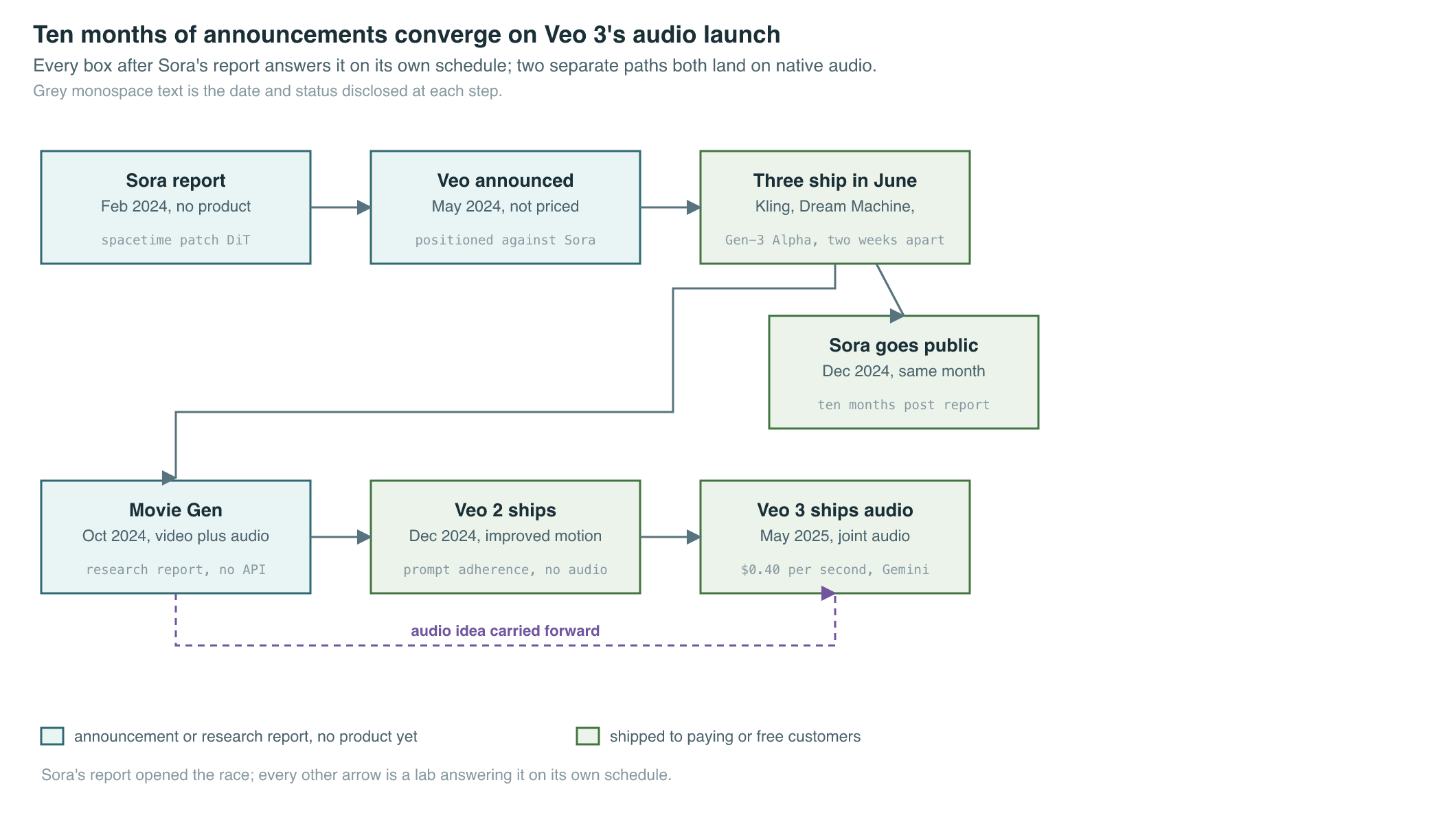
Google shipped that axis to paying customers seven months after Movie Gen’s report. Veo 2, released in December 2024 alongside Sora’s own public launch, focused on motion realism and prompt adherence rather than audio. Veo 3, announced in May 2025, closed the gap Movie Gen had opened: its technical report describes Veo 3 as using latent diffusion in which “the diffusion process is applied jointly to the temporal audio latents, and the spatio-temporal video latents,” producing a single clip with dialogue, sound effects, and ambient audio generated alongside the picture rather than added afterward. Where Movie Gen had demonstrated the capability in a research report, Veo 3 shipped it behind a metered, per-second API price — the same axis every other 2024 entrant had already started competing on, now extended to sound.
The Mathematics
None of the five products this chapter covers publish a new training objective — each is, in its disclosed form, a diffusion transformer over spacetime patch tokens, the architecture and loss Sora and Spacetime Patches already derives in full. What changed in 2024 was that the cost of running that architecture became the thing customers priced, shopped, and compared. A simple accounting identity makes the trade every lab was actually making explicit:
| Symbol | Meaning |
|---|---|
| dollar cost per second of finished video, for model | |
| number of denoising steps the sampler runs | |
| compute cost of one forward pass over spacetime patch tokens | |
| number of spacetime patch tokens in the clip, as defined in Sora and Spacetime Patches | |
| the provider’s realized compute price, FLOPs purchasable per dollar | |
| seconds of finished video produced per generation call |
A quoted retail price is not this number — it is this number plus whatever margin, subsidy, or loss-leader strategy a company layers on top during a land-grab phase. A second identity makes that comparison, capability against price, the way a buyer actually should:
What It Enabled
By the end of 2024, “can it generate video” had stopped being the question a buyer asked; “at what duration, resolution, and price” had replaced it. The five entrants that shipped in 2024 already looked different on every axis that mattered to a paying customer, not just on sample quality:
| Product | Launch | Max duration disclosed | Max resolution disclosed | Distinguishing feature |
|---|---|---|---|---|
| Runway Gen-3 Alpha | June 17, 2024 | Seconds-scale clips, extendable | Up to 1080p | New training infrastructure, tighter motion control |
| Kling | June 6, 2024 | Up to 2 minutes | 1080p | Longest disclosed duration at launch |
| Luma Dream Machine | June 12, 2024 | Seconds-scale clips | Up to 1080p | Free public web access, no waitlist |
| Google Veo (1) | Announced May 2024 | Minutes-scale, per Google’s demos | 1080p | Positioned directly against Sora’s disclosed capabilities |
| Sora | Announced Feb 2024, public Dec 2024 | Up to one minute | 1080p | Ten-month gap between announcement and any paying customer |
| Meta Movie Gen | October 2024 | 16 seconds at 16 fps | 1080p | Synchronized audio generated with the video, research report only |
| Google Veo 2 | December 2024 | Minutes-scale | 1080p | Improved motion realism and prompt adherence |
| Google Veo 3 | May 2025 | Minutes-scale | 1080p | Native, jointly-generated audio at product scale |
Price, once labs started disclosing it, turned out to be quoted in units that do not compare cleanly across vendors — a fact more consequential to a buyer than any single benchmark score:
| Provider | Pricing unit | Disclosed rate (mid-2026) |
|---|---|---|
| Google, Veo 3 via Gemini API | Per second, standard quality with audio | $0.40 per second |
| Google, Veo 2 via Gemini API | Per second, with audio | $0.35 per second |
| OpenAI, Sora 2 API | Per second, tiered by resolution | On the order of $0.10 per second at 720p, reported in Sora and Spacetime Patches |
| Runway | Monthly subscription, credit-metered | $12–$76 per month across three consumer tiers, credits drawn down per generation at a rate the price sheet does not state in seconds |
| Kling | Monthly subscription, credit-metered | Credits per clip vary by resolution, duration, and whether audio is included; no published per-second rate |
Only one of the five vendors above publishes a price a buyer can convert to dollars per second without first estimating how many credits a given clip will consume. That asymmetry, not any single model’s benchmark score, is what a buyer scoping a real integration has to solve for first.
The market that resulted also split by access model, not just by price. Google, and later OpenAI, exposed Veo and Sora through metered developer APIs suited to being embedded inside another company’s product. Runway, Luma, and Pika stayed consumer-subscription products first, with API access arriving later and priced separately from the web app. Kling ran both at once from a single vendor, a consumer web app in China and internationally plus a developer API, priced in the same opaque credit units either way. None of these are architecture differences — every one of these products still runs a diffusion transformer over patch tokens — they are go-to-market differences that determined which kind of buyer each vendor was actually built to serve.
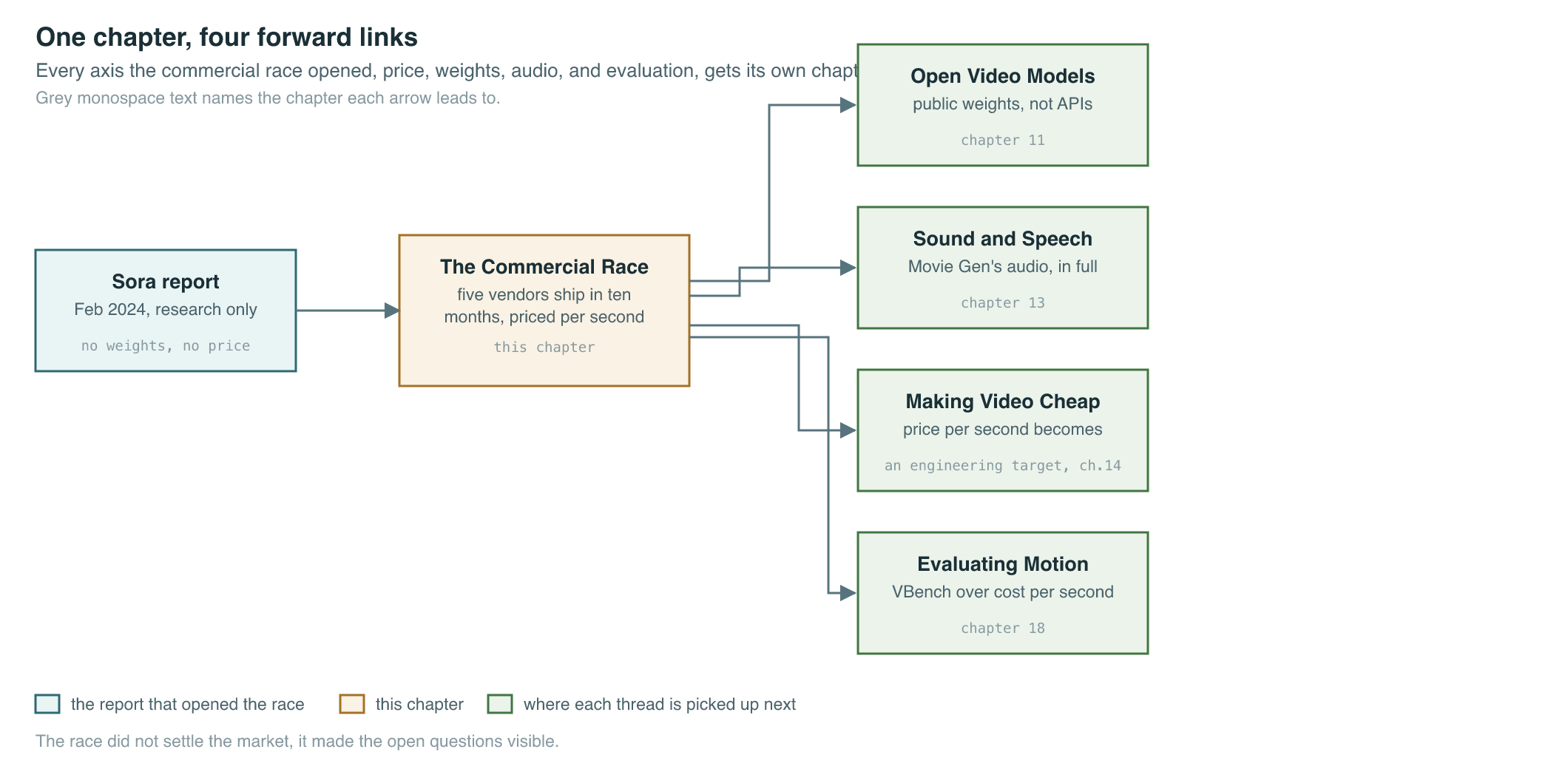
The race this chapter covers did not settle the market — it opened the next three questions this book takes up in turn. Open-weight labs answered the same architectural convergence with public checkpoints instead of metered APIs (Open Video Models). The audio thread Movie Gen opened and Veo 3 shipped gets its own mechanism-level treatment (Sound and Speech). And the price-per-second pressure this chapter documents as a market outcome becomes, two chapters later, an engineering problem with its own techniques for solving it directly (Making Video Cheap).
Key Papers
| Paper | Authors | Year | Link | Why it matters |
|---|---|---|---|---|
| Movie Gen: A Cast of Media Foundation Models | Polyak et al. | 2024 | arXiv:2410.13720 | Meta’s 30B-parameter video model paired synchronized audio generation with video for the first time in this chapter’s race, as a research report rather than a shipped product |
| Veo 3 Technical Report | Google DeepMind | 2025 | Veo 3 Technical Report (PDF) | Shipped Movie Gen’s audio-video convergence as a metered product, applying diffusion jointly to spatio-temporal video latents and temporal audio latents |
PM Lens
Papers referenced
- Movie Gen: A Cast of Media Foundation Models Polyak et al. · 2024 · arXiv:2410.13720
- Veo 3 Technical Report Google DeepMind · 2025