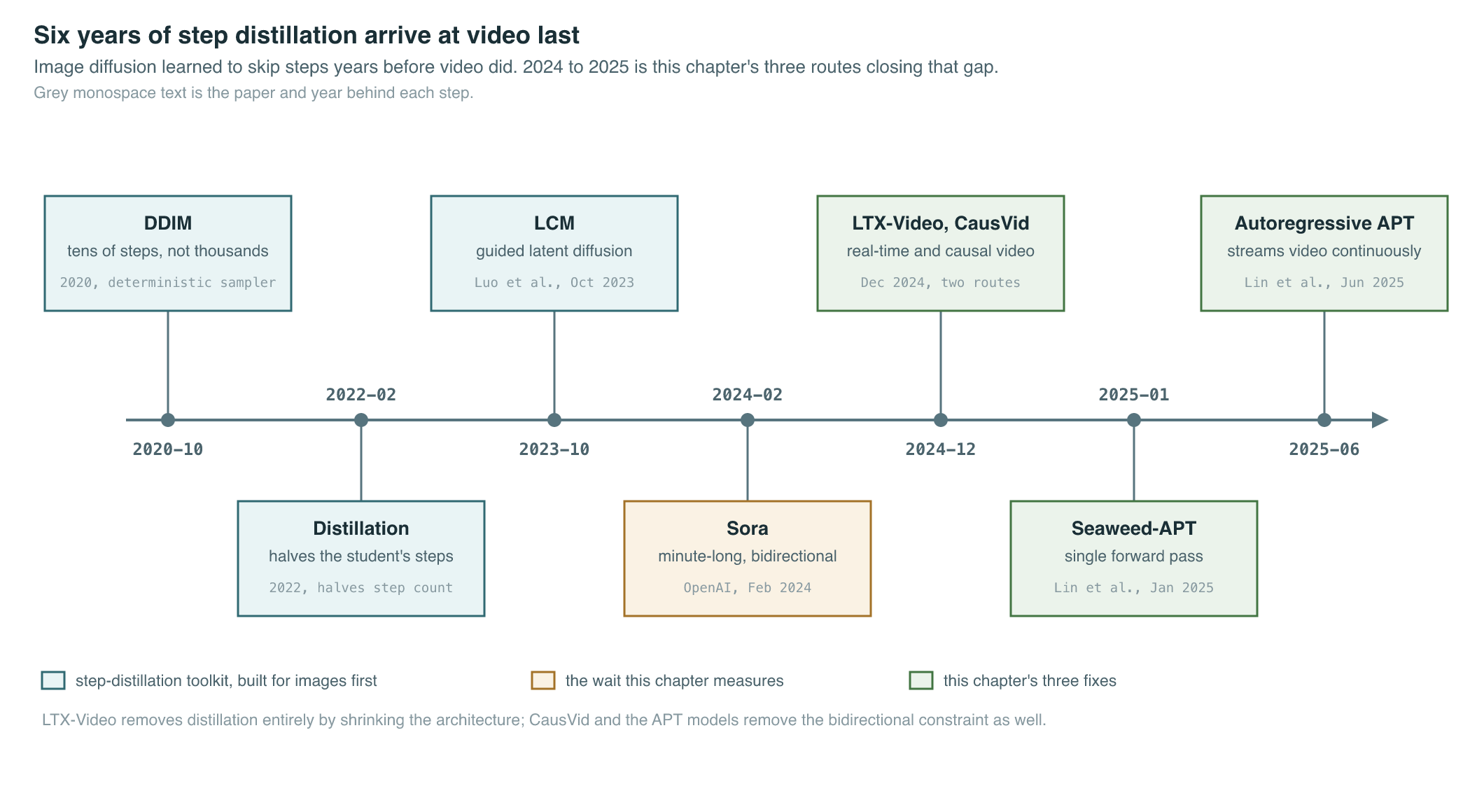
It is late 2024. Sora has just shown that a diffusion transformer can produce a minute of coherent video (Chapter 9), and Stable Video Diffusion has put an open video model in anyone’s hands (Chapter 6) — but every one of these models still generates a clip the way a print shop fills an order: submit the whole request, wait, collect the finished reel. Over the following year, three papers attack the cost of that wait from three different angles, and by mid-2025 a video model can stream frames as fast as a viewer watches them.
Where We Were
Video diffusion models inherited image diffusion’s step-count problem and made it worse. A single image sample from a guided latent diffusion model already meant tens of sequential network calls, each one doubled by classifier-free guidance (Chapter 10); video multiplies that per-step cost by the extra temporal dimension a video transformer has to attend over, and multiplies the wait again because a clip is many frames, not one. The step-distillation methods that solved this for images — progressive distillation, consistency models, Latent Consistency Models (LCM), adversarial diffusion distillation — collapsed tens of guided steps into as few as one for a single frame (Chapter 18), and by late 2023 LCM had already shown that the same consistency-distillation trick worked directly on Stable Diffusion’s latent space (Luo et al., 2023). Porting that trick to video was not simply a matter of re-running the same recipe on a bigger tensor.
Two obstacles were specific to video. First, the video diffusion transformers built on top of spacetime patches (Chapter 9) and temporal attention layers (Chapter 6) are bidirectional: to denoise frame 40, the network attends over frames 1 through 80, so it cannot start emitting frame 1 until it has already committed to what the whole clip will contain. That is workable for a batch job that returns a finished file, but it rules out streaming — there is no way to hand a viewer frame 1 while the model is still deciding on frame 80. Second, even a distilled few-step video model still pays that few-step cost once per clip, and a longer clip, or an interactive session where a user’s input should change what happens next, needs the model to keep generating indefinitely rather than stopping after one fixed-length sample.
By the second half of 2024, a state-of-the-art bidirectional video diffusion model took on the order of a couple of minutes on a single high-end GPU to produce ten seconds of video — the CausVid paper’s own bidirectional teacher measured 219.2 seconds for a 10-second clip on one GPU (Yin et al., 2024) — a wait that is fine for a render queue and unworkable for anything a user expects to talk to.
The Breakthrough
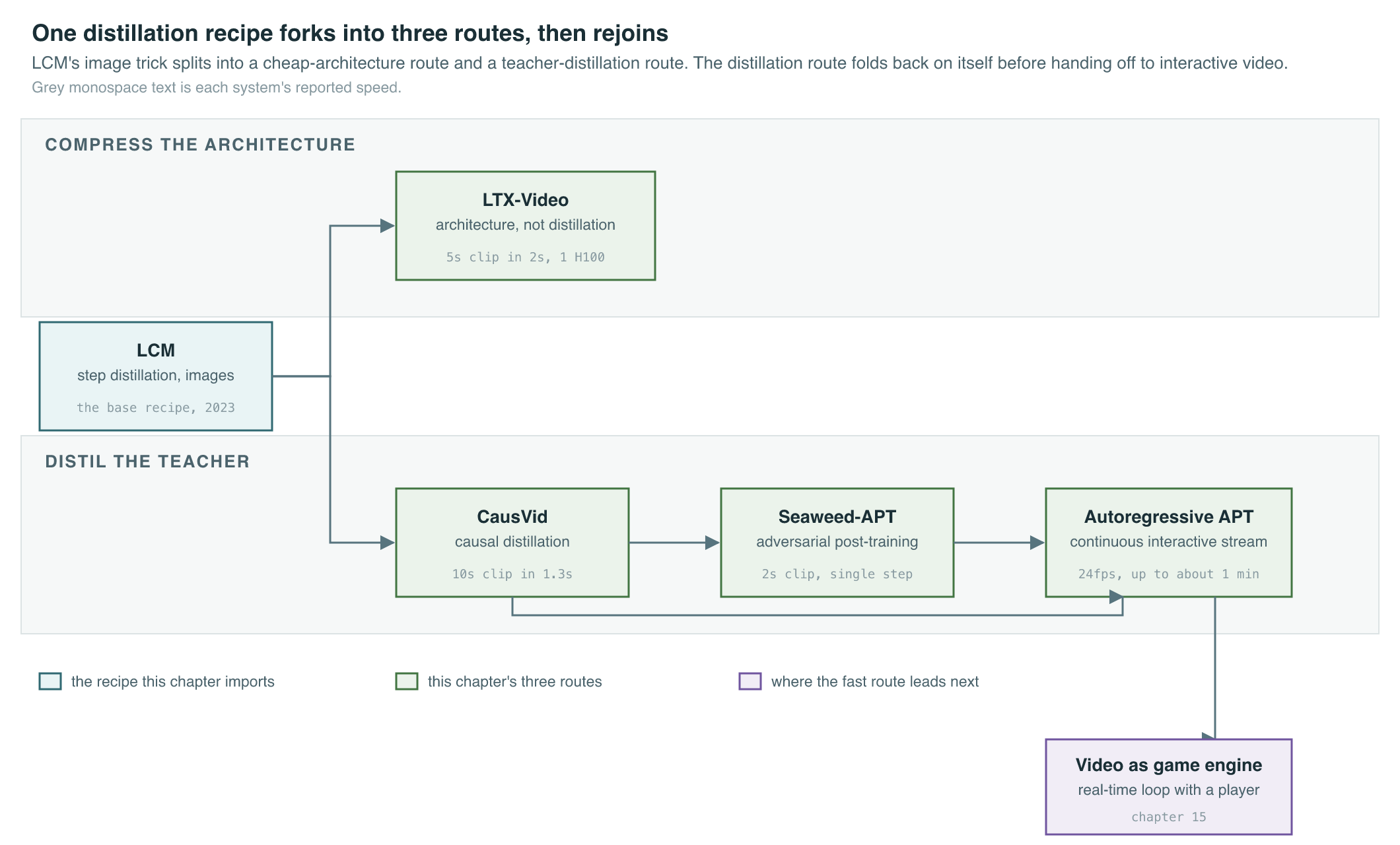
LTX-Video: making the architecture itself cheap. Rather than distilling an existing model, the Lightricks team redesigned the video autoencoder and transformer together so that the expensive part of the pipeline — the per-step transformer forward pass — operates on far fewer tokens per second of video. LTX-Video’s video variational autoencoder (VAE) compresses each clip by a factor of 1:192, folding a 32×32×8 pixel block into a single latent token, and moves the patchifying step that most video diffusion transformers perform on the transformer’s input into the VAE itself, which lets the transformer run full spacetime self-attention over a much smaller token grid (HaCohen et al., 2024). Because the VAE decoder also absorbs the last stage of denoising rather than handing off a fully clean latent, the paper reports generating five seconds of 24fps video at 768×512 resolution in two seconds on a single H100 GPU — faster than the clip’s own playback time, without any step-distillation training at all. The result shows that “cheap” and “few-step” are not synonyms: an aggressively compressed latent space, in the tradition of latent diffusion generally (Chapter 13), buys real-time throughput on its own.
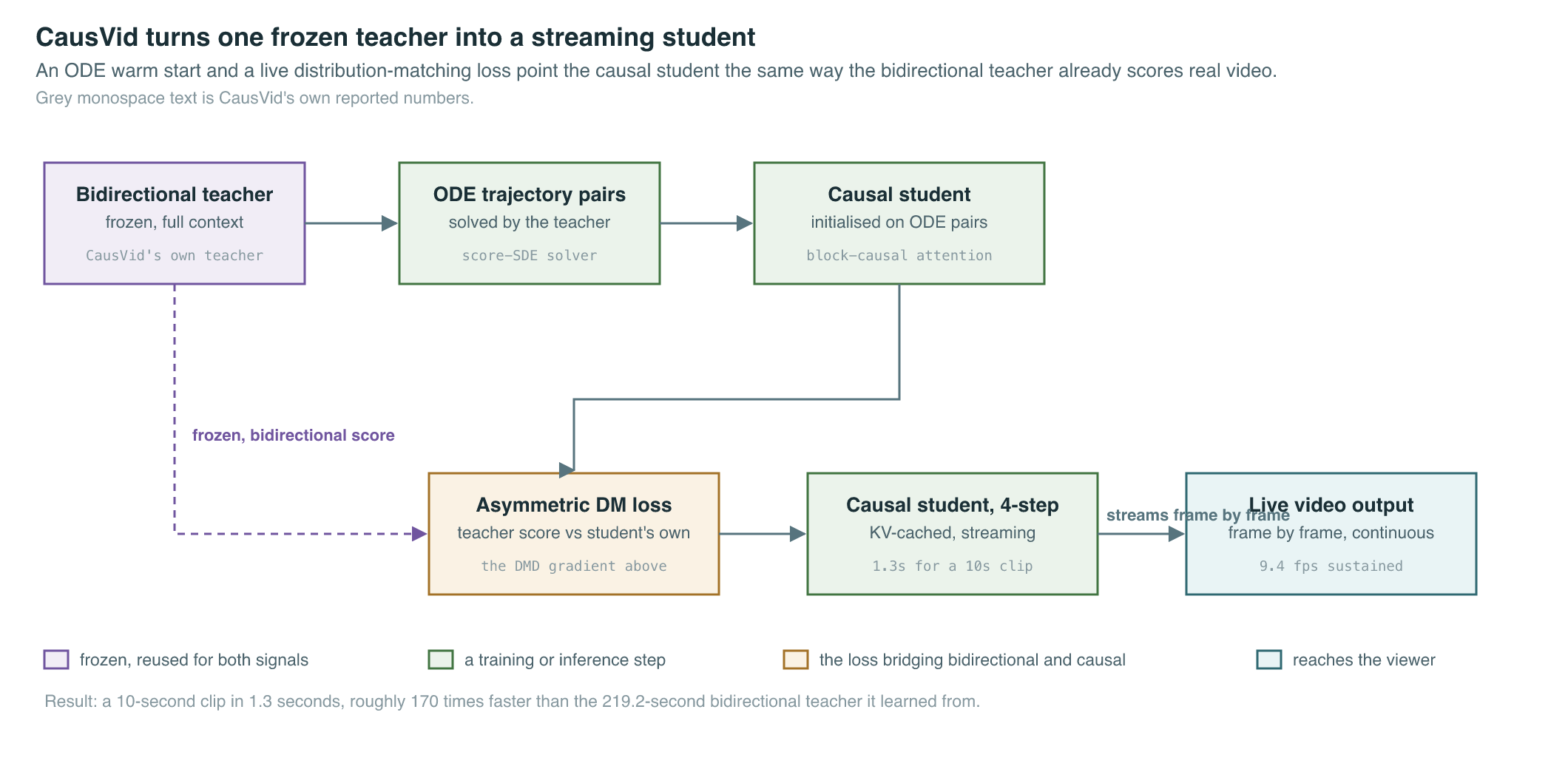
CausVid: turning the bidirectional teacher into a causal student. Tianwei Yin and colleagues at Adobe and MIT took the opposite route: keep an existing large bidirectional video diffusion model as a frozen teacher, and train a second, causal model to reproduce it frame-by-frame instead of clip-by-clip (Yin et al., 2024). A causal model generates frame using only frames before it, the same autoregressive dependency structure that language models and earlier autoregressive image models use (Chapter 5), which means it can start emitting output before it has “seen” the rest of the clip — and, paired with a key-value (KV) cache so each new chunk of frames does not have to re-attend over every previous frame from scratch (Engine Room, Chapter 17), it can stream indefinitely rather than stopping at a fixed clip length. The training recipe has two stages: first the causal student is initialized by regressing directly onto trajectories the bidirectional teacher already traced out with an ODE solver (Chapter 9, Score-SDEs); then an asymmetric distribution-matching loss refines it further, asymmetric because the teacher stays bidirectional and full-context while the student stays causal and chunked. The paper reports the resulting 4-step causal student generating a 10-second clip in 1.3 seconds on one GPU — sustaining 9.4 frames per second of streaming output — a roughly 170x wall-clock improvement over the 219.2-second bidirectional teacher, while scoring 84.27 on the VBench-Long benchmark, ahead of the prior state of the art at the time.
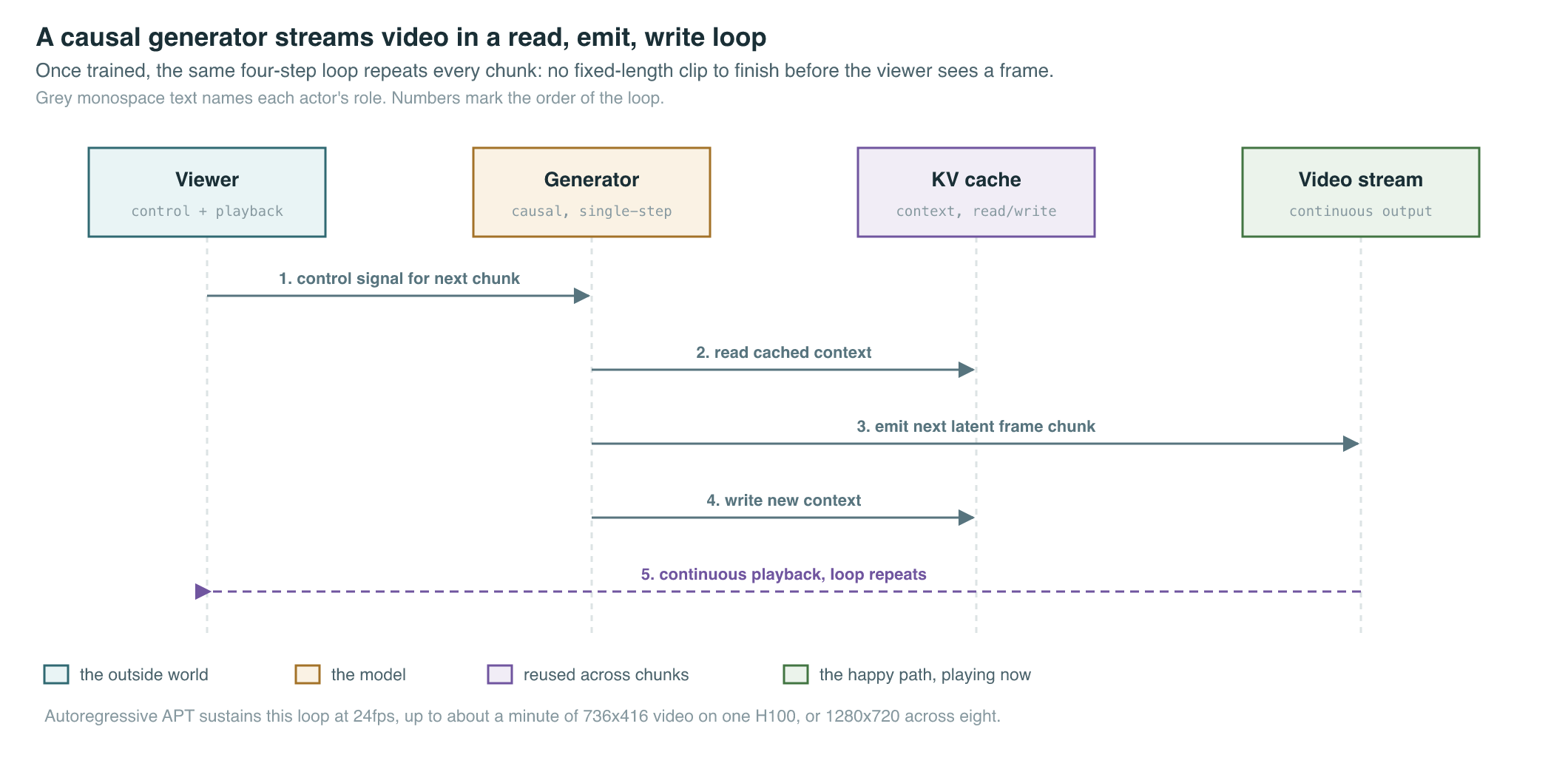
Seaweed-APT: adversarial post-training for a single step. A third route, from ByteDance’s Seaweed team, skips distillation-from-a-teacher’s-trajectory entirely and instead continues training an already-pretrained video diffusion model with an adversarial objective, in the spirit of adversarial diffusion distillation for images (Chapter 18) but built for video from the start (Lin et al., 2025). The discriminator reuses the pretrained diffusion transformer’s weights directly as its starting point; the generator instead starts from a consistency-distilled checkpoint of that same pretrained model — a fast but blurry one-step version that the paper reports as an effective initialization for the adversarial stage that follows. From there, the discriminator is trained to tell real clips apart from the generator’s single forward-pass output, while an approximated R1 regularization term keeps that adversarial signal from destabilizing training — the same instability problem that limited earlier GAN-based image and video generators (Chapter 2). The resulting model produces a 2-second, 1280×720, 24fps video in a single forward pass: 6.03 seconds on one H100 GPU, or close to real time — about 2 seconds — when the forward pass is split across 8 H100 GPUs. A follow-up from the same group extends the recipe to autoregressive, chunk-by-chunk generation, so the single-step generator does not stop after one clip but keeps producing new latent frames conditioned on a viewer’s ongoing input, streaming 24fps video continuously — 736×416 on a single H100, or 1280×720 across 8 H100 GPUs for clips up to about a minute long (Lin et al., 2025).
The Mathematics
CausVid restricts the video transformer’s attention to a block-causal pattern: frames are grouped into chunks of size , and a frame in chunk may attend only to frames in chunks up to and including :
| Symbol | Meaning |
|---|---|
| attention mask entry, whether frame can attend to frame | |
| frame indices | |
| chunk size, frames processed together |
The causal student is first initialized by regressing directly onto the teacher’s own ODE-solved trajectories, over chunks with per-chunk timesteps :
The second stage refines the student with an asymmetric distribution-matching loss, whose gradient compares the teacher’s score against a second, continuously updated score network trained on the student’s own outputs:
| Symbol | Meaning |
|---|---|
| teacher’s frozen score function, and the score of the student’s current output distribution | |
| the causal student generator | |
| input noise to the student | |
| signal- and noise-retention terms at diffusion timestep | |
| the noised version of the student’s output at timestep |
Seaweed-APT’s discriminator combines a standard adversarial term with an approximated R1 regularizer, computed by comparing the discriminator’s judgment of a real clip to its judgment of that same clip after a small amount of Gaussian noise is added:
| Symbol | Meaning |
|---|---|
| discriminator (DiT-initialized) and single-step generator (initialized from a consistency-distilled checkpoint) | |
| real clip, generator input noise, and conditioning | |
| Gaussian perturbation and its scale | |
| non-saturating adversarial loss functions | |
| weight on the approximated R1 term |
What It Enabled
None of these three approaches replaced the others outright; they occupy different points on a training-cost, latency, and interactivity trade-off, and the fastest-moving products through 2025 combined more than one.
| Method | Year | Mechanism | Reported latency | Streaming/interactive |
|---|---|---|---|---|
| Bidirectional baseline (CausVid’s teacher) | 2024 | full-clip diffusion, tens of steps | 219.2s for a 10s clip, 1 GPU | no — must finish before output |
| LTX-Video | 2024 | compressed VAE plus DiT, no distillation | 5s of 768×512 video in 2s, 1 H100 | no — still clip-at-a-time |
| CausVid | 2024 | asymmetric distillation to a causal, 4-step, KV-cached student | 10s clip in 1.3s, 9.4 FPS streaming | yes — frame-chunk streaming |
| Seaweed-APT | 2025 | adversarial post-training, single step | 2s of 1280×720 video in 6.03s on 1 H100, ~2s on 8 H100 | no — single clip per call |
| Autoregressive APT | 2025 | single-step generator made causal and continuous | 736×416 at 24fps on 1 H100, 1280×720 on 8 H100, up to ~1 min | yes — indefinite interactive stream |
The immediate effect was to make “video generation” stop meaning only “submit a prompt, wait, download a file.” A causal, KV-cached, few-step (or single-step) generator can, in principle, keep producing new frames for as long as a viewer keeps watching, and it can accept new conditioning — a changed prompt, a camera-control signal, a player’s input — between chunks rather than only at the start of a clip. That capability is the direct prerequisite for treating a video model as something closer to a real-time simulator than a renderer: the world-model framing introduced when video models first learned to predict physical dynamics (Chapter 3) only becomes an interactive product once generation is fast enough to run in a loop with a user’s actions, which is exactly what Chapter 15 and Chapter 16 build on. It is also, separately, a distinct compression axis from shrinking a model’s parameter count — the general teacher-student framing for that is in Engine Room, Chapter 16 — and production video pipelines increasingly combine both: a smaller model, distilled to fewer steps, running on a compressed latent space.
Key Papers
| Paper | Authors | Year | Link | Why it matters |
|---|---|---|---|---|
| Latent Consistency Models: Synthesizing High-Resolution Images with Few-Step Inference | Luo, Tan, Huang, Li, and Zhao | 2023 | arXiv:2310.04378 | Established that consistency-style step distillation ports directly into guided latent diffusion, the base case video distillation extends |
| LTX-Video: Realtime Video Latent Diffusion | HaCohen et al. | 2024 | arXiv:2501.00103 | Showed real-time video generation is reachable through architecture and compression alone, with no distillation step |
| From Slow Bidirectional to Fast Autoregressive Video Diffusion Models | Yin, Zhang, Zhang, Freeman, Durand, Shechtman, and Huang | 2024 | arXiv:2412.07772 | Distilled a bidirectional teacher into a causal, KV-cached, 4-step streaming student — the mechanism behind CausVid |
| Diffusion Adversarial Post-Training for One-Step Video Generation | Lin, Xia, Ren, Yang, Xiao, and Jiang | 2025 | arXiv:2501.08316 | Reached single-forward-pass video generation via adversarial post-training of a pretrained diffusion transformer |
| Autoregressive Adversarial Post-Training for Real-Time Interactive Video Generation | Lin, Yang, He, Jiang, Ren, Xia, Zhao, Xiao, and Jiang | 2025 | arXiv:2506.09350 | Extended single-step adversarial post-training to continuous, interactive, multi-GPU streaming generation |
PM Lens
Papers referenced
- Latent Consistency Models: Synthesizing High-Resolution Images with Few-Step Inference Luo, Tan, Huang, Li, and Zhao · 2023 · arXiv:2310.04378
- LTX-Video: Realtime Video Latent Diffusion HaCohen et al. · 2024 · arXiv:2501.00103
- From Slow Bidirectional to Fast Autoregressive Video Diffusion Models Yin, Zhang, Zhang, Freeman, Durand, Shechtman, and Huang · 2024 · arXiv:2412.07772
- Diffusion Adversarial Post-Training for One-Step Video Generation Lin, Xia, Ren, Yang, Xiao, and Jiang · 2025 · arXiv:2501.08316
- Autoregressive Adversarial Post-Training for Real-Time Interactive Video Generation Lin, Yang, He, Jiang, Ren, Xia, Zhao, Xiao, and Jiang · 2025 · arXiv:2506.09350