It is December 2022. Text-to-video diffusion models can already generate a short clip from a caption, but nobody has yet shown a general way to take a video that already exists — a phone recording, a stock clip, a rendered animation — and change it: swap the subject, restyle the footage, or apply an edit described in words while keeping the motion intact. Over the following four months, three papers close that gap by three different routes, and one of them, Runway’s Gen-1, ships as a commercial product before most of the field has even finished reading the preprint.
Where We Were
By late 2022, text-to-video generation had a real toolkit, but it was a generation toolkit, not an editing one. Video Diffusion Models (April 2022), Make-A-Video (September 2022), and Imagen Video (October 2022) — covered in Chapter 5 — had shown that a diffusion model could turn a caption into a short clip by extending image diffusion with factorized spatio-temporal attention and joint image-video training. CogVideo and Phenaki, covered in Chapter 4, took the autoregressive route to the same goal, tokenizing frames and predicting them one after another. What none of these systems accepted as input was a video. They ran forward from a text prompt and noise, once, to a finished clip; there was no slot in the pipeline for “and here is the footage I already have.”
Image diffusion, one book over, had a head start. SDEdit (August 2021) and Prompt-to-Prompt (August 2022) — covered in Chapter 17 of the image-generation book — had already shown two ways to edit a real image with a pretrained diffusion model: partially renoise it and let the reverse process finish the job, or intervene on the model’s own cross-attention maps to hold a layout in place while a prompt changes. Both tricks depend on DDIM’s proof, covered in Chapter 9 of the image-generation book, that the reverse diffusion process can be run deterministically and, therefore, inverted. Applying either trick to video was not a matter of copy-paste: a video is not one image but dozens of them, and any per-frame edit that is not forced to agree with its neighbors flickers instead of moving.
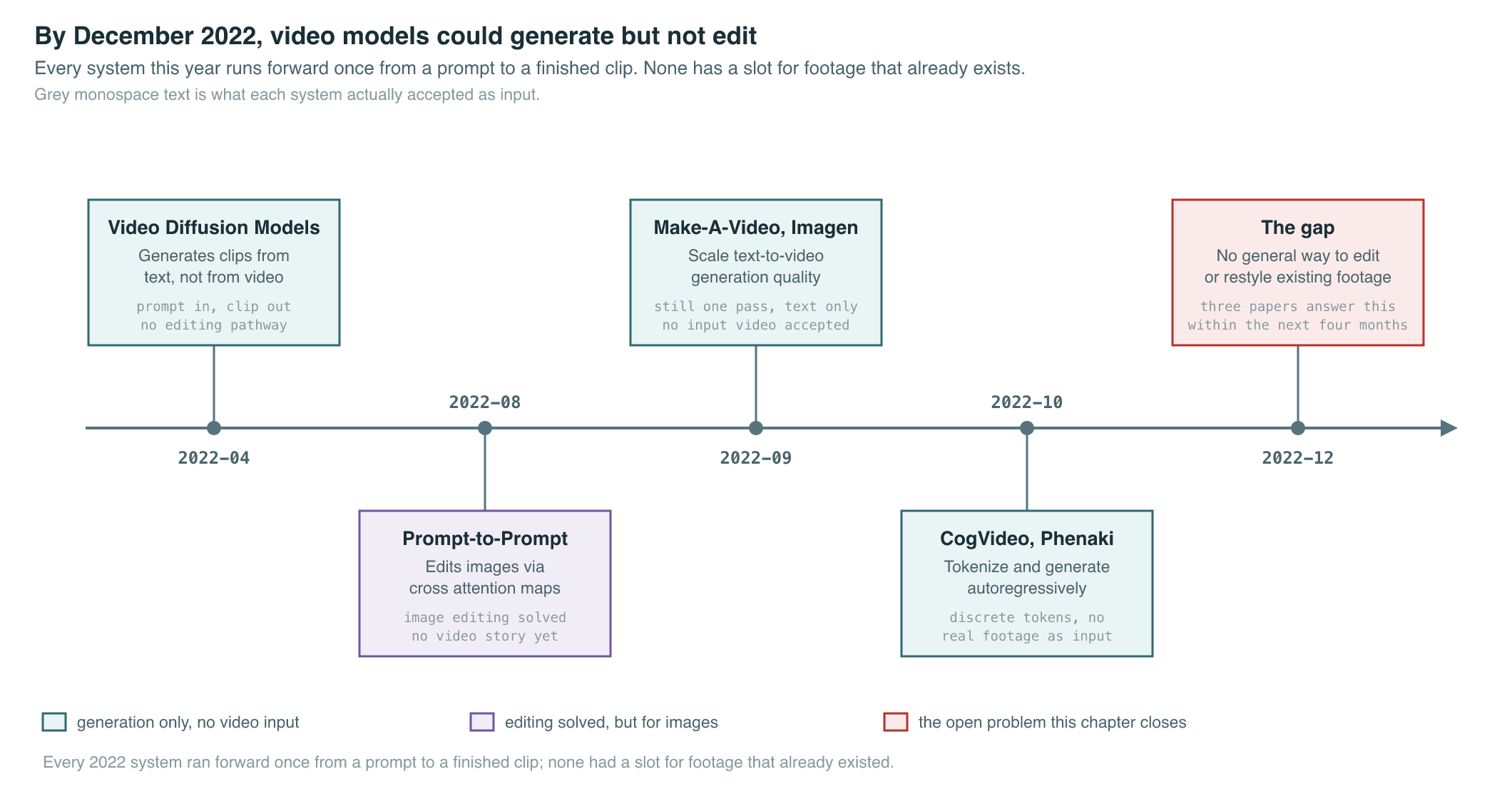
The missing piece was a way to keep a video’s motion and layout fixed while changing everything else about how it looks — without collecting a paired before-and-after video dataset, which barely existed at any scale, and without generating from scratch and hoping the result happened to match the input’s motion. Three groups, working independently, reached three different answers within a single winter.
The Breakthrough
Tune-A-Video (Wu et al., 2022), submitted to arXiv on December 22, 2022, took the narrowest and cheapest route: treat a single input video as its own training set. The method starts from a pretrained text-to-image latent diffusion model — the kind Chapter 13 of the image-generation book covers in full — and briefly fine-tunes it on one video and its caption, updating only a small slice of the network’s weights: the query projections inside the model’s existing cross-attention layers, plus a new temporal self-attention module, plus the query projection of a modified spatial self-attention module that now also looks at other frames. Everything else in the pretrained model — the layers that know how to draw a face, a car, or a snowy street — is left untouched. Once fine-tuned, the model has learned this one video’s motion well enough that swapping the caption’s subject (“a man is skiing” to “a panda is skiing”) and re-running generation, seeded from the original video’s own DDIM-inverted latent, produces a new video with the same motion and a different subject.
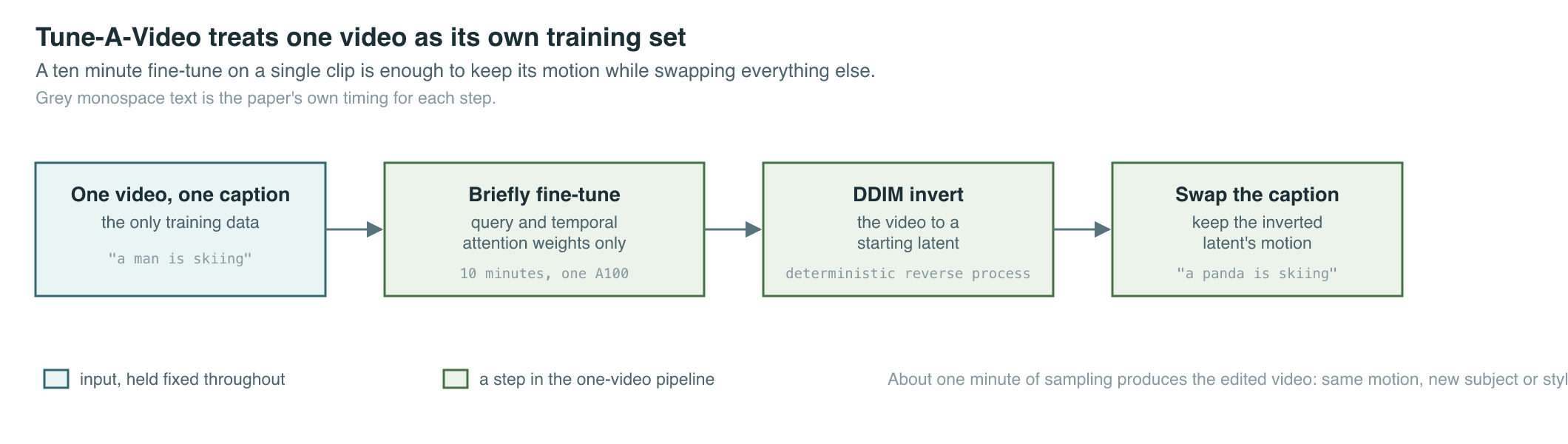
The mechanism that lets a model fine-tuned on a single video still generate frames that agree with each other is what the paper calls sparse-causal attention: each frame’s self-attention no longer looks only at itself, but also at the first frame and the immediately preceding frame, so a change introduced anywhere propagates forward through the sequence instead of being decided independently, frame by frame. Ten minutes of fine-tuning on one NVIDIA A100 GPU, and about a minute of sampling on the same card, is enough to turn a general-purpose image model into a bespoke, one-video video editor.
Gen-1 (Esser et al., 2023), submitted on February 6, 2023 by Runway, rejected the per-video fine-tuning approach entirely in favor of training one model, once, that generalizes to any input video at inference time. Gen-1 factors the editing problem into two separate conditioning signals. Structure — the coarse shape and layout of each frame, extracted as a monocular depth map — is concatenated to the noisy latent at every denoising step, telling the model where things are without telling it what they look like. Content — what the output should actually look like, supplied either as a driving image or as text — is injected through the model’s cross-attention layers as a CLIP embedding, the same joint image-text representation Chapter 11 of the image-generation book develops in full. Splitting “where” from “what” means a user can hand Gen-1 a video of someone dancing, describe the desired look in a sentence or a reference image, and get back a video with the original dancer’s motion and a new appearance.
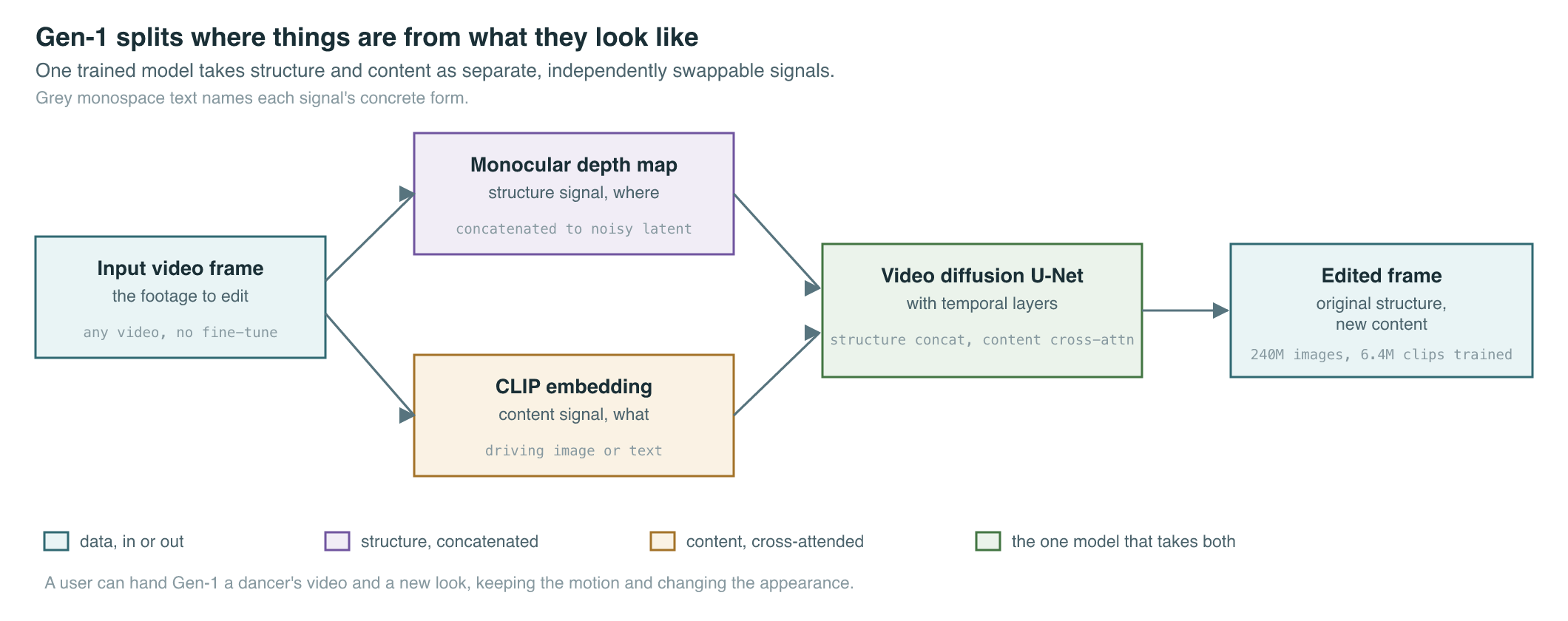
Gen-1 is built the way Chapter 6 describes in general for later models: start from a pretrained image latent-diffusion model and add temporal convolution and attention layers so the network can reason across frames, not only within one. Gen-1’s specific contribution sits on top of that shared pattern — the depth-plus-CLIP conditioning split — and it was trained jointly on 240 million images and 6.4 million video clips, mixing image and video batches so the model retains the visual breadth of an image model while learning temporal behavior from video. Runway shipped Gen-1 as a feature inside its product within weeks of the preprint, turning a video-editing paper into a subscription feature before most competing labs had a comparable demo.
Text2Video-Zero (Khachatryan et al., 2023), submitted on March 23, 2023, went the opposite direction from Gen-1: instead of training anything at all, it repurposed a frozen, off-the-shelf Stable Diffusion checkpoint and produced temporally consistent video purely through how sampling is orchestrated. Two changes, applied at inference time only, do the work. First, the self-attention inside the pretrained U-Net is replaced with cross-frame attention: every frame’s queries are matched against the keys and values of a single fixed frame — the first frame — rather than its own, so every frame keeps rendering the same object identity and background instead of each one independently reimagining it. Second, before any denoising happens, the initial noise latents for frames after the first are not sampled independently; they are produced by warping the first frame’s own partially-denoised latent along a chosen motion direction, then re-noising, so the frames start from correlated points instead of unrelated random noise.
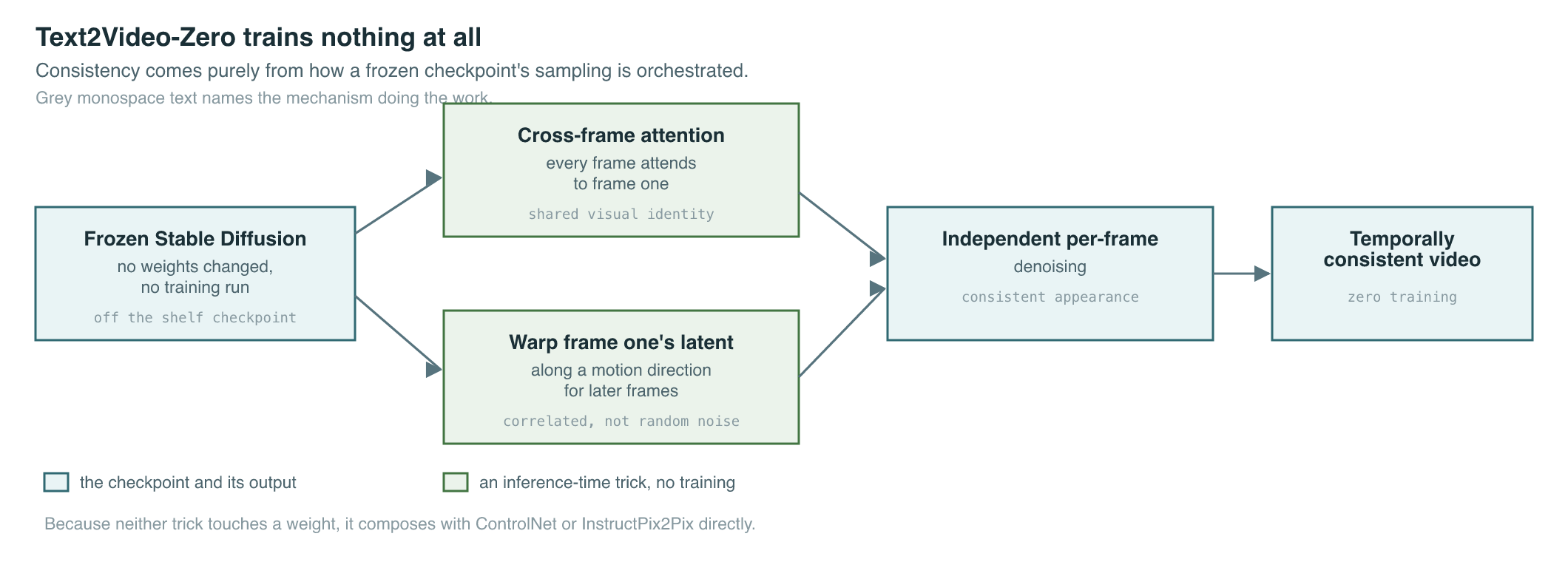
Because neither trick touches a single model weight, Text2Video-Zero’s authors also showed it composing directly with existing conditioning tools: feeding it ControlNet-style pose or edge maps for conditional generation, or combining it with InstructPix2Pix — covered alongside Prompt-to-Prompt in Chapter 17 of the image-generation book — to perform instruction-guided video editing, again with no video-specific training anywhere in the pipeline.
The Mathematics
Tune-A-Video’s central mechanism is sparse-causal attention. For frame , the query still comes from that frame alone, but the keys and values are drawn from the first frame and the immediately preceding frame:
| Symbol | Meaning |
|---|---|
| features of the current frame | |
| features of the first frame | |
| features of the previous frame | |
| shared query, key, value projection matrices | |
| the resulting query, key, and value tensors | |
| the attention head dimension |
Only a subset of Tune-A-Video’s weights — the query projections in this attention, plus a comparable set in the model’s cross-attention layers — are updated when the network is briefly fine-tuned on the single input video; the diffusion training loss itself is the same denoising objective Chapter 8 of the image-generation book derives, and generation afterward reuses the DDIM inversion and sampling Chapter 9 of the image-generation book covers, applied here to a video’s frames rather than a single image.
Gen-1 conditions its denoiser on two additional signals beyond the usual noisy latent and timestep: a structure representation , derived from per-frame depth, and a content representation , a CLIP embedding of a driving image or text. Its training objective extends the DDPM posterior-mean loss with these two extra arguments:
| Symbol | Meaning |
|---|---|
| true forward-process posterior mean at step | |
| the network’s predicted posterior mean | |
| noisy and clean latent encodings of the video | |
| structure conditioning, a per-frame depth map | |
| content conditioning, a CLIP embedding | |
| the per-timestep loss weight |
At inference, Gen-1 extends classifier-free guidance — the single-signal mechanism Chapter 10 of the image-generation book covers in full — to three terms instead of one:
| Symbol | Meaning |
|---|---|
| the final, guided prediction used for sampling | |
| the model’s image-only-pathway prediction | |
| the full video model’s prediction | |
| the noisy latent at step | |
| the content conditioning signal | |
| the structure conditioning signal | |
| the temporal-consistency guidance scale | |
| the content guidance scale | |
| the null conditioning signal |
Text2Video-Zero’s cross-frame attention replaces ordinary self-attention with a rule that always looks at the first frame:
| Symbol | Meaning |
|---|---|
| frame ‘s own query | |
| frame one’s key and value | |
| the total number of frames | |
| the attention feature dimension |
Cross-frame attention alone only fixes appearance; motion still needs a push, which Text2Video-Zero supplies before denoising even begins:
| Symbol | Meaning |
|---|---|
| frame one’s initial Gaussian noise | |
| frame one’s latent after backward steps | |
| the base motion-direction vector | |
| the motion-magnitude scale | |
| frame ‘s scaled displacement | |
| the warping operator applying | |
| the number of forward/backward diffusion steps | |
| frame ‘s resulting initial noise |
What It Enabled
The three methods trade training cost, generality, and edit fidelity against each other in ways that were never fully resolved by 2023 — later chapters show the industry continuing to pick different points on this same trade-off:
| Tune-A-Video, Dec 2022 | Gen-1, Feb 2023 | Text2Video-Zero, Mar 2023 | |
|---|---|---|---|
| Training required | one short fine-tune, per input video | one large training run, reused for any video | none — frozen pretrained checkpoint |
| Editing signal | edited caption | driving image or text (content), plus structure | text prompt, optionally with ControlNet-style conditioning |
| Generalizes without retraining | no, needs 10 minutes per new video | yes | yes |
| Shipped as a product | research code only | Runway Gen-1, within weeks of the preprint | research code only |
A second table places the numbers each paper reported against CogVideo — covered in Chapter 4 — as a common autoregressive baseline, though each pair was measured on its own set of prompts, not a shared benchmark, so the two CogVideo rows below are not the same run:
| Metric | CogVideo | Tune-A-Video |
|---|---|---|
| Frame consistency, CLIP embedding similarity | 90.64 | 92.40 |
| Text-video CLIP score | 23.91 | 27.58 |
| Human preference, frame consistency | 12.14% | 87.86% |
| Human preference, textual alignment | 15.00% | 85.00% |
| Metric | CogVideo | Text2Video-Zero |
|---|---|---|
| Text-video CLIP score, 25 sampled prompts | 29.63 | 31.19 |
Gen-1’s own human study, run against per-frame image-editing baselines rather than CogVideo, found it preferred over SDEdit (at 50% noising strength) 85.29% of the time and over Text2LIVE 88.24% of the time — evidence that editing video directly, rather than editing each frame independently and hoping the results agreed, was already the stronger approach by early 2023.
None of the three methods solved every problem the category would eventually need solved. Tune-A-Video’s per-video fine-tuning does not scale to a product serving many users’ videos at once. Gen-1’s depth-based structure signal ties the edit to the input video’s exact geometry, which is a poor fit for changes that should alter motion itself rather than just appearance — the subject Chapter 8 takes up directly, with explicit camera-trajectory and drag-based motion conditioning. Text2Video-Zero’s warped-latent motion is a single global direction, not per-object or camera-aware motion, and its cross-frame attention alone starts to lose consistency over longer clips — a limitation Chapter 12 addresses for video generation broadly. Gen-1’s product path, meanwhile, continued directly into Runway’s later Gen-2 and Gen-3 models, covered in Chapter 10, as video editing and video generation increasingly ran through the same commercial pipelines rather than separate research tracks.
Key Papers
| Paper | Authors | Year | Link | Why it matters |
|---|---|---|---|---|
| Tune-A-Video: One-Shot Tuning of Image Diffusion Models for Text-to-Video Generation | Wu et al. | 2022 | arXiv:2212.11565 | Shows a pretrained image diffusion model can be turned into a single-video editor with ten minutes of fine-tuning and a sparse-causal attention trick |
| Structure and Content-Guided Video Synthesis with Diffusion Models | Esser et al. | 2023 | arXiv:2302.03011 | Separates structure (depth) from content (CLIP) conditioning in a single trained model; shipped as Runway Gen-1 within weeks |
| Text2Video-Zero: Text-to-Image Diffusion Models are Zero-Shot Video Generators | Khachatryan et al. | 2023 | arXiv:2303.13439 | Produces temporally consistent video from a frozen Stable Diffusion checkpoint via cross-frame attention and latent warping, with no training at all |
PM Lens
Papers referenced
- Tune-A-Video: One-Shot Tuning of Image Diffusion Models for Text-to-Video Generation Wu et al. · 2022 · arXiv:2212.11565
- Structure and Content-Guided Video Synthesis with Diffusion Models Esser et al. · 2023 · arXiv:2302.03011
- Text2Video-Zero: Text-to-Image Diffusion Models are Zero-Shot Video Generators Khachatryan et al. · 2023 · arXiv:2303.13439