It is September 2016. The generative adversarial network has spent two years reshaping still-image synthesis, and a group at MIT asks the obvious next question: if a discriminator can teach a generator what a convincing photograph looks like, can a discriminator teach a generator what a convincing second of video looks like? The answer arrives in three widening steps over the following three years — a tiny 64-pixel clip, a generator that separates what moves from how it moves, and finally an attempt to do both at the scale of a real internet video dataset.
Where We Were
By late 2016 the adversarial game was already the leading recipe for sharp still images. The GAN objective — a generator and a discriminator locked in a minimax game with no explicit density and no Markov chain — is covered in full in image-generation, Chapter 3; this chapter assumes that objective and asks what changes when the sample being judged has a time axis instead of just two spatial axes.
Video research had already tried the alternative path — regression rather than adversarial judgment — and run into a well-documented wall. Recurrent networks trained to predict future frames by minimizing pixel-wise error, surveyed in early unsupervised video representation work from February 2015, produce blurry, washed-out predictions whenever the future is genuinely uncertain: a mean-squared-error loss is minimized by averaging over every plausible continuation, and the average of several sharp, different futures is a blur. Why that specific failure happens, and why it is a property of the loss rather than of the network, is owned by Chapter 1 — this chapter is the point where GAN training becomes one of the two mainstream fixes.
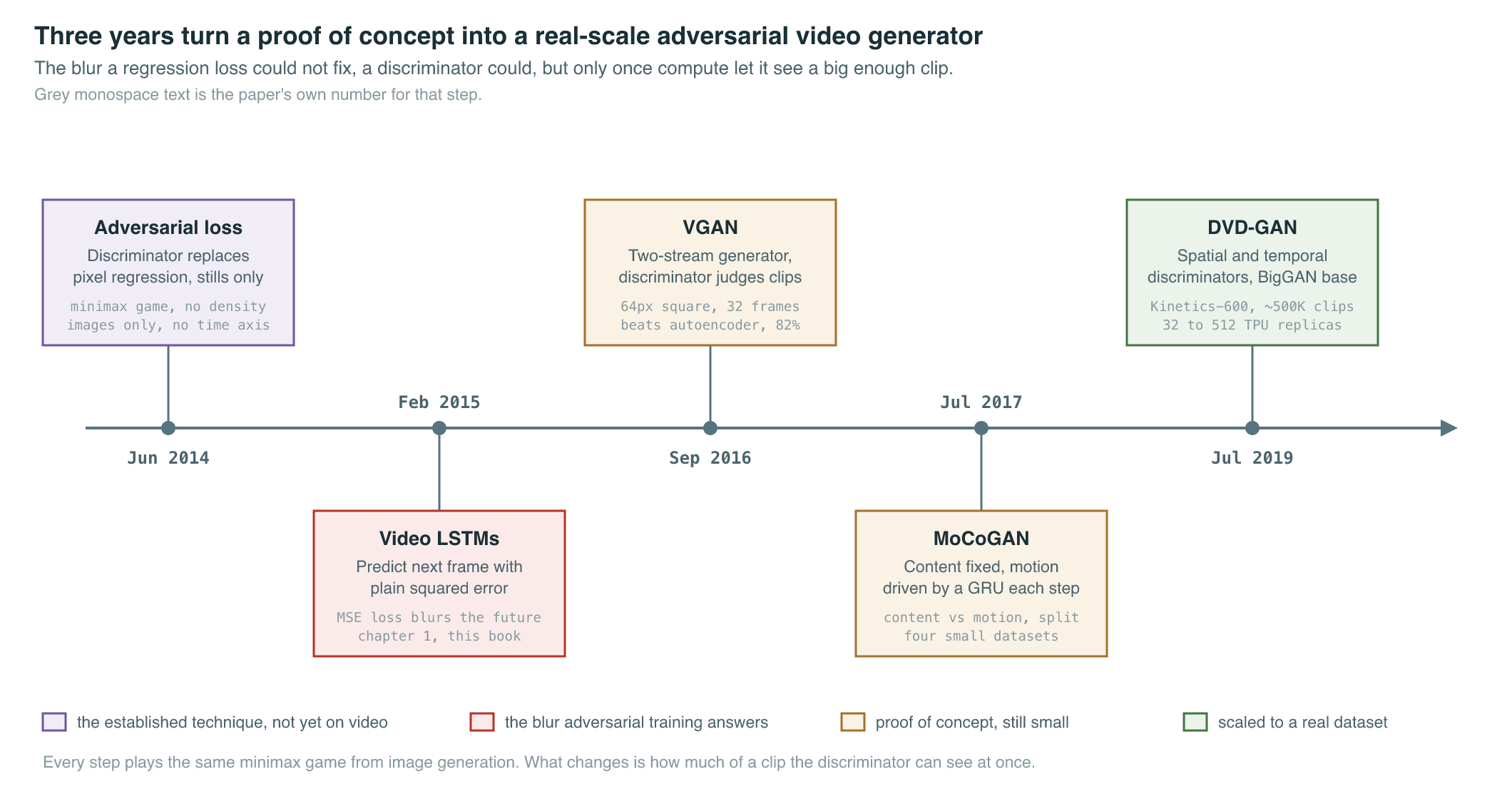
The case for trying the adversarial route in video was the same case that had already worked for images: a discriminator judging an entire generated clip has no reason to reward the safe, blurry average of several possible futures, because a blurry clip is easy for a discriminator to flag as fake. The generator is pushed toward committing to one sharp, plausible continuation instead of hedging across all of them. What nobody had yet worked out, going into 2016, was how to build a discriminator — and a generator — that could look at motion at all, rather than just judging one frame at a time.
The Breakthrough
Generating Videos with Scene Dynamics (Vondrick et al., 2016) is the first paper to point the adversarial game at raw video. Rather than feed noise through one generator network, it splits the generator into two streams that share early weights but specialize toward the end. A foreground stream applies spatio-temporal convolutions — convolutions that slide across space and across time — to model the parts of the scene that move. A background stream applies ordinary spatial convolutions to a single frame and then replicates that static frame across every time step, on the observation that in most short clips the camera and the setting barely change while the subject does. A third output, a per-pixel mask produced by a branch that shares weights with the foreground stream, decides at every location and every frame how much of the final pixel comes from the moving foreground versus the static background. The generator, discriminator, and training procedure otherwise follow the plain adversarial objective from image-generation, Chapter 3: a 3-D-convolutional discriminator judges whole clips as real or generated, and gradients flow back through both streams and the mask.
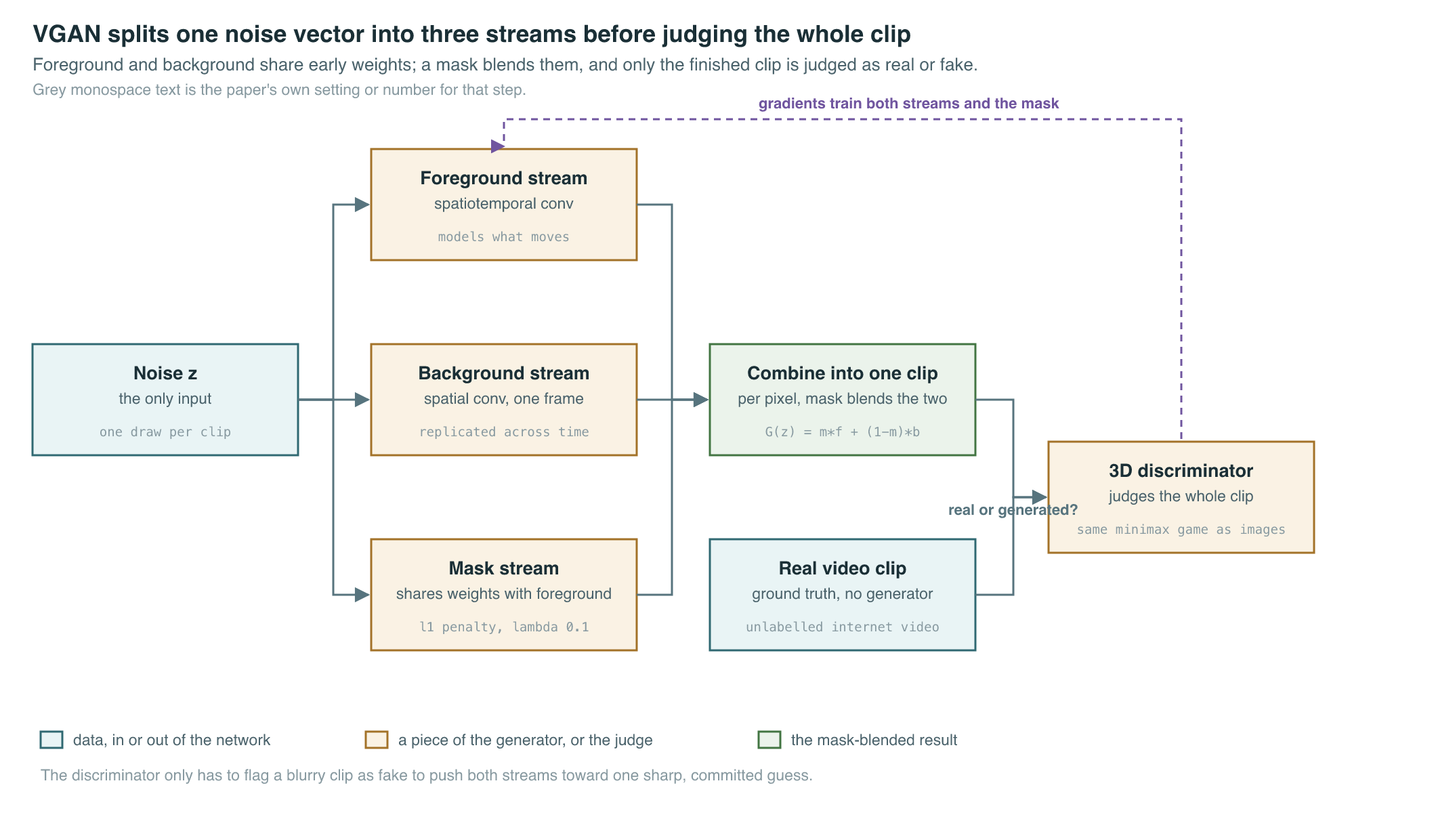
Trained on large amounts of unlabeled internet video, the model — nicknamed VGAN — generated clips only 64 pixels square and one second long at full frame rate (32 frames), a scale chosen because adversarial video training was, at the time, barely stable even at that size. The paper reported three results, all from a human preference study and two follow-on experiments: workers preferred the two-stream generator over a same-architecture autoencoder baseline 82% of the time on average, and preferred it over a one-stream ablation of the model itself 53% of the time, evidence that the foreground/background split was doing real work rather than just adding parameters; the same generator, given a single static image as a conditioning input, could paint in a plausible short future for that image, rarely correct but often plausibly in motion; and, perhaps most surprisingly, the internal features the discriminator learned while telling real motion from generated motion turned out to be useful for recognizing human actions with minimal labeled supervision — fine-tuned on UCF-101, the discriminator’s features reached 52.1% accuracy, edging out hand-crafted STIP features (43.9%) and a contemporary unsupervised video-representation method, Shuffle and Learn (50.2%), though still well short of the 91.4% a fully supervised ImageNet-pretrained network reached on the same task. It was an early hint that a model trained only to distinguish real from fake video had, along the way, learned something like a representation of what motion in the world normally looks like. A sparsity penalty on the mask, discussed under the Mathematics section below, was needed in practice to stop the model from routing everything through the more flexible foreground stream and ignoring the background stream entirely.
MoCoGAN: Decomposing Motion and Content for Video Generation (Tulyakov et al., 2017) took a different cut at the same problem: instead of separating a video into foreground and background pixels, it separates the latent code that generates a video into a content part and a motion part. The intuition is that a short clip of a person waving has one thing that stays fixed across the whole clip — who the person is, what they are wearing, the room they are in — and one thing that changes frame to frame — the trajectory of the wave. MoCoGAN fixes a single content vector for an entire clip and drives a separate recurrent network, at every time step, with fresh noise to produce a motion vector that evolves over time; the frame generator then maps the concatenation of the fixed content vector and the current motion vector to a single image, one frame at a time. Two discriminators supervise training: an image discriminator that judges individual sampled frames for realism, and a video discriminator that judges a sampled sequence of consecutive frames for realistic motion. Crucially, the recurrent motion network is driven by an independent noise draw at every step rather than by its own previous output alone, which the authors found necessary to keep the model from settling into one repetitive motion pattern regardless of the noise it was given.
Because content and motion are separate inputs, MoCoGAN could, after training, be asked to hold content fixed while sampling different motion — the same face making different expressions — or hold motion fixed while sampling different content, a capability image-domain conditional GANs (covered as the conditioning mechanism in image-generation, Chapter 3) never had a temporal axis to demonstrate. The paper evaluated this on four datasets of increasing difficulty: a synthetic shape-motion dataset of moving circles and squares, the MUG facial-expression database, a Tai-Chi clip collection scraped from YouTube, and the Weizmann human-action dataset — none at internet scale, but each chosen to isolate a specific kind of motion the decomposition needed to capture.
Adversarial Video Generation on Complex Datasets (Clark et al., 2019) is the paper that asked whether any of this scaled. Its model, DVD-GAN — Dual Video Discriminator GAN — borrowed its generator and much of its discriminator design directly from BigGAN (Brock et al., 2018), the large-scale class-conditional image GAN covered in image-generation’s Chapter 6: class-conditional batch normalization, residual blocks, and spectral normalization all carried over from images into video. The paper’s own innovation was splitting judgment of a clip into two specialized discriminators rather than one: a spatial discriminator that samples a handful of individual frames at full resolution and judges each one’s image quality, and a temporal discriminator that looks at the whole clip — every frame, but spatially downsampled — and judges whether the motion across time is coherent. Because the spatial discriminator only ever sees a few full-resolution frames rather than the whole clip, and the temporal discriminator only ever sees downsampled frames, the combination processes far fewer pixels than a single discriminator looking at every frame at full resolution would — a design the authors reported cut per-clip pixel processing by 58% for a 48-frame, 128-pixel clip, which is what made training on a dataset the size of Kinetics-600 tractable at all.
DVD-GAN trained on Kinetics-600, a DeepMind action-recognition dataset of roughly 500,000 video clips across 600 action classes, at resolutions up to 256 pixels square and clip lengths up to 48 frames, using between 32 and 512 replicas on Google’s TPU pods for 12 to 96 hours depending on configuration. It reported a new state of the art in Fréchet Inception Distance for frame prediction on Kinetics-600 and in Inception Score for unconditional video synthesis on UCF-101 — the first time an adversarial video model had been shown to hold state-of-the-art numbers on datasets that size, rather than on small, curated clip collections.
The Mathematics
VGAN’s contribution is not a new training objective — it trains with the same minimax game as image-generation, Chapter 3 — but a new generator architecture, which is worth writing out because the composition rule is the whole idea:
| Symbol | Meaning |
|---|---|
| input noise vector | |
| foreground stream output — a full video, spatio-temporal convolutions | |
| background stream output — one frame, spatial convolutions only, replicated over time | |
| mask, values in , one per pixel per frame | |
| element-wise multiplication |
Training the mask with only the adversarial loss let the model route almost everything through the more expressive foreground stream and ignore the background stream, which defeated the point of separating them. The paper added a small penalty to push the mask toward using the background stream wherever possible:
MoCoGAN’s core idea is a factorization of the latent code rather than of the pixels. A clip’s content is drawn once and held fixed; its motion is produced step by step by a recurrent network driven by fresh noise at each step:
| Symbol | Meaning |
|---|---|
| full latent code for frame , the concatenation of content and motion | |
| content vector, drawn once from and held fixed for the whole clip | |
| motion vector at frame | |
| recurrent network (GRU) producing the motion vector at each step | |
| fresh Gaussian noise fed to at step , drawn from |
Two discriminators supervise the result, one judging single frames and one judging short sequences:
| Symbol | Meaning |
|---|---|
| , | a real video clip; a generated video clip |
| , | operators sampling one frame, or consecutive frames, from a clip |
| image discriminator, judges a single sampled frame | |
| video discriminator, judges a -frame sequence | |
| expectation over the given distribution of clips |
DVD-GAN, like its parent architecture BigGAN, replaced the log-loss GAN objective with a hinge-loss variant, a margin-based objective rather than a probability-based one:
| Symbol | Meaning |
|---|---|
| , | discriminator loss, generator loss |
| a real video clip, drawn from the data distribution | |
| a noise vector, drawn from the generator’s prior | |
| , | the discriminator’s unbounded score; the generator’s video output |
| the hinge — zero penalty once a sample is past its margin |
What It Enabled
The three papers describe a single axis of progress — scale — measured in resolution, clip length, and dataset size, with the underlying adversarial recipe from image-generation, Chapter 3 held constant throughout:
| VGAN, 2016 | MoCoGAN, 2017 | DVD-GAN, 2019 | |
|---|---|---|---|
| Resolution | 64 × 64 | 64 × 64 | up to 256 × 256 |
| Clip length | 32 frames | 16 frames | up to 48 frames |
| Discriminator design | single 3D-conv discriminator | image + video discriminator | spatial + temporal discriminator |
| Largest training set | unlabeled internet video | ~1,000–4,500 clips per dataset | Kinetics-600, ~500,000 clips |
| Compute | single-GPU scale | single-GPU scale | 32–512 TPU replicas |
| Headline result | plausible one-second clips, transferable action features | independent control of content and motion | state-of-the-art FID and Inception Score at Kinetics-600 scale |
None of the three models solved video generation outright, and by design their ambitions stayed modest — a second of motion, a handful of controllable datasets, one action-recognition benchmark. The adversarial line continued past this chapter in two directions. Scaling further under the same paradigm ran into the same instability and mode-collapse pressures that had already forced image-generation, Chapter 4’s three years of GAN-training fixes onto still images, now compounded by a second axis of variation; video generation’s own path to a learned world model, rather than a discriminator-judged clip, is the separate lineage covered starting at Chapter 3. The dominant paradigm shift, though, mirrored what had already started happening to images: diffusion models, introduced for images in 2020 and covered in image-generation, Chapter 8, were adapted to video beginning with Video Diffusion Models in April 2022, covered in Chapter 5 — the point at which the field’s frontier for video fidelity stopped being adversarial. The one place adversarial video generation kept a durable advantage was latency: a GAN generator is one forward pass, not a multi-step sampler, which is why lip-sync and real-time face-video work such as Wav2Lip in August 2020, covered in Chapter 13, stayed in the GAN family well after diffusion had taken over open-ended text-to-video.
Key Papers
| Paper | Authors | Year | Link | Why it matters |
|---|---|---|---|---|
| Generating Videos with Scene Dynamics | Vondrick, Pirsiavash, and Torralba | 2016 | arXiv:1609.02612 | First adversarial video generator; introduces the two-stream foreground/background/mask decomposition and shows discriminator features transfer to action recognition |
| MoCoGAN: Decomposing Motion and Content for Video Generation | Tulyakov, Liu, Yang, and Kautz | 2017 | arXiv:1707.04993 | Factorizes the latent code into a fixed content vector and a recurrently-generated motion vector, giving independent control over subject and motion |
| Adversarial Video Generation on Complex Datasets | Clark, Donahue, and Simonyan | 2019 | arXiv:1907.06571 | Scales adversarial video to Kinetics-600 via a BigGAN-derived generator and a spatial/temporal dual-discriminator split, the largest adversarial video result before diffusion took over |
PM Lens
Papers referenced
- Generating Videos with Scene Dynamics Vondrick, Pirsiavash, and Torralba · 2016 · arXiv:1609.02612
- MoCoGAN: Decomposing Motion and Content for Video Generation Tulyakov, Liu, Yang, and Kautz · 2017 · arXiv:1707.04993
- Adversarial Video Generation on Complex Datasets Clark, Donahue, and Simonyan · 2019 · arXiv:1907.06571