It is April 2022. Language models can write fluent prose from a text prompt, but they are blind — GPT-3 has never processed a pixel, and a decade of image-captioning research still leans on task-specific pipelines built for one benchmark at a time. Over the next twenty months, a DeepMind team, OpenAI, a two-person academic project, and a thousand-person Google effort each answer the same question — how do you give a language model eyes — and by the end of 2023 the answers converge on a single model that reads, writes, and sees without task-specific glue.
Where We Were
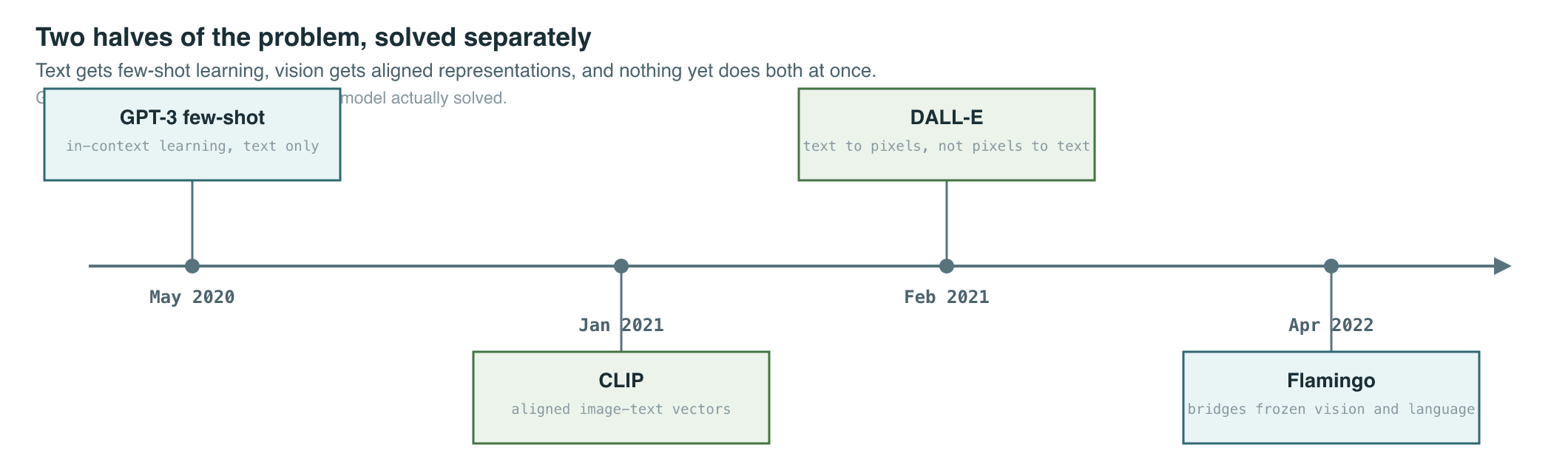
By early 2022 two separate lines of work had solved two separate halves of the problem, and neither had solved both. In-context few-shot learning — showing a language model a handful of examples in its prompt and letting it infer the task, introduced with GPT-3 in May 2020 — had made task-specific fine-tuning optional for text. But GPT-3 was text-only: it had no mechanism for taking an image as part of its input at all.
The vision side had its own advance. CLIP (CLIP, bridging text and image), released in January 2021, trained a two-tower model to align images and text captions with a contrastive objective, and the resulting embeddings transferred to zero-shot image classification with no labeled examples. That was a genuine breakthrough in representation — an image and its caption end up near each other in a shared space — but CLIP has no generative half. It can score how well a caption matches an image; it cannot answer an open-ended question about the image, describe what is happening in it, or hold a conversation about it. Text-to-image generation, exemplified by DALL-E in February 2021 (owned by image-generation/12), ran the pairing the other direction — text in, pixels out — which is a different problem again from reading an image and writing text about it.
Before either of these, visual question answering had existed for years as its own subfield: object detectors extracted region features, a fusion module combined them with a question embedding, and a classifier picked an answer from a fixed vocabulary. Every new dataset needed a new labeled training run and a new task head. There was no version of GPT-3’s trick — paste a few examples in a prompt and generalize — for anything involving pixels. That was the gap standing open in April 2022: a model that could look at an image or a video, read arbitrary text about it, and produce open-ended answers, ideally with the same few-shot flexibility that had just made text-only in-context learning work.
The Breakthrough
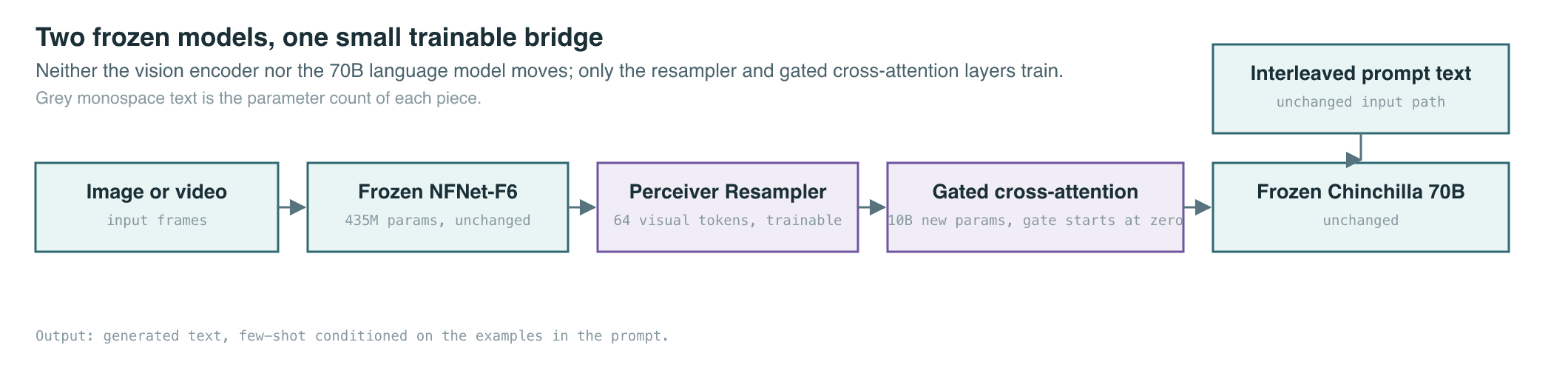
Flamingo: bridge, don’t retrain. “Flamingo: a Visual Language Model for Few-Shot Learning” (Alayrac et al., 2022), submitted in April 2022, answered the gap with a deliberately conservative architecture: take two models that already work — a vision encoder and a language model — freeze both, and train only a small bridge between them. The vision side was NFNet-F6, a convolutional network of 435 million parameters pretrained with a contrastive image-text objective in the style CLIP established. The language side was a frozen decoder-only transformer from the Chinchilla family (the compute-optimal scaling work published one month earlier), at 70 billion parameters. Neither model’s weights moved during Flamingo training.
The bridge had two trainable pieces. A Perceiver Resampler (194 million parameters) took the variable-length grid of features the vision encoder produced — more for a video, fewer for a single image — and cross-attended them into a fixed set of 64 visual tokens, regardless of input size. Those 64 tokens were then injected into the frozen language model through new Gated Cross-Attention Dense layers, inserted before every seventh transformer block starting from the first, adding 10 billion trainable parameters on top of the frozen 70 billion. The whole assembly, plus vision encoder and resampler, totaled roughly 80 billion parameters for the largest Flamingo variant. Training data mixed paired image-text and video-text datasets with webpages where images and text appear interleaved in their natural reading order — the same distributional trick that let GPT-3 learn to follow in-context examples, now with pictures in the context.
The result behaved like GPT-3 for pixels: shown a handful of image-question-answer triples in its prompt, Flamingo generalized to new images with no gradient update. It set a new few-shot state of the art on 16 of the vision-language benchmarks studied, reaching 67.6% accuracy on VQAv2 and 57.8% on OK-VQA at 32 shots — the OK-VQA number surpassing the previous fine-tuned state of the art, despite Flamingo seeing no task-specific training data at all. On video, it reached 31.0% on MSRVTT-QA and 52.3% on MSVD-QA, and produced captions scoring 113.8 CIDEr on COCO and 86.8 CIDEr on YouCook2, all in the 32-shot setting.
GPT-4: capable, but undisclosed. Eleven months later, in March 2023, OpenAI submitted the “GPT-4 Technical Report” (OpenAI, 2023), describing “a large-scale, multimodal model which can accept image and text inputs and produce text outputs.” The report is unusual for an anchor paper in this chapter: it discloses capabilities in detail — GPT-4 passes a simulated bar exam around the top 10% of test takers, and the team could predict aspects of its performance from smaller models trained on as little as one-thousandth the compute — but says nothing about how the multimodal input is fused, how large the model is, or what it was trained on. The report states this directly: “given both the competitive landscape and the safety implications of large-scale models like GPT-4, this report contains no further details about the architecture (including model size), hardware, training compute, dataset construction, [or] training method.” GPT-4 is confirmed multimodal and confirmed capable; its mechanism is not public.
LLaVA: the same idea, a hundredfold cheaper. One month after GPT-4, “Visual Instruction Tuning” (Liu et al., 2023) — an academic project out of University of Wisconsin–Madison and Microsoft Research, submitted in April 2023 — showed that Flamingo’s expensive bridge was not the only way to connect a frozen vision encoder to a frozen language model. LLaVA used a frozen CLIP ViT-L/14 encoder and a single trainable linear layer: a projection matrix that maps CLIP’s visual features directly into the word-embedding space of Vicuna, a LLaMA-derived instruction-tuned language model. No resampler, no cross-attention layers threaded through the LM — just enough of a linear map that visual features and word embeddings live in the same space, after which they are concatenated into one token sequence and trained with the ordinary next-token loss.
The harder problem was training data: nobody had a large corpus of multimodal instruction-following conversations. LLaVA’s authors solved this by feeding GPT-4 symbolic text descriptions of images — captions and bounding-box coordinates — and prompting it to synthesize conversations, detailed descriptions, and reasoning questions as if it could see the image directly. Fine-tuned on this GPT-4-generated data, LLaVA reached an 85.1% relative score compared with GPT-4 on a held-out synthetic multimodal instruction benchmark, and, fine-tuned further on ScienceQA, the combination of LLaVA and GPT-4 reached a new state-of-the-art accuracy of 92.53%. A method that had needed a DeepMind-scale training budget in April 2022 was reproduced by a small academic team, on public compute, twelve months later.
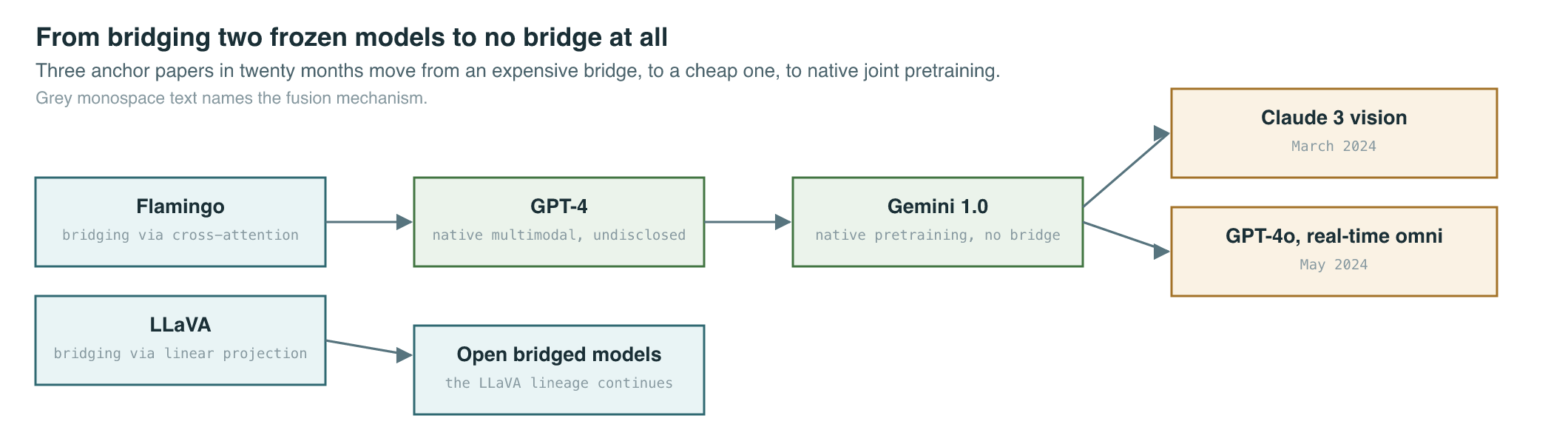
Gemini: no bridge at all. By December 2023, Google’s “Gemini: A Family of Highly Capable Multimodal Models” (Gemini Team, 2023) dropped the bridging pattern entirely. Where Flamingo and LLaVA start from separately pretrained vision and language components and connect them after the fact, Gemini was pretrained jointly on interleaved text, image, audio, and video data from the start — natively multimodal rather than stitched together. It shipped in three sizes, Ultra, Pro, and Nano, spanning data-center reasoning down to on-device deployment. Gemini Ultra reached 90.04% on MMLU, the first model reported to exceed the paper’s human-expert baseline of 89.8%, and advanced the state of the art on 30 of 32 benchmarks evaluated, including all 20 multimodal benchmarks examined. Three anchor papers in twenty months had moved from bridging two frozen models, to a cheap linear bridge anyone could train, to no bridge at all.
The Mathematics
Flamingo’s only genuinely new mechanism is how a frozen language model is made to attend to visual tokens without disturbing what it already knows how to do. The attention operation itself — queries, keys, values, softmax — is the mechanism attention and the transformer already define; what Flamingo adds is where that attention sits and how its contribution is scaled in:
| Symbol | Meaning |
|---|---|
| Language-model hidden state before and after the gated cross-attention layer | |
| The 64 visual tokens produced by the Perceiver Resampler | |
| Layer-specific learnable gate, initialized to 0 | |
| Standard cross-attention: queries from , keys and values from |
LLaVA’s bridge is smaller than Flamingo’s by design — no gating, no new attention layers, just an embedding-space alignment:
The two equations bracket a real design trade-off. Flamingo’s 10-billion-parameter gated cross-attention stack gives the frozen language model a dedicated mechanism for attending to visual detail at every few layers, which is part of why it holds up on fine-grained VQA; LLaVA’s single projection matrix is orders of magnitude cheaper to train — closer in spirit to the parameter-efficient adapters PEFT and LoRA formalizes for text-only fine-tuning — but leans entirely on the frozen LLM’s own attention to make sense of visual tokens once they arrive. Neither approach touches the vision encoder’s weights at all; both treat “connect a frozen expert model to a frozen language model” as the whole problem, which is exactly the pattern Gemini’s native joint pretraining, with no frozen components and no bridge to speak of, was built to avoid.
What It Enabled
| Approach | Vision fusion mechanism | New trainable parameters | Base language model | Jointly pretrained? |
|---|---|---|---|---|
| Flamingo (Apr 2022) | Gated cross-attention + Perceiver Resampler | ~10.2B | Frozen Chinchilla 70B | No |
| LLaVA (Apr 2023) | Linear projection into embedding space | A few million | Frozen Vicuna 7B/13B | No |
| GPT-4 (Mar 2023) | Undisclosed | Undisclosed | Undisclosed | Not stated |
| Gemini 1.0 (Dec 2023) | Native, no bridge | N/A — single training run | Gemini Ultra / Pro / Nano | Yes |
The era did not stop at Gemini. Two more releases, both owned by this chapter on the master timeline, closed out the 2022–2024 window without publishing new architecture papers. In March 2024, Anthropic’s Claude 3 family — Opus, Sonnet, and Haiku — added vision input across all three tiers alongside a 200,000-token context window (the mechanics of extending context that far are long context’s territory, not this chapter’s). In May 2024, OpenAI’s GPT-4o — “o” for omni — unified text, vision, and audio processing in one model, responding to spoken audio in as little as 232 milliseconds and 320 milliseconds on average, and was priced at half of GPT-4 Turbo in the API.
| Release | Date | What changed | Verified detail |
|---|---|---|---|
| Claude 3 family | Mar 2024 | Vision added across Opus/Sonnet/Haiku | 200K-token context window at launch |
| GPT-4o | May 2024 | Single model for text, vision, and audio in real time | ~320ms average voice response latency; half the API price of GPT-4 Turbo |
Two threads run forward from here. The bridging pattern that Flamingo and LLaVA established did not disappear once native multimodal pretraining arrived — it is cheaper, and it remains the default way open-weight communities add vision to an existing language model, the same way instruction tuning made capable chat models reproducible outside frontier labs. The native-pretraining pattern that Gemini established, by contrast, is what frontier labs converged on for their flagship models: GPT-4o and later Gemini and Claude releases all train on multimodal data from the start rather than bridging afterward. Both threads feed directly into later chapters: perceiving a screenshot or a UI is a prerequisite for the tool-using systems agents covers, and evaluating what a multimodal model actually knows, as opposed to what it merely restates from training data, is the subject taken up in measuring minds and the frontier.
Key Papers
| Paper | Authors | Year | Link | Why it matters |
|---|---|---|---|---|
| Flamingo: a Visual Language Model for Few-Shot Learning | Alayrac et al. | 2022 | arXiv:2204.14198 | First frozen-vision-plus-frozen-LM bridge; gated cross-attention preserves the LM at init; few-shot SOTA on 16 benchmarks |
| GPT-4 Technical Report | OpenAI | 2023 | arXiv:2303.08774 | First frontier model with disclosed multimodal capability but withheld architecture; ~top-10% simulated bar exam |
| Visual Instruction Tuning | Liu et al. | 2023 | arXiv:2304.08485 | LLaVA: open replication via one linear projection and GPT-4-generated instruction data; 85.1% relative to GPT-4 |
| Gemini: A Family of Highly Capable Multimodal Models | Gemini Team, Google | 2023 | arXiv:2312.11805 | First natively multimodal frontier model; 90.04% MMLU, first to exceed the paper’s human-expert baseline |
PM Lens
Papers referenced
- Flamingo: a Visual Language Model for Few-Shot Learning Alayrac et al. · 2022 · arXiv:2204.14198
- GPT-4 Technical Report OpenAI · 2023 · arXiv:2303.08774
- Visual Instruction Tuning Liu et al. · 2023 · arXiv:2304.08485
- Gemini: A Family of Highly Capable Multimodal Models Gemini Team, Google · 2023 · arXiv:2312.11805