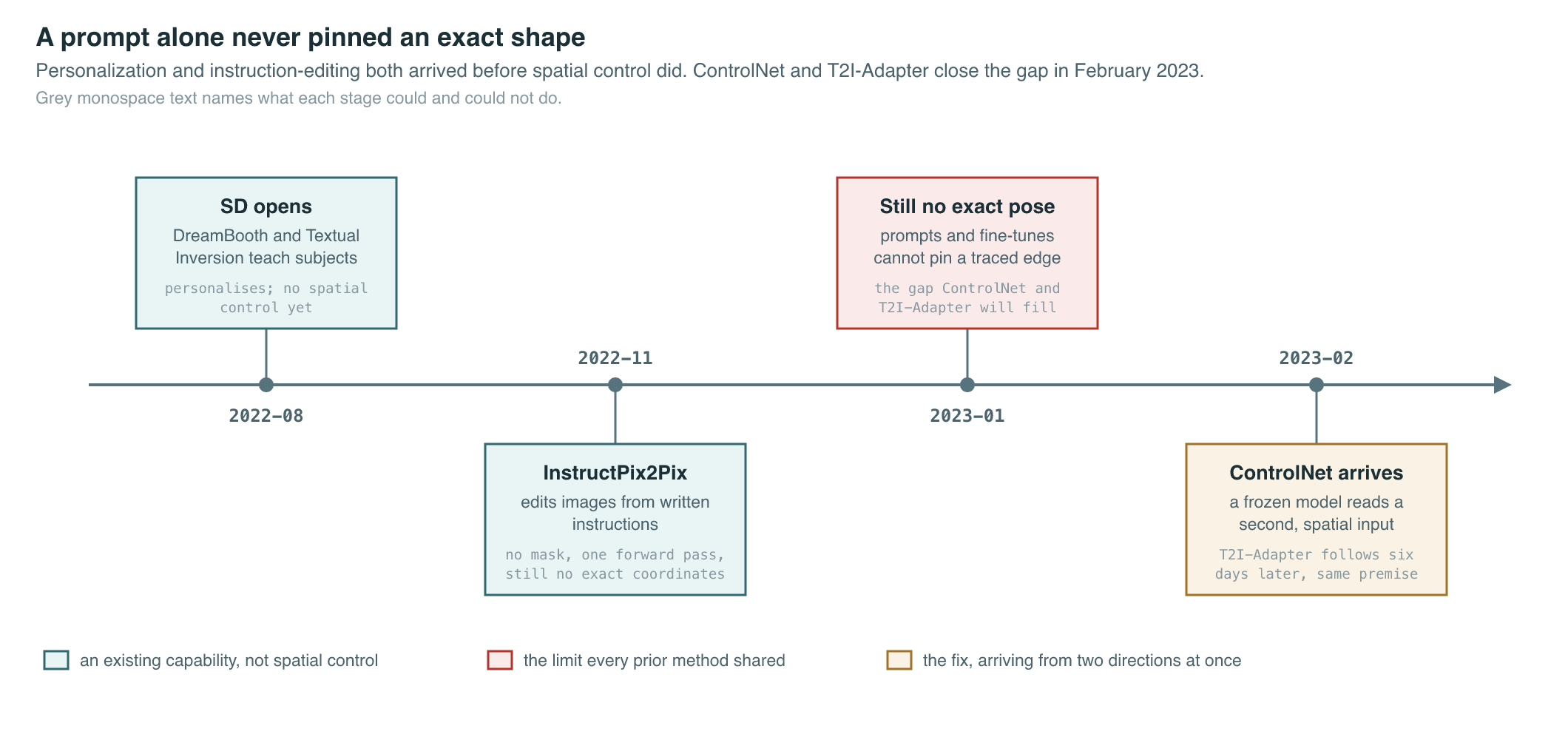
It is February 2023. Stable Diffusion has been public for six months, and a text prompt has proven to be a blunt instrument: it steers subject matter, style, and rough composition, but it cannot pin an exact pose, trace a specific building’s outline, or hand the model a reference face and ask for that face. Six days apart, two papers propose the same fix from different angles — freeze the pretrained model and teach something small to read a second, non-text signal — and by August a third extends the idea from spatial layout to reference imagery itself.
Where We Were
By early 2023, text-to-image diffusion had two proven ways to narrow a generation beyond what a prompt alone could specify, and both had a structural limit. The first was personalization: Textual Inversion and DreamBooth, both from August 2022 (Chapter 16 covers them in full), taught a model a new subject or style by fine-tuning on a handful of images of that one thing. This worked, but it produced a new set of weights — or a new embedding — per concept, and it answered a different question than “put this exact shape where I specify.” A model fine-tuned to recognize a particular dog does not thereby gain any way to place that dog in a pose traced from a reference photograph.
The second was training-free editing. SDEdit (Meng et al., August 2021) injects a starting image partway into the forward noising process and lets the reverse process denoise it back out, nudging a rough sketch toward a photorealistic image; InstructPix2Pix (November 2022) turns natural-language instructions into edits of an existing image. Both live in Chapter 17, which owns both methods in full. Neither gives a model a literal, pixel-aligned map to follow — SDEdit’s fidelity to the input degrades quickly as the amount of injected noise grows, and instruction-following edits describe a change in words rather than specify one in coordinates. Classifier-free guidance (Chapter 10) sharpens how strongly a model listens to its conditioning, but it cannot manufacture conditioning richer than a prompt in the first place, and the cross-attention conditioning mechanism Latent Diffusion built into the U-Net (Chapter 13) was designed for text tokens, not for a depth map or a pose skeleton.
What was missing was a general slot for a second, spatial or visual input — one that any pretrained text-to-image model could accept without a full retraining run for every new concept, and without the base model’s own weights being disturbed enough to risk the visual quality that run of pretraining had bought.
The Breakthrough
“Adding Conditional Control to Text-to-Image Diffusion Models” (Zhang, Rao & Agrawala, 2023), submitted February 10, 2023, calls its method ControlNet. The idea is to keep every weight of the pretrained diffusion model exactly as it is, clone the block that needs to see the new conditioning signal into a second, trainable copy, and connect the two through a purpose-built kind of layer. The locked copy keeps whatever the base model learned from its original training data; the trainable copy learns only how to fold a new condition — a Canny edge map, a depth map, a human-pose skeleton, a semantic segmentation mask, an M-LSD line map, an HED soft-edge map, or a raw user sketch — into that pathway.
The connector is what makes this trainable without wrecking the frozen model on day one. A “zero convolution” is an ordinary 1×1 convolution whose weight and bias are initialized to zero. At the very first training step, a zero convolution outputs exactly zero, so the trainable copy’s contribution to the network is nothing at all — the combined model behaves identically to the untouched base model. As training proceeds, the zero convolution’s weights move away from zero gradually, letting the conditioning signal in a little at a time rather than all at once with whatever random, untrained noise a normally initialized layer would inject. The paper reports that this produces a “sudden convergence phenomenon”: the model does not gradually improve at following the conditioning image so much as abruptly start succeeding, typically in under ten thousand optimization steps.
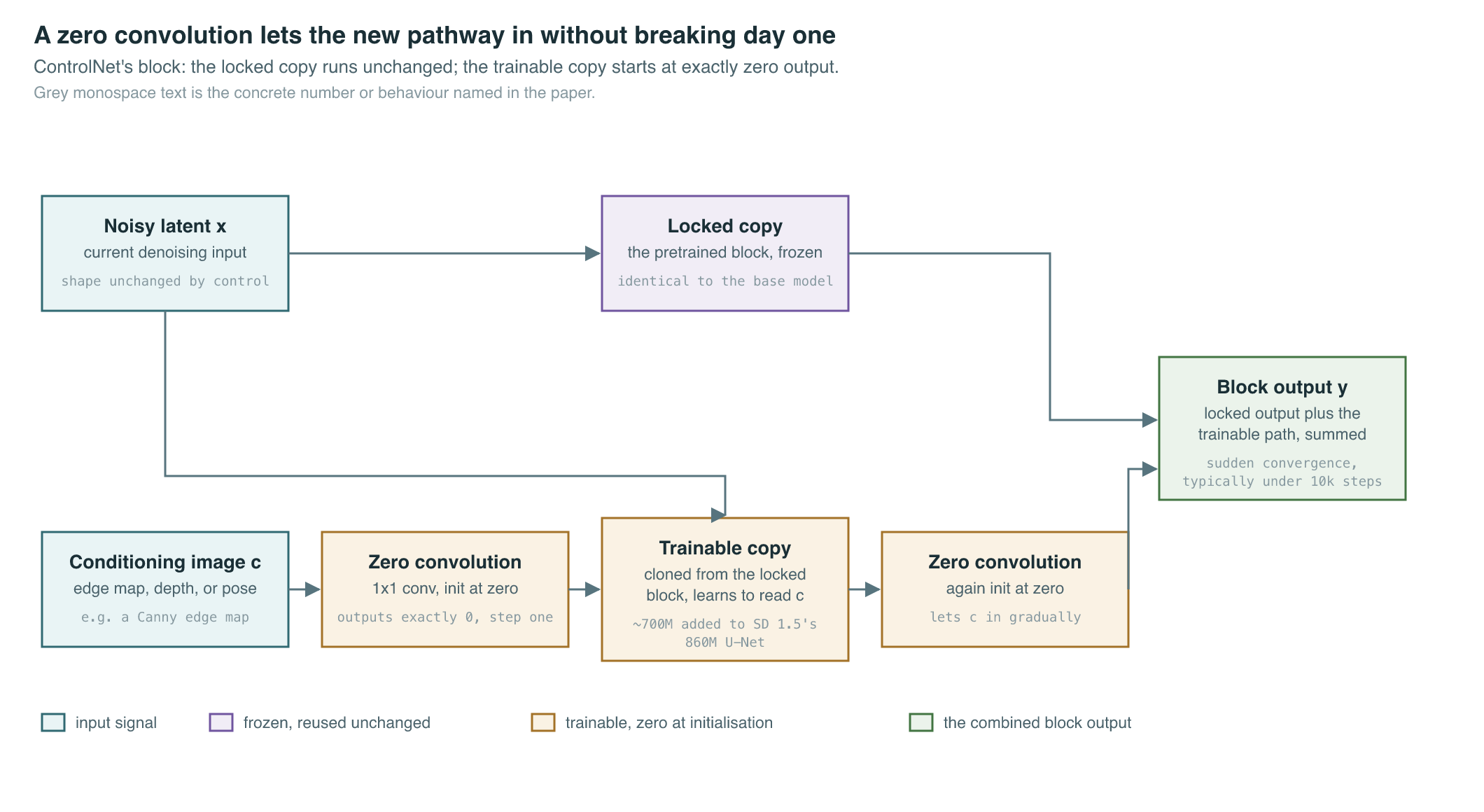
ControlNet’s trainable copy is a full duplicate of Stable Diffusion’s encoding blocks and middle block — a substantial amount of new capacity, and Hugging Face’s own accounting of a packaged ControlNet checkpoint puts the added weight at roughly 700 million parameters on top of Stable Diffusion 1.5’s own 860-million-parameter U-Net. That size bought reliability — a lighter “ControlNet-lite” ablation the paper also tested scored worse in its own user study — but it also meant every new condition doubled the memory and compute footprint of a large fraction of the base model.
“T2I-Adapter: Learning Adapters to Dig out More Controllable Ability for Text-to-Image Diffusion Models” (Mou et al., 2023), submitted six days later on February 16, 2023, takes the same starting premise — freeze the base model, learn something small — to a different architectural conclusion. Rather than cloning any part of the U-Net, T2I-Adapter is a separate, lightweight network that extracts features from the conditioning image at several resolutions and injects them into the frozen U-Net’s encoder at matching scales. The full adapter has around 77 million parameters and roughly 300 MB of storage; the paper also reports two compressed variants, an 18-million-parameter “adapter-small” and a 5-million-parameter “adapter-tiny,” trading some quality for a smaller footprint. Because nothing in the base U-Net is duplicated, several adapters trained independently — a sketch adapter and a color adapter, say, or depth and human pose together — can be combined at inference time by weighted summation of their injected features, without retraining either one, though the paper notes that balancing the combination weights when stacking adapters still needs manual tuning. T2I-Adapter’s training data was correspondingly modest: 164,000 images from COCO17 for the sketch adapter, 164,000 from COCO-Stuff for semantic segmentation, and 600,000 image-text pairs from LAION-Aesthetics for other conditions — a small fraction of the scale a from-scratch model would need, because the frozen base model still supplies everything about general image synthesis.
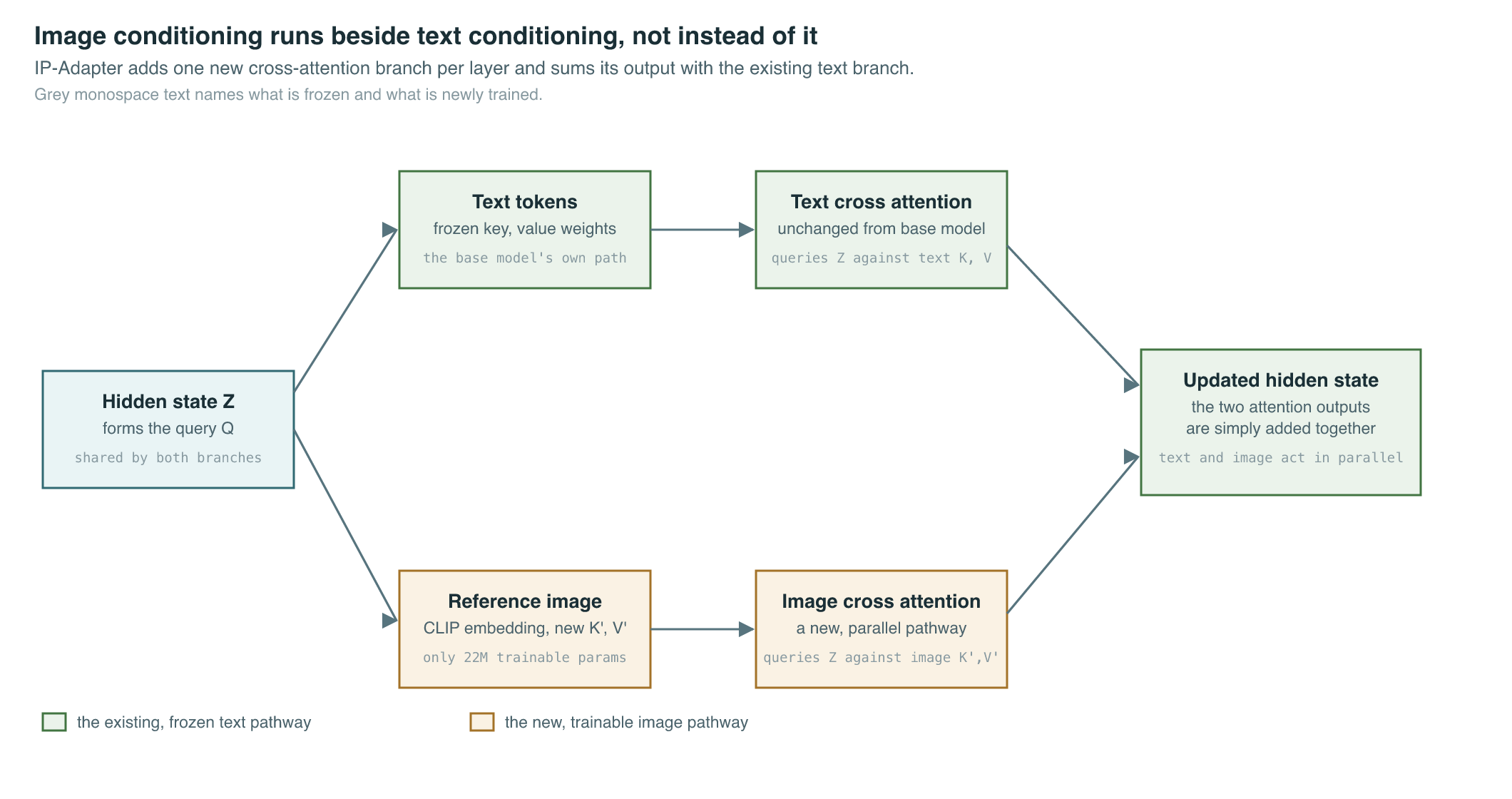
“IP-Adapter: Text Compatible Image Prompt Adapter for Text-to-Image Diffusion Models” (Ye et al., 2023), submitted August 13, 2023, changes what the second input is. ControlNet and T2I-Adapter both condition on spatial structure — a map that says where edges, depth discontinuities, or joints fall. IP-Adapter instead accepts a reference image and asks the model to draw on its content or style, the way a text prompt draws on a word’s meaning — “an image is worth a thousand words,” as the paper puts it, where prompt engineering struggles to describe a specific face, an exact texture, or a particular composition in words at all. Rather than cloning any part of the U-Net or building a separate feature-extraction network, IP-Adapter adds one new pair of projection matrices to every cross-attention layer already inside the frozen U-Net, so the reference image gets its own cross-attention pathway running in parallel with the existing text cross-attention, and the two are summed. The reference image itself is encoded with a frozen CLIP image encoder — the same contrastive embedding space Chapter 11 covers — so the new pathway has a well-defined, pretrained representation to attend over from the start rather than needing to learn one from raw pixels. Only those new projection matrices train; the paper reports 22 million trainable parameters in total, smaller than either prior method, trained on roughly 10 million image-text pairs drawn from LAION-2B and COYO-700M, on a single machine with eight V100 GPUs for one million steps at a batch size of eight per GPU.
The Mathematics
ControlNet’s core mechanism is the zero-convolution block itself. Given a frozen block from the pretrained network, a feature map , and a conditioning input , the block’s output is:
| Symbol | Meaning |
|---|---|
| the input feature map to this block | |
| the conditioning image, e.g. an edge map or pose skeleton | |
| the original pretrained block, kept frozen | |
| the frozen weights of the locked copy | |
| the trainable weights of the cloned copy, initialized from | |
| zero convolutions, weight and bias initialized to zero | |
| the block’s output once the trainable pathway is added |
Training itself uses the same denoising objective Chapter 8 establishes, extended with a second conditioning argument alongside the text prompt:
| Symbol | Meaning |
|---|---|
| the clean and noised latent at timestep | |
| the diffusion timestep | |
| the text conditioning, unchanged from the base model | |
| the new spatial conditioning image | |
| the true noise added by the forward process | |
| the network’s noise prediction, now a function of both conditions |
IP-Adapter’s decoupled cross-attention keeps the base model’s existing text cross-attention pathway untouched and runs a second one beside it for the reference image, then sums the two:
| Symbol | Meaning |
|---|---|
| the U-Net’s hidden state at this layer | |
| the text embedding, unchanged conditioning source | |
| the reference image’s CLIP embedding | |
| the frozen text cross-attention weights | |
| the new, trainable image cross-attention weights | |
| the combined output, text and image attention summed | |
| the key dimension, used to scale the dot product |
What It Enabled
ControlNet’s own user study, comparing sketch-conditioned generation against two prior approaches on a 20-sketch, 12-rater panel scored one to five, shows how large the gap to the previous state of the art was:
| Method | Quality (1–5) | Fidelity (1–5) |
|---|---|---|
| PITI | 1.10 ± 0.05 | 1.02 ± 0.01 |
| Sketch-Guided Diffusion, | 2.52 ± 0.44 | 3.28 ± 0.72 |
| ControlNet-lite (ablation) | 3.93 ± 0.59 | 4.09 ± 0.46 |
| ControlNet | 4.22 ± 0.43 | 4.28 ± 0.45 |
The same paper’s depth-conditioning comparison against Stable Diffusion v2’s own purpose-built depth-to-image model found raters correct only 0.52 ± 0.17 of the time at telling the two apart — indistinguishable from chance, despite ControlNet’s depth model being trained by a much smaller team on far less compute than an official model release.
The three methods this chapter covers do not simply compete; they occupy different points on a cost-versus-scope trade-off that the field kept using after 2023:
| ControlNet | T2I-Adapter | IP-Adapter | |
|---|---|---|---|
| Submitted | Feb 10, 2023 | Feb 16, 2023 | Aug 13, 2023 |
| Conditioning type | Spatial maps — edges, depth, pose, segmentation | Spatial maps — sketch, depth, keypose, segmentation | Reference image content and style |
| Mechanism | Cloned encoder blocks, zero convolutions | Separate lightweight feature-injection network | New cross-attention branch per layer |
| Base model modified | No — frozen; new copy runs alongside | No — frozen; adapter runs alongside | No — frozen; new weights only |
| Added trainable parameters | ≈ 700M added to SD 1.5’s 860M U-Net | ≈ 77M (18M / 5M compressed variants) | 22M |
| Training data | Per-condition, up to roughly 1M pairs | 164K–600K images per condition | ≈ 10M pairs, LAION-2B and COYO-700M |
| Composability | One ControlNet per condition, stackable | Multiple adapters, weighted-sum combination | Combines with text prompts and with ControlNet |
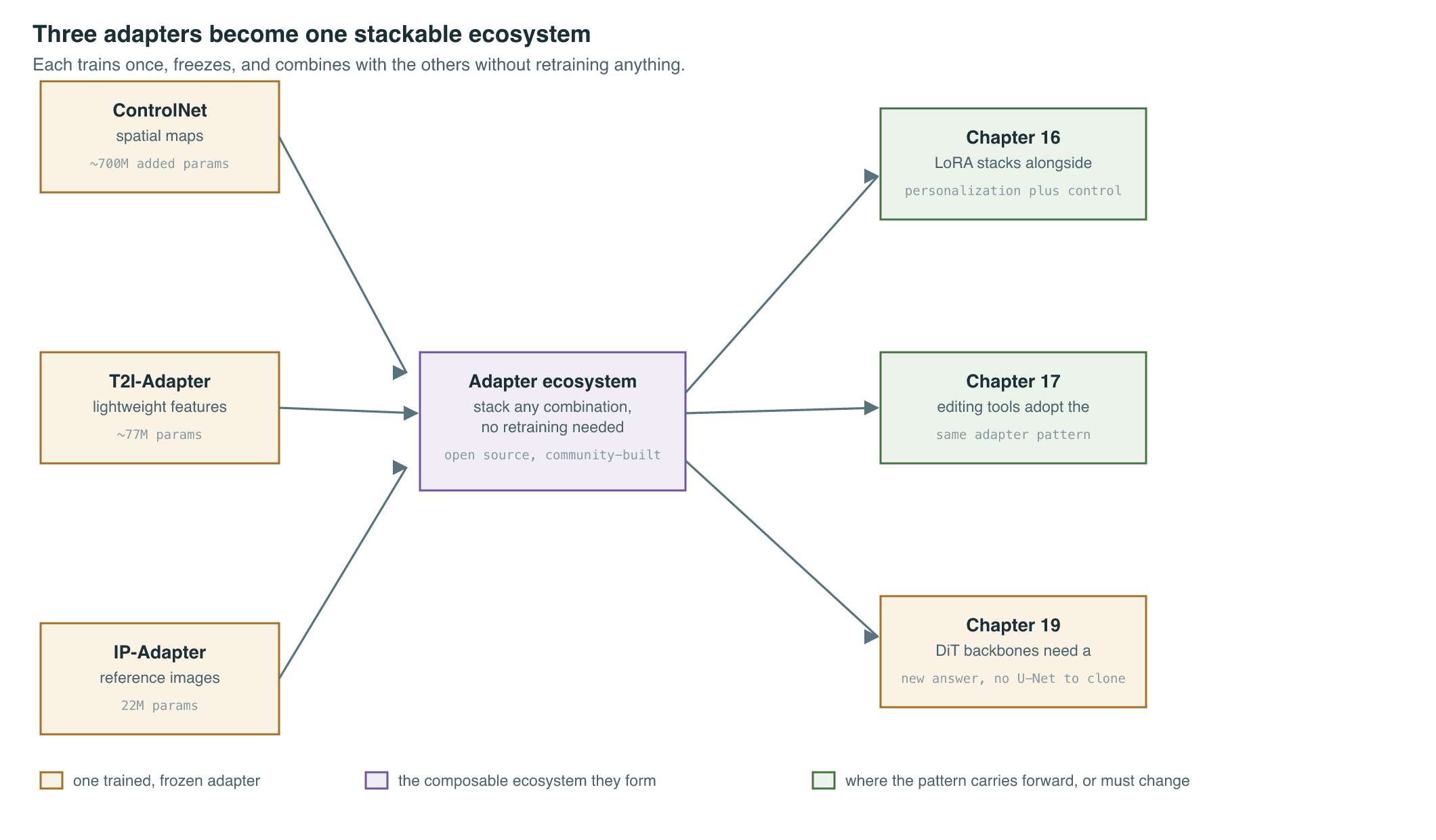
None of the three needed the base model’s own training data or the compute of the original Stable Diffusion run — a point that matters as much as the architecture. Because the pretrained weights never move, a single ControlNet or adapter, trained once, works with any fine-tune, merge, or style checkpoint sharing the same base architecture, and multiple adapters can run at once. That composability is what let downstream tooling — the open-source interfaces that grew up around Stable Diffusion through 2023 — treat “add a ControlNet” and “add an IP-Adapter” as generic, stackable operations rather than one-off integrations, in the same way Chapter 16’s LoRA fine-tunes became generic, stackable additions to a base checkpoint. A workflow combining a DreamBooth-trained subject, a LoRA style, a ControlNet pose map, and an IP-Adapter reference face — four separately trained, separately frozen additions layered on one base model — became a routine construction rather than a research result.
The limits were the ones already visible in the numbers above: a ControlNet checkpoint is heavier than the model it controls by nearly the size of the original U-Net, IP-Adapter’s reference-image conditioning competes with the text prompt for the model’s attention in ways that still need per-application tuning of a balance weight, and multi-adapter combinations inherited T2I-Adapter’s own caveat that stacking conditions well is a manual tuning problem, not something guaranteed by the architecture. Later diffusion-transformer backbones (Chapter 19) would need their own answer to the same question, since a zero-convolution block cloned from a U-Net does not transplant unchanged onto an architecture with no U-Net to clone.
Key Papers
| Paper | Authors | Year | Link | Why it matters |
|---|---|---|---|---|
| Adding Conditional Control to Text-to-Image Diffusion Models | Zhang, Rao & Agrawala | 2023 | arXiv:2302.05543 | Introduces ControlNet: locked and trainable copies connected by zero convolutions, letting a frozen diffusion model learn precise spatial conditioning without disturbing its pretrained weights |
| T2I-Adapter: Learning Adapters to Dig out More Controllable Ability for Text-to-Image Diffusion Models | Mou et al. | 2023 | arXiv:2302.08453 | Achieves comparable spatial control with a far smaller, separate adapter network and demonstrates composable, weighted-sum combination of multiple conditions |
| IP-Adapter: Text Compatible Image Prompt Adapter for Text-to-Image Diffusion Models | Ye et al. | 2023 | arXiv:2308.06721 | Extends adapter-based control from spatial maps to reference images via a decoupled cross-attention branch, with only 22M trainable parameters |
PM Lens
Papers referenced
- Adding Conditional Control to Text-to-Image Diffusion Models Zhang, Rao & Agrawala · 2023 · arXiv:2302.05543
- T2I-Adapter: Learning Adapters to Dig out More Controllable Ability for Text-to-Image Diffusion Models Mou et al. · 2023 · arXiv:2302.08453
- IP-Adapter: Text Compatible Image Prompt Adapter for Text-to-Image Diffusion Models Ye et al. · 2023 · arXiv:2308.06721