At 9:14 on a Tuesday morning a shopper types “waterproof hiking boots” into Google on an Android phone. An auction resolves in a few hundred milliseconds, ranking the eligible ads by bid, quality, and context, and a text ad lands above the organic results (Google Ads Help, About Ad Rank). She taps it. The landing URL now carries a parameter she will never notice: gclid, a click identifier Google Ads appends automatically so that any conversion she completes can be traced back to the exact auction that produced the visit (Google Ads Help, GCLID). Two hours later she reads a gear review on a news site. A display slot halfway down that page fills with a boot ad from the same retailer. Different transaction, different product, separate invoice. Google is on every side of both.
That is the subject of this book, and it is worth stating flatly before anything gets technical. Google builds the software advertisers use to buy advertising. Google builds the software publishers use to sell advertising. Google runs the exchange where those two groups meet. And Google is paid at more than one point along the path a single impression travels, from a bid to a rendered pixel to a conversion written back into a bidding model.
None of that is a secret. Google publishes the product names, the help documentation, and the revenue figures. What is genuinely hard to see is the shape: which product sits on which side, which fee applies where, and why two Google products that appear to measure the same conversion return different numbers. Twenty-five chapters from here you should be able to draw that shape from memory.
The Two Ledgers
Sort the products into the two groups they actually belong to and the business stops looking like a suite and starts looking like a market with a house dealer.
On the buy side: Google Ads, Display & Video 360, Search Ads 360, Campaign Manager 360, Google Analytics 4 and its paid tier Analytics 360, Merchant Center, Google Tag Manager, and Looker Studio. Each one helps somebody spend money on media, or tells them afterwards whether the money worked.
On the sell side: Google Ad Manager, AdSense, AdMob, and Google Ad Exchange, universally shortened to AdX. Each one helps somebody convert audience attention into revenue.
The brand architecture that makes this legible dates to 27 June 2018, when Google retired both the AdWords and DoubleClick names and replaced them with three brands: Google Ads for self-serve advertisers, Google Marketing Platform for enterprise advertisers, and Google Ad Manager for publishers (Google, Introducing simpler brands and solutions for advertisers and publishers). Read as marketing, that was a simplification exercise. Read as an org chart, it was a public disclosure of the two-sided structure, and The 2018 Rebrand as an Org Chart makes that case in detail.
| Buy side | Sell side | |
|---|---|---|
| Who logs in | advertiser, media agency, in-house performance team | publisher, app developer, retail media network |
| Core products | Google Ads, DV360, SA360, CM360, GA4 / Analytics 360, Merchant Center, GTM, Looker Studio | Google Ad Manager, AdSense, AdMob, AdX |
| Question being asked | what is this impression worth to me | what is this impression worth to someone else |
| Unit of work | campaign, insertion order, line item, keyword, asset group | ad unit, line item, price floor, deal ID |
| How Google earns | media spend flows through the platform; enterprise tiers carry a percentage-of-spend license | a take rate on each transaction cleared through the exchange |
| Measurement lineage | GA4 events, Floodlight activities | ad server delivery logs, exchange bid logs |
The last row is the one practitioners feel first. Floodlight, the conversion tag shared by CM360, DV360, and SA360, is a DoubleClick-lineage system (DV360 Help, About Floodlight). GA4’s event model descends from a different acquisition entirely. Two measurement systems, one purchase, two numbers. Join Keys: GCLID, Floodlight, and Attribution is the chapter where that stops being an annoyance and starts being the point.
Why Each Side Raises the Price of Leaving the Other
The two-sided structure is not a coincidence of acquisition history, although acquisition history is how it got assembled. It is a reinforcing loop, and the loop is the reason both halves keep growing.
Start on the demand side. Google Ads carries a long tail of advertisers no other platform reaches at that volume, because self-serve search advertising is where small businesses start. It also carries YouTube, which Display & Video 360 buys through dedicated “YouTube and partners” line items with inventory toggles no rival demand-side platform is given (DV360 Help, YouTube and partners line items). A publisher who wants that demand needs to be reachable by it.
Now flip to the supply side. Google Ad Manager, inherited from DoubleClick for Publishers, is the ad server of record for a large share of large web publishers. Its inventory scale is what makes Google Ads and DV360 unavoidable for buyers who want reach on the open web. So the buyer stays because of the inventory, and the seller stays because of the demand, and neither side’s decision is irrational.
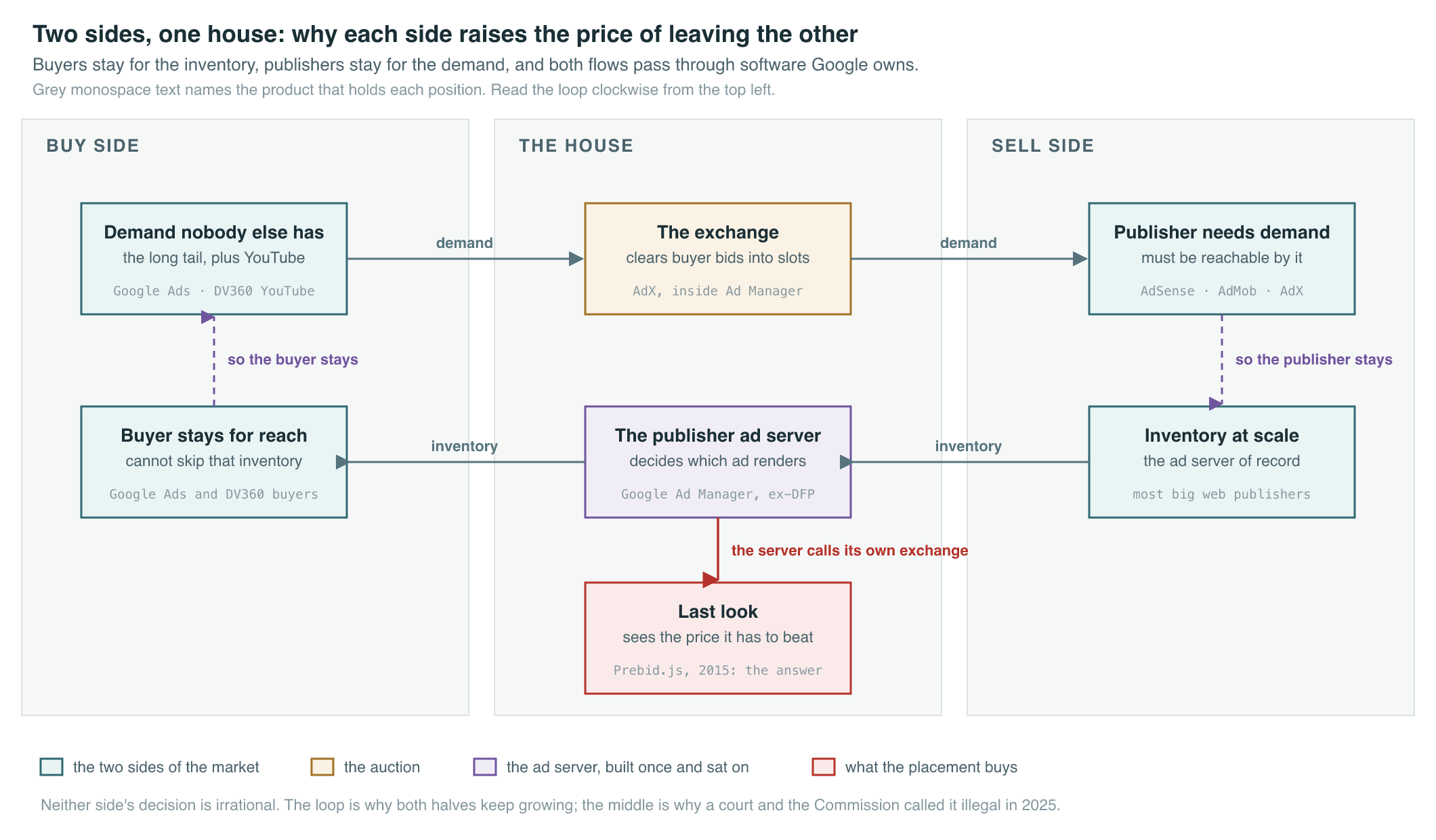
What makes the loop legally interesting is the middle. AdX did not merely compete for that inventory. It sat inside the publisher ad server, which meant it could see the price it had to beat before deciding what to bid, the arrangement the industry named “last look.” Header bidding, and specifically the Prebid.js library that appeared in 2015, existed because publishers wanted an auction that ran before the ad server call rather than inside it. The Last Look traces that fight from dynamic allocation through header bidding to Google’s 2019 concessions, because it is the single best-documented example of what owning both sides plus the auction actually buys.
The Fee at Every Layer
Scale first, so the rest of the book has a denominator. Google’s advertising revenue reached $294.7 billion in 2025, of which Search and other advertising accounted for $224.5 billion (Alphabet FY2025 annual report; Statista). The search half of that is a single-sided business: an advertiser pays Google, Google shows an ad on its own property, nobody else is in the transaction. The display and video half is where two-sidedness lives, and it is a smaller line item with a much larger legal footprint.
Follow one open-web impression and count the places money changes hands.
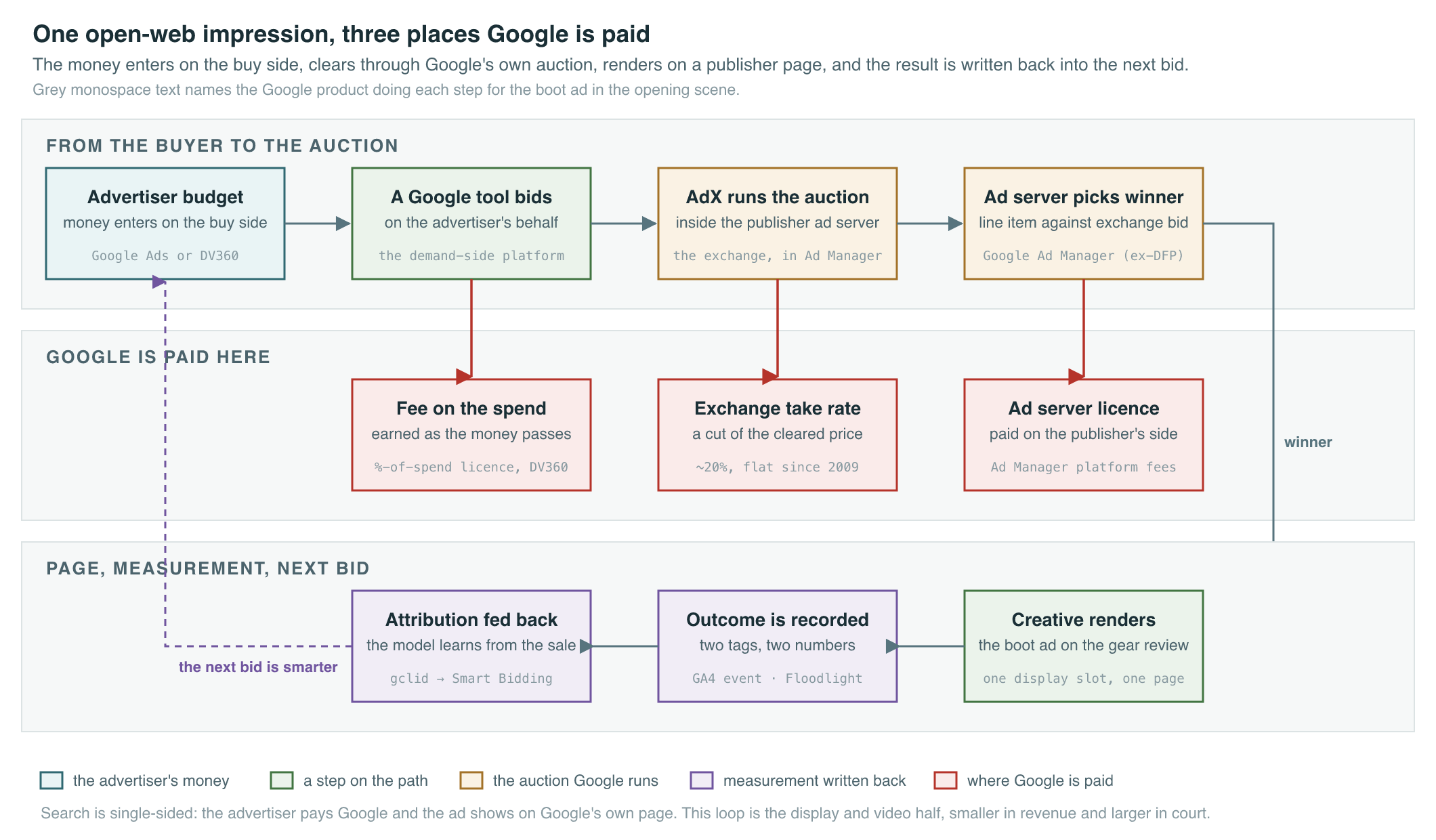
The demand-side platform earns on the spend passing through it. The exchange takes a percentage of the cleared price. The publisher ad server is a licensed product on the other end. Evidence presented in the United States Department of Justice ad tech case described AdX’s take rate as roughly 20 percent and essentially unchanged since 2009, at a time when independent exchanges charged materially less (AdExchanger, 2025: The Year Google Lost In Court And Won Anyway). A price that does not move for fifteen years is either a very stable market or a very stable position. The courts picked the second reading.
April 2025: A Court Puts a Name On It
On 17 April 2025, Judge Leonie Brinkema of the Eastern District of Virginia found that Google had illegally monopolized two markets, publisher ad servers and open-web ad exchanges, and had unlawfully tied AdX to DFP (Simpson Thacher, District Court Rules Google Is a Monopolist in Ad Tech). The ruling was not a clean sweep for the government. Brinkema rejected the DOJ’s proposed “advertiser ad networks” market as not cognizable, which is why the liability finding lands on the sell side and the buy side walked out clean (Courthouse News).
Five months later the European Commission reached a parallel conclusion by a different route. On 5 September 2025 it fined Google €2.95 billion under Case AT.40670 for self-preferencing AdX, including informing AdX in advance of the value of competitors’ best bids, and ordered Google to end the practice and address what the Commission called structural conflicts of interest (McDermott Will & Emery; CNBC).
Hold that against the origin. When the Federal Trade Commission closed its investigation of the DoubleClick acquisition on 20 December 2007, it did so on the finding that Google and DoubleClick “are not direct competitors in any relevant antitrust market” (FTC). That was accurate in 2007 and it is the hinge of the whole story. The two companies were complements, not competitors, and the theory of harm that eventually stuck was about vertical integration, not horizontal overlap. Remedies closes the book on what regulators are now proposing to do about a structure their predecessors waved through.
What Is Actually In This Book
Six parts follow this one, and each maps to a real seam in the stack rather than to a product catalogue.
Part II is measurement. It opens with The Death of the Session, on how Google Analytics 4 replaced twenty years of session-and-hit vocabulary with a flat event log, and what broke when it did.
Part III is paid search: The Auction That Ate Advertising follows one query from the 2002 pay-per-click auction to today’s machine-learned bid, where the mechanism barely changed but the identity of whoever chooses the bid did.
Part IV is the buy side, opening with The Acquisition That Bought a Filing Cabinet, because DoubleClick gave Google ad serving and not a bidder, and the bidder had to be purchased separately.
Part V is the sell side and the auction, which is where the antitrust record lives.
Part VI is the connective tissue: tags, feeds, and reporting, starting from the observation in The dataLayer Is a Message Bus that Google Tag Manager is closer to event-bus middleware than to a tag list.
Part VII is identity and regulation: click IDs, hashed first-party matching, consent as an API, and the remedies now in front of two courts.
The next chapter goes back to the beginning and asks a narrower question. If the stack were designed, it would not have two conversion-counting systems, two mobile ad businesses, and two ad servers. It was not designed. It was bought.
Key Sources
| Source | Author/Org | Year | Link | Why it matters |
|---|---|---|---|---|
| Introducing simpler brands and solutions for advertisers and publishers | 2018 | blog.google | The announcement that split the ad stack into three public brands along buy-side and sell-side lines | |
| About Ad Rank | Google Ads Help | 2026 | support.google.com | Google’s own statement of what enters the search auction, the opening scene’s mechanism |
| About click IDs and GCLID | Google Ads Help | 2026 | support.google.com | Documents the click identifier that makes advertiser-side attribution possible at all |
| About Floodlight | Google, DV360 Help | 2026 | support.google.com | Establishes that Google Marketing Platform runs a conversion system separate from GA4 |
| YouTube and partners line items | Google, DV360 Help | 2026 | support.google.com | Shows the demand-side asset no rival platform can buy the same way |
| FTC Closes Google/DoubleClick Investigation | US Federal Trade Commission | 2007 | ftc.gov | The clearance decision, and the “not direct competitors” finding the 2025 rulings had to work around |
| District Court Rules Google Is a Monopolist in Ad Tech | Simpson Thacher | 2025 | stblaw.com | Summarises the April 2025 liability finding on publisher ad servers and exchanges |
| Judge hands Google partial defeat in ad tech monopoly case | Courthouse News | 2025 | courthousenews.com | Records the rejected advertiser-side market, the reason the buy side escaped liability |
| European Commission fines Google €2.95 billion for self-preferencing | McDermott Will & Emery | 2025 | mwe.com | The parallel EU finding under Case AT.40670, framed around structural conflicts of interest |
| 2025: The Year Google Lost In Court And Won Anyway | AdExchanger | 2025 | adexchanger.com | Industry account of the trial record, including the flat AdX take rate argument |
| Alphabet FY2025 Annual Report | Alphabet Inc. | 2026 | sec.gov | The revenue split that sizes the single-sided search business against the two-sided display business |
PM Lens
Papers referenced
- Introducing simpler brands and solutions for advertisers and publishers Google · 2018
- About Ad Rank Google Ads Help · 2026
- About click IDs and GCLID Google Ads Help · 2026
- About Floodlight Google, Display & Video 360 Help · 2026
- YouTube and partners line items Google, Display & Video 360 Help · 2026
- Federal Trade Commission Closes Google/DoubleClick Investigation US Federal Trade Commission · 2007
- District Court Rules Google Is a Monopolist in Ad Tech Simpson Thacher & Bartlett · 2025
- Judge hands Google partial defeat in ad tech monopoly case Courthouse News Service · 2025
- The saga continues: European Commission fines Google €2.95 billion for self-preferencing McDermott Will & Emery · 2025
- 2025: The Year Google Lost In Court And Won Anyway AdExchanger · 2025
- Alphabet FY2025 Annual Report Alphabet Inc. · 2026