A publisher who signed up for the DoubleClick Ad Exchange in 2009 gave Google 20% of the revenue from every open auction impression it sold. A publisher who checked the same line on a statement in 2024 gave Google 20%. Fifteen years, three brand names, one financial crisis, the entire arrival of header bidding, the launch of at least a dozen competing exchanges, the rise and collapse of the Privacy Sandbox, and the number did not move (Big Tech on Trial, 2024).
Most antitrust arguments are arguments about intent. They require reading internal email and deciding what a product manager meant. This one does not. A price that holds flat for fifteen years in a market that added competitors the entire time is a measurement, and it is the cleanest single piece of evidence in the case against Google’s ad exchange.
Prices Are Supposed to Fall in a Contested Market
The ordinary behavior of an intermediary fee under competition is decay. New entrants undercut. Incumbents match or lose volume. Buyers and sellers get better at measuring the fee and start routing around it. This is not a theoretical prediction, it is what happened to almost every other layer of programmatic advertising over the same period. Supply-side platform fees, demand-side platform fees, and data fees all came under sustained public pressure, and the vocabulary of the trade acquired terms like supply path optimization and fee transparency precisely because buyers started treating intermediary margin as a variable to minimize.
AdX did not participate in that decay. Trial evidence in the DOJ case put the average take rate of third-party exchanges over 2018 to 2022 well below AdX’s 20%, meaning Google was charging a premium to a market it also dominated (Big Tech on Trial, 2024). Rival exchanges were not charging less because they were more efficient. They were charging less because they had to.
The share figures explain why AdX did not have to. Judge Brinkema’s April 2025 liability opinion found that Google’s tying of DFP to AdX helped it achieve and hold roughly 91% share of the publisher ad server market for open-web display (PPC Land, 2025). A publisher shopping for a cheaper exchange still had to run the ad server that AdX was native to, and the mechanic described in The Last Look meant the cheaper exchange bid at a structural disadvantage inside it. The 20% was not the price of an exchange. It was the price of the position the exchange occupied.
Google Considered 15% and Decided Against It
The most damaging detail is not that the fee stayed flat. It is that Google looked at cutting it and chose not to.
Internal analysis discussed at trial contemplated reducing the AdX fee from 20% to 15%, with the stated reasoning that this would better align the price with the value delivered and make AdX more price competitive. Google did not make the change (Big Tech on Trial, 2024). A firm under competitive pressure that concludes its price exceeds its value cuts the price. A firm that concludes its price exceeds its value and keeps the price is telling you, in writing, that it does not expect to lose the customer.
Discounting practice pointed the same way. A 2017 internal document surfaced at trial indicated that of 3,815 publishers running open auctions, 13 received any discounted revenue share at all, at an average of 19.8% (Big Tech on Trial, 2024). That is not a negotiated market with a posted rate and quiet exceptions. It is a posted rate with rounding error. Publisher witnesses at trial made the practical version of the point repeatedly: they disliked the fee, they said so, and they kept paying it because the alternative cost more in lost revenue than the fee did (Marketing Brew, 2024).
| Signal | What the record shows | What it implies |
|---|---|---|
| AdX open auction take rate | roughly 20% from 2009 through the trial period | no competitive pressure reached the price |
| Third-party exchange take rates | materially below 20% across 2018 to 2022 | rivals competed on fee, AdX did not need to |
| Internal proposal to cut to 15% | considered, not implemented | Google priced above its own value estimate and expected to keep volume |
| Discounting, 2017 snapshot | 13 of 3,815 open auction publishers discounted, averaging 19.8% | the rate was effectively non-negotiable |
| Publisher ad server share | roughly 91% for open-web display, per the 2025 liability opinion | switching the exchange did not escape the ad server |
Why Nobody Left
The obvious objection to all of this is that a 20% fee only persists if customers accept it, and publishers are not naive. They ran the numbers constantly. The reason they stayed is that the fee and the switching cost were not comparable quantities.
Moving an exchange is a configuration change. Moving an ad server is a migration. An enterprise publisher’s ad server holds every direct-sold contract, every creative, every targeting key-value pair, every delivery forecast, and the reporting history that the sales team’s commission is calculated from. Trafficking workflows, tag implementations across every template, and third-party verification integrations all sit on top of it. A migration puts guaranteed revenue at risk for a quarter, in exchange for uncertain programmatic upside. Publisher testimony at trial repeatedly described this arithmetic rather than any affection for the product (Marketing Brew, 2024).
That is also why the DOJ’s remedy proposals target switching costs directly, including open-sourcing the ad server’s final auction logic so that a competitor could reproduce the behaviour publishers have tuned against (Public Knowledge, 2025). A fee only becomes contestable when leaving becomes cheap. Until then, the fee is not a price in the ordinary sense. It is a toll.
One measurement caveat belongs here, because sloppy versions of this argument invite an easy rebuttal. The 20% is the AdX revenue share on open auction impressions. It is not the total Google takes from the path between an advertiser’s budget and a publisher’s payout, which also includes whatever the buying tool retains on the demand side, and it is not the rate on every transaction type, since programmatic guaranteed and preferred deals carry different terms. The relevant comparison is therefore like for like: AdX’s open auction take rate against rival exchanges’ open auction take rates, over the same years, on comparable inventory. That comparison is the one trial evidence made, and AdX lost it while winning the market anyway.
The Fee Sat Inside a Name That Had Been Used Before
Anyone researching this history runs into a naming problem within about ten minutes, and it is worth clearing up because it corrupts a lot of secondary writing about the take rate.
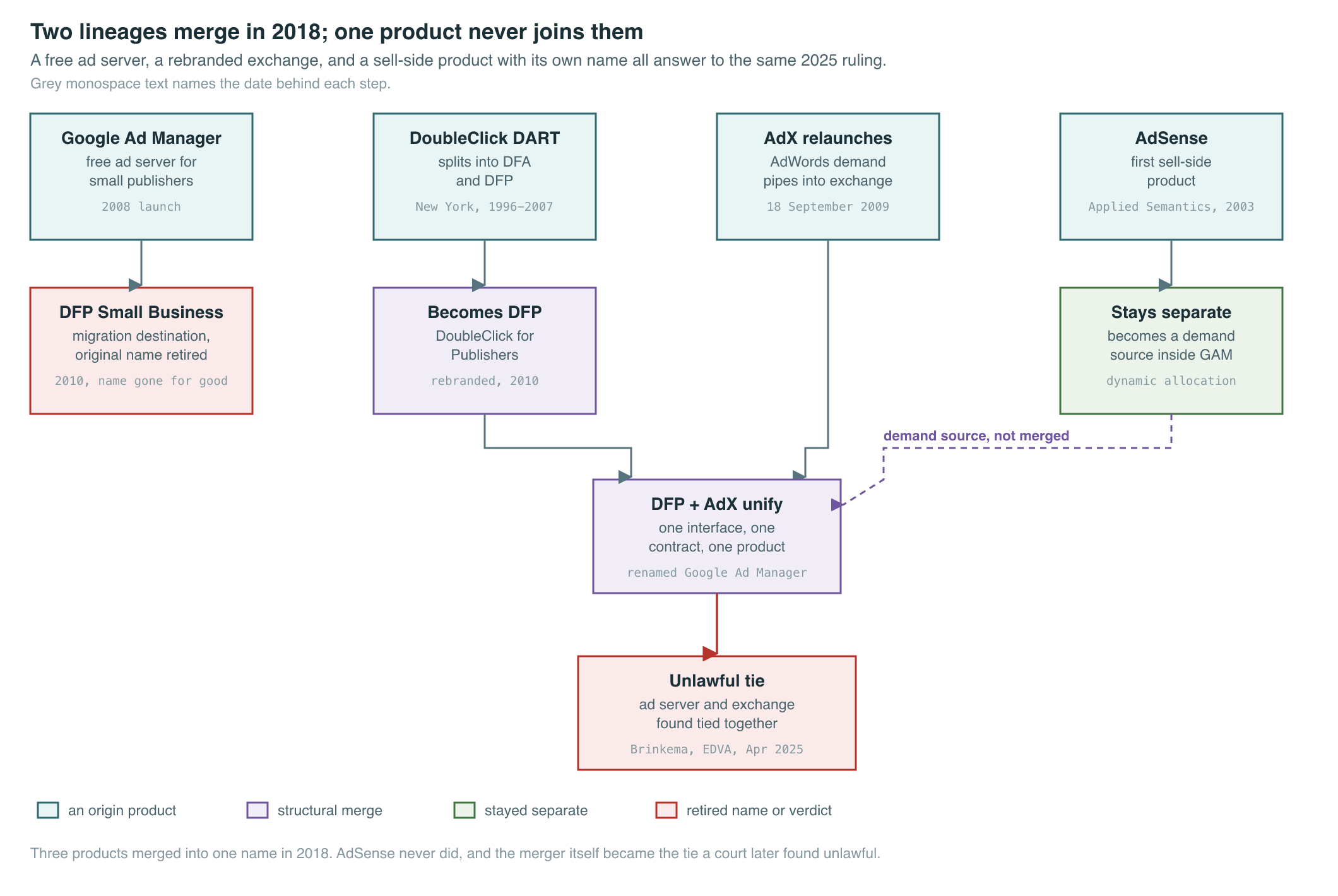
“Google Ad Manager” is a reused name. In 2008, Google launched a free, hosted ad server aimed at small publishers under that name. It had nothing to do with the DoubleClick stack, no exchange attached, and no relationship to the 20% fee. In 2010, when DART was rebranded DoubleClick for Publishers, those Google Ad Manager publishers were migrated into a free tier called DFP Small Business, and the original name was retired (DoubleClick Publisher Blog, 2010).
Eight years later Google used the name again for something entirely different. On June 27, 2018, Google retired the AdWords and DoubleClick brands and introduced three replacements: Google Ads, Google Marketing Platform, and Google Ad Manager (Google, 2018). The new Google Ad Manager was DFP and AdX brought together as one product (DoubleClick Publisher Blog, 2018). So a 2009 sentence about “Google Ad Manager” and a 2019 sentence about “Google Ad Manager” refer to unrelated products with different customers, different capabilities, and different economics (Wikipedia).
The 2018 rebrand also did something more consequential than renaming. It merged the ad server and the exchange into a single product surface, with one interface, one contract, and one support relationship. That is the arrangement Brinkema later found to be an unlawful tie. The brand consolidation and the tying claim describe the same event from two directions.
What Did Not Merge in 2018: AdSense
The most common error in this history is the claim that AdSense was folded into Google Ad Manager in 2018. It was not.
AdSense remained a separate product with its own interface, its own publisher base, and its own terms, and it still is. Its relationship to Ad Manager is as a demand source. A publisher running Ad Manager can enable AdSense to compete for unsold inventory through dynamic allocation, the same mechanic that lets AdX bid against remnant line items, and the setting appears in Ad Manager as an option rather than as a merged capability (AdPushup). AdSense and AdX draw on overlapping but distinct demand, and in some configurations enabling one requires turning the other off. Google documents the account linking that connects the two products, which is not the shape of a merger (Google Ad Manager Help).
The tier structure matters here too, because it determines who actually pays the 20%. The free tier of Ad Manager generally does not include AdX access. A small publisher on it gets AdSense demand and can run header bidding, but does not get Open Bidding or the exchange. AdX access comes with Ad Manager 360, the enterprise tier. That is why “the AdX take rate” is a statement about professional publishers with real inventory, not about the long tail, and why the long tail’s experience of Google’s publisher products is often described in terms of AdSense payouts rather than exchange fees.
Why the Flat Fee Is the Strongest Fact in the Case
Everything else in the litigation requires interpretation. Whether dynamic allocation was yield optimization or self-preferencing depends on which purpose you credit. Whether unified pricing rules simplified floor management or disarmed publishers depends on whose account of publisher intent you accept. Whether an internal project name was aggressive product work or manipulation is exactly the fight described in What Google Gave Back, and When.
The take rate does not require any of that. It is a posted price, held for fifteen years, in a product whose own internal analysis said the price was above the value delivered, sold into a market where the seller held roughly nine out of ten ad servers. There is no intent question to resolve, because the price is the behavior. Whatever else the record shows about how Google’s exchange competed, it never had to compete on what it charged.
That is also the reason the European Commission and the DOJ arrived at overlapping theories from different legal traditions. A flat monopoly rent is legible to any competition regime, and both proceedings treated it as the economic consequence that the conduct findings were about. The remedy question, which is whether a fee like that can be brought down by conduct rules or only by separating the exchange from the ad server, is taken up in Remedies.
Key Sources
| Source | Author/Org | Year | Link | Why it matters |
|---|---|---|---|---|
| Google Knows Its Ad Exchange Isn’t Worth its 20% Fee, but Refuses to Lower It | Big Tech on Trial | 2024 | article | Trial-evidence account of the flat 20%, the rejected 15% proposal, and the 2017 discounting snapshot |
| DOJ vs. Google, Day Five Rewind: Unfair Rev Share | AdExchanger | 2024 | article | Contemporaneous trial coverage of the revenue-share testimony |
| Google’s AdX takes center stage again as antitrust trial nears end of second week | Marketing Brew | 2024 | article | Publisher testimony on paying a disliked fee because switching cost more |
| Court rules Google monopolized digital ad tech markets | PPC Land | 2025 | article | Source for the roughly 91% publisher ad server share finding |
| How DOJ’s Proposed Ad Tech Remedies Could Do What the Court Would Not | Public Knowledge | 2025 | analysis | Frames switching costs as the reason a monopoly fee persists and the target a remedy has to hit |
| Introducing DFP Small Business | DoubleClick Publisher Blog | 2010 | blog | Documents the migration that retired the original 2008 Google Ad Manager name |
| Introducing simpler brands and solutions for advertisers and publishers | 2018 | blog | The June 2018 rebrand announcement that reused the Google Ad Manager name | |
| Introducing Google Ad Manager | DoubleClick Publisher Blog | 2018 | blog | States plainly that the new product is DFP and AdX unified, and nothing else |
| Google Ad Manager | Wikipedia | current | entry | Useful for disentangling the two separate uses of the same product name |
| Can AdSense and AdX Run Together in Ad Manager? | AdPushup | current | article | Explains AdSense as a distinct demand source inside GAM, not a merged product |
| About Linked accounts and MCM setup options | Google Ad Manager Help | current | help | Google’s own documentation of account linking between separate products |
PM Lens
Papers referenced
- Google Knows Its Ad Exchange Isn't Worth its 20% Fee, but Refuses to Lower It Big Tech on Trial · 2024
- DOJ vs. Google, Day Five Rewind: Prebid Reality Check, Unfair Rev Share And Jedi Blue (Sorta) AdExchanger · 2024
- Google's AdX takes center stage again as antitrust trial nears end of second week Marketing Brew · 2024
- Court rules Google monopolized digital ad tech markets PPC Land · 2025
- How DOJ's Proposed Ad Tech Remedies Could Do What the Court Would Not in Online Search Public Knowledge · 2025
- Introducing DFP Small Business DoubleClick Publisher Blog · 2010
- Introducing simpler brands and solutions for advertisers and publishers Google · 2018
- Introducing Google Ad Manager DoubleClick Publisher Blog · 2018
- Google Ad Manager Wikipedia · 2025
- Can AdX Run and AdSense Together in Ad Manager? AdPushup · 2024
- About Linked accounts and MCM setup options Google Ad Manager Help · 2025