Between February and April 2024, Google switched off the platform that enterprise search teams had been running their accounts on since the DoubleClick era. Legacy Search Ads 360 went dark in stages, and every advertiser on it had to be on the rebuilt version by the time their stage arrived (Google blog). For a retailer with four search engines, six markets and a few hundred thousand products under management, that migration was a multi-quarter programme with a Floodlight retagging project inside it. The interesting question is not whether the migration was painful. It is what the thing being migrated is still for.
A Layer Above the Engines
Search Ads 360 is not a place to buy search ads. It is a place to manage the places where you buy search ads.
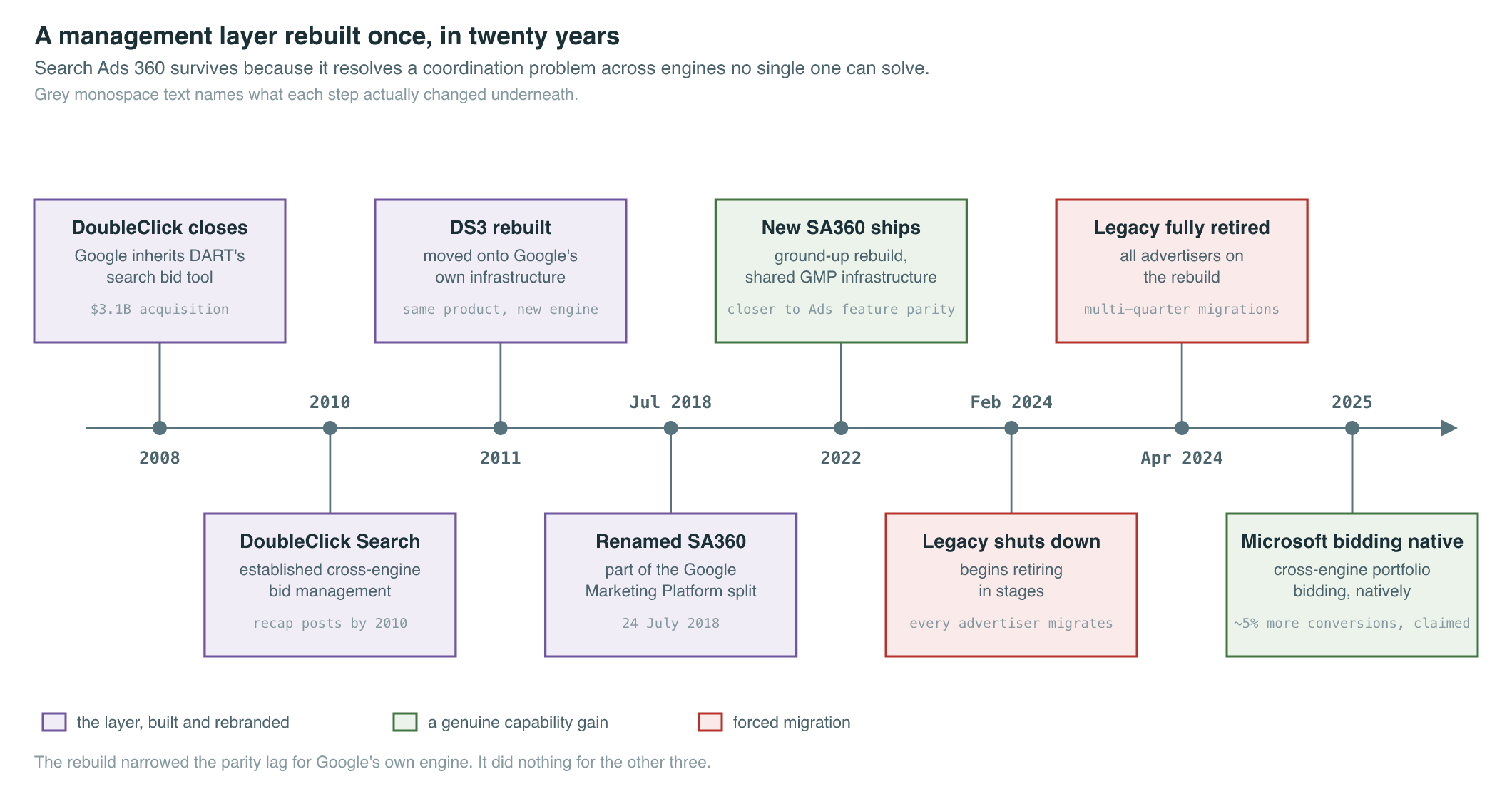
Its lineage runs back to DoubleClick Search, a cross-engine bid-management product Google built and operated on the DoubleClick brand it acquired in 2008. DoubleClick Search was already an established platform by 2010, when Google was publishing yearly recap posts on its feature additions (DoubleClick Advertiser Blog, 2010), and it was substantially rebuilt again in 2011 as “DS3” on Google’s own infrastructure (MediaPost). On 24 July 2018 it was renamed Search Ads 360 as part of the Google Marketing Platform consolidation, the same rebrand that turned AdWords into Google Ads and folded DoubleClick for Publishers and Ad Exchange into Google Ad Manager (Search Engine Land).
The distinction that justifies its existence is narrow and real. Google Ads manages Google inventory. Search Ads 360 manages Google Ads, Microsoft Advertising, Yahoo! Japan and Baidu from one account structure, with one reporting model and one set of bid strategies applied across all of them (XPON). If your business runs meaningful search spend in Japan or China, or if Microsoft Advertising carries enough volume in your category to matter, you have a coordination problem that no single engine’s interface can solve. Search Ads 360 is the answer to that coordination problem, and for a long time bidding was the sharpest edge of it.
The Rebuild and the Forced March
The version of Search Ads 360 running today is not an evolution of DoubleClick Search. It is a ground-up rebuild, shipped in early 2022 and referred to internally and in the documentation as “new SA360.” Google ran the two platforms in parallel for roughly two years, then retired the legacy one across February to April 2024 (Google blog).
A rewrite of that scale is worth reading as a signal. Google did not modernize the DoubleClick Search codebase. It rebuilt the product on the same infrastructure and data model as the rest of Google Marketing Platform, which is what allowed the newer version to support current Google Ads campaign types, including Performance Max, close to feature parity rather than months behind.
That parity problem is chronic for any management layer. A layer above an engine can only expose what the engine’s API exposes, on the engine’s schedule. Every time Google Ads ships a new campaign type or reporting dimension, Search Ads 360 is briefly a worse place to manage Google Ads than Google Ads is. Rebuilding on shared infrastructure narrows that lag for Google’s own engine. It does nothing for the other three.
The migration itself is instructive about what the layer really contains. Moving an advertiser from legacy Search Ads 360 to the rebuild was not a data export. Floodlight configurations had to be reviewed and in many cases retagged, bid strategies had to be re-established and given time to relearn, business data tables and formula columns had to be rebuilt against a changed schema, and every automated rule and scheduled report had to be recreated. Enterprises budgeted quarters for it and ran the two platforms side by side while conversion counts reconciled. That is not the profile of a bidding tool. It is the profile of a system of record, and systems of record are hard to leave for reasons that have nothing to do with how good their algorithms are.
Cross-Engine Portfolio Bidding
The capability that no engine can copy is portfolio bidding across engines. A Search Ads 360 bid strategy can hold a single target cost per acquisition or target return on ad spend and allocate budget across Google Ads, Microsoft Advertising and the others to hit it, rather than optimizing each engine against its own separate goal. Google’s published claim is roughly 5% more conversions or conversion value compared with optimizing engines independently (SA360 Help).
The mechanism is easy to state. If Microsoft is delivering conversions at $22 and Google at $31 against a $28 target, an independent optimizer leaves both at target and stops. A portfolio optimizer moves spend toward the cheaper engine until the marginal cost converges. That arbitrage only exists if something can see and act on both engines at once.
Search Ads 360 has also gone further into the other engines rather than retreating from them. It now supports Microsoft Advertising’s own automated bidding strategies natively, meaning an advertiser can run Microsoft’s algorithms from inside a Google-owned management layer (Search Engine Land). That is an unusual thing for Google to build, and it is a reasonable indicator of where Google thinks the product’s remaining value sits: not in out-bidding the engines, but in being the single console that operates them.
| Google Ads | Search Ads 360 | |
|---|---|---|
| Engines managed | Google only | Google Ads, Microsoft Advertising, Yahoo! Japan, Baidu |
| Bid optimization scope | within Google inventory | portfolio strategies spanning engines |
| Conversion measurement | Google Ads conversion tracking | Floodlight, shared with CM360 and DV360 |
| Campaign generation | manual, plus feed-driven campaign types | inventory templates from product or location feeds |
| Reporting model | account, campaign, ad group | business data tables, formula columns, cross-engine rollups |
| Cost | free to use, you pay for media | media-percentage licence on top of media |
| Feature lag on new Google Ads types | none | some, narrowed by the 2022 rebuild |
Floodlight Is the Quieter Moat
Ask a Search Ads 360 customer why they cannot leave, and bid strategies are rarely the first answer. Floodlight is.
Floodlight is the conversion tagging system shared across Search Ads 360, Campaign Manager 360 and Display & Video 360 (SA360 Help). One tag deployment, one conversion definition, one set of numbers across search, display and video. For an organization that buys all three, that shared definition is the only thing standing between the media team and three mutually contradictory conversion counts in the same quarterly review. The identity plumbing that makes those counts join up at all, from click identifiers through to hashed first-party matching, is worked through in Join Keys: GCLID, Floodlight and Attribution.
Around that core sit the operational features that enterprise teams actually spend their days in. Inventory templates auto-generate campaigns, ad groups, keywords and ads from a product or location feed, which is how a retailer covers a six-figure SKU count or a franchise brand covers two thousand store locations without hand-building anything. Business data tables let you join your own attributes, margin, stock level, store region, into reporting and bid rules. Formula columns compute derived metrics across engines. Performance Center handles budget planning and forecasting against those goals.
None of this is glamorous. All of it is expensive to replace. The switching cost of Search Ads 360 is not the bid algorithm, it is the accumulated configuration.
The bill is correspondingly serious. Licensing is typically a percentage of media spend, Floodlight retagging is mandatory rather than optional, and the operational learning curve is steep enough to be a staffing decision rather than a training one (e-CENS). The customer base reflects that: enterprise in-house teams and holding-company agencies, concentrated in retail, travel and finance, usually already invested in Campaign Manager 360, Display & Video 360 or Analytics 360.
What Is Left When the Engine Bids for You
Here is the tension the whole product now sits on.
Search Ads 360’s founding value proposition was that it bid better than you could, across more engines than any one engine could see. That proposition assumed bids were the lever. For most of the platform’s history they were: an advertiser set keyword-level bids, and a smarter algorithm setting those bids was worth real money.
That assumption has been dismantled inside Google Ads itself. Smart Bidding sets bids at auction time. Performance Max removed the ad group. AI Max removed the keyword list as a boundary. The advertiser-facing input is now a target and a budget. A management layer whose distinctive skill is bid setting is a layer built for a control surface that no longer exists in the form it was built for.
Three things survive that shift, and they are worth naming precisely.
Cross-engine parity survives, and it may strengthen. Microsoft, Baidu and Yahoo! Japan are not going to be optimized by Google’s models. Somebody has to hold the goal across all of them, and no engine will ever do that for a competitor.
Measurement and governance survive, and they arguably matter more now than they did. When the buying platform decides channel, query, creative and bid, an independent conversion definition and an independent reporting layer stop being a convenience and start being the only audit you have. That argument is directly downstream of the reporting gaps in Performance Max, and it is one of the few genuinely strong reasons a large advertiser has to keep a layer between itself and Google Ads.
Operational scale survives. Feed-driven campaign generation, business data joins and budget planning across dozens of accounts are workflow problems, and workflow problems do not get solved by better bidding models.
The build-versus-buy calculation shifts accordingly, and it is worth being blunt about where the line falls. An advertiser with one engine, one market and a competent analyst does not need this layer, and paying a percentage of media for it is a straightforward loss. An advertiser with four engines, a Floodlight estate already deployed across Campaign Manager 360 and Display & Video 360, and a finance function that reconciles media spend to revenue quarterly is not really buying bid management at all. They are buying a single conversion definition and a single console, and the alternative is a data engineering team building the same thing on top of four APIs. That team is not cheaper, and it does not come with a support contract. The uncomfortable middle case is the advertiser with two engines and ambitions, where the licence fee is real money and the cross-engine benefit is a rounding error, and that is where most of the churn in this category has always been.
What does not obviously survive is the category’s original pitch. The consolidation pressure is real, and it points the same direction as everything else in this book: Google’s first-party ingestion is converging on a single pipe, with offline conversion imports and enhanced conversions for leads moving to the Data Manager API from 15 June 2026 and being blocked in the Google Ads API after that date (Google Ads API docs). Every consolidation of that kind makes the surrounding tool layer thinner.
The honest answer is that the management layer survives, but as a different product than the one that was built. It becomes a measurement, governance and multi-engine coordination product that happens to retain bidding features, rather than a bidding product with reporting attached. That is a smaller business than search management was in 2012, and it is a strange one to buy from Google, because the layer’s most defensible remaining function is holding the auctioneer accountable. Which is the structural problem this book opened with, showing up one level higher in the stack: One Company, Both Sides of the Table.
Key Sources
| Source | Author/Org | Year | Link | Why it matters |
|---|---|---|---|---|
| Scheduling your upgrade to the new Search Ads 360 | 2023 | blog post | Primary source for the 2022 rebuild and the February to April 2024 legacy shutdown | |
| Google is retiring the AdWords and DoubleClick brands | Search Engine Land | 2018 | article | Dates the DoubleClick Search to Search Ads 360 rename under Google Marketing Platform |
| DoubleClick Search 2010 Recap | DoubleClick Advertiser Blog | 2010 | blog post | Confirms DoubleClick Search was an established platform by 2010, not a claim invented for this chapter |
| Google Rebuilds DoubleClick Search | MediaPost | 2011 | article | Documents the 2011 “DS3” rebuild onto Google’s own infrastructure |
| Search Ads 360 guide | XPON | 2024 | guide | Documents the engines SA360 manages and how the layer sits above Google Ads |
| About cross-engine bid strategies | SA360 Help | 2024 | help doc | Google’s own ~5% uplift claim for portfolio bidding across engines |
| Google’s SA360 adds Microsoft automated bidding | Search Engine Land | 2024 | article | Evidence that SA360’s positioning is shifting toward operating other engines’ algorithms |
| About Floodlight | SA360 Help | 2024 | help doc | Defines the shared conversion layer across SA360, CM360 and DV360 |
| Search Ads 360 vs Google Ads: the strategic upgrade guide | e-CENS | 2024 | article | Sets out the licensing, retagging and operational costs of adopting the layer |
| Upload offline conversions | Google Ads API docs | 2025 | developer doc | Documents the June 2026 move of offline conversion ingestion to the Data Manager API |
Papers referenced
- Scheduling your upgrade to the new Search Ads 360 Google · 2023
- Google is retiring the AdWords and DoubleClick brands in a major rebranding Search Engine Land · 2018
- DoubleClick Search 2010 Recap DoubleClick Advertiser Blog · 2010
- Google Rebuilds DoubleClick Search MediaPost · 2011
- Search Ads 360 guide XPON · 2024
- About cross-engine bid strategies Search Ads 360 Help · 2024
- Google's SA360 adds Microsoft automated bidding Search Engine Land · 2024
- About Floodlight Search Ads 360 Help · 2024
- Search Ads 360 vs Google Ads: the strategic upgrade guide e-CENS · 2024
- Upload offline conversions Google Ads API documentation · 2025