Sometime in early 2022, a performance marketer with a newly launched Performance Max campaign opens the reporting tab to answer the two questions any client will ask about a spending campaign. Which channels did the money go to. Which searches triggered the ads. Neither answer is in the interface. Search Engine Land put the complaint in exactly those terms: “you could not see where your budget went. You could not see which search queries triggered your ads” (Search Engine Land). The campaign was working, by the numbers Google reported. Verifying that claim independently was not possible, and it stayed not possible for years.
The Report With Nothing In It
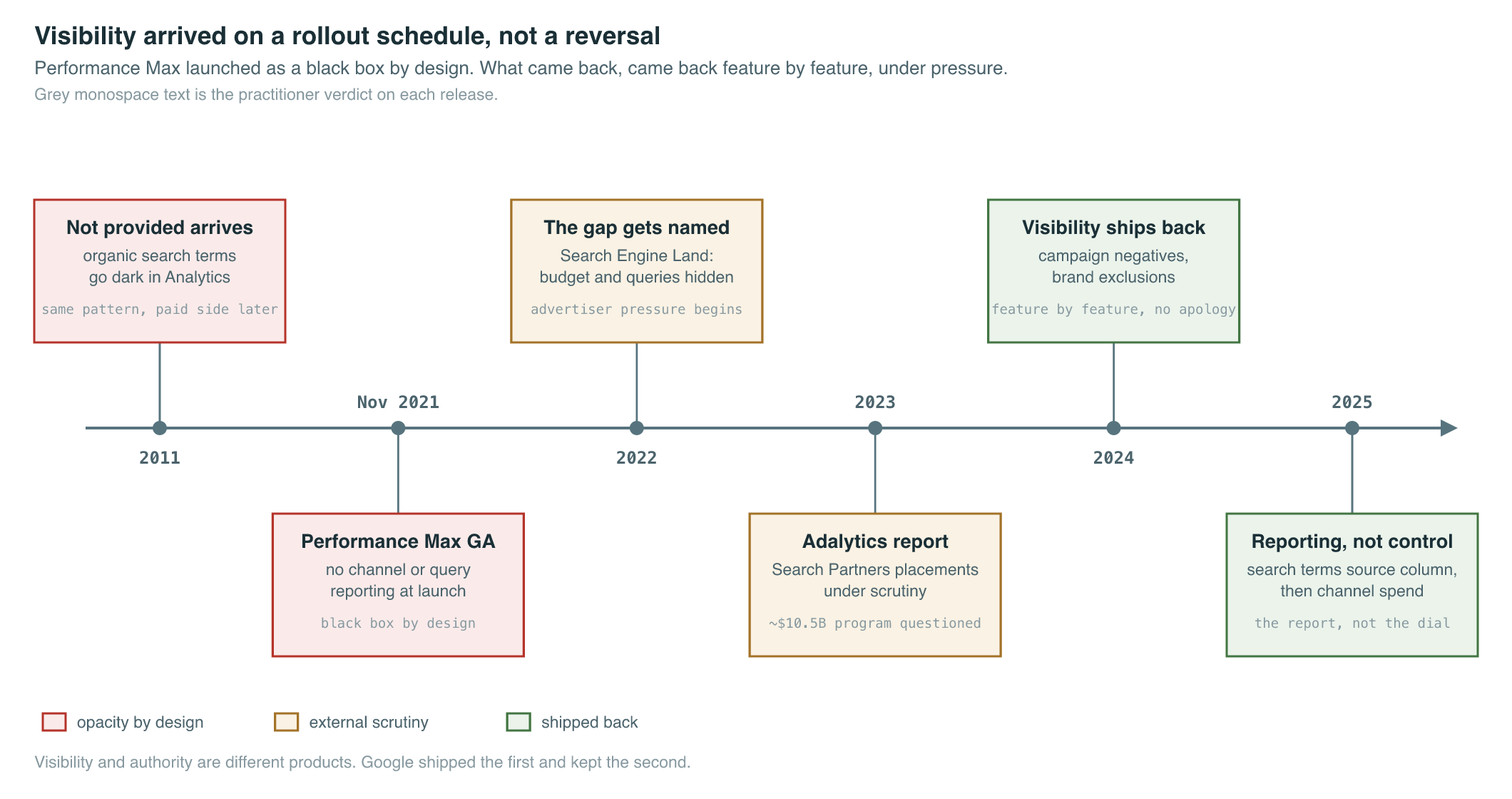
Performance Max launched as a black box by design, not by oversight. The campaign spans Search, Shopping, Display, YouTube, Discover, Gmail and Maps. A channel breakdown of spend and conversions is a trivial report to generate for a system that already allocates budget across those channels internally. Its absence was a product decision.
The argument for that decision is coherent. If advertisers can see channel-level performance, they will demand channel-level control, and channel-level control defeats the point of a system whose value comes from reallocating budget freely across surfaces in response to predicted return. Give people a dial and they will turn it, usually toward the channel with the best last-click numbers, which is exactly the bias the model exists to correct.
The problem with that argument is structural, and it has nothing to do with whether Google’s models are good. The auctioneer also sets your bid, chooses your channel, writes half your ad copy and reports your results. Every step in that chain is run by the party collecting the revenue. In any other procurement relationship this arrangement would trigger an audit requirement as a matter of course. In paid search it shipped as a campaign type, and the buy-side conflict it embodies is the one traced from the top in One Company, Both Sides of the Table.
Opacity Has a Precedent
None of this was new to anyone who worked on the organic side of search. Between 2011 and 2013 Google progressively encrypted search referrals, replacing the query string that used to arrive in analytics with the string “not provided.” The stated reason was user privacy. The effect was that the single most useful diagnostic in search engine optimization went dark, while the same data remained purchasable through Google Ads. Practitioners who lived through it recognized the Performance Max reporting gap immediately: the same query-to-outcome chain, broken again, this time on the paid side.
The pattern worth extracting from “not provided” is not that Google withheld data. It is what the industry did next. Within about two years, an entire tooling category grew up to reconstruct approximately what had been removed: rank trackers, Search Console query sampling, log file analysis, correlational modelling of landing page traffic against ranking positions. None of it was as good as the original data. All of it was billable. Removing a data source does not remove the demand for the answer, it relocates the answer behind a paid or effortful reconstruction, and the party that removed the source is frequently the party best placed to sell the replacement.
There is an older precedent for how visibility eventually arrives, and it is not through product management. In 2006 Google settled Lane’s Gifts & Collectibles v. Google, a click-fraud class action, for $90M: $30M in plaintiffs’ fees and $60M in advertising credits, working out to roughly $4.50 per $1,000 spent since 2002, with no admission of liability (Computerworld). The court-appointed expert report by Alexander Tuzhilin, published as part of that settlement, remains one of the more detailed public descriptions of how Google’s invalid-click detection worked (Tuzhilin report). It exists because of litigation, not because someone filed a feature request.
The Walk-Back, One Release Note at a Time
Advertiser pressure on Performance Max did not produce a policy reversal or an apology. It produced a rollout schedule. Between 2024 and 2025 Google shipped the missing visibility back, feature by feature, each one announced as a routine product update (Google blog; PPC Land).
| Feature shipped back | What it gives you | What it still does not give you |
|---|---|---|
| Campaign-level negative keywords | a hard exclusion list that applies to the whole campaign | no positive keyword control, and no bid modifier by query |
| Brand exclusions | the ability to keep Performance Max off your own or a competitor’s brand terms | no way to see how much branded traffic it absorbed before you excluded it |
| Search terms reporting with a source column | queries served, labelled as keywordless or from search themes | no query-level cost or conversion detail comparable to a Search campaign |
| Channel-level performance reporting | spend and conversions split by Search, Shopping, Display, YouTube and the rest | no channel-level budget control, targeting or exclusion |
| Asset group reporting improvements | performance signals on individual assets | no direct control over which combinations serve where |
Take the last row of that table seriously, because it is the shape of the whole exercise. Channel-level reporting arrived after roughly five years of advertisers asking for it. What arrived was the report. The dial did not arrive with it. An advertiser can now see that 40% of a Performance Max budget went to Display and can do precisely nothing about it inside the campaign.
Campaign-level negative keywords are the most substantive item on the list, and worth understanding for what they are. Before them, Performance Max negatives had to be requested through a Google representative or applied at account level, which put a supposedly self-serve campaign type behind a support ticket. Making them a normal campaign setting was not a new capability. It was the removal of an artificial obstacle to an existing one.
The search terms report deserves the same careful reading. What shipped includes a source column distinguishing queries matched without keywords from queries matched against the search themes an advertiser supplied. That distinction is genuinely useful, because it tells you which portion of your traffic came from your own hint and which portion the model found on its own. What it does not include is the query-level cost and conversion detail that a Search campaign has provided since the previous decade. You can see that a query happened. Reconstructing what it cost and what it earned still requires inference. A report that shows activity without economics is a strange artefact: enough to satisfy the request, not enough to run a bid decision from.
There is a reasonable defence of the pace here, and it is worth stating fairly. Reporting on a system that allocates across seven surfaces in real time is not the same engineering problem as reporting on a keyword. Attribution across those surfaces has to be modelled rather than observed, and shipping a modelled number that advertisers will treat as ground truth invites a different category of complaint. That defence explains a delay. It explains it less well across five years, and not at all for controls like campaign-level negatives that required no new measurement.
The Search Partners Case Runs the Same Playbook
The clearest evidence that transparency in this system is pressure-driven rather than roadmap-driven came from outside the Performance Max debate entirely.
In 2023 the research firm Adalytics published an analysis of the Google Search Partner Network, the syndication program that places search ads on third-party sites. It documented brand ads appearing on roughly 390 pornographic sites, around 2,200 piracy sites and 197 sanctioned Iranian sites, in a program it valued at approximately $10.5B a year (AdExchanger). The World Federation of Advertisers, representing the largest global brand buyers, issued a formal response and pressed for answers (WFA).
Google disputed the report’s methodology and conclusions. It then shipped the ability to opt out of the Search Partner Network across all campaign types, a control advertisers had been requesting for years and which had previously been unavailable on several campaign types including Performance Max (Search Engine Land).
The sequence is the tell. Dispute the finding, then ship the control the finding implied was needed. The same three-step pattern shows up in the Performance Max reporting timeline: defend the design, absorb sustained criticism, ship a partial version of what was asked for and describe it as a product improvement.
Transparency Without Real Control
The industry verdict on the 2025 releases was not gratitude. One widely circulated framing called the channel-reporting launch “transparency without real control” (GRoas), and the phrase stuck because it identifies the exact gap. Visibility and authority are different products. Google shipped the first and kept the second.
There is a specific case where that gap costs real money, and it is brand cannibalization. Performance Max will happily serve against searches for your own brand name. Branded search converts at high rates and costs very little, because nobody else is competing hard for a query that already contains your company name. A campaign that absorbs that traffic reports excellent blended performance while contributing very little incremental demand. Before brand exclusions existed, advertisers had no clean way to prevent this and no query-level report to detect it. Both problems were the same problem: the reporting gap was what made the behaviour invisible, and the invisibility was what made it profitable to leave in place.
The counterfactual problem underneath brand cannibalization is what makes it so durable. To know whether a branded click was incremental, you need to know what the customer would have done if the ad had not been there, and no reporting interface can tell you that. Only an experiment can, which means turning the campaign off in some markets and not others and watching total revenue rather than platform-reported conversions. Very few advertisers run that test, because the platform’s numbers look good and the test costs money to run. The reporting gap and the measurement gap reinforce each other: the report shows conversions, the experiment shows incrementality, and the platform ships only the first.
Detecting cannibalization now requires stitching data the platform reports against data you control. That means click identifiers, first-party conversion records and your own definition of an incremental sale, which is the join problem worked through in Join Keys: GCLID, Floodlight and Attribution. It is solvable. It is not solvable from inside the Google Ads interface alone, which is the point.
The reasonable position on all of this is neither that Google acted in bad faith nor that the criticism was overblown. It is simpler. Opacity was a product decision with a defensible design rationale and an obvious commercial benefit to the party making it. Transparency arrived as a series of release notes, on Google’s schedule, in the minimum viable form, after several years of pressure from advertisers and the trade press. That is how it will arrive next time too.
Which raises a practical question for anyone spending at scale. If the buying platform will not give you an independent view of your own campaigns, is there a layer above it that will? That layer exists, it predates Performance Max by more than a decade, and whether it survives the shift to model-run bidding is the subject of Does the Management Layer Survive the Model?.
Key Sources
| Source | Author/Org | Year | Link | Why it matters |
|---|---|---|---|---|
| 4 things to beware of with Google’s Performance Max automated campaigns | Search Engine Land | 2022 | article | The canonical statement of the budget and query visibility gap at launch |
| New Performance Max features | 2025 | blog post | Primary source for the 2025 transparency releases including channel-level reporting | |
| Google wraps up Performance Max feature rollouts in 2025 | PPC Land | 2025 | article | Trade-press inventory of what actually shipped across the 2024 to 2025 rollout |
| Google Performance Max channel reporting 2025: transparency without real control | GRoas | 2025 | analysis | Names the gap between reporting and authority that defines the walk-back |
| Adalytics exposes an alleged $10.5 billion black hole in the Google Search Partners program | AdExchanger | 2023 | article | Documents the Search Partner placement findings and the program’s estimated scale |
| WFA response to Adalytics report on Google Search advertising | World Federation of Advertisers | 2023 | statement | Shows the buyer-side pressure that preceded the opt-out control |
| Google now lets advertisers opt out of the Search Partner Network | Search Engine Land | 2023 | article | Records the control that shipped after Google disputed the underlying report |
| Google to settle click fraud lawsuit for $90M | Computerworld | 2006 | article | The earliest large-scale case of ad accountability arriving through litigation |
| Report to the court in Lane’s Gifts v. Google | Tuzhilin | 2006 | report PDF | Court-mandated technical disclosure of invalid-click detection, published because a judge required it |
Papers referenced
- 4 things to beware of with Google's Performance Max automated campaigns Search Engine Land · 2022
- New Performance Max features Google · 2025
- Google wraps up Performance Max feature rollouts in 2025 PPC Land · 2025
- Google Performance Max channel reporting 2025: transparency without real control GRoas · 2025
- Adalytics exposes an alleged $10.5 billion black hole in the Google Search Partners program AdExchanger · 2023
- WFA response to Adalytics report on Google Search advertising World Federation of Advertisers · 2023
- Google now lets advertisers opt out of the Search Partner Network Search Engine Land · 2023
- Update: Google to settle click fraud lawsuit for $90M Computerworld · 2006
- Report to the Court in Lane's Gifts & Collectibles v. Google Tuzhilin · 2006