On 13 April 2007, Google agreed to pay $3.1 billion in cash for DoubleClick, a twelve-year-old New York company whose core asset was a system for deciding which banner went into which slot and then writing down that it happened. Most of the coverage read this as Google buying its way into display advertising. That reading was half right. What Google actually acquired was DART, and DART’s job was delivery and record-keeping: hold the creative files, pick from a set of line items someone had already negotiated, fire the tag, count the impression, reconcile the numbers at month end. It was an excellent filing cabinet with a clock attached. It could not buy a single impression on an open market, because nothing inside it had been built to.
Google would spend the next five and a half years fixing that. The fix required a second acquisition, a full rebuild, and a product launch in October 2012 that most people have forgotten happened separately from 2007 at all.
The Two Halves of DART
DoubleClick was founded in 1995 in New York by Kevin O’Connor and Dwight Merriman. Its platform was DART, for Dynamic Advertising, Reporting and Targeting, and the important structural fact about DART is that it split into two product lines that still define this stack thirty years later: DFA, DoubleClick for Advertisers, the advertiser-side ad server, and DFP, DoubleClick for Publishers, the publisher-side ad server (DoubleClick history).
Both halves solve a scheduling and logging problem. They solve it from opposite ends of the same transaction. DFA answers the advertiser’s question: of the placements I have bought across twelve publishers, which creative should this particular user see, and did the publisher actually deliver what the insertion order said? DFP answers the publisher’s question: of the seventeen advertisers who have booked this slot, which one gets this impression, and how do I hit everyone’s guaranteed volume by month end? Same underlying technology, mirror-image incentives.
It is worth pausing on why an advertiser needs its own ad server at all, since the publisher already has one. The answer is discrepancies. Publishers bill for impressions they counted. Advertisers pay for impressions they counted. Those two numbers never match exactly, because a browser can request an ad, get counted by the publisher, and then close before the creative finishes loading. Small percentage gaps on a large budget are real money, so the advertiser wants an independent count produced by a system it controls, and the publisher wants the same. DFA existed to be the advertiser’s meter. That single job, counting the same events from the buyer’s side of the wire, is why the product outlived the company, the private equity owners, three brand names, and the entire buying model it was designed for.
The split hardened from a technical distinction into an organizational one in July 2005, when Hellman & Friedman, with JMI Equity, took DoubleClick private for $1.1 billion at $8.50 per share (Hellman & Friedman, SEC filing, 2005). The new owners ran the publisher and advertiser businesses as separate units. So when Google arrived two years later, it did not buy one company. It bought two products, two customer bases, and two sets of account managers who had learned to think of each other as a different business.
Google kept the cleave. DFP became the spine of what is now Google Ad Manager, the sell-side story taken up in The Last Look. DFA became DoubleClick Campaign Manager and then Campaign Manager 360. Twenty years after a private equity firm drew the org chart, the line is still visible in the product.
$3.1 Billion for a Company That Was Not a Competitor
The regulatory case for the deal rested on a claim that sounds strange in 2026 and was defensible in 2007: Google and DoubleClick did not compete.
The Federal Trade Commission closed its investigation on 20 December 2007 by a 4-1 vote, concluding that the two companies “are not direct competitors in any relevant antitrust market” (FTC, December 2007). The Commission also disposed of the loudest objection to the deal, which was about privacy rather than pricing, by noting that the concerns raised were “not unique to Google and DoubleClick” and fell outside its merger authority. EPIC had built much of the opposition around exactly that data-consolidation argument (EPIC docket), and the American Antitrust Institute filed a memo in November 2007 arguing the Commission was reading the market too narrowly (AAI, November 2007). The European Commission cleared the transaction and the deal closed on 11 March 2008.
On the facts available in 2007, the FTC’s non-overlap finding was reasonable. Google sold keyword-triggered text ads through an auction it ran itself. DoubleClick sold software licenses to advertisers and publishers who had negotiated their media by phone and fax. One company priced inventory; the other one shipped and counted it. There was no product on either side of that deal that bid on a display impression in real time.
That is also precisely why the finding aged badly. The FTC evaluated the acquisition as a merger of a network and a toolmaker, and the thing that made Google’s ad-tech position durable was the later combination of the publisher ad server with an exchange, which was not on the table in 2007. The antitrust consequences arrive in 2025 and are handled in Remedies. What matters here is the shape of what Google owned on the morning of 12 March 2008.
What an Ad Server Cannot Do
An ad server executes decisions. A demand-side platform makes them.
Concretely: DFA received a booked insertion order, a set of creatives, a flight window, and a frequency cap, and its job was to serve within those constraints and produce a defensible impression log. Price was an input, agreed in advance by humans. The system did not have an opinion about whether a given impression was worth more or less than the average one.
A DSP inverts that. For each individual impression offered by an exchange, it has roughly a hundred milliseconds to decide whether to bid at all and what to pay, using whatever it knows about the user, the page, the time of day, the creative, and its own remaining budget. That is not inventory scheduling with logging. It is real-time valuation under uncertainty, at a few million decisions per second, where the cost of being wrong is measured per impression rather than per campaign.
Nothing in DART did this, because from 1995 through 2007 almost nobody bought media that way. The auction infrastructure that makes a DSP necessary was still being assembled while Google’s acquisition was clearing review.
The two systems also fail differently, which is the part engineering leaders underestimate. An ad server is a write-heavy logging system whose hardest requirement is that the log be complete and reconcilable, because at month end a finance team will compare it against an invoice line by line. It can tolerate a few hundred milliseconds. It can retry. A bidder is a read path with a hard timeout: if it has not returned a bid inside the exchange’s window, the auction closes without it and the opportunity is gone forever, uncounted and unbillable. There is no retry, no queue, and no graceful degradation that a buyer would accept. You do not evolve one of those architectures into the other. You write the second one from a blank file.
That is exactly what Google eventually did, and the interesting thing is how long it took to decide to.
Buying the Bidder: Invite Media, June 2010
Google’s answer was to buy one. In June 2010 it acquired Invite Media, a media-buying and optimization platform built for the emerging ad exchanges, for a reported $70 million to $81 million (TechCrunch, June 2010, Search Engine Land, June 2010). Set that against the DoubleClick price. Google paid roughly 2 to 2.5 percent of the DoubleClick figure for the piece of the stack that would eventually decide where the money went.
Then it did the thing Google does with acquired ad products, which is to retire the brand and re-implement the function on its own infrastructure. Invite Media as a standalone product disappeared. Its replacement shipped as DoubleClick Bid Manager, which came out of beta and reached general availability in October 2012 (Ad Age, October 2012).
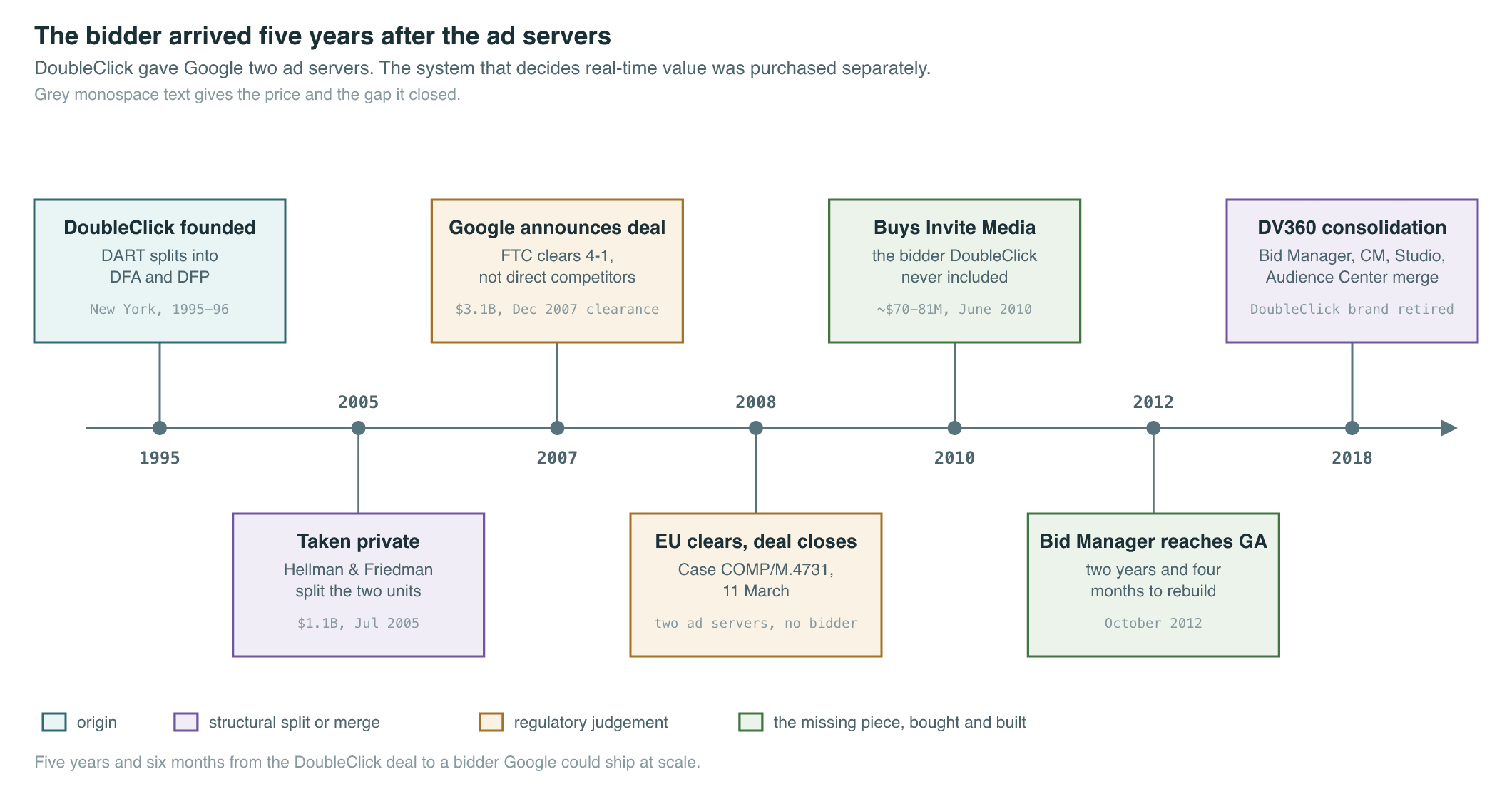
Count the interval. Two years and four months from the Invite Media purchase to a generally available DSP. Five years and six months from the DoubleClick announcement. An advertiser who watched the April 2007 press release and concluded that Google now had an end-to-end buying platform was wrong for the entire following presidential cycle.
That lag is not incompetence, and it is worth defending, because the same pattern will recur in every later chapter of this book. What Google bought from Invite Media was a working thesis, a customer list, and a team that had already learned which parts of exchange buying are hard. What it could not use was the implementation, because a startup bidder built to handle one client’s traffic on rented servers does not survive contact with Google’s volume, Google’s serving infrastructure, or Google’s billing systems. Rewriting took the two years. Retiring the brand took an afternoon. Whether the two-year rebuild was faster than building from nothing without the acquisition is unknowable, which is precisely why acquisitions of this shape keep happening.
Five Years of Assembly
| Capability | Arrived with DoubleClick in 2007 | Acquired or built afterward |
|---|---|---|
| Advertiser ad serving and creative hosting | Yes, DFA | Renamed to Campaign Manager, later CM360 |
| Publisher ad serving and yield management | Yes, DFP | Renamed to Google Ad Manager |
| Impression and click logging, verification | Yes, DART reporting | Extended into Floodlight and Data Transfer files |
| Conversion tracking tag infrastructure | Partly, Spotlight tags | Rebuilt as Floodlight across three platforms |
| Real-time bidding on third-party inventory | No | Invite Media, June 2010, GA as Bid Manager October 2012 |
| Algorithmic bid strategies and custom bidding | No | Built in-house on Google infrastructure |
| YouTube inventory access | No | Came from the 2006 YouTube acquisition, wired into the DSP much later |
The 2018 consolidation on the last row of that timeline is where Bid Manager, Campaign Manager, Studio and Audience Center were folded into Display & Video 360 and the DoubleClick brand was retired after twenty-two years (Google, June 2018). The full acquisition ledger for the stack, YouTube and Urchin and Applied Semantics included, is laid out in Bought, Not Built.
Why the Order Matters
It would be easy to file this chapter under trivia about who bought what and when. The sequence has a consequence that shows up in every enterprise media plan running today.
Because the ad server arrived first and the bidder arrived second, the measurement layer in Google’s stack was never architecturally subordinate to the buying layer. CM360 predates DV360 by fifteen years as a product lineage. It was designed when the media it measured was bought by humans on the phone from publishers who had never heard of an exchange, which means it was designed to be indifferent to how the media was purchased. That indifference turned out to be the most valuable property in the stack, and it is the subject of Two Layers, One Ledger.
Had Google bought a DSP in 2007 and bolted reporting onto it, the shape would be different and worse. The accident of acquisition order produced a separation of concerns that a greenfield design would have had to be disciplined to preserve.
Key Sources
| Source | Author/Org | Year | Link | Why it matters |
|---|---|---|---|---|
| DoubleClick company history, DART, DFA and DFP | Wikipedia | 2025 | entry | Establishes the 1995 founding and the DART split into advertiser and publisher ad servers |
| DoubleClick, Inc. portfolio page | Hellman & Friedman | 2005 | page | Confirms the July 2005 take-private and the separation into advertiser and publisher units |
| DoubleClick merger proxy supplement | SEC / DoubleClick | 2005 | DEFA14A | Primary source for the $1.1B, $8.50-per-share private-equity transaction |
| FTC closes Google/DoubleClick investigation | Federal Trade Commission | 2007 | press release | The 4-1 vote and the “not direct competitors” finding that let the deal through |
| Proposed Google/DoubleClick merger docket | EPIC | 2007 | docket | The privacy-based opposition the FTC declined to act on |
| Google/DoubleClick memo | American Antitrust Institute | 2007 | memo | Contemporaneous argument that the relevant market was drawn too narrowly |
| Google acquiring Invite Media for approximately $70 million | TechCrunch | 2010 | article | Dates and prices the separate DSP purchase |
| Google buys Invite Media, media buying platform for ad exchanges | Search Engine Land | 2010 | article | Describes what Invite Media did that DoubleClick could not |
| Google officially launches DoubleClick Bid Manager | Ad Age | 2012 | article | Fixes the October 2012 general-availability date, five years after the acquisition |
PM Lens
Papers referenced
- DoubleClick: company history, DART, DFA and DFP Wikipedia · 2025
- DoubleClick, Inc. (portfolio) Hellman & Friedman · 2005
- DoubleClick merger proxy supplement (DEFA14A) DoubleClick / SEC EDGAR · 2005
- Federal Trade Commission Closes Google/DoubleClick Investigation Federal Trade Commission · 2007
- Privacy: Proposed Google/DoubleClick Merger EPIC · 2007
- Memorandum on the Google/DoubleClick merger American Antitrust Institute · 2007
- Google Reportedly Acquiring Invite Media For Approximately $70 Million TechCrunch · 2010
- Report: Google Buys Invite Media, Optimization And Media Buying Platform For Ad Exchanges Search Engine Land · 2010
- Google Officially Launches DoubleClick Bid Manager Ad Age · 2012
- Introducing Google Marketing Platform Google · 2018