In December 2025, Google Ad Manager publishers got a change that yield teams had been asking for since 2019: the ability to set different price floors for different bidders again. Unified pricing rules, which had forced one floor across all indirect programmatic demand, were removed (Search Engine Land, 2025). Trade coverage did not describe it as a feature launch. It described it as a response to antitrust pressure in the United States and Europe (Press Gazette, 2025).
That is the pattern this chapter maps. Every significant publisher-favorable change to Google’s sell-side stack over the last seven years arrived within a measurable distance of an enforcement event. Not one of them arrived because a publisher asked. The useful exercise is to line the concessions up against the docket and see what the sequence implies about how the roadmap was actually set.
2019: Giving Up Last Look, Taking Away Floors
Google announced in March 2019 that Ad Manager would move to a first-price unified auction, with the rollout running through the rest of that year (Google Ad Manager Blog, 2019), and confirmed the completed transition later in 2019 (Google Ad Manager Blog, 2019). This is where last look ended. The mechanic and its consequences are the subject of The Last Look.
Taken alone, it is a real concession. AdX gave up a genuine informational advantage. Taken as shipped, it is more complicated, because the same package introduced unified pricing rules: one floor across all indirect demand, capped at 100 rules. Publishers lost the ability to price differently against different exchanges, which was the only lever they had for pushing back on AdX’s fee without leaving Ad Manager entirely.
The timing is worth noting. March 2019 sits after the Texas-led state investigation had begun organizing and well into the period when European and American regulators were actively examining Google’s ad tech. Header bidding adoption was also at its peak, meaning last look was already leaking value. Giving up an advantage the market had partly neutralized, while acquiring a new restriction on publisher pricing, is not the shape of a company retreating under pressure. It is the shape of a company trading.
Jedi Blue: Alleged in 2020, Dismissed in 2022
The most quoted controversy in this history is also the one least supported by a court.
In the Texas-led multistate complaint, state attorneys general alleged that a September 2018 agreement between Google and Facebook, code-named Jedi Blue inside Google, induced Facebook to abandon its header bidding efforts in exchange for preferential terms in Google’s Open Bidding programme. The allegations included bid rate and win rate commitments, information advantages, and a minimum annual spend, with sign-off reaching the chief executives of both companies. The European Commission and the UK’s Competition and Markets Authority opened parallel formal investigations into the agreement in March 2022 (TechCrunch, 2022).
In September 2022, Judge P. Kevin Castel dismissed the Jedi Blue claim. He found valid business justifications for the agreement, writing that there was nothing inexplicable or suspicious about the two companies entering it, and pointing to Facebook’s ordinary interest in driving the hardest bargain it could and Google’s ordinary interest in winning as much of Facebook’s business as possible (Adweek, 2022). The rest of the states’ case survived. Jedi Blue did not (Engadget, 2022).
Anyone writing about this history should stop calling Jedi Blue a proven conspiracy. It was an allegation, it was tested, and it lost on the merits at the pleading stage. The European Commission’s eventual 2025 adtech decision rested on self-preferencing in Google’s own auction, not on the Meta agreement.
Project Bernanke: The Opacity Evidence That Held Up Better
The stronger evidence of auction opacity is a set of internal programs that got far less press.
The states’ third amended complaint, unredacted in January 2022, alleged that Google ran what amounted to a third-price auction inside AdX while publicly describing the auction as second-price. Under the program the states called Bernanke, AdX would in some cases pass the publisher a lower clearing price than the second bid implied, charge the advertiser closer to the second-price amount, and pool the difference into a fund used to top up bids from advertisers buying through Google’s own tools (Techdirt, 2022). A later variant the complaint called Global Bernanke pooled that value across publishers rather than within a single one (Ad Tech Explained).
The number that made this land was Google’s own. According to the state attorneys general, internal Google analysis found the practice could reduce some publishers’ revenue by as much as 40% (Engadget, 2021). Bernanke was one of a family of programs named in the litigation alongside Reserve Price Optimization and Dynamic Revenue Share, all of which involved Google adjusting auction parameters using information publishers and advertisers could not see.
Precision matters here. These remain allegations in the states’ case, and Google has disputed the characterization, describing the programs as bid optimization rather than deception. What distinguishes them from Jedi Blue is that the underlying conduct, not just the theory, carried into the federal case. The DOJ’s account of price manipulation through auction parameter changes was argued at trial before Judge Brinkema (Tech Policy Press). Jedi Blue was dismissed. The opacity conduct was litigated to judgment.
2025: Liability in Virginia, a Fine in Brussels
On April 17, 2025, Judge Leonie Brinkema found Google liable for monopolizing the open-web publisher ad server market and the open-web display ad exchange market, and for unlawfully tying DFP to AdX (CNBC, 2025). The opinion did not find liability across every claim. The DOJ failed to establish a relevant market for open-web display advertiser ad networks, which is the buy-side half of the stack covered in The Acquisition That Bought a Filing Cabinet. Two markets out of three, plus the tie.
On September 5, 2025, the European Commission fined Google €2.95bn for abusing its dominant position in publisher ad servers and programmatic buying tools by favouring AdX in ad selection and in how Google Ads and DV360 bid into exchanges, conduct the Commission traced back to at least 2014. Google was ordered to end the self-preferencing and given 60 days to submit a compliance plan, with the Commission stating a preliminary view that only a structural remedy, meaning divestiture, may be sufficient (European Commission, 2025). The fine was reported at roughly $3.45bn (CNBC, 2025).
Both proceedings converged on the same structural fact from different legal traditions, and both left the remedy open. The comparative theories, and why divestiture is easier to order than to execute, are worked through in Remedies.
December 2025: The Floors Come Back
Then came the release note. Unified pricing rules, introduced in 2019 as part of the first-price package, were removed from Ad Manager in December 2025. Publishers can once again set bidder-specific floors, and yield teams began estimating mid-single-digit to low-double-digit revenue upside from differential pricing (Search Engine Land, 2025).
The court had already characterized unified pricing rules as limiting publishers’ ability to set floor prices, which put the feature squarely inside the conduct at issue in both the US and EU proceedings (Press Gazette, 2025). Google did not remove it in 2020, when publishers complained loudly. It did not remove it in 2022, when the EU and UK opened investigations. It removed it in December 2025, after a liability finding in Virginia and a €2.95bn fine in Brussels.
What Was Not Given Back
The concession list is short, and reading it next to the list of things that did not change is the fastest way to see what enforcement has and has not reached.
The AdX open auction fee stayed at roughly 20% throughout, including through a period when Google’s own internal analysis put the price above the value delivered, as covered in The 20% That Never Moved. The tie itself stayed. DFP and AdX remain one product with one contract, which is the arrangement Brinkema found unlawful in April 2025 and which no announced change has altered. Publishers still cannot audit the final allocation decision on an impression. Open Bidding still runs inside infrastructure operated by the largest bidder in it.
The auction parameter programs named alongside Bernanke are instructive on this point. Reserve Price Optimization used publisher-specific historical bid data to set floors, and Dynamic Revenue Share adjusted Google’s own cut on individual impressions rather than applying a fixed percentage. Both were discontinued or restructured, and neither ended in a way that gave publishers a new capability. They ended by being removed from a system publishers still could not see into (Techdirt, 2022). Removing an undisclosed practice is not the same concession as granting visibility, and the difference is exactly why the DOJ’s remedy proposals moved past conduct rules toward structural separation and disclosure of the auction logic.
So the honest ledger reads: one informational advantage surrendered in 2019, in a package that took a pricing lever away. One restriction reversed in December 2025, after a liability finding and a €2.95bn fine. Several undisclosed programs withdrawn without replacement. The fee, the bundle, and the opacity intact.
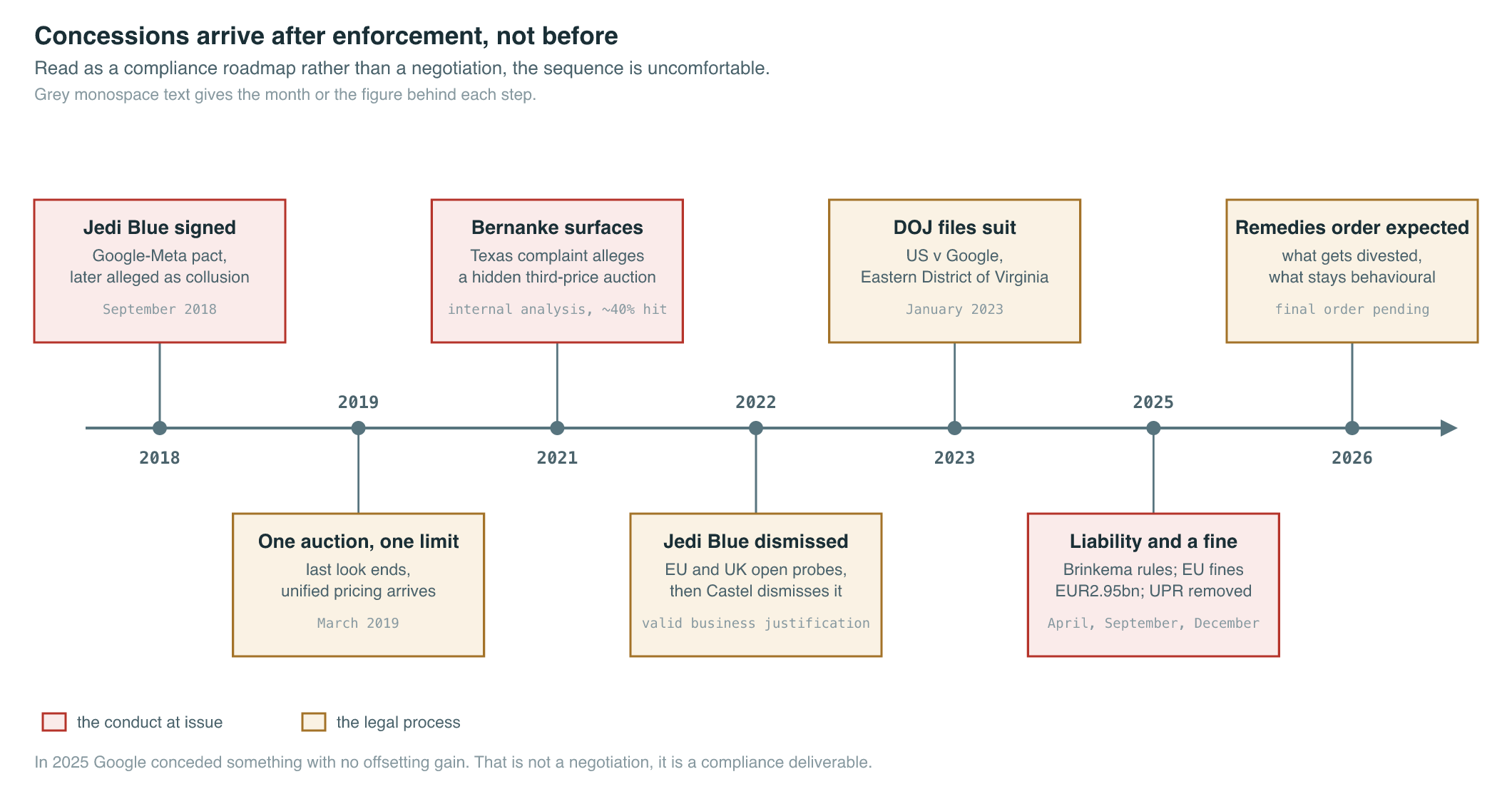
Compliance Engineering Is a Roadmap
Read the sequence as a product manager rather than as a lawyer and the pattern is uncomfortable.
| Concession | Date | Nearest enforcement event | Publisher benefit | What Google kept or gained |
|---|---|---|---|---|
| Last look removed inside Open Bidding | 2017 | header bidding at peak adoption, early regulatory interest | rival exchanges bid on equal terms server-side | the auction moved back inside Google’s infrastructure |
| First-price unified auction | 2019 | state investigations organizing, EU adtech scrutiny building | one auction, no privileged look for AdX | unified pricing rules removed bidder-specific floors |
| Jedi Blue terms defended, not changed | 2022 | Castel dismissal, EU and UK probes opened | none | the agreement survived on valid business justification |
| AdX fee held at roughly 20% | throughout | internal 15% proposal declined | none | full monopoly rent, as covered in the previous chapter |
| Unified pricing rules removed | December 2025 | April 2025 liability finding, September 2025 EU fine | bidder-specific floors restored | nothing obvious, which is the point |
The last row is the one that changes the reading of all the others. In 2017 and 2019, Google conceded things it was going to lose anyway, and attached a new restriction on the way out. In December 2025, it conceded something with no offsetting gain, because a federal court had already found the conduct unlawful and a European regulator had already priced it. That is not a negotiation. That is a compliance deliverable.
For anyone building on Google’s sell-side stack, the operational lesson is that the roadmap has an input the release notes never mention. Features arrive and disappear on a schedule set partly in Alexandria, Virginia and partly in Brussels. The single-floor constraint that yield teams designed around for six years was not a product decision that could be argued with on product grounds, and it did not go away for product reasons either. Whether the remaining structure survives the remedies phase, and what a divested exchange would even look like, is where this book turns in Remedies. Before that, the honest summary of the record is short. Google gave publishers back the things it was ordered to, roughly when it was ordered to, and not before.
Key Sources
| Source | Author/Org | Year | Link | Why it matters |
|---|---|---|---|---|
| Rolling out first price auctions to Google Ad Manager partners | Google Ad Manager Blog | 2019 | blog | Primary source for the 2019 package that ended last look and introduced unified pricing rules |
| An update on first price auctions for Google Ad Manager | Google Ad Manager Blog | 2019 | blog | Confirms the completed rollout timeline |
| Google, Meta ‘Jedi Blue’ ad deal faces new antitrust probes | TechCrunch | 2022 | article | Dates the March 2022 EU and UK investigations and describes the alleged agreement |
| Judge Dismisses Google and Facebook Jedi Blue Lawsuit | Adweek | 2022 | article | Castel’s valid-business-justification reasoning, the reason Jedi Blue cannot be cited as proven |
| Google’s Jedi Blue ad deal with Meta wasn’t unlawful, judge rules | Engadget | 2022 | article | Confirms the rest of the states’ case proceeded without the Jedi Blue claim |
| States’ 3rd Amended Antitrust Complaint Against Google Looks A Lot More Damning | Techdirt | 2022 | article | Walks through the unredacted Bernanke allegations in the states’ complaint |
| Google’s Project Bernanke Explained | Ad Tech Explained | current | article | Mechanically clear explanation of the alleged third-price behaviour and Global Bernanke |
| Google faces more detailed allegations in updated US antitrust lawsuit | Engadget | 2021 | article | Source for the up to 40% publisher revenue reduction figure attributed to Google’s own analysis |
| How Google Manipulated Digital Ad Prices and Hurt Publishers, Per DOJ | Tech Policy Press | 2024 | article | Shows the opacity conduct carrying from the state complaint into the federal trial record |
| Judge finds Google holds illegal online ad tech monopolies | CNBC | 2025 | article | Dates the April 17, 2025 liability finding and its scope |
| Commission fines Google €2.95 billion over abusive practices in adtech | European Commission | 2025 | press release | Primary source for the fine, the self-preferencing finding, and the 60-day compliance deadline |
| Google slapped by EU with $3.45 billion antitrust fine | CNBC | 2025 | article | Dates the decision to September 5, 2025 and gives the dollar equivalent |
| Google scraps unified pricing rules in Ad Manager after antitrust pressure | Search Engine Land | 2025 | article | Dates the December 2025 removal and the return of bidder-specific floors |
| Google removes unified pricing rules that hit publisher ad yield | Press Gazette | 2025 | article | Connects the removal directly to the court’s characterisation of the rules |
PM Lens
Papers referenced
- Rolling out first price auctions to Google Ad Manager partners Google Ad Manager Blog · 2019
- An update on first price auctions for Google Ad Manager Google Ad Manager Blog · 2019
- Google, Meta 'Jedi Blue' ad deal faces new antitrust probes TechCrunch · 2022
- Judge Dismisses Google and Facebook Jedi Blue Lawsuit Adweek · 2022
- Google's Jedi Blue ad deal with Meta wasn't unlawful, judge rules Engadget · 2022
- States' 3rd Amended Antitrust Complaint Against Google Looks A Lot More Damning Techdirt · 2022
- Google's Project Bernanke Explained Ad Tech Explained · 2023
- Google faces more detailed allegations in updated US antitrust lawsuit Engadget · 2021
- How Google Manipulated Digital Ad Prices and Hurt Publishers, Per DOJ Tech Policy Press · 2024
- Judge finds Google holds illegal online ad tech monopolies CNBC · 2025
- Commission fines Google €2.95 billion over abusive practices in adtech European Commission · 2025
- Google slapped by EU with $3.45 billion antitrust fine CNBC · 2025
- Google scraps unified pricing rules in Ad Manager after antitrust pressure Search Engine Land · 2025
- Google removes unified pricing rules that hit publisher ad yield Press Gazette · 2025