An analyst opens two browser tabs. The first is Google Analytics 4, showing 1,842 purchases last month. The second is Campaign Manager 360, showing 1,911 conversions for the same period, same site, same checkout. Nobody has made a mistake. The two numbers come from two different tag systems, built by two different companies, acquired nine years apart, and never merged. GA4 counts events descending from a San Diego log-file analytics product Google bought in 2005. Campaign Manager counts Floodlight activities descending from a New York ad server Google bought in 2008. The gap between the tabs is not a bug report. It is a merger boundary, still visible.
Google’s marketing stack is usually described as a suite. It is more accurately described as a sediment. Nine acquisitions between 2003 and 2020 supplied nearly every major component, and in almost every case the acquired product’s internal model survived the integration. Where two products feel like they should be one and are not, an acquisition boundary is usually the reason.
Nine Purchases, Seventeen Years
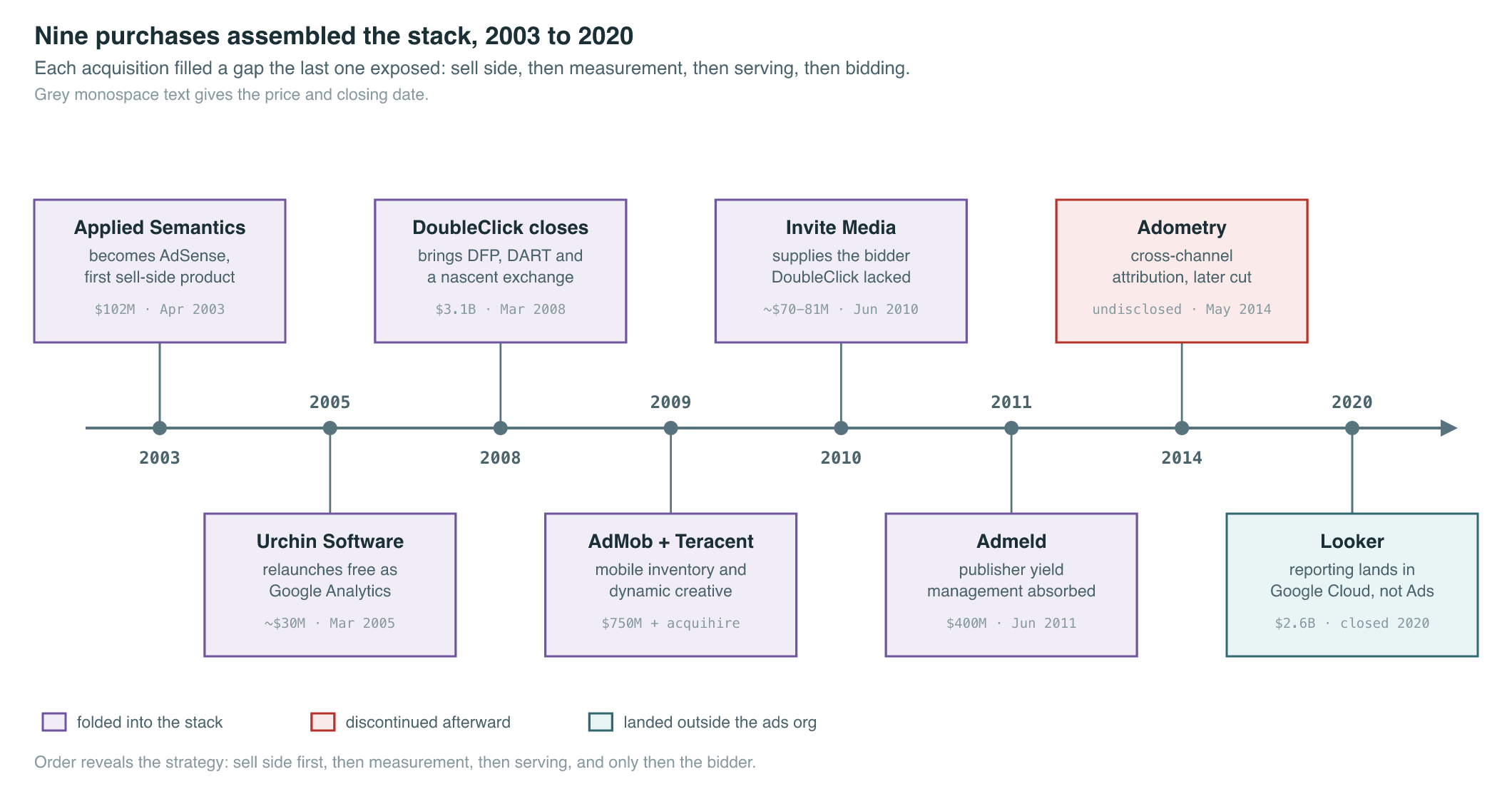
The chronology matters more than the prices, because the order reveals the strategy. Google bought contextual sell-side monetisation first, measurement second, ad serving third, and only then the buying platform. Each purchase filled a gap the previous one had exposed.
Applied Semantics, April 2003, $102 million. Google acquired the Santa Monica company behind Oingo, whose semantic text-processing technology became the contextual targeting engine inside AdSense (Google press release; Digiday). This is the origin of the sell side. Five years before Google owned a publisher ad server, it already had a publisher monetisation product.
Urchin Software, March 2005. Urchin Software Corp. of San Diego sold a hybrid analytics product that combined server log-file parsing with page tagging. Google announced the acquisition on 28 March 2005 and relaunched the product as a free service called Google Analytics on 14 November 2005, at which point sign-ups had to be suspended within a week because demand overwhelmed capacity (Primo Interactive). The widely repeated purchase price of roughly $30 million was never officially confirmed by Google, so treat it as reported rather than established. The tag file was named urchin.js and remained so until 2007, when it became ga.js (BBCCSS, The History of Google Analytics).
DoubleClick, announced April 2007, closed March 2008, $3.1 billion. This is the load-bearing acquisition and it deserves its own paragraph below.
AdMob, announced November 2009, $750 million. The FTC opened a six-month second-request investigation into the combination of the two largest mobile ad networks, then closed it on 21 May 2010 by a unanimous vote, reasoning that Apple’s acquisition of Quattro Wireless had introduced a serious new competitor (FTC; TechCrunch). Note the pattern already forming: a clearance justified by a competitor who had just arrived.
Teracent, November 2009. A small acquisition with an outsized legacy. Teracent’s technology assembled display creatives in real time from thousands of component elements, varying image, product, message, and colour by geography, language, page content, and time of day (TechCrunch; Search Engine Land). It became the dynamic creative capability inside DoubleClick Studio, and Studio was later folded into Display & Video 360.
Invite Media, June 2010, reported at roughly $70 million to $81 million. DoubleClick had given Google ad serving, not programmatic buying, and the gap was conspicuous. Invite Media was a demand-side platform; Google bought it, rebuilt it, and shipped it as DoubleClick Bid Manager, which did not reach general availability until October 2012 (TechCrunch; Ad Age). Two years from acquisition to general availability is the single clearest signal in the timeline that these were not drop-in parts.
Admeld, announced June 2011, $400 million, cleared by the Department of Justice in December 2011. Admeld sold yield-management tools that helped large publishers compare prices across competing exchanges, which is to say it helped publishers get less dependent on any single exchange. The DOJ took nearly six months and imposed no significant conditions (TechCrunch; Washington Post). The product was folded into AdX and DFP and eventually retired. In its 2023 ad tech complaint the DOJ characterised the Admeld purchase as an acquisition of a company Google internally viewed as a threat, one of three mergers it argued built the monopoly (Tech Policy Press).
Adometry, May 2014. A cross-channel attribution and media-mix modelling vendor, announced on 6 May 2014 with terms undisclosed (TechCrunch). It shipped as Attribution 360 inside the Analytics 360 Suite and was later discontinued. It is the one acquisition in this list whose product did not survive, and it is instructive precisely for that reason.
Looker, announced 6 June 2019 for $2.6 billion, closed February 2020. Google’s largest purchase in this chronology went to Google Cloud rather than to the ads organisation (Alphabet investor relations; TechCrunch). In October 2022 Google renamed Data Studio, the free reporting tool marketers actually used, to Looker Studio, aligning it with the acquired brand. The Data Studio name later returned, retiring the Looker Studio label after roughly three and a half years (JumpFly). Two products, one brand, then two brands again.
DoubleClick Arrived Already Split
The 2008 acquisition is the reason the stack has the shape it has, and the reason is a structural detail that predates Google’s involvement entirely.
DoubleClick was founded in New York in 1995 and 1996 by Kevin O’Connor and Dwight Merriman. Its core platform, DART, stood for Dynamic Advertising, Reporting and Targeting, and it had already split into two distinct product lines: DFA, DoubleClick for Advertisers, an advertiser-side ad server, and DFP, DoubleClick for Publishers, a publisher-side ad server. In July 2005 the company was taken private for $1.1 billion at $8.50 per share by Hellman & Friedman with JMI Equity, and the private-equity owners separated the publisher and advertiser businesses into distinct units (Hellman & Friedman; DoubleClick DEFA14A, 2005).
So when Google announced the $3.1 billion purchase on 13 April 2007, it was not buying one ad server. It was buying a two-sided company that had already been organisationally cleaved by someone else, plus the DoubleClick user ID, plus an exchange still under construction. That exchange launched as DoubleClick Ad Exchange in September 2009 and became AdX.
Regulators looked at the deal twice and cleared it twice. The FTC closed its investigation on 20 December 2007 by a 4 to 1 vote, finding that Google and DoubleClick “are not direct competitors in any relevant antitrust market” and that the privacy objections raised were not unique to the parties and fell outside its merger authority (FTC). The European Commission cleared it on 11 March 2008 in Case COMP/M.4731, declaring the concentration compatible with the common market, and the deal closed the same day (European Commission, Case COMP/M.4731).
Both authorities were correct on the narrow question they asked. Google sold search ads; DoubleClick sold ad-serving software. They were complements. The theory of harm that eventually succeeded seventeen years later was about vertical integration and self-preferencing, not about horizontal overlap, and it is developed across Part V and Remedies.
The Bidder Came Separately, and It Shows
Here is the sentence that reorganises most people’s mental model of the stack: DoubleClick did not include a demand-side platform. It included ad servers. Ad serving decides which creative to show in a slot you have already won. Bidding decides whether to try to win it and at what price. Those are different products with different latency budgets and different data models.
Google noticed the gap in 2010 and bought Invite Media to fill it. The rebuild took two years. That sequence, ad server first and bidder second, is why Campaign Manager 360 and Display & Video 360 are still two products in 2026 rather than one, and it is the subject of The Acquisition That Bought a Filing Cabinet.
There is a mirror image of this on the sell side. AdMob arrived in 2009 as a self-contained mobile ad network with its own mediation layer, its own publisher relationships, and its own reporting. AdX arrived from DoubleClick with a different auction model aimed at web display. Sixteen years on, an app publisher who wants both AdMob mediation and Ad Manager still works with two products, two interfaces, and two mental models. The seam is exactly where the acquisitions met.
Reading the Seams
The practical value of this history is diagnostic. When a Google product boundary makes no sense, check whether it corresponds to a purchase.
| Seam a practitioner hits | Acquisition boundary underneath it |
|---|---|
| GA4 events and Floodlight activities count the same conversion differently | Urchin (2005) lineage versus DoubleClick (2008) lineage, two tag systems never unified |
| GA4 and CM360 disagree on monthly conversion totals | different attribution engines, different lookback and de-duplication rules, inherited from the same split |
| Mobile app monetisation splits between AdMob and Ad Manager | AdMob (2009) network versus DoubleClick (2008) exchange, two supply models |
| CM360 and DV360 remain separate products despite one 2018 brand | ad serving from DoubleClick, bidding from Invite Media (2010), built two years apart |
| Dynamic creative lives in a Studio-derived module, not in the bidder | Teracent (2009), folded into DoubleClick Studio before DV360 existed |
| Enterprise BI and marketer reporting carry a shared brand but different engines | Looker (2020) in Google Cloud versus Data Studio, built in-house |
| Multi-touch attribution disappeared from the enterprise suite | Adometry (2014) shipped as Attribution 360, then discontinued |
Two general observations follow, and both hold up across the rest of the book.
First, acquired data models are stickier than acquired brands. Google retired the DoubleClick name completely in 2018. It did not retire the DoubleClick conversion tag, the DoubleClick user ID lineage, or the DFP line-item priority system. Renaming is cheap; re-plumbing a conversion pipeline that thousands of enterprise advertisers have hard-coded into their sites is not.
Second, the acquisition that failed is the most informative one. Adometry was bought to answer a question the rest of the stack could not: how do channels contribute jointly to a conversion. That capability was discontinued, and the replacement was data-driven attribution running inside the ad platforms themselves. The measurement question migrated from an independent product into the bidding engine, which is a considerably more comfortable place for the auctioneer to keep it.
Chapter 3 takes the single day on which Google reorganised all of this in public, 27 June 2018, and reads the renaming as a strategy document rather than a design refresh.
Key Sources
| Source | Author/Org | Year | Link | Why it matters |
|---|---|---|---|---|
| Google Acquires Applied Semantics | 2003 | googlepress.blogspot.com | The $102 million purchase that produced AdSense, the stack’s first sell-side product | |
| History of Google Analytics | Primo Interactive | 2023 | primointeractive.com | Dates the Urchin acquisition and the November 2005 free relaunch that overwhelmed sign-ups |
| The History of Google Analytics | BBCCSS | 2023 | bbccss.com | Tracks the tag lineage from urchin.js to ga.js to Universal Analytics |
| DoubleClick Inc. portfolio entry | Hellman & Friedman | 2005 | hf.com | Documents the 2005 take-private that split DoubleClick into publisher and advertiser units before Google arrived |
| DoubleClick DEFA14A merger filing | DoubleClick Inc. / SEC | 2005 | sec.gov | Primary source for the $1.1 billion, $8.50-per-share private-equity transaction |
| FTC Closes Google/DoubleClick Investigation | US Federal Trade Commission | 2007 | ftc.gov | The “not direct competitors” clearance, and the privacy objections it declined to reach |
| Case No COMP/M.4731 Google/DoubleClick | European Commission | 2008 | ec.europa.eu | The EU clearance decision issued on the day the deal closed |
| FTC Closes its Investigation of Google AdMob Deal | US Federal Trade Commission | 2010 | ftc.gov | Clearance of the $750 million mobile acquisition, justified by Apple’s market entry |
| Google Acquires Teracent To Apply Machine Smarts To Display Ads | TechCrunch | 2009 | techcrunch.com | The dynamic-creative purchase that became Studio and then part of DV360 |
| Google officially launches DoubleClick Bid Manager | Ad Age | 2012 | adage.com | Shows the two-year gap between buying Invite Media and shipping a general-availability DSP |
| Google Acquires AdMeld For $400 Million | TechCrunch | 2011 | techcrunch.com | The publisher yield-management purchase later cited by the DOJ as a killer acquisition |
| How Three Mergers Buttressed Google’s Ad Tech Monopoly, Per DOJ | Tech Policy Press | 2024 | techpolicy.press | The government’s retrospective theory tying DoubleClick, AdMeld and Invite Media together |
| Google Acquires Adometry To Bring More Attribution To Google Analytics | TechCrunch | 2014 | techcrunch.com | The attribution acquisition whose product was discontinued, unlike every other entry here |
| Google to Acquire Looker | Alphabet Inc. | 2019 | abc.xyz | The $2.6 billion purchase that landed in Google Cloud rather than in the ads organisation |
PM Lens
Papers referenced
- Google Acquires Applied Semantics Google · 2003
- History of Google Analytics Primo Interactive · 2023
- The History of Google Analytics BBCCSS · 2023
- DoubleClick Inc. portfolio entry Hellman & Friedman · 2005
- DoubleClick Inc. DEFA14A merger filing DoubleClick Inc. / US SEC · 2005
- Federal Trade Commission Closes Google/DoubleClick Investigation US Federal Trade Commission · 2007
- Case No COMP/M.4731 Google/DoubleClick, Commission Decision European Commission · 2008
- FTC Closes its Investigation of Google AdMob Deal US Federal Trade Commission · 2010
- Google Acquires Teracent To Apply Machine Smarts To Display Ads TechCrunch · 2009
- Google officially launches DoubleClick Bid Manager Ad Age · 2012
- Google Acquires AdMeld For $400 Million TechCrunch · 2011
- How Three Mergers Buttressed Google's Ad Tech Monopoly, Per DOJ Tech Policy Press · 2024
- Google Acquires Adometry To Bring More Attribution To Google Analytics TechCrunch · 2014
- Google to Acquire Looker Alphabet Inc. · 2019