On 21 November 2025, in a federal courthouse in Alexandria, Virginia, lawyers finished arguing about what to do with a company that had already been found guilty. Liability was seven months settled by then. Judge Leonie Brinkema had ruled in April 2025 that Google unlawfully monopolised two markets and unlawfully tied a product in one to a product in the other. The remaining question was narrower and much harder: what, mechanically, do you change about a piece of software infrastructure that roughly half the open web’s display advertising runs through?
Two answers were being drafted at once, on two continents, from two different theories of the problem. The Department of Justice wanted to take the exchange out of Google’s hands. The European Commission, having fined Google €2.95 billion in September 2025 for the same underlying conduct, was still deciding whether it agreed. Neither process had produced a final, enforceable remedy by mid-2026, and both were expected to be appealed for years afterward. This chapter is about the gap between finding a violation and fixing an architecture, because that gap is where practitioners actually live.
What Was Actually Ruled
Precision matters here, because ad tech commentary routinely upgrades allegations into findings.
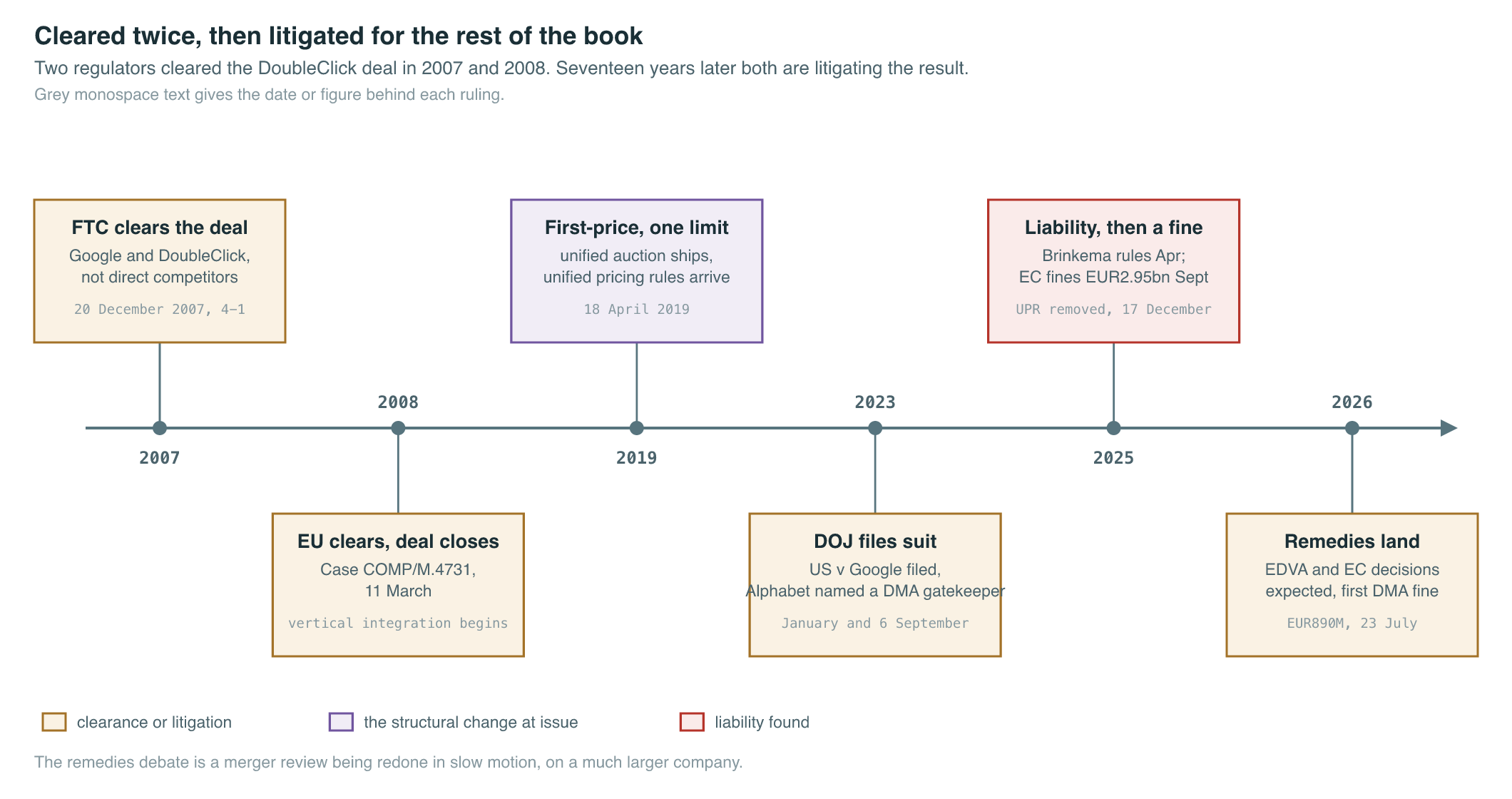
The DOJ and a group of plaintiff states filed United States v. Google LLC in the Eastern District of Virginia in January 2023 (DOJ Antitrust Division case page). After a bench trial, Brinkema found in April 2025 that Google had wilfully acquired and maintained monopoly power in two markets: publisher ad servers and ad exchanges for open-web display. She found the tying of AdX to DFP unlawful, describing the competition Google’s conduct left behind in terms like anemic and stifled. She did not find monopolisation of the advertiser-side ad-network market, which the DOJ had also pleaded. That partial outcome is often dropped from summaries and it matters, because it shapes which remedies are legally available.
The mechanism at issue is covered in depth in The Last Look: AdX sat inside DFP, could see the price to beat before bidding, and won impressions it would not otherwise have won. Header bidding and Prebid.js emerged from 2015 onward as the industry’s engineering workaround (Prebid.org), and Open Bidding was Google’s server-side absorption of it. Google gave up last look in April 2019 when Ad Manager moved to a unified first-price auction, and simultaneously introduced unified pricing rules, which removed publishers’ ability to set bidder-specific floors (Google Ad Manager blog, March 2019). One concession, one new constraint, announced together.
Two corrections to carry into any discussion of this case. First, the Jedi Blue agreement, alleged by Texas and nine other states to be a deal in which Meta abandoned header bidding in exchange for preferential Open Bidding terms, was dismissed: Judge P. Kevin Castel found valid business justifications for the arrangement (In re Google Digital Advertising Antitrust Litigation, S.D.N.Y.). Citing it as proven conduct is wrong. The stronger opacity evidence is Project Bernanke, where state attorneys general alleged Google ran auctions on mechanics materially different from what it described publicly. Second, AdSense was never merged into Google Ad Manager. It survived the 2018 rebrand as a distinct product and demand source, and it is what free-tier Ad Manager publishers get instead of AdX access.
The DOJ’s Theory: Separate the Layers
The DOJ’s remedies position treats vertical integration itself as the harm. If one company owns the publisher ad server, owns the exchange, and controls the auction that runs between them, then no rule about how it behaves can fully remove the incentive to favour itself. The only durable fix is to remove one of the layers.
Concretely, the DOJ asked for divestiture of AdX, on a timeline around fifteen months, plus open-sourcing the final auction logic so publishers and rivals can verify how impressions are actually awarded, plus a phased divestiture of the DFP side of Google Ad Manager as a fallback if exchange divestiture alone proves insufficient (DOJ case filings).
The open-sourcing element is the more interesting half, and it is under-discussed. The industry already ran this experiment: Prebid.js was written in early 2015 by engineers at AppNexus and Aplus, and Prebid.org was established in September 2017 as an independent, dues-funded steward. An auditable auction, maintained in public, turned out to be a workable competitive response to an opaque one. The DOJ’s proposal is essentially to compel for AdX what publishers built voluntarily for header bidding. The strongest empirical fact behind the whole case supports that framing: AdX’s take rate has sat around 20 percent since 2009, while independent exchanges compete at a fraction of that. A price that does not move for fifteen years in a market with entrants is the cleanest monopoly-rent evidence in the record.
Google’s Counter: Make the Layers Behave
Google’s remedies offer is behavioural throughout. It concedes conduct restrictions and information asymmetries while keeping the corporate structure intact.
The package included exposing real-time bid data to rival exchanges and publishers, building server-to-server interoperability between DFP and Prebid so publishers can route Google demand through an auction Google does not control, accepting injunctions against specific named practices including unified pricing rules, First Look, and Last Look, and providing data files to publishers on request.
Brinkema’s own scepticism cut in Google’s direction on structure. She questioned divestiture at what she called an abstract level, noted the absence of an obvious buyer with the capability to operate AdX at scale, and observed that AI-driven changes to advertising could reshape the market before any remedy took effect. That last point is genuinely difficult. Remedies in technology markets are slow, and the market they were designed for may not exist by the time they bind.
Google also made one concession outside the courtroom that is worth logging, because it shows how enforcement pressure translates into product changes without any order being issued. On 17 December 2025, Google removed unified pricing rules from Ad Manager, restoring publishers’ ability to set bidder-specific price floors (Google Ad Manager Help: unified pricing rules). UPR had been introduced in 2019 alongside the first-price move, capped publishers at 100 rules, and was one of the practices the DOJ specifically targeted. Google gave it back voluntarily, six years later, while both the US and EU proceedings were live.
| DOJ position | Google’s counter-offer | European Commission position | |
|---|---|---|---|
| Core theory | vertical integration is the harm | conduct is the harm, structure is fine | self-preferencing creates structural conflicts of interest |
| Primary ask | divest AdX, roughly 15 months | no divestiture | divestment as a preliminary view, not yet ordered |
| Transparency | open-source the final auction logic | expose real-time bid data, data files on request | more AdX bid data to rivals, per-bidder minimum prices |
| Interoperability | not the central ask | server-to-server DFP to Prebid | auction adjustments |
| Fallback | phased GAM divestiture | injunctions against UPR, First Look, Last Look | behavioural package under assessment |
| Status by mid-2026 | remedies order expected, then appeals | rejected structural remedies, 13 November 2025 | final remedial decision expected H1 2026 |
Brussels Runs a Different Experiment
The European Commission reached a parallel conclusion on a separate legal basis. Case AT.40670 concluded on 5 September 2025 with a €2.95 billion fine and an order to end self-preferencing of AdX, which the Commission found had been occurring since at least 2014 (European Commission, Case AT.40670). Google was given 60 days to submit a compliance plan. The Commission stated a preliminary view that only divestment may be capable of removing the conflict of interest, which is a stronger structural signal than a fine alone conveys.
Google’s response, filed 13 November 2025, rejected structural remedies and offered behavioural ones: per-bidder minimum prices, increased AdX bid data disclosure to rival exchanges, and specified auction adjustments (Google Europe blog). A redacted version of the decision was published on 14 January 2026. A final remedial decision was expected in the first half of 2026.
The difference between the two tracks is not really about severity. It is about instrument. A US court in an antitrust case is asking what relief restores competition in a defined market, subject to the evidentiary record and the specific findings of liability. The Commission is applying Article 102 and, separately, operating a standing regulatory regime under the Digital Markets Act that can impose forward-looking obligations without proving a market definition each time. The DMA route is faster and more granular. The Article 102 route can reach structure.
There is also a historical irony neither track can undo. The DoubleClick acquisition that created this architecture was cleared by the FTC on 20 December 2007 (FTC closing statement) and by the European Commission on 11 March 2008 as Case COMP/M.4731 (European Commission, Case M.4731). Both regulators looked at a $3.1 billion deal combining an advertiser-side auction business with the dominant publisher ad server, and both let it through. Seventeen years later, both are litigating the result. The remedies debate is, in part, a merger review being redone in slow motion, at far higher cost, on a company several orders of magnitude larger.
The Pressure Is Broadening
Ad tech is no longer the only front. On 23 July 2026 the Commission issued the first fine ever levied under the Digital Markets Act: €890 million against Alphabet, split between €460 million for self-preferencing in Search results and €430 million for restricting app developers from steering users to offers outside Google Play, with 60 days to remedy (European Commission, Digital Markets Act). It is the largest DMA penalty to date, and it lands on core platform services rather than on the advertising stack.
Read alongside the AT.40670 fine and the EDVA liability finding, the pattern is that enforcement has stopped treating Google’s advertising business as a special case and started treating self-preferencing as a general behaviour to be policed wherever the same company controls a marketplace and competes inside it. That framing is what makes the ad tech remedies consequential beyond ad tech.
One counter-example argues for humility about how much any of this will change. The third-party cookie deprecation was, for four years, the most confidently predicted change in digital advertising. Chrome announced a two-year phase-out in January 2020. Privacy Sandbox proposed replacements: Topics, Protected Audience, Attribution Reporting. The UK Competition and Markets Authority took commitments from Google in February 2022 that gave a regulator effective veto over the timeline (CMA, Privacy Sandbox case page). Then Google pivoted to a user-choice model in July 2024, announced in April 2025 that Chrome would not block third-party cookies by default and would not ship the choice prompt either, and wound Privacy Sandbox down in October 2025 after six years (Privacy Sandbox news). Privacy Sandbox is discontinued, not ongoing, and third-party cookies were never actually deprecated in Chrome.
The industry rebuilt itself around a deadline that never arrived, and the rebuild stuck anyway. Server-side tagging, first-party endpoints, hashed identity matching, warehouse-centric measurement: all of it was built for a cookie apocalypse that got cancelled, and none of it got rolled back. That is the honest base rate for predictions about what the remedies will do.
What a Post-Remedy Stack Would Actually Mean
This book opened with a single claim: that Google sits on both sides of the table, and that nearly everything strange about the products follows from that one fact (One Company, Both Sides of the Table). Twenty-three chapters later, that claim has been the explanation for most of what we found. Two conversion-measurement systems that disagree, because Urchin and DoubleClick were bought eleven years and one strategy apart. An exchange that could see the price to beat, because it lived inside the ad server. A consent specification written to satisfy a competition regulator rather than a privacy one. A take rate that did not move for fifteen years. None of those are engineering accidents. They are what one company owning both sides looks like from the inside.
So what changes if a court finally separates the layers?
Less than the headlines will suggest, and more than sceptics expect. If AdX is divested, publishers get an exchange whose incentives are not aligned with a specific demand source, which mainly means floor pricing and yield management become games with fewer hidden rules. If the final auction logic is open-sourced, the largest single information asymmetry in open-web display disappears, and everyone who buys or sells programmatically can finally reconcile what they were told against what happened. If unified pricing rules stay dead, price discrimination returns as a legitimate publisher tool. Those are real changes to daily practice, and they are all changes to auditability rather than to volume. Nobody’s CPMs move because of a divestiture order.
What almost certainly does not change is the demand concentration. Google Ads advertiser demand is the reason Ad Manager became the default publisher server, and a divested AdX still needs that demand to be worth buying. Nor does the identity architecture change: hashed first-party matching against a signed-in account graph, described in Join Keys, is untouched by any remedy on the table, and it structurally favours whoever has the most logged-in users. A structural remedy on the sell side does not weaken a buy-side identity advantage.
The practical guidance for anyone operating in this stack is therefore unglamorous. Build for auditability now, because that is the direction every remedy points, and the teams already reconciling platform-reported numbers against their own warehouse will be the ones who can act on new transparency when it arrives. Assume the join keys will change again, because they always have. Treat regulatory events as roadmap events, because Consent Mode v2 and the December 2025 UPR removal both show platform behaviour changing on enforcement timelines, not product timelines. And read the remedy orders when they land rather than the coverage of them, because the difference between what was alleged, what was found, and what was ordered is exactly where the operational consequences hide.
Everything in this chapter is provisional. The EDVA remedies order, the Commission’s final AT.40670 decision, and the years of appeals that follow both will have moved by the time this is read, and possibly moved a long way. The full chronology, with sources for every date used across the book, is in Timeline and Reading List. What will not have moved is the reason any of it was necessary. In 2007 and 2008, two regulators looked at a company proposing to own the advertiser’s auction, the publisher’s ad server, and the exchange in between, and decided that was fine. Everything in this book is what happened next.
Key Sources
| Source | Author/Org | Year | Link | Why it matters |
|---|---|---|---|---|
| United States and Plaintiff States v. Google LLC (ad tech) | US DOJ Antitrust Division | 2023–2026 | justice.gov | Primary docket for the EDVA liability finding and the remedies phase |
| Case AT.40670, Google adtech | European Commission | 2025 | competition-cases.ec.europa.eu | The €2.95bn fine, the self-preferencing order, and the divestment preliminary view |
| Digital Markets Act | European Commission | 2026 | digital-markets-act.ec.europa.eu | The €890m July 2026 fine showing enforcement broadening beyond ad tech |
| Case COMP/M.4731, Google/DoubleClick | European Commission | 2008 | competition-cases.ec.europa.eu | The 11 March 2008 clearance that created the architecture now being litigated |
| Statement on the Google/DoubleClick investigation | US Federal Trade Commission | 2007 | ftc.gov | The 20 December 2007 US clearance of the same deal |
| In re Google Digital Advertising Antitrust Litigation | S.D.N.Y. (MDL 3010) | 2022–2025 | CourtListener | Where the Jedi Blue claim was dismissed, which is why it should not be cited as proven |
| Simplifying programmatic: first price auctions for Google Ad Manager | Google Ad Manager blog | 2019 | blog.google | The April 2019 first-price move that ended last look and introduced UPR together |
| Unified pricing rules | Google Ad Manager Help | 2025 | support.google.com | The floor-pricing constraint Google introduced in 2019 and removed on 17 December 2025 |
| Prebid.org | Prebid.org | 2017– | prebid.org | The voluntary open-source auction that the DOJ’s open-sourcing remedy would compel |
| Google Europe blog | 2025 | blog.google | Google’s 13 November 2025 rejection of structural remedies and behavioural counter-offer | |
| Investigation into Google’s Privacy Sandbox browser changes | UK Competition and Markets Authority | 2022– | gov.uk | The February 2022 commitments that gave a regulator veto over cookie deprecation |
| Privacy Sandbox news | 2025 | privacysandbox.com | The April and October 2025 announcements that ended the initiative without deprecating cookies |
PM Lens
Papers referenced
- United States and Plaintiff States v. Google LLC (ad tech) US Department of Justice, Antitrust Division · 2023
- Case AT.40670: Google adtech European Commission · 2025
- Digital Markets Act: enforcement and compliance European Commission · 2026
- Case COMP/M.4731: Google/DoubleClick European Commission · 2008
- Federal Trade Commission closes Google/DoubleClick investigation US Federal Trade Commission · 2007
- In re Google Digital Advertising Antitrust Litigation (MDL 3010, S.D.N.Y.) United States District Court, Southern District of New York · 2022
- Simplifying programmatic: first price auctions for Google Ad Manager Google Ad Manager blog · 2019
- Unified pricing rules Google Ad Manager Help · 2025
- Prebid.org Prebid.org · 2017
- Google Europe blog Google · 2025
- Investigation into Google's Privacy Sandbox browser changes UK Competition and Markets Authority · 2022
- Privacy Sandbox news and announcements Google · 2025