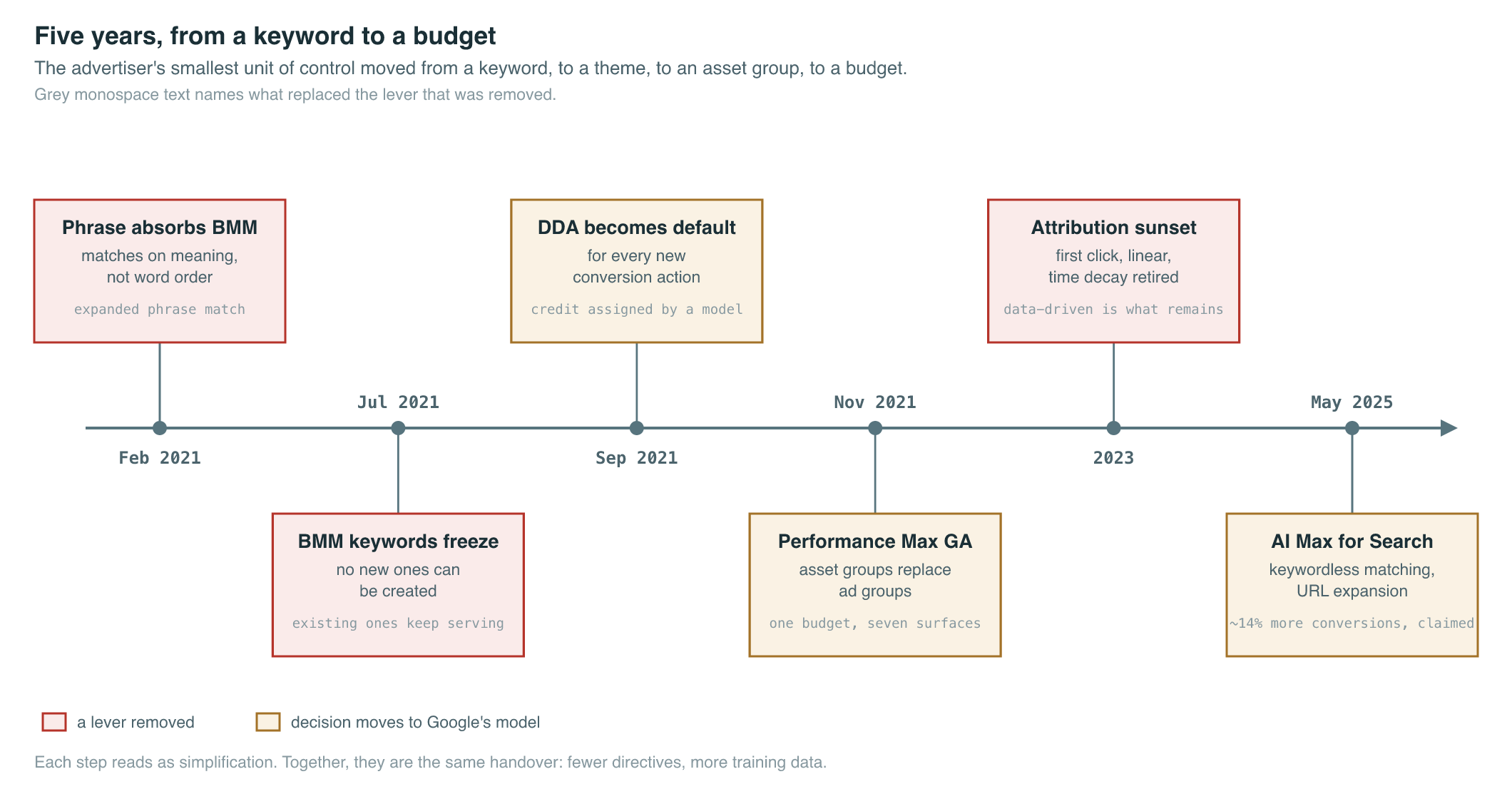
In February 2021 Google published a support page announcing that broad match modifier keywords were going away. Every account manager who read it understood immediately what it meant for their build. Broad match modifier was the match type you used when you wanted reach without abandoning control: prefix each required term with a plus sign, and Google had to include those terms, in any order, before it could match. It was the compromise setting. Its removal left three match types where there had been four, and it started a five-year sequence in which the advertiser’s smallest unit of control moved from a keyword, to a theme, to an asset and a budget.
Four Match Types Became Three
The phase-out ran on a published schedule. Starting in February 2021, phrase match began absorbing broad match modifier behavior, matching queries that included the meaning of the keyword regardless of word order. From July 2021, no new broad match modifier keywords could be created, though existing ones kept serving under the expanded phrase-match logic (Google Ads Help; Optmyzr).
Google framed this as simplification, and on the surface it was. Two match types that behaved similarly collapsed into one. The practical effect was different. Broad match modifier let you specify which words were mandatory. Expanded phrase match matches on meaning, and meaning is Google’s judgment, not yours. A keyword stopped being a filter you wrote and became a hint you supplied. The negative keyword list, always the unglamorous half of account structure, became the only place an advertiser could still say “not that” with precision.
It is worth being concrete about what was lost, because the loss is easy to under-describe. A travel advertiser running +cheap +flights +tokyo was guaranteed all three concepts in any matched query. Word order was free, synonyms were not. After the change, the same intent expressed as a phrase match keyword could pull queries about budget airlines to Osaka, or Tokyo hotel deals, because a system that matches on meaning has to decide where one meaning ends and a neighbouring one begins. Some of those extra queries convert. Some of them are a different business. The advertiser no longer gets to draw that line, only to observe where Google drew it and add negatives afterward.
That shifts the operating rhythm of an account. Under broad match modifier, account structure was a design activity done up front. Under expanded phrase match, it became a maintenance activity done continuously against the search terms report. The work did not shrink. It moved from specification to cleanup.
Five months after the modifier died, Google shipped the campaign type that removed keywords from the picture entirely.
One Campaign, Every Surface
Performance Max went generally available in November 2021, after a beta that ran through 2020 and 2021. One campaign, one budget, one bid goal, serving across Search, Shopping, Display, YouTube, Discover, Gmail and Maps (Search Engine Land).
The structural change is in the container. A classic Search campaign contains ad groups, and an ad group contains keywords and ads. Performance Max replaces the ad group with an asset group: a bundle of headlines, descriptions, images, logos and videos, plus listing groups that select which products from a Merchant Center feed are in scope, plus audience signals. The word “signal” is doing precise work there. An audience signal is not targeting. It does not restrict who sees the ad. It is a hint about where the model should start looking, and Google is explicit that the system will go beyond it.
Read the whole thing as a data-format change. Advertiser inputs used to be instructions: show this ad on this query at this bid. In Performance Max, advertiser inputs are training data. Assets are candidate creative for a model to combine and test. Audience signals are priors. The budget and the target cost per acquisition are the objective function. Nothing an advertiser supplies is a directive any more, with the single exception of the exclusion list.
The workflow consequences landed on agencies first. A search team’s deliverable used to be a build: keyword research, match type strategy, ad group segmentation, negative lists, bid tiers. Much of that artefact has no place to live in a Performance Max campaign. What replaced it is asset production, feed hygiene, conversion configuration and budget allocation across campaigns rather than within them. Teams that had spent a decade hiring for keyword craft found the scarce skills were now creative volume and data plumbing, neither of which sits naturally in a search practice.
That change also makes the product feed load-bearing in a way it never was for text search. Without a Merchant Center link, a retail Performance Max campaign cannot run at all, and once linked, product titles, prices, availability and GTINs become the metadata the model matches against. In a keywordless campaign, the feed is the keyword list, a dependency worked through in The Feed Is the API.
AI Max, or the Keyword as an Optional Extra
Performance Max was a separate campaign type. An advertiser who distrusted it could simply not use it and keep running keyword-based Search campaigns the way they always had. In May 2025 that escape route narrowed.
AI Max for Search launched as a one-click upgrade applied to existing Search campaigns. It adds keywordless matching, which finds queries your keyword list does not cover, dynamic ad copy generated against the query and the landing page, and URL expansion, which lets Google route a click to a page on your site other than the one you specified. Google’s claim at launch was roughly 14% more conversions or conversion value at a similar cost per acquisition (Google blog; Search Engine Land).
The delivery mechanism is the notable part. This is not a new campaign type sitting beside the old one. It is a toggle inside the campaign type that keyword purists retreated to. Turn it on and your keyword list stops being the boundary of what you buy. It becomes one input among several, sitting next to your landing page content and your historical conversion data.
URL expansion deserves separate attention, because it crosses a line the previous changes did not. Every prior step automated the buy. URL expansion automates the destination. Google reads your site, decides that a query is better served by a page other than the one attached to your ad, and sends the click there. For a large ecommerce site that is often correct and occasionally very wrong, because the pages a crawler judges relevant are not always the pages a merchandising team wants traffic on: out-of-stock categories, thin landing pages built for a discontinued promotion, legacy URLs kept alive for redirects. The practical consequence is that paid search now has a dependency on site hygiene that used to belong entirely to the organic team. A stale page that nobody linked to internally was previously harmless. It is now biddable inventory.
The 14% figure is a Google claim measured against Google’s own baseline, and it should be read the way any vendor uplift number is read. It is not a controlled experiment you ran on your account, and the comparison campaign is the one Google configured. It is still a meaningful signal about direction: Google is confident enough in keywordless matching to put a number on it and offer the upgrade as one click.
| Era | Unit of control | What the advertiser specifies | What Google decides |
|---|---|---|---|
| 2002 to 2020 | Keyword | exact query patterns, bid per keyword, ad copy | which eligible ad wins, at what price |
| 2021, expanded phrase match | Keyword as meaning | approximate intent, negatives, bid target | which queries share that meaning |
| Nov 2021, Performance Max | Asset group and audience signal | creative assets, feed scope, budget, goal | channel mix, query, audience, creative combination, bid |
| May 2025, AI Max | Campaign and budget | assets, goal, brand and negative exclusions | queries beyond the keyword list, ad copy, landing page |
Three Pressures That Made This Inevitable
It is tempting to read the sequence as Google simply taking control because it could. The commercial incentive is real, and it is the third pressure below. Two others are structural, and ignoring them makes the arc harder to understand than it needs to be.
The first is signal loss. Apple’s App Tracking Transparency and the long grind of third-party cookie restriction removed much of the deterministic linkage that manual bid rules depended on. A human bid adjustment of “minus 20% on mobile after 9pm” was always a crude proxy for a conversion-probability estimate. When the observable data behind that proxy thins out, a modeled estimate fed by first-party conversion data outperforms the rule, because the model can interpolate where the rule can only look up. Attribution moved the same way and on the same clock. In September 2021 data-driven attribution became the default for new conversion actions, with no minimum data requirement attached (AdExchanger). In 2023 Google retired first click, linear, time decay and position-based, citing adoption below 3%, leaving data-driven attribution and last click as the only surviving options (Search Engine Land). Credit assignment became modeled at the same time bidding did, and the model that assigns credit feeds the model that sets bids. This is the same pressure that reshaped measurement on the analytics side, covered in The Death of the Session, and the conversion import path between the two products is what feeds the bidding model its training labels.
The second is the shape of query volume. Search demand has an extremely long tail, and a large share of daily queries have never been typed before in that exact form. No keyword list can cover queries that do not yet exist. Exact and phrase match, by construction, can only monetize demand someone anticipated. Broad and keywordless matching monetize the rest. That is not a rhetorical advantage for Google, it is an arithmetic one, and it is why every step in this timeline moves toward looser matching rather than tighter.
The third pressure is the one Google does not put in its blog posts. Each move shifts the control surface from advertiser to platform, and each move expands the set of impressions that can be billed. Performance Max did not just automate an existing buy. It merged seven surfaces into one budget line, which means budget an advertiser allocated to Search can now be spent on Display and YouTube inventory without a separate decision. Automation and inventory expansion arrived in the same release, and the industry noticed.
What the Advertiser Still Owns
Strip out what has been automated and the remaining levers are worth listing, because they are now the whole job.
Budget and goal are the primary controls. A target cost per acquisition or return on ad spend, set against a daily budget, is the main instruction the model receives, and moving those targets is the highest-leverage change most accounts can make.
Conversion definition is the second, and it is under-rated. The model optimizes toward whatever you told it a conversion is. If that is a form fill rather than a qualified lead, the model will efficiently buy you unqualified leads. Offline conversion import and value-based bidding exist to correct exactly this, and they are the difference between automation working for you and automation working precisely against you at scale.
Exclusions are the third: negative keywords, brand exclusions, placement and content exclusions. These are the only remaining inputs that Google treats as hard constraints rather than hints.
Creative assets are the fourth, and with keyword control gone they carry more weight than they used to. When the model chooses the query, the audience, the placement and the bid, the asset pool is one of the few places where an advertiser’s judgment still enters the system directly.
Experiment design is the fifth, and the only one that is genuinely new work. When you controlled the keyword, you could reason about causality by inspection: this keyword produced these sales. When the model chooses the query, the channel and the bid, the only reliable way to know whether a change helped is to withhold it from part of your spend and compare. Geographic holdouts, campaign-level experiments and staggered rollouts moved from advanced technique to basic hygiene between 2021 and 2025, because they became the only instrument left that measures anything the platform is not also grading.
The uncomfortable part of this list is that it is short, and that verifying whether any of it is working requires reporting the platform did not initially provide. For the first several years of Performance Max, an advertiser could not see which channel their budget went to or which queries triggered their ads. What happened to that complaint, and what Google eventually shipped in response, is the subject of Transparency as a Release Note.
Key Sources
| Source | Author/Org | Year | Link | Why it matters |
|---|---|---|---|---|
| About phrase match and broad match modifier changes | Google Ads Help | 2021 | help doc | Google’s own phase-out schedule for broad match modifier, February to July 2021 |
| Google Ads is phasing out modified broad match keywords | Optmyzr | 2021 | article | Practitioner reading of what the four-to-three match type collapse cost advertisers |
| Performance Max guide | Search Engine Land | 2022 | guide | Dates the November 2021 GA and documents asset groups, listing groups and audience signals |
| Introducing AI Max for Search campaigns | 2025 | blog post | Primary source for keywordless matching, URL expansion and the ~14% conversion claim | |
| Google Ads AI Max for Search spotted | Search Engine Land | 2025 | article | Independent confirmation of the May 2025 rollout and the one-click upgrade mechanic |
| Goodbye last-click attribution: Google Ads changes default to data modeling | AdExchanger | 2021 | article | Dates the September 2021 shift to data-driven attribution as the default |
| Google sunsets attribution models | Search Engine Land | 2023 | article | Records the 2023 removal of four attribution models, leaving DDA and last click |
Papers referenced
- About phrase match and broad match modifier changes Google Ads Help · 2021
- Google Ads is phasing out modified broad match keywords Optmyzr · 2021
- Performance Max: a guide Search Engine Land · 2022
- Introducing AI Max for Search campaigns Google · 2025
- Google Ads AI Max for Search spotted Search Engine Land · 2025
- Goodbye last-click attribution: Google Ads changes default to data modeling AdExchanger · 2021
- Google sunsets attribution models Search Engine Land · 2023