Every large advertiser has, at some point, run the consolidation exercise. Someone in finance notices there are four demand-side platforms on the vendor list, each with its own seat fee, its own tech tax, and its own reporting interface that disagrees with the other three. A rationalization project starts. The shortlist gets built, the competitive DSPs pitch hard, and the case for cutting the Google seat is usually strong on price and always strong on principle.
Then someone asks the question that ends the exercise: what happens to the YouTube budget?
There is no good answer, because there is no substitute path. That single unanswerable question is why Display & Video 360 sits on media plans belonging to companies that would genuinely prefer to buy elsewhere. It is not a switching cost in the ordinary sense. Switching costs can be paid. This is an access problem, and access is not for sale.
The Line Item That Only Exists in One DSP
In DV360, YouTube is not a targeting checkbox you tick on a video line item. It is its own line-item type. When you create a YouTube & partners line item, you get a different object with different rules, different creative requirements, and its own inventory-source controls covering YouTube, Google TV, and YouTube Video Partners (DV360 Help: YouTube & partners).
That is an architectural statement, not a UI convenience. Google modeled owned-and-operated video inventory as a first-class buying primitive inside its DSP, alongside but distinct from the open-auction primitives that bid into exchanges. There are variants: YouTube & partners on CTV for the living-room screen (DV360 Help: CTV), and audio line items for the streaming-audio inventory Google sells (DV360 Help: audio).
No competing demand-side platform has an equivalent object, because none of them has a path to the inventory it addresses. A third-party DSP bidding into open exchanges can reach an enormous amount of web and app video. It cannot construct a line item that buys YouTube.
Operationally, these line items behave less like programmatic buys and more like a booking on a broadcast network. The creative is a video hosted on YouTube rather than a tag you hand to a publisher, so the asset lives inside Google’s system before the campaign starts. Format choices, skippable and non-skippable and in-feed placements, come from YouTube’s inventory rules rather than from an exchange’s specification. Brand-safety control comes from Google’s inventory and content-suitability modes rather than from whichever third-party verification vendor an advertiser has standardized on. Each of those is a small loss of independence, and buyers accept all of them, every time, because the alternative is not buying the largest video audience in the world.
| Inventory | Google Ads | DV360 | Third-party DSP |
|---|---|---|---|
| YouTube in-stream and in-feed | Yes | Yes, via YouTube & partners line items | No |
| YouTube on connected TV | Yes | Yes, via the CTV line-item variant | No |
| Google TV as an inventory source | Limited | Yes, as a toggle on YouTube line items | No |
| Open-web display and video via exchanges | Limited | Yes, open auction, PMP and PG | Yes |
| Non-Google CTV inventory | No | Yes | Yes |
| Digital out-of-home | No | Yes | Varies |
Read the first three rows and the last three together. A competing DSP can match DV360 on the bottom half of that table, sometimes beat it on execution or on fee transparency. It cannot compete at all on the top half. So the consolidation exercise never resolves into “pick one.” It resolves into “keep DV360 for YouTube, and argue about who gets the rest.”
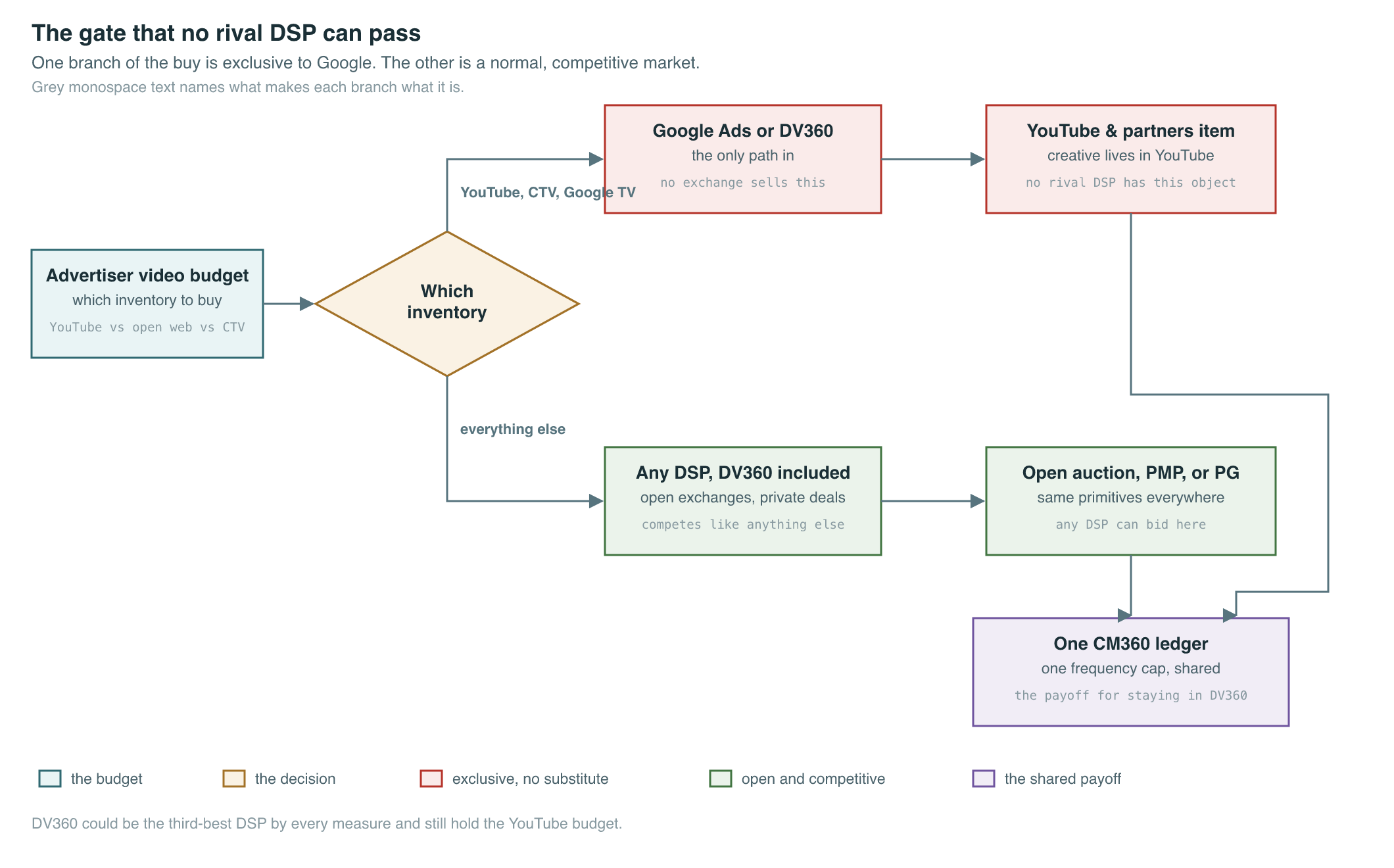
The last node in that diagram is the part enterprises actually pay for. Because the YouTube buy and the open-web buy live in the same DSP, they share frequency management, they roll into the same insertion-order structure, and they reconcile into the same Campaign Manager 360 ledger described in Two Layers, One Ledger. Split YouTube into Google Ads and the rest into a competing DSP and you keep the inventory access but lose the unified frequency cap and the single planning surface. That is a real operational cost, paid every quarter, by anyone who tries the split.
Why This Is Structural and Not Contractual
The important distinction for anyone modeling Google’s competitive position is that this moat is not a pricing advantage or a favorable deal term. Those erode. Contracts get renegotiated, take rates get compressed, and a competitor with better technology can win on both.
YouTube is owned-and-operated inventory, and Google sells it through its own buying surfaces. The demand-side platforms in the rest of the market reach inventory by bidding into exchanges, and there is no exchange path to YouTube for them to bid into. The moat therefore has nothing to do with how good DV360 is. DV360 could be the third-best DSP on the market by every technical measure and still hold the YouTube budget, because the alternative is not a worse DSP, it is no YouTube.
This is also the cleanest example in the whole stack of a principle worth stealing: the most durable product advantages come from access to something, not from being better at something. Feature parity is achievable. Inventory parity is not, when the inventory is owned by the counterparty.
Google is not unusual in owning an audience and selling access to it only through its own front door. Every large closed platform does the same, and the industry has a settled word for the arrangement. What makes DV360 unusual is that it is a walled garden which also functions as a general-purpose buyer of the open web. Most owners of premium inventory sell you a self-service tool that reaches their property and nothing else, so the buyer treats it as one more line on the plan. DV360 reaches its owner’s property and bids into exchanges for everybody else’s, which turns the exclusive inventory from a destination into a lever. You come for the thing you cannot get elsewhere, and while you are there the same seat will happily spend the rest of your budget.
The Split-Seat Workaround and Why It Loses
The obvious response is to refuse the lever: buy YouTube in Google Ads, buy everything else in the DSP you actually prefer, and keep the Google seat off the DSP line of the budget. Plenty of advertisers run this way. It works, and it costs more than it looks like it costs.
What you give up is not inventory, it is coordination. Frequency capping stops being a single control and becomes two independent controls that cannot see each other, which means your heaviest-viewing customers get the combined total of both caps. Audience suppression degrades the same way: a converter suppressed in one platform keeps receiving impressions from the other until both platforms independently learn. Budget shifts between video and the open web stop being a slider and become a two-sided negotiation between two teams on two tools with two reporting lags. None of these is fatal. All of them are recurring operational tax, and the tax is paid monthly while the seat fee you avoided was annual. Tagging everything into Campaign Manager 360 recovers the measurement half of the problem and none of the delivery half, because a shared ledger tells you afterward how often you over-served a household. It cannot stop you doing it.
Custom Bidding: The Escape Hatch Google Built on Purpose
Given that lock, the reasonable next worry is the one from the previous chapter: if the platform decides what to pay, and the platform also defines what “good” means, the advertiser is optimizing toward Google’s objective function rather than its own.
DV360’s answer is custom bidding. Alongside the standard algorithmic bid strategies, advertisers can supply their own scoring logic: a script that assigns a value to an impression opportunity using signals the advertiser chooses, frequently first-party signals routed in through Ads Data Hub and BigQuery (Adswerve). Instead of bidding to Google’s notion of a conversion, you bid to your notion of a qualified lead, a high-margin basket, a subscriber who does not churn in ninety days.
It is worth being precise about what this does and does not change:
- It changes the objective. The score being maximized is yours, expressed in your economics, computed from your data.
- It does not change the auction. Google still runs the auction, sets floors, and decides what inventory is offered.
- It does not change the observability. You define the score, and DV360 still reports how it performed. The measurement independence problem is solved in CM360, not here.
- It raises the skill floor. Custom bidding done badly is worse than the default strategy, because the default strategy at least has the benefit of Google’s aggregate calibration. Teams need someone who can write and validate the script, and organizations that lack that person should not turn it on.
Custom bidding is among the most under-used features in enterprise DV360 accounts, and the reason is organizational rather than technical: it requires a data team and a media team to agree on a definition of value and then maintain it. That is harder than accepting a default.
What the 2025 Ruling Did Not Touch
On 17 April 2025, Judge Leonie Brinkema in the Eastern District of Virginia found that Google had illegally monopolized two markets, the publisher ad server market and the open-web ad exchange market, and had unlawfully tied its publisher ad server to its exchange (Simpson Thacher, April 2025).
She also rejected one of the Department of Justice’s three markets. The DOJ had asked the court to recognize a market for “advertiser ad networks,” and the court declined to find it a cognizable relevant market (Courthouse News, April 2025). The buy side, DV360 included, came out of the liability phase substantially unscathed. Remedies proceedings ran through late 2025, with a divestiture decision expected in 2026 (AdExchanger).
The full ruling and the remedy fight get their own treatment in Remedies, and the sell-side conduct at issue is the subject of The Last Look. The point that belongs in this chapter is narrower, and it is about asymmetry.
Google’s sell-side integration was found illegal. Its buy-side position was not found to constitute a market at all. Whatever the remedy turns out to be, an AdX divestiture, behavioral commitments on DFP, or something narrower, none of the relief on the table opens YouTube inventory to competing demand-side platforms. The moat described in this chapter is untouched by the case that Google lost.
That is the asymmetry to hold onto. The part of Google’s ad business that got condemned is the part built by combining acquired assets into a conflicted intermediary. The part that survived is the part built on owning something nobody else can offer. Antitrust law is far more comfortable attacking the first structure than the second, and a strategist reading the 2025 ruling for lessons should take exactly that away.
Key Sources
| Source | Author/Org | Year | Link | Why it matters |
|---|---|---|---|---|
| About YouTube & partners line items | Google DV360 Help | 2025 | help | Documents YouTube as a distinct line-item type with its own inventory-source controls |
| YouTube & partners on CTV | Google DV360 Help | 2025 | help | Establishes the connected-TV variant that extends the moat to the living-room screen |
| About audio line items | Google DV360 Help | 2025 | help | Shows the same owned-inventory pattern applied to streaming audio |
| Elevate your advertising with CTV and YouTube using DV360 | Adswerve | 2024 | article | Practitioner account of custom bidding fed by first-party signals through BigQuery and Ads Data Hub |
| District Court Rules Google Is a Monopolist in Ad Tech | Simpson Thacher | 2025 | analysis | Legal summary of the 17 April 2025 liability findings on the publisher ad server and exchange markets |
| Judge hands Google partial defeat in ad tech monopoly case | Courthouse News | 2025 | report | Records the rejection of the DOJ’s “advertiser ad networks” market, which is why the buy side escaped |
| 2025: The Year Google Lost In Court And Won Anyway | AdExchanger | 2025 | article | Tracks the remedies phase and the expected timing of a divestiture decision |
PM Lens
Papers referenced
- About YouTube & partners line items Google Display & Video 360 Help · 2025
- YouTube & partners on CTV line items Google Display & Video 360 Help · 2025
- About audio line items Google Display & Video 360 Help · 2025
- Elevate your advertising with CTV and YouTube using DV360 Adswerve · 2024
- District Court Rules Google Is a Monopolist in Ad Tech Simpson Thacher · 2025
- Judge hands Google partial defeat in ad tech monopoly case Courthouse News Service · 2025
- 2025: The Year Google Lost In Court And Won Anyway AdExchanger · 2025