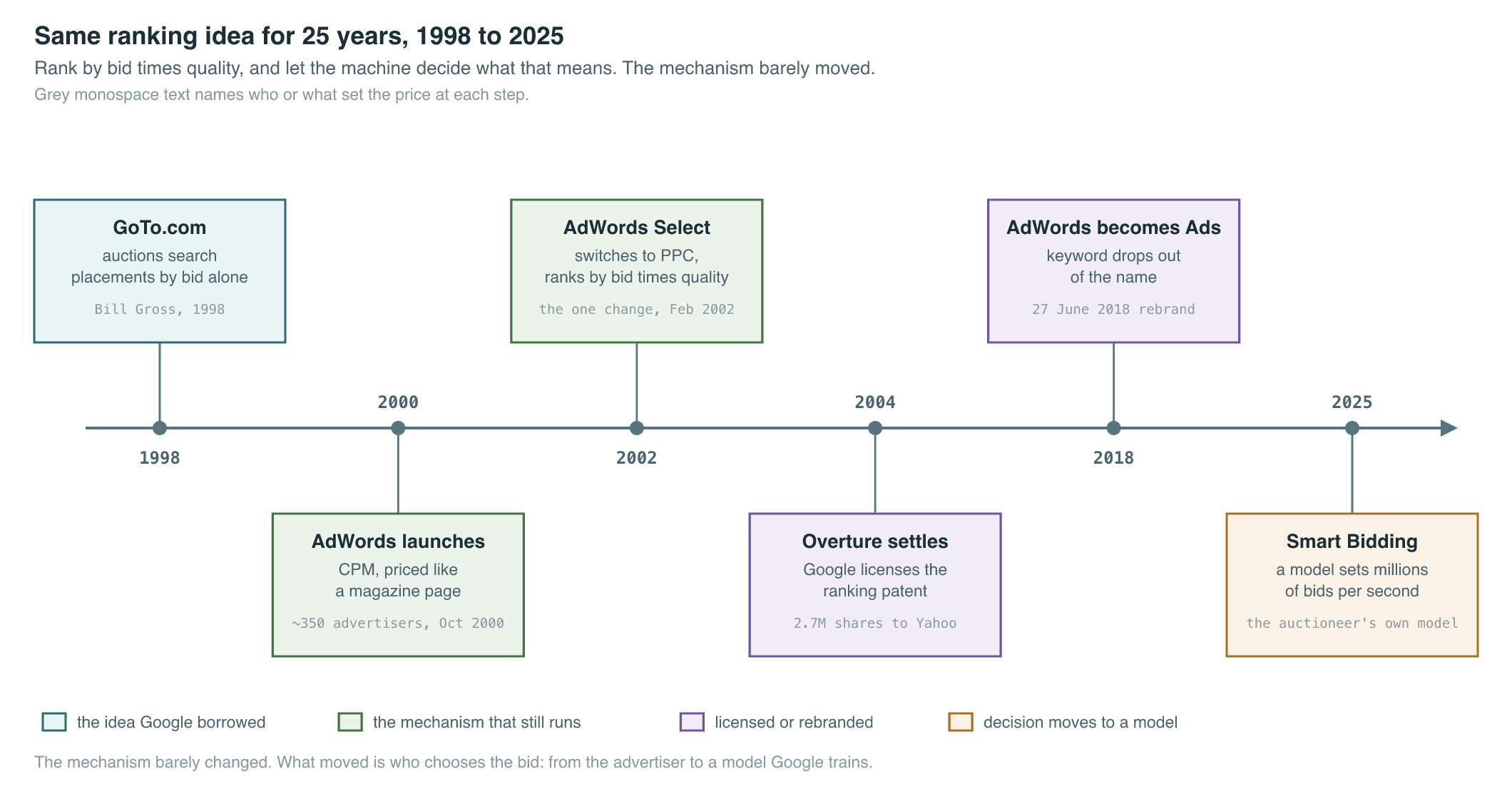
It is February 2002, and Google is changing how it charges for the narrow column of text ads beside its search results. The original AdWords, launched on 23 October 2000 with roughly 350 advertisers, sold those slots on a CPM basis: you paid for impressions, the way you would pay for a magazine page (PPC Hero). The replacement, AdWords Select, sold them by auction and billed per click. The idea was not Google’s. It belonged to Bill Gross, whose GoTo.com had been auctioning search placements since 1998 (Slate). What Google added was one change to the ranking rule. That change is still running today, a few hundred milliseconds at a time, on every commercial query the company serves.
The Model Google Took From Pasadena
GoTo.com’s auction was blunt. The highest bid took the top slot, the second-highest took the second, and so on down the page. Bill Gross had built it as a direct-response listing service, and it worked well enough that Overture, the renamed company, was the reference implementation of paid search when Google made its move.
Google’s modification was to rank by bid multiplied by a quality estimate rather than by bid alone. The commercial logic is arithmetic. A slot is sold per click but consumed per impression, so what a slot earns is bid times click-through rate. An advertiser bidding $0.50 with a 4% click rate earns Google more per thousand impressions than one bidding $1.00 with a 1% click rate. Ranking by bid alone leaves that money on the table. Ranking by bid times quality collects it, and as a side effect it pushes the ads users actually want toward the top. The alignment between revenue and relevance was real, and it was the reason Google’s version of a copied business model out-earned the original.
Overture sued for patent infringement in 2002, asserting US patent 6269361, “System and method for influencing a position on a search result list.” Google settled in 2004, issuing 2.7 million shares to Yahoo, which by then owned Overture, in exchange for a perpetual license (Wikipedia: Yahoo litigation). The auction Google runs today is legally descended from a patent it paid for in stock. In 2003 the Content Network, later renamed the Display Network, extended the same buying motion beyond the results page (Relevant Audience). The auction had stopped being a search feature and started being an advertising system.
What Ad Rank Actually Computes
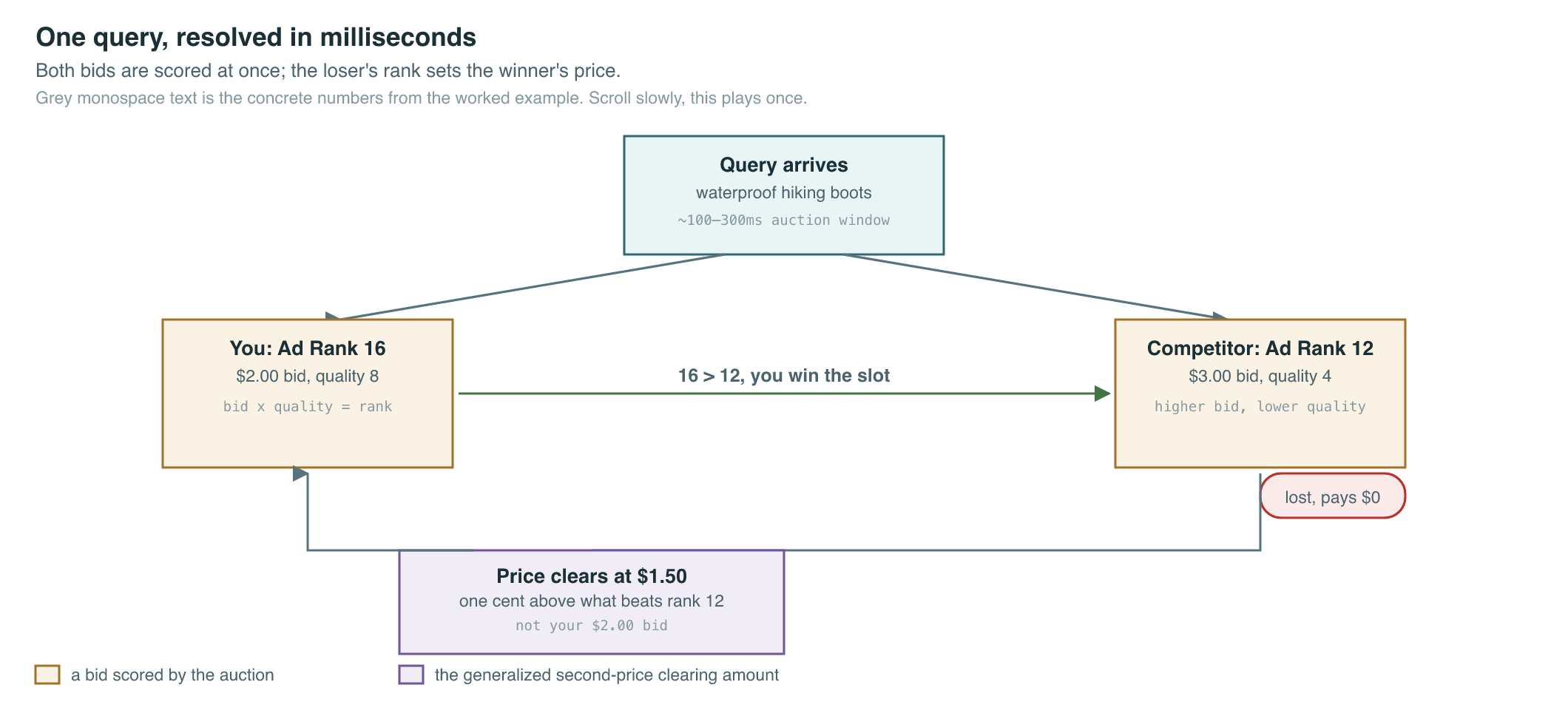
A commercial query today triggers a real-time auction that resolves in roughly 100 to 300 milliseconds. The value that decides everything is Ad Rank. It determines whether your ad is eligible to show at all, where it sits relative to other ads, and what you pay.
Google’s own documentation lists the inputs, and the list is longer than practitioner shorthand suggests: your bid, ad quality including expected click-through rate and relevance, landing page experience, the Ad Rank thresholds your ad must clear, the competitiveness of the auction, the context of the search including location, device, time of day and the nature of the query, and the expected impact of your assets and other ad formats (Google Ads Help: About Ad Rank). Ad Rank is computed twice per auction. Once to decide eligibility against the thresholds, and once to decide ordering among the ads that survived.
The thresholds matter more than most advertisers treat them. They are reserve prices that vary by context. A low-quality ad on a query where Google expects poor user experience can be priced out of the page entirely, no matter what the bid is. That is not a ranking outcome, it is an exclusion, and it is why raising a bid sometimes buys nothing at all.
Pricing is a generalized second-price mechanism, modified. You do not pay your bid. You pay the minimum amount that would have been needed to beat the Ad Rank of the advertiser immediately below you, rounded up by a cent. Written out, the price you pay falls as your own quality rises, because a higher quality multiplier means a lower bid clears the same Ad Rank. Quality is a discount, not just a ranking bonus, and it applies at every position on the page.
Put arithmetic on it and the incentive becomes obvious. Suppose you bid $2.00 with a quality multiplier of 8, giving an Ad Rank of 16. The advertiser below you bids $3.00 with a multiplier of 4, giving an Ad Rank of 12. You win the higher slot despite bidding a third less. Your price is whatever bid, at your multiplier of 8, would just clear their Ad Rank of 12, which is $1.50 plus a cent. Now double your quality to 16 and hold the bid. Your Ad Rank rises to 32, and your price falls to $0.75 and a cent, because it takes half as much money at that multiplier to clear the same competitor. The competitor’s bid never changed. Your cost per click halved because Google’s estimate of your ad improved.
This is why quality work has always paid twice in paid search: better position and lower price from the same budget. It is also why the number Google shows you for quality matters less than most advertisers assume, which is the subject of the next section.
| Overture, 1998 | AdWords Select, 2002 | Google Ads, 2025 | |
|---|---|---|---|
| Ranking rule | bid only | bid times quality estimate | Ad Rank: bid, quality, context, thresholds, asset impact |
| Pricing | pay your bid | generalized second price | generalized second price |
| Bid set by | advertiser, manually | advertiser, manually | Smart Bidding model, per auction |
| Unit of control | listing | keyword | goal and budget |
| Auction latency | batch listing order | real time | real time, roughly 100 to 300 ms |
Quality Score Is a Diagnostic, Not a Dial
Quality Score is the number every account manager has been trained to chase. It runs from 1 to 10, it is reported at keyword level, and it is built from three components: expected click-through rate, ad relevance, and landing page experience (Google Ads Help: Quality Score).
It is also not what the auction uses. Google states plainly that Quality Score is a diagnostic tool, an aggregate estimate of past performance under standardized conditions, and that the live auction uses query-time quality estimates instead. The reported 1 to 10 figure is a historical average. The auction looks at this query, on this device, in this location, right now.
The distinction has practical consequences. A keyword can carry a Quality Score of 5 and still win the top slot on a query where the live estimate is favourable, because the reported score averages across contexts that may have nothing to do with the auction in front of it. A keyword with a score of 9 can be priced out of a page entirely on a query where the landing page is a poor match for the specific intent. Neither outcome is a bug in the score. The score was never the input.
The folklore formula, Ad Rank equals Bid times Quality Score, is a simplification of a real relationship rather than a description of the mechanism. Quality genuinely multiplies into rank and genuinely discounts price. The reported score is not the multiplier. Treating it as one produces a familiar failure mode: teams optimize a dashboard number, watch it climb from 6 to 8, and see no movement in cost per acquisition, because the thing they improved was the summary statistic rather than the query-time estimate underneath it.
The Rebrand That Retired the Word “Keyword”
On 27 June 2018 Google announced the largest renaming in its advertising history, effective 24 July. AdWords became Google Ads. The DoubleClick advertiser stack became Google Marketing Platform. DoubleClick for Publishers and Ad Exchange merged into Google Ad Manager (Search Engine Land).
Marketing teams read it as brand simplification. It was also a statement about the product. “AdWords” is a promise about the unit of purchase: you buy words. By 2018 Google was already selling Shopping ads bought from a product feed, app campaigns with no keyword layer at all, and Display and YouTube inventory bought against audiences. The word in the name described a shrinking fraction of what the system sold. The consolidation of the DoubleClick brands into one advertiser platform and one publisher platform is the same story told at company scale, and it is the structural fact the Part I opener sets up: the same firm operating the buy side and the sell side of the same auction.
Who Chooses the Bid
Here is what did not change between 2002 and 2025. A query arrives. Eligible ads are scored on bid and quality plus context. The winner pays roughly what it took to beat the ad below it. Every sentence of that description was true in 2002 and is true now.
Trace one query through both eras and the continuity is almost eerie. Someone searches for waterproof hiking boots. In 2004 that query matched a keyword an account manager had typed into a list, probably as an exact match plus a couple of plural and misspelling variants, sitting in an ad group next to two hand-written text ads with a 25-character headline limit. The bid attached to that keyword was a number a person chose, reviewed on Monday mornings against a spreadsheet of last week’s cost per conversion, and adjusted by intuition and a rule of thumb. The auction took that number, multiplied it by Google’s quality estimate, ranked it, and charged the second-price clearing amount. The advertiser could read the whole chain afterward: this query, this keyword, this ad, this cost, this sale.
In 2025 the same query arrives and the chain looks different everywhere except at the auction itself. There may be no keyword. The query may be matched by a model against the advertiser’s landing page content, product feed and historical conversions rather than against a list. The ad may be assembled at serve time from a pool of headlines and descriptions. The bid is computed for that specific auction from device, time, browser, audience membership and predicted conversion probability, one of what Google describes as millions of unique bids set every second. Ad Rank then multiplies that bid by a quality estimate, ranks it, and charges the second-price clearing amount. The last sentence is the 2004 sentence, unaltered.
Here is what did change. In 2002 a human typed the bid into a text field, adjusted it on a weekly cadence, and reasoned about it from a spreadsheet of last month’s cost per conversion. Today Smart Bidding sets what Google describes as millions of unique bids every second, predicting conversion rate for each individual auction from contextual signals including device, time, browser, and remarketing list membership (Google Ads Help: About Smart Bidding). The advertiser supplies a target cost per acquisition or return on ad spend and a budget. The model supplies everything below that line.
The scale that runs through this pipe is the reason the shift matters. Google Search and other advertising revenue reached $224.5B in 2025, out of $294.7B in total Google advertising revenue (Alphabet FY2025 filings; Statista). The mechanism that allocates the large majority of that money is the same generalized second-price auction Google licensed from Overture. What moved is the location of the decision. The bid used to be an advertiser input. It became a model output, computed inside the same company that runs the auction and collects the clearing price.
That relocation is not a single event, and it did not stop at bidding. Over the following five years the same movement worked its way up the account structure, from the bid to the keyword to the campaign itself, which is the arc traced in From Keywords to Signals.
Key Sources
| Source | Author/Org | Year | Link | Why it matters |
|---|---|---|---|---|
| A History of Google AdWords and Google Ads | PPC Hero | 2023 | article | Dates the 23 October 2000 launch and the original CPM pricing model |
| Google’s Big Break: How Bill Gross’ GoTo.com Inspired the AdWords Business Model | Slate | 2013 | article | Establishes that pay-per-click search auctions were Overture’s invention, not Google’s |
| Yahoo litigation (Overture patent settlement) | Wikipedia | 2004 | entry | Records the 2.7M-share settlement that bought Google a perpetual license to the auction patent |
| History of Google Ads | Relevant Audience | 2023 | timeline | Dates the 2003 Content Network expansion beyond the results page |
| About Ad Rank | Google Ads Help | 2025 | help doc | Google’s own enumeration of auction inputs, thresholds, and the twice-computed rank |
| About Quality Score | Google Ads Help | 2025 | help doc | States the three components and that the score is a diagnostic, not the auction’s live input |
| Google is retiring the AdWords and DoubleClick brands | Search Engine Land | 2018 | article | Dates the 27 June announcement and 24 July 2018 effective rebrand across all three platforms |
| About Smart Bidding | Google Ads Help | 2025 | help doc | Describes auction-time bidding and the per-auction conversion-rate prediction |
| Alphabet FY2025 annual report | Alphabet / SEC | 2026 | filing | Sizes the revenue the auction allocates: $224.5B Search and other, $294.7B total ads |
Papers referenced
- A History of Google AdWords and Google Ads PPC Hero · 2023
- Google's Big Break: How Bill Gross' GoTo.com Inspired the AdWords Business Model Slate · 2013
- Yahoo litigation: the Overture patent settlement Wikipedia · 2004
- History of Google Ads Relevant Audience · 2023
- About Ad Rank Google Ads Help · 2025
- About Quality Score Google Ads Help · 2025
- Google is retiring the AdWords and DoubleClick brands in a major rebranding Search Engine Land · 2018
- About Smart Bidding Google Ads Help · 2025
- Alphabet FY2025 Annual Report Alphabet Inc. / SEC · 2026