Add up the conversions your buying platforms report and the total will exceed the number of orders your finance team booked. This is not a bug in anyone’s software. A customer sees a display ad on Tuesday, clicks a search ad on Thursday, and buys on Friday. DV360 counts a view-through conversion because it served the Tuesday impression. Search Ads 360 counts a click conversion because it drove the Thursday visit. The social platform counts one too, on its own attribution window and its own rules. Three platforms, three honest reports, one order. Every system that spends money also grades its own spending, and every one of them grades generously.
Google’s buy side solves this with a structural answer rather than a diplomatic one. There are two products, and they are deliberately not the same product. DV360 is where you buy. CM360 is how you serve creative and measure everything you bought, including what you bought somewhere else. Learn that sentence and most of the confusion about Google Marketing Platform evaporates.
Where You Buy: The DV360 Hierarchy
Display & Video 360 is a demand-side platform. It bids on inventory. It does not own inventory, and that distinction separates it cleanly from the sell-side products covered in The Last Look.
Its object model is five levels deep, and settings cascade downward: Partner → Advertiser → Campaign → Insertion Order → Line Item. The two levels that matter operationally are the bottom two. The insertion order is the budget container, holding flight dates and spend limits. The line item is the atomic buying unit, and it carries targeting, creative assignment, bid strategy, pacing, frequency capping, and brand-safety controls (DV360 API reference, XPON DV360 guide).
If you want to know what a DV360 campaign is actually doing, you read its line items. Everything above them is accounting and permissions.
The cascade is also where debugging starts, and this is the practical reason to memorize the five levels. Because settings inherit downward, a targeting exclusion applied at the Partner level silently constrains every line item underneath it, across every advertiser and every campaign, with no indication at the line-item screen that anything has been removed. A planner staring at a line item that will not spend is usually looking at the wrong level of the tree. The correct instinct is to walk up, not to widen targeting at the bottom, and any team running DV360 at scale needs a written rule about who is permitted to change anything at the Partner or Advertiser level.
Underneath the hierarchy sit three transaction types, and this is the mental model a product manager needs before arguing with anyone about programmatic:
| Transaction type | Price | Volume | Control | Typical use |
|---|---|---|---|---|
| Open auction / RTB | Set by auction | None guaranteed | Lowest | Maximum reach across Google Ad Manager plus third-party exchanges |
| Private Marketplace (PMP) | Negotiated floor, still auctioned | None guaranteed | Medium, buyer-specific deal ID | Premium inventory with invitation-only competition |
| Programmatic Guaranteed (PG) | Fixed | Guaranteed impressions | Highest | A direct insertion order executed over programmatic pipes, no auction |
Open auction reaches thousands of publishers through Google Ad Manager and through third-party exchanges including Microsoft Monetize, Magnite and PubMatic. Private Marketplace narrows that to an invitation-only auction against a negotiated floor, identified by a deal ID issued to a specific buyer. Programmatic Guaranteed removes the auction entirely: fixed price, fixed volume, which is a phone-and-fax media buy wearing programmatic plumbing (DV360 Help: Programmatic Guaranteed, Microsoft Learn: DV360 deal acceptance).
Channel coverage spans display, video, connected TV, audio and digital out-of-home. It also spans YouTube, through dedicated line-item types that no competing DSP can replicate, which is the entire argument of YouTube as the Moat.
What DV360 does not do is tell you the truth about your whole media plan. It cannot. It only sees what it bought.
How You Serve and Measure: CM360’s Four Pillars
Campaign Manager 360 is a web-based ad management system for advertisers and agencies, and Google’s own documentation organizes it around four functions (CM360 Help):
- Trafficking and ad serving. Creative hosting, versioning, rotation rules, and the generation of impression tags and click trackers that get handed to any media partner willing to take a tag.
- Verification. Checks on how impressions actually behaved: tag integrity, geographic targeting, content verification.
- Reporting. A single reporting surface across everything trafficked through CM360, not everything bought through one platform.
- Attribution Modeling Tool. Side-by-side comparison of credit-assignment models across channels, so the attribution rule becomes an explicit choice rather than a vendor default.
The load-bearing property is in pillar one. CM360 tracks any media that accepts a tag. Direct publisher buys, non-Google DSPs, social platforms via pixels, email, affiliate networks: if it will host an impression tag or route a click through a tracker, CM360 counts it (XPON CM360 guide). That is why CM360 has standalone value to advertisers who never open DV360 at all, and it is the reason the previous chapter’s point about acquisition order matters. The advertiser ad server was designed in an era of manually negotiated media, so it was built indifferent to how the media was purchased. That indifference is now its main feature.
Floodlight: One Tag Set, Three Platforms
The connective tissue is Floodlight, which Google describes as the conversion tracking system for Google Marketing Platform: a shared data layer spanning CM360, DV360 and Search Ads 360 using a single tag set (DV360 Help: About Floodlight).
The mechanics are worth being precise about, because this is where teams make expensive mistakes. The Floodlight configuration is the container, and it lives in CM360. Individual Floodlight activities, the specific events you want counted, can be created in CM360 or in Search Ads 360, and they synchronize across the platforms sharing that configuration (CM360 Help: Floodlight activities).
Activities come in two flavors, and choosing the wrong one is among the most common tagging errors in production accounts. A counter activity records that something happened: a page view, a signup, a video completion. A sales activity records a transaction and carries revenue and quantity, which is what makes return-on-spend reporting possible at all. A team that tags its checkout confirmation as a counter gets a conversion count and no revenue, discovers the gap a quarter later, and cannot retroactively repair the history because the values were never sent.
One container, one tag set, three platforms reading from it. That is what makes cross-platform conversion de-duplication possible. When the same user clicks a display ad and then a search ad before converting, the platforms are not each counting a private conversion from a private tag. They are reading one recorded conversion and disputing only how to divide credit for it, and the attribution model settles that dispute according to a rule the advertiser chose.
Be honest about the boundary of that guarantee, though, because it is narrower than the marketing implies. De-duplication works across the platforms sharing the Floodlight configuration. It does not work across platforms that refuse to accept a tag or to expose their own conversion events, which describes most of the large closed platforms an advertiser also buys. You get one clean ledger for the tagged portion of the plan and a manual reconciliation problem for the rest. That is a substantially better position than having no clean ledger anywhere, and it is not the same thing as a single source of truth for all media.
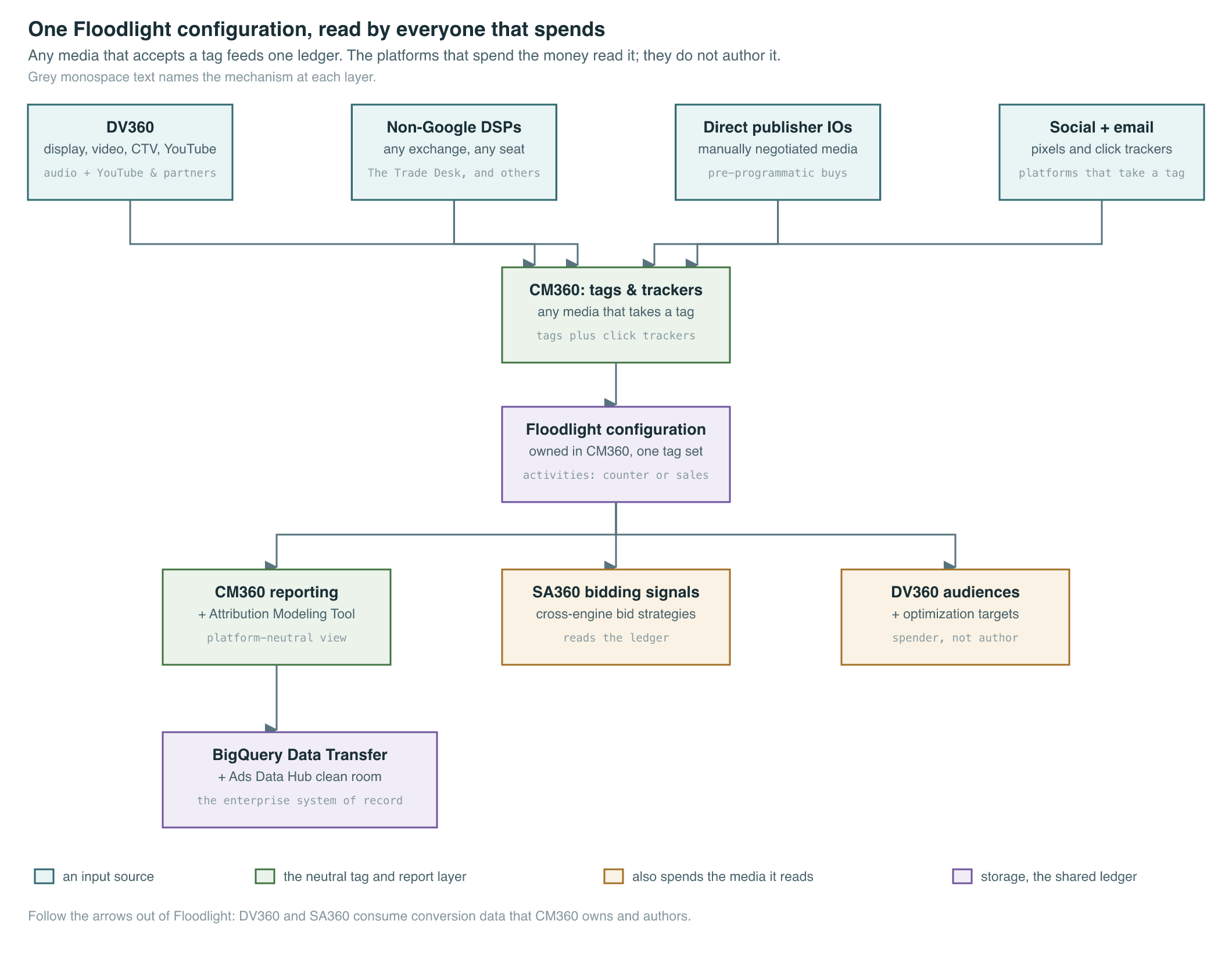
Note the direction of the arrows out of Floodlight. DV360 consumes conversion data that CM360 owns. The spender is a reader of the ledger, not its author.
The warehouse layer at the bottom of that diagram is where enterprises end up regardless of intentions. BigQuery Data Transfer Service pulls DV360 and CM360 Data Transfer files, which are impression, click and activity-level logs, into BigQuery, and Ads Data Hub provides the privacy-safe clean room for user-level joins Google will not expose as raw rows (Cardinal Path).
Never Let the System That Spends the Money Grade the Money
Strip the product names away and the pattern generalizes.
DV360 reports on DV360’s media and optimizes toward objectives DV360 controls. It is not dishonest. It is interested. Its reporting exists partly to justify its own allocation decisions, and a bid algorithm optimizing to a metric it also computes is an algorithm with a conflict of interest baked into its loss function.
CM360 reports on all tagged media, de-duplicates across it, and produces a platform-neutral view. It is the record-of-truth for an agency reconciling Google, Meta, The Trade Desk and a direct buy from a trade publication in the same spreadsheet (Improvado, DWAO).
| DV360 | CM360 | |
|---|---|---|
| Primary job | Buy inventory | Serve creative and measure |
| Scope of reporting | Media bought through DV360 | All media carrying a CM360 tag |
| Owns the Floodlight configuration | No | Yes |
| Neutral toward buying platform | No | Yes |
| Value if you leave Google’s DSP | None | Full |
The failure mode when teams ignore this split is predictable and slow. Reporting gets built on the DSP’s interface because that is where the media team already works and where the numbers refresh fastest. Optimization decisions follow the reporting. Six months later the quarterly business review shows platform-reported conversions that finance cannot tie to revenue, and nobody can reconstruct which decisions were made on which numbers. The argument that follows is never really about attribution windows. It is about the fact that no independent record of the campaign was ever kept, and by then the media has already run.
That last row is the governance argument, and it is the one to make in a procurement meeting. Because Floodlight configurations and creative assets live above the DSP, an advertiser can change demand-side platforms without re-tagging the website. The measurement layer is the portability layer. Google conceded this openly in its 2018 platform relaunch, where the pitch to advertisers was framed as taking what you want and leaving the rest (AdExchanger, 2018).
The general form of the rule is not about advertising at all. Never let the system that executes transactions be the system of record for evaluating them. Keep the payment processor separate from the reconciliation ledger. Keep the recommender out of the metrics store that decides whether the recommender works. Keep the deployment tool from owning the reliability dashboard. In each case the reason is identical: an executor’s telemetry is optimized for the executor’s story, and the moment it becomes the arbiter you lose the ability to detect when the executor is wrong.
Google built this correctly on the buy side, in part by accident of acquisition order. It notably did not build it this way on the sell side, where the ad server and the exchange ended up inside the same product with the same owner, which is the subject of Remedies.
The Naming Wrinkle Google Left Behind
One footnote that trips up every new hire on a Google Marketing Platform account.
On 27 June 2018, Google announced Google Marketing Platform and said Display & Video 360 “brings together features from” Bid Manager, Campaign Manager, Studio and Audience Center (Google, June 2018). Read plainly, that sentence says Campaign Manager was absorbed. It was not. The advertiser ad server survived as a separate, separately licensed product, renamed from DoubleClick Campaign Manager to Campaign Manager and then to Campaign Manager 360 in the later “360” suffix wave (Cardinal Path).
Google’s marketing collapsed a distinction that Google’s architecture carefully preserved. The architecture was right. If you inherited a media plan and cannot find the ad server because a 2018 blog post told you it was merged, this is why.
Key Sources
| Source | Author/Org | Year | Link | Why it matters |
|---|---|---|---|---|
| Display & Video 360 API: advertisers.lineItems | 2025 | reference | Authoritative definition of the line item as the atomic buying unit | |
| DV360 guide | XPON | 2024 | guide | Practitioner walkthrough of the Partner to Line Item hierarchy |
| About Programmatic Guaranteed deals | Google DV360 Help | 2025 | help | Defines fixed-price, guaranteed-volume buying without an auction |
| DV360 buyer deal acceptance workflow | Microsoft Learn | 2025 | docs | Third-party exchange view of how DV360 deal IDs are transacted |
| About Campaign Manager 360 | Google CM360 Help | 2025 | help | Source for the four pillars: trafficking, verification, reporting, attribution |
| About Floodlight | Google DV360 Help | 2025 | help | States that Floodlight is the shared conversion layer across CM360, DV360 and SA360 |
| Floodlight activities | Google CM360 Help | 2025 | help | Confirms the configuration lives in CM360 and activities sync across platforms |
| CM360 vs DV360 | Improvado | 2024 | analysis | Frames the neutrality difference between the two reporting surfaces |
| DoubleClick No More: Google Renames Its Ad Stack | AdExchanger | 2018 | article | Records the 2018 portability pitch that concedes the measurement layer is swappable |
| What is Google Campaign Manager 360 | Cardinal Path | 2023 | article | Documents the DCM to Campaign Manager to CM360 renaming the 2018 post obscured |
PM Lens
Papers referenced
- Display & Video 360 API v4: advertisers.lineItems reference Google · 2025
- DV360 guide XPON · 2024
- About Programmatic Guaranteed deals Google Display & Video 360 Help · 2025
- DV360 buyer deal acceptance workflow Microsoft Learn (Xandr Monetize) · 2025
- About Campaign Manager 360 Google Campaign Manager 360 Help · 2025
- About Floodlight Google Display & Video 360 Help · 2025
- Floodlight activities Google Campaign Manager 360 Help · 2025
- CM360 guide XPON · 2024
- CM360 vs DV360 Improvado · 2024
- CM360 vs DV360: key differences and when to use each DWAO · 2024
- Extracting data from Campaign Manager and Display & Video 360 Cardinal Path · 2023
- DoubleClick No More: Google Renames Its Ad Stack AdExchanger · 2018
- Introducing Google Marketing Platform Google · 2018
- What is Google Campaign Manager 360? Cardinal Path · 2023