The promise. In Chapter 3 you learned to read your revenue by geography and surface and decide where to fund density versus harvest for reach. Now you inherit the machine that sets the price on every one of those impressions — and the temptation to treat it as plumbing the engineers maintain. This chapter equips you to make the opposite move: to treat your ad auction as the single most consequential policy you own. Every quarter the auction silently decides whose ad wins, what a click is worth, and how much of the user’s attention you sell today versus protect for tomorrow. Those are not engineering defaults. They are your calls, and you will be asked to defend them to a board, to your biggest advertiser, and to a regulator. Book 1 taught you how a real-time auction clears (Chapter 3) and how floors and a yield curve shape it (Chapter 5). This chapter is about the dials you turn on top of that machine.
You will be able to:
- Decide how heavily to weight the user-value term in your ranking formula — and why competing it to zero is a mispriced trade.
- Reason about why a lower bid can and should win, and explain it to an advertiser who thinks they were robbed.
- Defend the use of reserve prices and non-truthful mechanisms as deliberate revenue tools, not bugs, especially once autobidders dominate your demand.
- Distinguish the auction parameters that belong on a board slide from the ones that belong to a launch review.
- Connect an auction-tuning decision to its four-quarters-out effect on ARPU and advertiser trust.
Builds on: Book 1 ch3 (the real-time auction, RTB) and ch5 (floors, the yield curve); Book 2 ch2 (the price × volume P&L) and ch3 (profit pools and where to fund pricing infrastructure). It opens Part II — The Core Engine, and sets up ch5’s argument that your durable moat now lives in the ML stack feeding this auction.
The call on Maya’s desk
Six weeks into the job, Maya gets a one-line message from her head of auction ML: “Ranking team wants to ship a +1.8% user-value weight bump in the EU. Revenue model says −0.9% short-term ad revenue. Need your sign-off by Thursday.”
Her instinct, trained at the challenger platform, is to ask the obvious question — why would I knowingly give up nine-tenths of a percent of revenue? — and then she catches herself. At her last company, with roughly 500M daily users and a thin North American base, a 0.9% revenue cut would have been a quarter-defining wound; the auction was tuned to extract every last cent because the platform could not afford patience. Here, against a 3.5B-person base where US&Canada users monetize at roughly 16× the Rest-of-World rate (Meta’s 2024 US&Canada annual ARPU ran about $233 versus about $14 RoW; ~$57 worldwide — Meta filings / Statista, 2024; treat as directional), 0.9% of EU revenue is real money but the long-run asset she is protecting — the willingness of billions of people to keep scrolling past her ads — is worth vastly more.
This is the chapter’s whole argument in one inbox message. The auction is not a fixed exchange rate she has inherited. It is a policy surface — a set of parameters that encode, every millisecond, how she balances the advertiser who is paying her this quarter against the user whose attention she needs for the next forty. The ranking team is not asking an engineering question. They are asking her to set monetary policy for an economy of trillions of auctions a day, and to own the result.
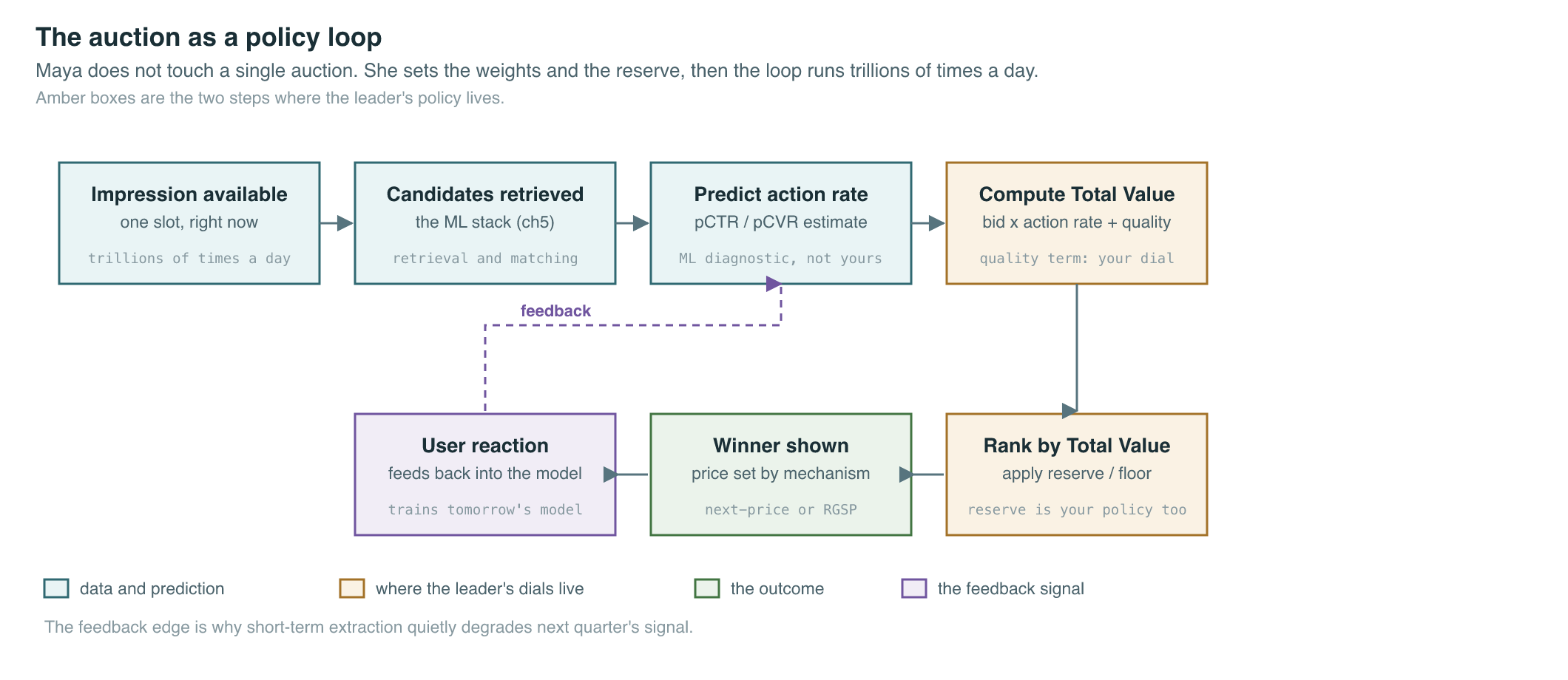
Figure 4.1 — The auction as a policy loop. The leader does not touch any single auction; she sets the weights and reserves in the boxed steps, then the loop runs trillions of times a day. The feedback edge (G→C) is why short-term extraction quietly degrades next quarter’s signal.
Why a lower bid wins — and why that is the point
Book 1 taught you the open-web second-price auction: highest bid wins, pays just above the runner-up. Inside your garden the formula is richer, and the difference is the strategy. Meta states its ad auction picks the winner by Total Value, defined as Bid × Estimated Action Rate + Ad Quality (Meta Business Help Center, ads auctions, 2025). Parse the three terms, because each is a different person’s lever:
- Bid — what the advertiser is willing to pay for the outcome. Their lever.
- Estimated Action Rate — your model’s prediction that this user will do the thing the advertiser is paying for (click, install, purchase). A diagnostic the ML team owns; it is the bridge between a per-outcome bid and a per-impression price.
- Ad Quality — your estimate of the ad’s value to the user: signals of relevance, post-click satisfaction, the absence of the things that make people put the phone down. This is your dial. It is the only term in the formula that represents someone who is not paying you today.
Because Total Value multiplies bid by predicted action rate and adds a quality term, a low bidder with a highly relevant, high-quality ad routinely beats a high bidder pushing a mediocre one. That is not a glitch in your auction. It is the auction doing exactly what you designed it to do: pricing the impression in the platform’s long-run currency — sustained engagement — rather than the advertiser’s short-run one.
You will have to defend this to Northwind, your large commerce advertiser, the first time they lose a placement they “outbid” someone for. The honest answer is: you bid more per click, but our model predicted fewer clicks and a worse experience, so your offer was worth less to the auction than the number you typed. Said well, this builds trust — Northwind learns the system rewards good ads, not just deep pockets, which is precisely the incentive that keeps your feed worth scrolling. Said badly, it sounds like a rigged casino. How clearly your account teams can explain Total Value is itself a trust lever, and trust is revenue infrastructure (we will see X’s counter-example shortly).
FIGURE 4.2 (spec): A side-by-side “auction card” UI mockup. Two advertiser tiles. Left: “Advertiser A — Bid $4.00, Est. Action Rate 1.2%, Ad Quality +0.6 → Total Value 5.4.” Right: “Advertiser B — Bid $6.00, Est. Action Rate 0.7%, Ad Quality −0.3 → Total Value 3.9.” A green “WINS” ribbon on the lower-bid Advertiser A. Caption: “The lower bid wins on predicted relevance and quality — the auction priced in the user, not just the dollar.” Alt-text: “Mockup showing a $4 bid beating a $6 bid because of higher estimated action rate and ad quality.”
The user-value term is the dial — and zero is the wrong setting
Now to Maya’s Thursday decision. The user-value (Ad Quality) term is a continuous weight, and the leader’s real question is never on or off but how heavy. Set it too light and you over-serve aggressive, low-quality demand: revenue ticks up this quarter, sessions get worse, and the feedback loop in Figure 4.1 degrades the very engagement that produces next year’s impressions. Set it too heavy and you leave money on the table that a healthier feed did not actually need you to leave.
The trap is that the cost of setting it too light is invisible in the quarter you set it. Revenue is up; the engagement erosion shows up two or three quarters later as a soft decline in sessions per user that no single dashboard attributes back to the auction. This asymmetry — extraction pays now and visibly, protection pays later and diffusely — is exactly why the call cannot be delegated to a team whose quarterly metric is revenue. It has to sit with the leader who owns both the revenue line and the engagement line.
Meta institutionalizes this as the engagement-versus-extraction trade-off at the most senior level, reporting it through two paired metrics: DAP (Daily Active People — unique users across the app family per day) beside ARPP (Average Revenue Per Person — how much each of those people monetizes). Family Daily Active People averaged 3.56B in March 2026, up only ~4% YoY, even as Family-of-Apps ad revenue grew far faster — $55.0B in Q1 2026, +33% YoY (Meta Q1 2026 results, Apr 2026). With user growth in the mid-single digits while revenue grows 30%+, the leader’s lever is yield and load per person (rising ARPP), not raw headcount (DAP) — and the auction’s user-value weight is the governor that keeps that yield from eating the engagement it depends on. Decompose that same quarter and the price × volume identity is doing the work on both sides: impressions +19%, average price per ad +12% worldwide (Meta Q1 2026, Apr 2026). The auction is the machine that sets the +12%; the user-value term is what stops the +12% from quietly costing you next year’s +19%.
So Maya signs off on the EU bump. Her defense is not “the model said so.” It is: we are not revenue-constrained at the margin; we are engagement-constrained over the horizon. A 0.9% short-term EU revenue cost to buy a measurably better feed in our second-largest profit pool is a cheap option on four quarters of retained impressions. I would not make this trade at the challenger; I make it here because the long-run asset is bigger.
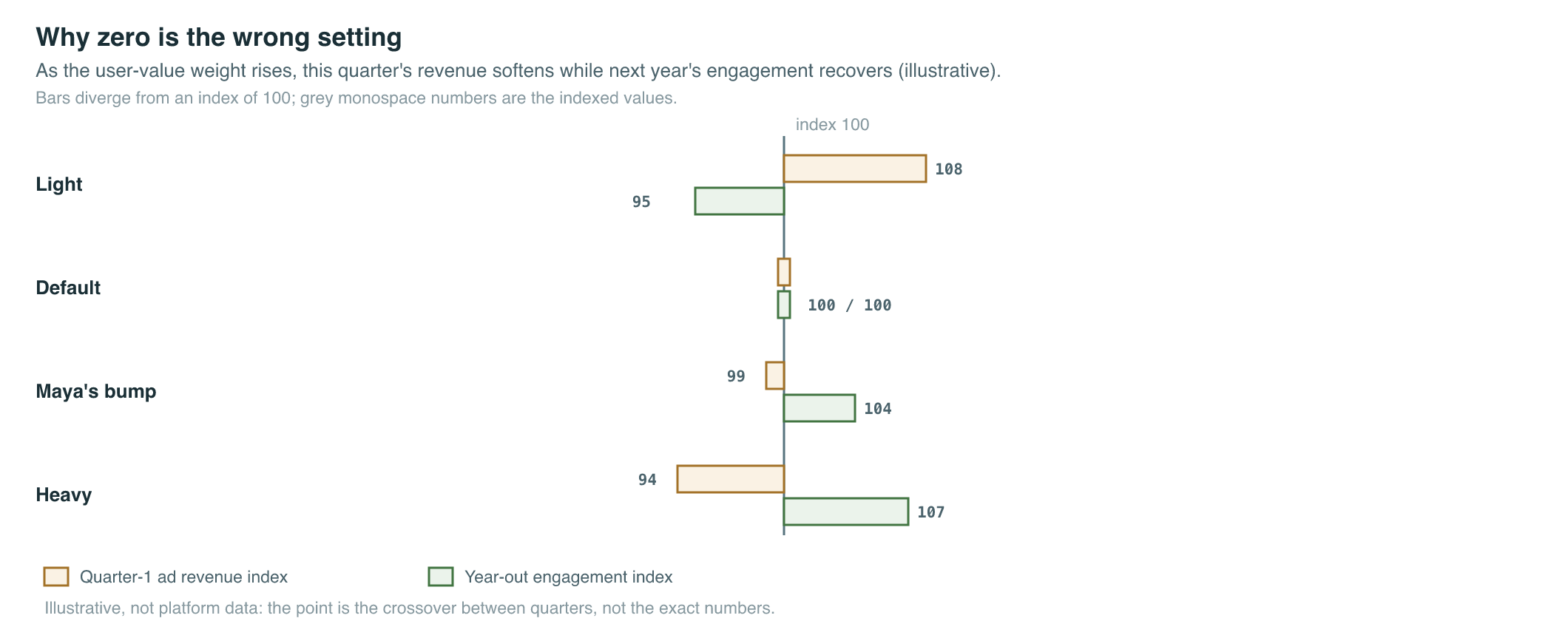
Figure 4.3 — Why zero is the wrong setting (illustrative, not platform data). Lightening the weight buys near-term revenue and sells next year’s impressions; the leader picks the point where the long-run engagement curve is still rising fast relative to the revenue she gives up.
Reserves and non-truthful mechanisms are tools, not imperfections
The second policy surface in your auction is the reserve price — the floor below which you simply will not sell an impression (Book 1, ch5). On the open web a floor is mostly a yield-management tactic. Inside your garden, where you control the whole auction, the reserve is a strategic instrument: it sets the minimum price of attention, protects perceived inventory value, and — crucially — shapes how autobidders behave.
Which brings up the uncomfortable theory. The textbook reason auctions are “fair” is the second-price / VCG (Vickrey-Clarke-Groves) result: when bidders pay the externality they impose on others, telling the truth is each bidder’s best strategy and the outcome maximizes total welfare. Leaders quote this to justify a hands-off auction. The problem is that the result breaks under the demand you actually have. Modern advertisers don’t bid per impression; they hand you an autobidder — an automated agent told to maximize conversions or value subject to a budget or a target return. Against such value-maximizing (rather than utility-maximizing) bidders, VCG’s welfare guarantee no longer holds: the academic literature finds realized welfare can fall to as low as roughly 50% of optimal in adversarial cases (auction-theory literature on autobidding, 2024–2025; theoretical bound, directional).
That result should change how you frame the default. If the “truthful, efficient” mechanism is not guaranteed to stay truthful or efficient once software does the bidding, then declining to intervene is not automatically neutrality — it can be choosing a degraded outcome. Reserves, randomized or deliberately non-truthful mechanisms (Google’s RGSP, Randomized Generalized Second Price, is the publicly described industry example), and quality weighting become legitimate, defensible tools for steering revenue and efficiency where you want them. RGSP is widely understood as Google’s response to the same pressure: a pure second-price auction left value on the table under autobid demand.
For you the takeaway is altitude-appropriate: you do not need to derive the mechanism, but you must stop treating “let the auction run truthfully” as the automatically safe, principled default. With autobidders dominant — and they are; see the next chapter on automation — mechanism choice is policy, and the policy is yours. The question to put to your auction team is not “is our auction truthful?” but “under the autobid demand we actually have, what reserve and mechanism maximize revenue without degrading the experience or advertiser trust we’re underwriting for next year?”
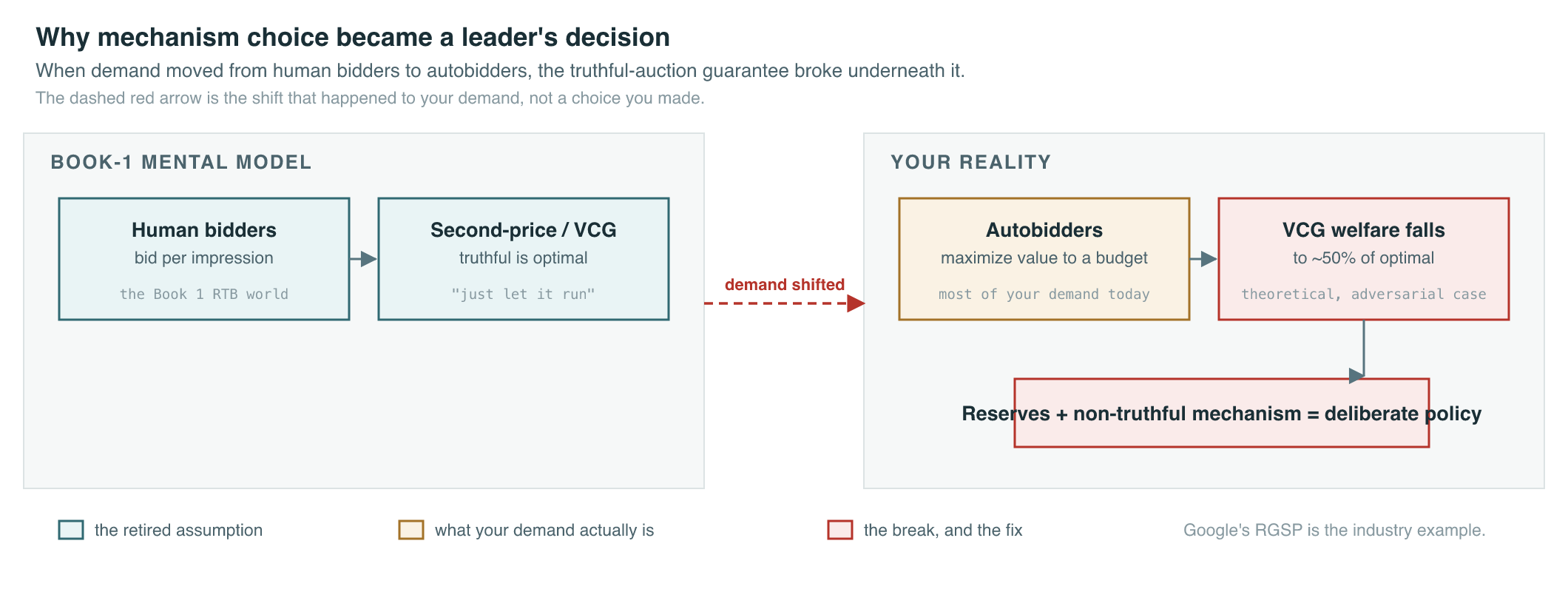
Figure 4.4 — Why mechanism choice became a leader’s decision. When demand moved from human per-impression bids to autobidders, the truthful-auction guarantee broke, and reserves plus non-truthful mechanisms stopped being imperfections and became levers.
Trust is the constraint the auction is solving for
It is tempting to read the user-value term as being only about the user. It is also about the advertiser, and the link runs through trust. An auction that rewards relevance and quality tells advertisers, good creative wins here — which pulls better ads into your supply, which improves the feed, which sustains the engagement that makes your inventory worth bidding on. That virtuous loop is an asset on your balance sheet even though no accountant books it.
The cautionary mirror is X. The lever there was not the auction’s quality term per se but the broader brand-safety and platform-trust posture; the mechanism is identical. When anchor advertisers lost confidence in the environment their ads ran in, spend did not erode gracefully — it fell off a cliff: X ad revenue went from ~$4.4B in 2022 to ~$2.5B in 2024, with marquee names cutting toward near-zero (industry reporting / eMarketer estimates, 2024; directional). No auction tuning rebuilt it, because the thing that broke was not price discovery — it was trust, and trust is fragile revenue infrastructure that a single posture can destroy faster than any model can rebuild it. When you weight the user-value term, you are buying insurance against your own version of that cliff.
The counter-example worth holding next to X is LinkedIn, where the auction sits on a verified first-party professional graph and the trust dividend shows up as durable B2B budgets: total LinkedIn revenue grew ~9% in Microsoft’s FY2025 (to roughly $17–18B), with Marketing Solutions ad revenue estimated around $8.2B (vendor/third-party estimate, not separately audited; treat as directional). High-intent, high-trust supply lets the auction clear at premium prices without aggressive load — the opposite end of the spectrum from X.
Same-Lever Scorecard
How the major platforms set the same dial — how much non-bid value the auction weights, and how openly they intervene in the mechanism. Figures dated and hedged inline.
| Platform | Auction value model (the lever) | User-value / quality term | Mechanism posture | Tell for the leader |
|---|---|---|---|---|
| Meta | Total Value = Bid × Est. Action Rate + Ad Quality (Help Center, 2025) | Explicit Ad Quality term; institutionalized via DAP/ARPP engagement-vs-extraction framing | Quality-weighted; reserves; auction tuned against autobid demand | Q1 2026 FoA ad rev $55.0B, +33%; price/ad +12% — yield is the lever, not headcount |
| Relevance-weighted auction on a verified professional graph | High; trust + intent let it clear at premium with low load | Conservative; protects a scarce high-intent pool | Marketing Solutions ~$8.2B FY25 (estimate) — trust dividend as premium price | |
| TikTok | Relevance/engagement-weighted; increasingly autobid (Smart+) | High implicit weight on watch-through / engagement quality | Heavy automation (Smart+ ~9%→~42% of US perf campaigns in a year; Tinuiti via eMarketer, Jan 2026) | Mechanism control receding into the autobidder — opacity risk |
| Google / YouTube | Quality Score / Ad Rank; Performance Max (pmax) across surfaces | Long-standing quality weight in Ad Rank | RGSP — widely understood as non-truthful, randomized | Publicly described case that a non-truthful mechanism can be a deliberate revenue tool |
| Amazon | Closed-loop, purchase-data-driven relevance | Weighted toward purchase propensity (first-party) | Reserves + relevance; defensible via owned purchase signal | Ad rev ~$68B FY2025 — closed loop makes the action-rate estimate unusually accurate |
| X (wildcard) | Standard auction; lever was platform-trust posture, not formula | Posture-level, not parameter-level | N/A — the cautionary case | ~$4.4B (2022) → ~$2.5B (2024): trust, not pricing, set the ceiling |
Decision or Diagnostic?
Sort the chapter’s metrics by who owns them. The leader sets the policy; the IC tunes the knobs that implement it.
| Decision (board / leader owns) | Diagnostic (IC / launch-review owns) |
|---|---|
| User-value term weight — how heavily the auction prices long-run engagement vs short-run revenue | Estimated Action Rate (pCTR/pCVR) — the model’s per-impression prediction; the bridge from bid to price |
| Reserve-price policy — minimum price of attention by surface/geo | Per-auction clearing price / bid landscape — operational, monitored at the launch desk |
| Mechanism choice — truthful vs non-truthful/randomized under autobid demand | Single-campaign auction-win rate (e.g., Northwind’s) — account-level, not a board metric |
| Short-term-revenue ↔ engagement trade rate — how much Q-revenue you’ll trade for year-out impressions | Ad Quality sub-signals — the component features (post-click satisfaction, etc.) feeding the quality term |
The leader’s call. The trade-off you own is the user-value weight in the auction: how much of this quarter’s advertiser revenue you deliberately decline in order to keep the feed worth scrolling four quarters out. The asymmetry is the trap — lighten the weight and revenue rises now and visibly while engagement erodes later and diffusely, so the metric that screams in the room is the wrong one. Meta resolved it by lifting the trade-off to the most senior level: it reports DAP (3.56B, +4% YoY, Mar 2026) beside ARPP and ad revenue (+33%) so the board sees that growth is coming from yield per person, not user count, and treats the auction’s quality term as the governor that protects the engagement base. Google resolved the adjacent call — that a truthful auction is no longer the automatically safe default under autobidders — by openly running a non-truthful mechanism (RGSP). Four quarters out: weight the user-value term too lightly and you book a good next quarter, then watch sessions soften and your best advertisers’ relevance scores — and trust — slide with them; weight it sensibly and you trade a measurable point or two of near-term revenue for a feed that keeps producing impressions and an advertiser base that believes good ads win. X is the proof of what the cliff looks like when trust, not price, is what breaks. The auction is your monetary policy; set it like a central banker, not a cashier.
Key terms
| Term | One-line definition |
|---|---|
| Total Value | The auction’s ranking score: Bid × Estimated Action Rate + Ad Quality — why a lower bid can win. |
| Estimated Action Rate | The model’s predicted probability this user takes the advertiser’s desired action; converts a per-outcome bid into a per-impression value. (Diagnostic.) |
| Ad Quality / user-value term | The component of Total Value representing the ad’s value to the user; the leader’s main sustainability dial. |
| Reserve price | The floor below which an impression won’t be sold; a strategic minimum price of attention, not just yield hygiene. |
| Autobidder | An advertiser’s automated agent that maximizes outcomes (conversions/value) under a budget or target, rather than bidding truthfully per impression. |
| VCG | Vickrey-Clarke-Groves auction: pay-your-externality mechanism, truthful and efficient with human bidders — guarantee breaks under value-maximizing autobidders. |
| Non-truthful mechanism | An auction (e.g., Google’s RGSP) deliberately designed so truthful bidding isn’t optimal, used as a revenue-vs-efficiency tool. |
| DAP / ARPP | Daily Active People (unique users per day across the app family) and Average Revenue Per Person (revenue per such user); the paired metrics that frame engagement vs extraction. |
| Engagement-vs-extraction trade-off | The leader-level balance between revenue taken this quarter and engagement preserved for future quarters. |
Recap & what is next
- The auction is a policy surface you own, not plumbing the engineers maintain — trillions of times a day it encodes your balance of advertiser revenue against user attention.
- Winners are ranked by Total Value = Bid × Estimated Action Rate + Ad Quality, so a lower bid with a better ad wins by design; how clearly your teams explain this to advertisers is itself a trust lever.
- The user-value term is your central dial, and its right setting is rarely the most extractive one — the cost of setting it too light is invisible in the quarter you set it and arrives later as engagement erosion.
- Under autobidders, the “truthful auction is safe” default is no longer guaranteed (VCG welfare can fall to ~50% of optimal in adversarial cases), which makes reserves and non-truthful mechanisms (e.g., RGSP) legitimate, defensible policy rather than imperfections.
- Trust is the constraint the auction solves for: a quality-weighted auction pulls better ads into supply and protects engagement; X shows how fast a broken trust posture erases revenue no auction tuning can rebuild.
- Sort the metrics ruthlessly — weight, reserves, mechanism, trade-rate are yours; action-rate, clearing price, win-rate belong to the launch desk.
Maya can now set the auction’s policy — but the quality of every Estimated Action Rate it depends on is produced upstream, by a recommendation-and-ranking stack that has quietly become the platform’s real moat. Chapter 5 — The Moat Migrated takes you there: why durable advantage moved from the targeting graph to foundation-model-scale recsys and custom silicon (Andromeda, GEM, Lattice), and how to value a one-percent model gain when it is worth billions.