The promise. In Chapter 23 you set the platform’s posture toward AI agents — whether to become a required, well-documented endpoint or defend the human self-serve UI — and you discovered that doing nothing is itself a choice to be intermediated. But a posture is only as good as the organization that ships it and the hiring market that staffs it. This chapter equips you to make the people-and-positioning calls that decide whether every prior decision in this book actually gets executed: how to structure the ads org so ranking is run as an AI-infrastructure discipline rather than a marketing-tech afterthought; how to hire and retain against a frontier-lab talent war where a single offer can carry a billion-dollar headline; where on the competitive map to fight Google/Meta head-on versus where to decline the battle and win a defensible mindset; and how to treat brand trust as a line on your P&L that one bad quarter can erase. Every chapter so far handed you a lever. This one builds the hands that pull them.
You will be able to:
- Structure the ads org — engineering, product, sales, and a standing measurement-governance function — for an organization whose core competency is now AI infrastructure, not media operations.
- Reason about hiring and retention against a frontier-lab talent-and-GPU war where compensation has detached from every prior software benchmark.
- Decide where to compete head-on with scale leaders versus where to defend a unique surface or mindset and deliberately decline a battle.
- Defend brand trust and advertiser confidence as fragile P&L infrastructure — a revenue asset protected by org design, not by the comms team.
- Distinguish the org-and-competition calls a leader owns from the staffing and pipeline diagnostics an IC manager runs.
Builds on: Book 1 ch8 (ad quality and integrity, the open-web view); Book 2 ch5 — The Moat Migrated (why durable advantage moved from the targeting graph to foundation-model-scale recsys and custom silicon), and ch7 — Quality, Integrity & the User-Value Term (why revenue and experience must stay aligned). This chapter is the penultimate before the capstone: it builds the org and competitive stance that lets the leader actually run the machine described in Chapters 1–23.
The call on Maya’s desk
Maya is sixteen months in. Two memos sit in her inbox on the same morning. The first is from her CFO: the ranking-and-retrieval roadmap she greenlit in Chapter 5 — the unified foundation-model stack on custom silicon — is now her single largest line item after media-acquisition cost, and finance wants to know why ads engineering headcount cost rose 40% on flat headcount. The second is from her head of recruiting: the two staff ML engineers who designed her retrieval ranker just took counter-offers from a frontier lab, and the recruiter’s note ends with a number she has to read twice — “their package is roughly 6× what we pay. We are not going to win this on cash.”
Underneath both memos is the same question, and it is not an HR question. It is the question of what kind of company her ads business now is. For two decades a platform ad org was a media business with engineers attached. Maya now runs an AI-infrastructure business with a media P&L attached — and the org chart, the comp philosophy, and the competitive map she inherited were all drawn for the old shape. Her job this quarter is to redraw them, and to decide, surface by surface and rival by rival, which fights are hers to win and which she should never have entered.
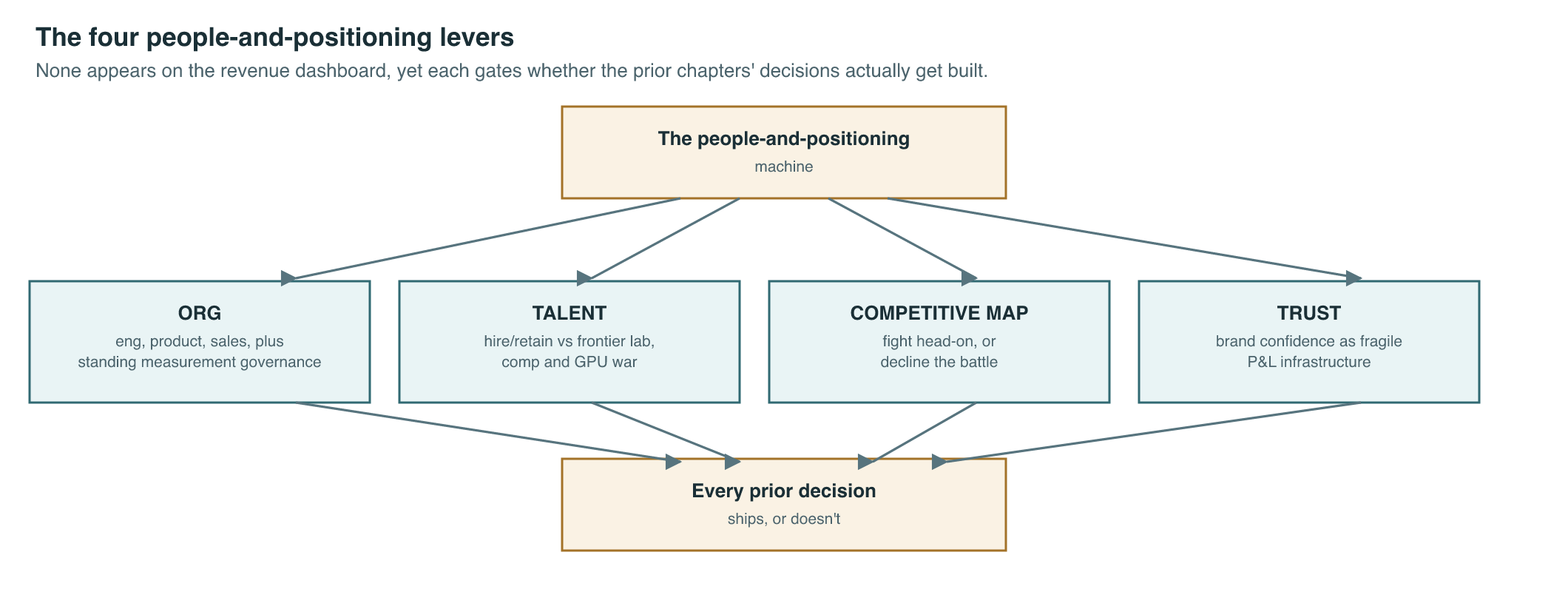
Figure 24.1 — The four people-and-positioning levers. None of them appears on the revenue dashboard, yet each one gates whether the auction, the ML stack, the automation dial, and the measurement system from the prior chapters actually get built and defended.
Structure the org as an AI-infrastructure discipline, not a media operation
The first call is the org chart, and the trap is treating it as a reporting-lines exercise. The deeper truth, established in Chapter 5, is that the platform’s moat migrated from the identity graph to the recommendation-and-ranking stack — foundation-model-scale retrieval and ranking running on custom accelerators. An org built to run media operations cannot ship that stack. So the leader’s first structural decision is to organize the ads business around four standing functions, and to be explicit about which one now carries the moat.
- Ads engineering / ML infrastructure — owns retrieval, ranking, the model-consolidation roadmap, and the silicon-and-latency budget. This is the moat function. At Meta this is the org that produced Andromeda (retrieval), GEM (ranking), and Lattice (model consolidation); the leader’s job is to fund it as a revenue lever and protect its compute budget from being treated as cost (Chapter 5).
- Ads product — owns the advertiser-facing surfaces: the automation products (Advantage+, Smart+, Performance Max analogs), the control surfaces, and the self-serve and agentic endpoints from Chapter 23. Its constraint is the opacity-versus-trust trade-off: how much control to abstract away versus expose.
- Sales / partnerships — owns the relationship with advertisers like Northwind, the explanation of why a lower bid won (Chapter 4), and the field signal on advertiser trust. In B2C this is a high-leverage thin layer over self-serve; in B2B (LinkedIn) it is the business.
- Measurement governance — the function most orgs do not have and most need. This is a standing group, independent of the revenue line, that owns the reconciliation of reported attribution against incrementality and MMM, and that governs the gap between reported and real ROAS. Making it a standing function — not a quarterly project — is how a leader keeps measurement honest when every incentive pushes toward flattering, last-touch numbers.
The reason measurement governance must be organizationally separate from the revenue line is the same asymmetry that ran through the auction and integrity chapters: reported ROAS is an inflated upper bound, and the team whose bonus depends on reported revenue cannot also be the team that audits it. Give the governance function its own reporting line to the leader (or the board), and you have built the institutional check that keeps the four-quarters-out trust asset intact. Skip it, and you have built an org that optimizes for the number that lies.
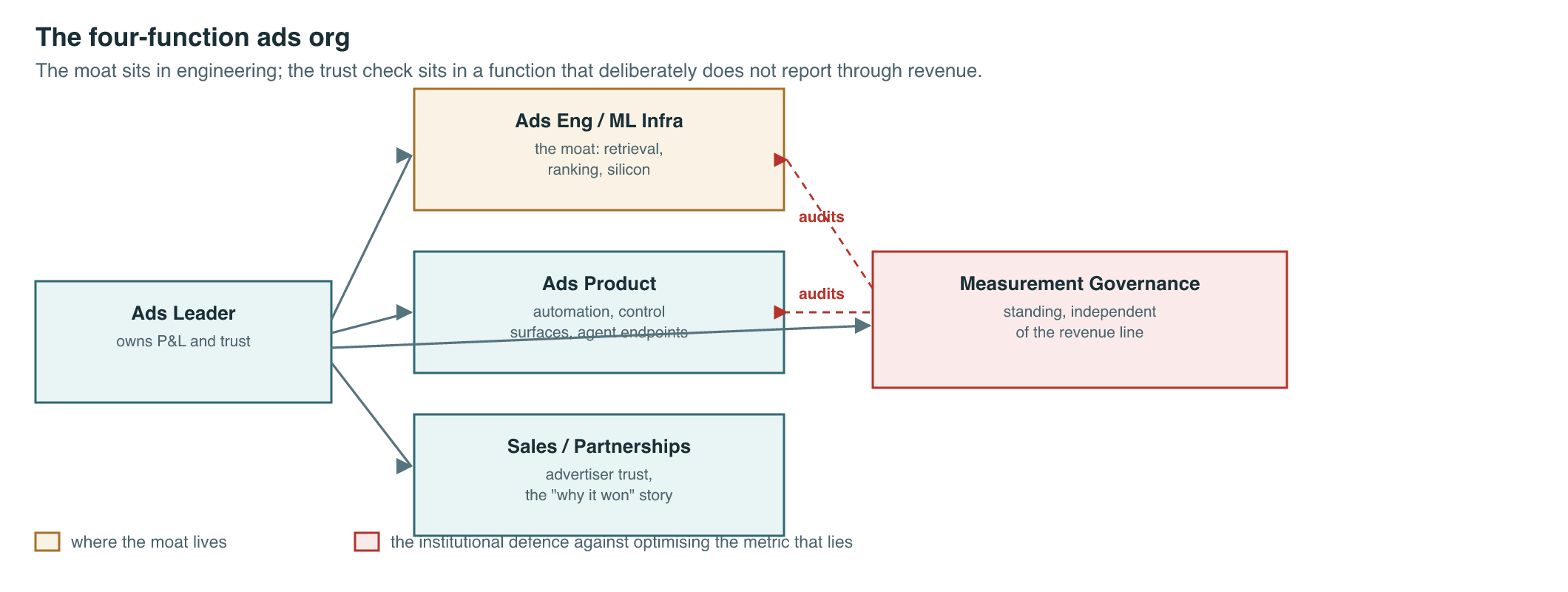
Figure 24.2 — The four-function ads org. The moat sits in engineering; the trust check sits in a measurement-governance function that deliberately does not report through revenue. The dotted “audits” edges are the institutional defense against optimizing the metric that lies.
Win the talent war you can win — because you will lose the one you can’t
Now the recruiting memo. The defining labor-market fact of this era is that compensation for frontier AI talent has detached from every prior software benchmark. Meta’s Superintelligence Labs push reset the ceiling: reported packages reached as high as ~$300M over four years for individual researchers, and Zuckerberg reportedly extended a single offer of roughly $1.5B over six years to one researcher (Andrew Tulloch, per WSJ) — which was rejected, though Meta disputed the figure as “inaccurate and ridiculous” and Tulloch later joined Meta on undisclosed terms (Fast-moving — re-verify; WSJ / TechCrunch / Entrepreneur, 2025). Even the steady-state numbers are extraordinary: median Meta ML-engineer total comp runs into the mid-six figures (reported ~$430K), with senior (E6) packages reported past $780K and frontier-lab software-engineer medians near OpenAI’s reported ~$795K (vendor-reported, Levels.fyi / Pin, 2026; treat as directional).
The leader’s mistake is to read this as a budget problem to be matched. It is not. Almost no ads P&L — not even Meta’s — can win a head-to-head cash war against a venture-funded frontier lab whose entire valuation is the talent. So the call is not how much do we pay to win but which fight are we actually in. Maya’s two departed engineers were being recruited for general-purpose superintelligence research; she does not need to win that auction, because that is not the work that moves her ARPU. The talent she must retain is the cohort that turns a foundation model into a single-digit-percent ranking gain on her specific surfaces — and at platform scale, a +1% ranking gain is worth more to her P&L than it is to anyone else, which means she can pay for the outcome even when she cannot match the headline.
That reframes retention into three durable levers that survive a comp war:
- Proprietary scale and data — a ranking researcher at a platform sees their model touch billions of impressions a day. No lab offers that loop. Frame the role as the only place the work compounds at production scale.
- The +1% economics — tie senior ML comp to the realized revenue of model gains (the Chapter 5 valuation: a 1% gain worth billions justifies the package). Pay for the lever you own, not the headline you can’t.
- GPU access as compensation. In a compute-constrained market, guaranteed access to accelerators is itself a recruiting and retention instrument. The talent war is also a GPU war, and a leader who can credibly promise compute is paying in a currency cash cannot replace.
The diagnostic-versus-decision line is sharp here. How many ML reqs are open, time-to-fill, and offer-acceptance rate are IC-manager diagnostics. Which talent market the platform competes in at all, and how senior ML comp is structured against model-gain economics is the leader’s decision — because it determines whether the moat function in Figure 24.2 can be staffed at all.
FIGURE 24.3 (spec): A two-tier “talent staircase” chart. Lower tier: a baseline software-engineer comp band (~$130K–$480K) labeled “the market you can compete in.” Upper tier: a steep, detached frontier-lab band ($795K median to $300M+ outlier packages, with a $1.5B starred outlier) labeled “the market you should decline.” A bracket between them captures the platform ads ML band, annotated “win here: scale + the +1% economics + GPU access — not on cash headline.” Caption: “Most of the eye-watering numbers are for a fight that doesn’t move your ARPU. Pick the rung you can defend.” Alt-text: “Bar chart contrasting normal software comp, platform ads ML comp, and detached frontier-lab packages up to $1.5B.”
Read the competitive map: where to fight, where to decline
The same decline-the-battle discipline that governs the talent war governs the competitive map. The instinct of a newly promoted leader is to compete head-on with the scale leaders on every surface. The data says that is how challengers die. The platforms that built durable ad businesses outside the Google/Meta duopoly did so by winning a defensible mindset — a user intent or context the scale leaders structurally cannot replicate — rather than fighting for the same broad-reach impression.
Walk the map:
- Pinterest declined the broad-social fight and won commerce/planning intent — users arrive in a buying mindset, which makes the surface lower-funnel without behavioral tracking (Q1 2025 revenue $855M, +16%, 570M MAU; Pinterest Q1 2025). Its Performance+ suite is the Advantage+/PMax analog, but the moat is the mindset, not the automation.
- Snap declined the feed war and won AR/camera as a native creative surface, then diversified revenue with the Snapchat+ subscription (~15M subscribers, ~$600M+ run-rate; Snap Q1 2025) — a defensible mindset plus a non-ad revenue engine.
- Reddit won community/contextual signal and turned it into a second engine — AI data licensing (reported ~$60M/yr Google, ~$70M/yr OpenAI; vendor-reported, 2024–2025) — monetizing the corpus itself, a fight the scale leaders can’t enter from outside.
- LinkedIn is the masterclass in declining the B2C battle entirely. It does not compete for broad reach; it monetizes a verified, user-declared professional graph (title, seniority, company, skills) that no B2C platform can replicate, at premium CPMs on far fewer impressions (Marketing Solutions estimated ~$8.2B in 2025; vendor estimate, not separately audited). And it compounds that with the Microsoft flywheel — LinkedIn profile targeting exposed inside Microsoft Advertising search and CTV, plus a Dynamics 365 CRM closed loop and the Revenue Attribution Report (RAR). That flywheel is an org-and-positioning decision: owning the CRM + ad + measurement loop, not just the ad surface, is what makes the value compound.
The leader’s call, then, is to locate the platform’s own defensible mindset and concentrate there, rather than spreading thin against scale. Maya’s challenger-tour instinct — fight everywhere because you can’t afford to cede anything — is exactly backwards at platform scale. The expensive lesson the map teaches is that declining a battle is a strategy, not a retreat.
Trust is a P&L asset — and the org is how you protect it
Every prior chapter ended on the same throughline: the choice moves ARPU and advertiser trust four quarters out. This chapter makes the second half structural. Trust is not a comms function or a brand-safety checkbox. It is fragile revenue infrastructure — a balance-sheet asset no accountant books — and the org is the instrument that protects or destroys it.
The cautionary tale is X, and the numbers are now clearer than when the book began. X ad revenue collapsed from ~$4.4B (2022) to ~$2.5B (2024) as anchor advertisers fled the trust environment. The 2025 story is the instructive coda: after rebuilding an ads leadership bench (CEO Linda Yaccarino, then ad chief John Nitti), eMarketer projected X global ad revenue of ~$2.26B for 2025 (+16.5%) — the first growth since the acquisition — yet still roughly half the pre-Musk business, and that leadership churned out (Yaccarino departed July 2025, Nitti in October 2025) (Fast-moving — re-verify; eMarketer / TechCrunch, 2025). The lesson is doubly sharp: trust falls off a cliff in quarters and claws back over years, and even a rebuilt revenue org could not fully restore what a posture broke. No auction tuning, no model gain, no automation product reverses an advertiser-trust collapse — because the thing that broke was not price discovery.
This is why the measurement-governance function (Figure 24.2) and the sales function are not overhead. They are the standing organs that detect trust erosion early — in advertiser sentiment, in reconciliation gaps between reported and incremental ROAS, in the churn signal from accounts like Northwind — and route it to the leader before it becomes a cliff. A leader who treats trust as PR has no instrument to see the erosion coming. A leader who builds it into the org chart has an early-warning system on the most fragile asset they own.
Same-Lever Scorecard
The same decision — how to organize, where to compete, and how trust is protected — across the majors. Figures dated and hedged inline.
| Platform | Org center of gravity | Where it fights vs declines | Trust protection posture | Tell for the leader |
|---|---|---|---|---|
| Meta | AI-infra eng (Andromeda/GEM/Lattice) is the moat function | Fights head-on at scale on performance | DAP/ARPP reporting institutionalizes engagement-vs-extraction; integrity org | The reference model: ads = AI-infra org with a media P&L attached |
| CRM + ad + measurement loop (RAR, Microsoft flywheel) | Declines B2C reach; wins verified professional graph | Trust = premium-pricing dividend; conservative load | ~$8.2B Marketing Solutions (est.) on a declined battle — concentration beats spread | |
| TikTok | Automation + commerce eng (Smart+, Symphony, TikTok Shop) | Fights performance + commerce; cedes nothing | Trust risk is geopolitical (US JV data/algorithm custody), not posture | Org strength can’t offset a structural-trust overhang outside its control |
| Google / YouTube | Scale ML + multi-surface auction org | Fights everywhere at scale | Antitrust ruling (Apr 2025, remedies pending) is the trust/structure risk | Even the scale leader’s org is contestable by regulators, not rivals |
| Amazon | Closed-loop retail-media + clean-room (AMC) org | Fights on owned purchase data | Trust = first-party purchase signal accuracy | Org built around the data asset rivals can’t see |
| X (wildcard) | Hollowed ad org post-acquisition; rebuilt leadership bench, then churned out (2025) | Tried to fight without the trust base | The cautionary tale: posture broke the asset |
Decision or Diagnostic?
Sort the chapter’s metrics by who owns them. The leader sets org shape, comp philosophy, and competitive concentration; the IC manager runs the pipeline.
| Decision (board / leader owns) | Diagnostic (IC / manager owns) |
|---|---|
| Org structure — making AI-infra the moat function and measurement governance a standing, independent function | Headcount-by-team / span-of-control — operational org-design detail |
| Senior-ML comp philosophy — competing on the +1% economics, scale, and GPU access vs cash headline | Time-to-fill / offer-acceptance rate / open reqs — recruiting-funnel diagnostics |
| Competitive concentration — which defensible mindset to own and which battles to decline | Per-campaign win rate vs a named rival — account-level, not a board metric |
| Trust as a P&L asset — building the early-warning organs and protecting the four-quarters-out trust line | Brand-safety incident count / response SLA — operational integrity diagnostics |
The leader’s call. The trade-off you own is where to concentrate a finite org and budget — which talent market to compete in, which competitive battles to fight, and how to organize so the asset that breaks slowest (trust) is the one you protect hardest. The asymmetry is the trap: comp and competitive spread feel like ambition, but spreading across every fight and matching every frontier-lab headline is how challengers bleed out, while trust — the asset that funds everything — erodes invisibly until it collapses in a quarter. Meta resolved it by organizing the ads business as an AI-infrastructure company first (the Andromeda/GEM/Lattice moat function) and institutionalizing the trust line at the most senior level via DAP/ARPP. LinkedIn resolved it by declining the B2C battle entirely and concentrating on a verified professional graph plus the Microsoft CRM-ad-measurement loop — winning ~$8.2B (est.) on a fight it refused to enter broadly. Four quarters out: build the org so the moat is staffed on outcomes you can pay for and the trust asset is watched by a function that doesn’t report through revenue, and ARPU compounds on a stable advertiser base; spread thin, chase the talent headline you can’t win, and treat trust as PR, and you get X’s lesson — a cliff that takes years to climb back from, if ever. Organize for the asset that compounds, and decline the battles that don’t.
Key terms
| Term | One-line definition |
|---|---|
| AI-infrastructure org | An ads organization whose moat function is foundation-model-scale retrieval/ranking on custom silicon, not media operations — the post-Chapter-5 shape of the business. |
| Measurement-governance function | A standing group, independent of the revenue line, that reconciles reported attribution against incrementality/MMM and governs the reported-vs-real ROAS gap. |
| The +1% economics | The Chapter-5 logic that a single-digit-percent model gain is worth billions at platform scale — used here to pay for ML outcomes rather than match cash headlines. |
| GPU war | The compute-scarcity dimension of the talent war; guaranteed accelerator access functions as a recruiting/retention currency cash can’t replace. |
| Defensible mindset / surface | A user intent or context (Pinterest’s commerce intent, Snap’s AR, Reddit’s community, LinkedIn’s professional graph) that scale leaders structurally can’t replicate. |
| Decline the battle | The deliberate strategic choice to not compete head-on with scale leaders and instead concentrate on a defensible mindset — a strategy, not a retreat. |
| Trust as P&L infrastructure | Advertiser confidence and user retention treated as a fragile, unbooked revenue asset that one posture can destroy faster than any model can rebuild. |
| Microsoft flywheel | LinkedIn’s compounding loop of profile targeting in Microsoft Advertising + Dynamics 365 CRM + Revenue Attribution Report — owning the CRM-ad-measurement loop, not just the ad surface. |
Recap & what is next
- The ads org is now an AI-infrastructure business with a media P&L attached — organize it around four functions (eng/ML infra as the moat, product, sales, and a standing, independent measurement-governance function), not as a media operation with engineers attached.
- You will lose the cash war against frontier labs (packages from ~$300M over four years to a reported ~$1.5B offer); win instead on proprietary scale, the +1% model-gain economics, and GPU access — pay for the outcome you own, not the headline you can’t.
- Read the competitive map and concentrate on a defensible mindset (Pinterest’s intent, Snap’s AR, Reddit’s community, LinkedIn’s professional graph) rather than fighting scale leaders everywhere — declining a battle is a strategy, not a retreat.
- Treat trust as fragile P&L infrastructure: X’s
$4.4B→$2.5B (2022→2024) collapse — and a rebuilt ads org that still couldn’t fully restore the pre-Musk business — proves it falls in quarters and claws back over years, so the org, not the comms team, is the early-warning system. - Sort ruthlessly — org shape, comp philosophy, competitive concentration, and the trust line are yours; time-to-fill, span-of-control, per-campaign win rate, and incident SLAs belong to the managers.
Maya now has an org that can build the machine, a comp philosophy that staffs the moat, a map that tells her which battles to decline, and an early-warning system on trust. Every individual decision in this book has been made and defended. Chapter 25 — the capstone collides all of them at once: eighteen months in, Maya must write the board memo that re-underwrites the entire platform ad P&L four quarters forward — setting the load/engagement frontier, the auction’s user-value parameter, the ML-infra capital ask, the automation dial, the measurement and privacy bets, the agentic posture, and the portfolio balance, in one coherent plan she has to defend under live constraints.