The promise. In Chapter 22 you decided which surfaces, subscriptions, and licensing streams to scale, skip, or sequence — and every one of those revenue lines today funnels through a self-serve interface a human logs into. That interface — Ads Manager, the campaign builder, the storefront, the checkout — is the moat you have spent the whole book sharpening. This chapter forces the call you have been able to defer: what happens to that moat when the entity on the other side of the glass stops being a human marketer clicking through your UI and becomes a piece of software acting on someone’s behalf. AI agents are arriving on both sides of your business at once — a buyer agent that wants to purchase your media without opening your campaign builder, and a commerce agent that wants to complete the user’s transaction without ever loading your storefront. This chapter equips you to decide your posture toward both: whether to expose inventory and checkout to agents as documented endpoints, defend the human UI, or — the only genuinely wrong answer — do nothing and be silently intermediated. Book 1’s Chapter 9 walked you through the plumbing of these protocols at the supply-chain level; this chapter is the leader’s posture decision sitting on top of that plumbing.
You will be able to:
- Explain how agentic buying (AdCP / MCP) and agentic commerce (ACP / AP2) disintermediate your self-serve interface from two different directions, and why those are distinct threats.
- Reason about why the protocol layers are stacking, not converging, and why that makes a deliberate multi-protocol posture the defensible move rather than a single bet.
- Decide whether to become a required, well-documented agent endpoint, defend the human UI, or build your own agent — and defend that choice as a four-quarters-out call on ARPU and advertiser trust.
- Distinguish the hype curve (membership counts, launch dates) from the liquidity curve (dollars actually transacting) so you do not over- or under-invest against a fast-moving standard.
Builds on: Book 1 ch9 (the agentic-buying and agentic-commerce protocols at the plumbing level — how MCP, AdCP, and ACP actually pass messages). Book 2 ch8 (the automation frontier — how far you abstract the human marketer’s controls into a black box; the agent is that abstraction taken one step past the UI) and ch22 (the portfolio of surfaces, each of which has the self-serve interface this chapter puts under attack). It closes Part V’s frontier arc before the org and capstone chapters.
The call on Maya’s desk
It is month sixteen. Maya’s head of product forwards her a one-paragraph note from the partnerships team: “Three of our top-fifty advertisers — Northwind among them — have asked for an MCP-style endpoint so their in-house buying agents can plan, launch, and report campaigns against our inventory programmatically, without a human in Ads Manager. Separately, the commerce team flags that ~4% of Northwind’s checkout-attributed sessions last month originated inside a third-party AI assistant rather than on our surface. Legal wants to know our position before we answer either. Decision needed in two weeks.”
Maya recognizes the shape of this immediately, because it is the same shape as every chapter before it: a request that looks operational (“build us an API”) but is actually a policy question she owns. The self-serve UI was never just a convenience. It was a point of control — the place where she sets defaults, surfaces upsells, enforces brand-safety review, observes the advertiser relationship, and books the margin that comes from being the system of record. An agent that buys her media through a programmatic endpoint, or completes her user’s purchase inside someone else’s chat window, is asking her to give up that point of control — from two directions at once.
Her instinct from the challenger platform is to protect the UI reflexively: traffic through your own interface is traffic you monetize and measure on your terms. But she catches the trap. The history of this book is that doing nothing is a decision — the auction runs whether or not you tune it, ad load creeps whether or not you set it, and agents will transact whether or not you give them a clean way to do it. The only question is whether they transact through a door you built and can instrument, or around you, scraping and guessing, with you blind to the relationship and the data.
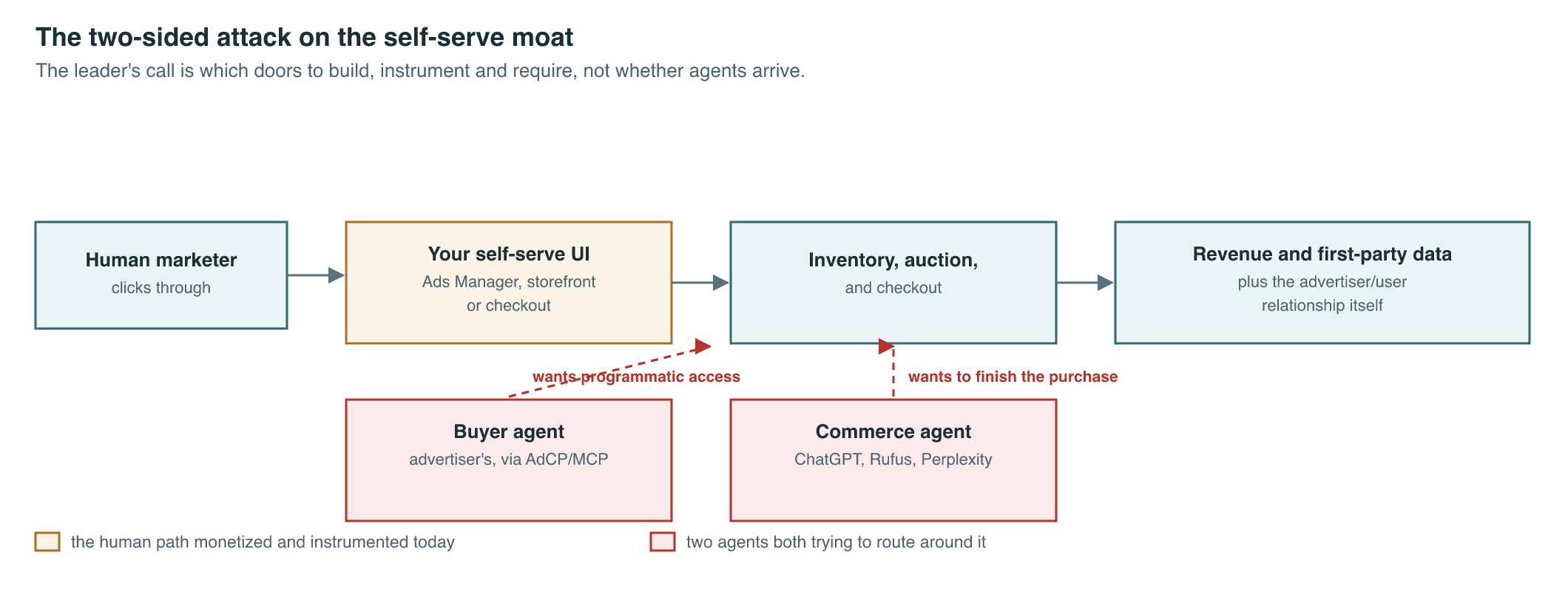
Figure 23.1 — The two-sided attack on the self-serve moat. The human path (top) is the one you monetize and instrument today. The buyer agent (left) wants to skip your campaign UI; the commerce agent (right) wants to skip your storefront/checkout. Both reroute the revenue and the relationship in the box on the right. The leader’s call is which doors to build, instrument, and require — not whether agents arrive.
Two different attacks: agentic buying vs agentic commerce
The single most common leader error here is collapsing two distinct threats into one “AI is coming for us” worry. They hit different parts of your P&L and demand different postures.
Agentic buying is software acting as the advertiser. An advertiser’s autonomous agent discovers your inventory, negotiates terms, places the buy, and pulls reporting — all programmatically, with no human opening your campaign builder. This is the natural endpoint of the automation frontier from Chapter 8: there, the human still typed an objective into your UI; here, the human delegates even that to an agent. The standard being built for it is the Ad Context Protocol (AdCP) — an open specification, launched October 15 2025, that defines how an AI buyer agent discovers media inventory, negotiates, transacts, and reports across platforms — which itself rides on MCP (Model Context Protocol) — Anthropic’s open standard, now under the Linux Foundation, for connecting AI agents to external tools and data. AdCP is to agent-led media buying what a published API spec is to any integration: it lets a buyer’s agent talk to your sell-side without a bespoke build per platform.
Agentic commerce is software acting as the user. A consumer asks an AI assistant — ChatGPT, Amazon’s Rufus, Perplexity — to find and buy a product, and the assistant completes the purchase on the user’s behalf. The standards here are the Agentic Commerce Protocol (ACP) — OpenAI and Stripe’s open standard, released September 29 2025, for completing a purchase inside an AI agent — and AP2 (Agent Payments Protocol) — Google’s September 2025 standard (announced Sept 16 2025 with 60+ partners) for authorizing and trusting agent-initiated payments, contributed to the FIDO Alliance in April 2026. This threat does not touch your campaign UI at all. It reroutes the user’s transaction and the demand-discovery moment — the exact moment your storefront, your shopping ads, and your checkout were built to own.
The reason to keep them separate: agentic buying threatens your advertiser relationship and self-serve margin; agentic commerce threatens your consumer relationship and the closed-loop commerce data you spent Chapter 12 learning to covet. A platform can be wide open to buyer agents (it wants the demand) while fiercely defending against commerce agents (it refuses to become a dumb fulfillment node for someone else’s assistant) — or any combination. Conflating them produces a single muddled posture instead of two sharp ones.
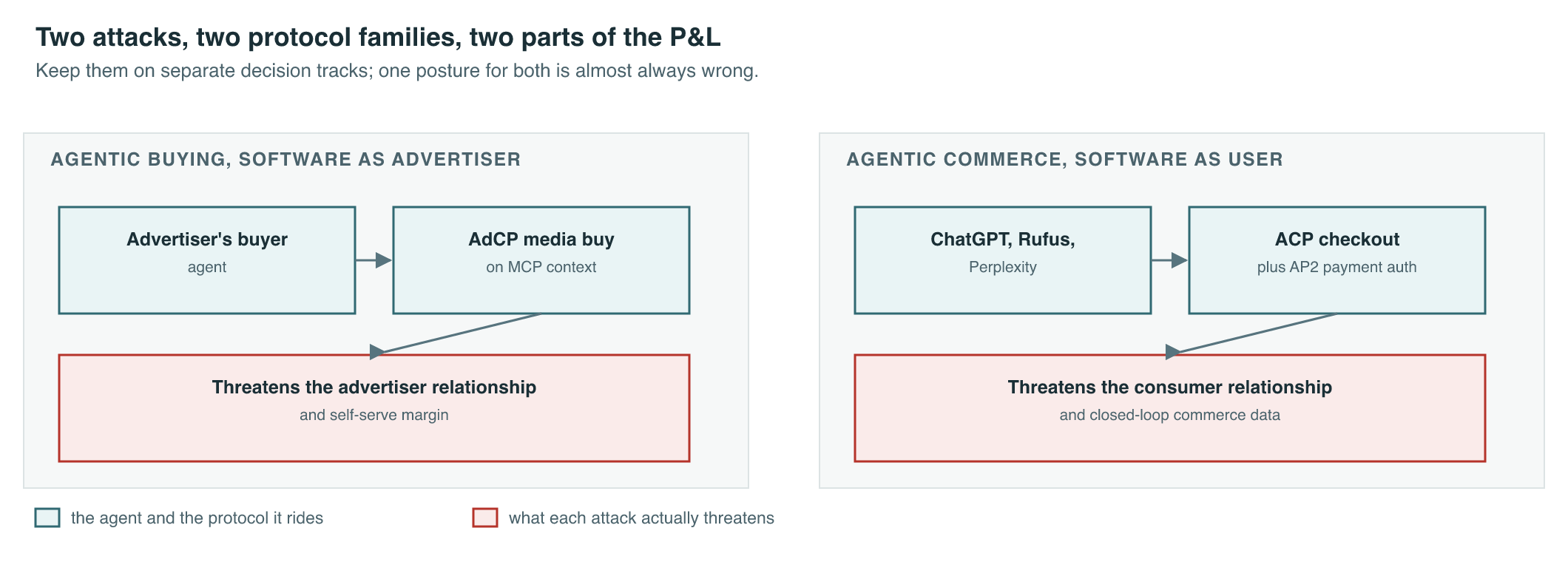
Figure 23.2 — Two attacks, two protocol families, two parts of the P&L. Keep them on separate decision tracks; a single posture for both is almost always wrong.
The protocols are stacking, not converging — so don’t bet on one
Every leader new to this space waits for the standards war to resolve so they can back the winner. That instinct, imported from the VHS-vs-Betamax mental model, is the wrong frame. These protocols are not competing to be the one standard; they each occupy a different layer of the same transaction, and a real agent-mediated buy touches several at once.
Think of it as a stack, the way Book 1’s reader learned the supply chain as a stack:
| Layer | What it does | The standard(s) |
|---|---|---|
| Context | Connect an agent to tools and data | MCP |
| Media buy | Discover, negotiate, transact, report on inventory | AdCP |
| Checkout | Complete a purchase inside the agent | ACP |
| Payment authorization | Authorize and trust an agent-initiated payment | AP2 |
| Settlement | Move the money (incl. stablecoin rails) | x402 |
Because the layers are complementary, “which protocol wins” is the wrong question — the answer is “most of them, because they don’t substitute for each other.” A buyer agent purchasing your media might speak MCP to its own tools and AdCP to your sell-side; a commerce agent buying a user’s sneakers might speak ACP to the merchant and AP2 to authorize the card. A platform that bets on exactly one and ignores the rest has simply chosen which layer to be intermediated at.
This is why the defensible posture is multi-protocol by default: support the layers relevant to your business, stay an active voice in the governance bodies (the Linux Foundation for MCP, the FIDO Alliance for AP2, the AdCP consortium) while the standards are still cheap to influence, and treat your endpoint documentation as a product surface in its own right. The cost of supporting an additional open protocol while it is young is small; the cost of being the platform an agent can’t cleanly transact with — and therefore routes around — compounds quarter over quarter.
FIGURE 23.3 (spec): A conceptual “stack” illustration rendered as five horizontal bands, bottom to top: Settlement (x402), Payment authorization (AP2), Checkout (ACP), Media buy (AdCP), Context (MCP). A single translucent “transaction” arrow pierces vertically through three or four bands at once, with a caption: “One agent-mediated buy touches multiple layers — the standards stack, they don’t converge.” Alt-text: “Five-layer protocol stack with a single vertical transaction arrow passing through several layers simultaneously, illustrating that agentic protocols are complementary rather than competing.”
Read the liquidity curve, not the hype curve
Here is the discipline that separates the leader from the trade-press headline. The agentic space generates two very different curves, and you must price them separately.
The hype curve is membership counts and launch dates: AdCP launched October 15 2025 with a founding consortium and reached 106+ members; the first agent-to-agent media buy executed October 16 2025; ACP debuted with ChatGPT Instant Checkout in late September 2025; AP2 launched with 60+ partners (all fast-moving — re-verify; figures as of late 2025). Impressive, and easy to over-index on.
The liquidity curve is dollars actually transacting through these rails — and as of mid-2026 it is far flatter than the hype. Industry observers note that effectively zero dollars are transacting through AdCP in any material sense; the protocol functions today more as a coordination conversation than as live revenue infrastructure, hampered by a chicken-and-egg problem — publishers can stand up AdCP agents, but the consumer AI assistants those agents would sell to have not integrated it (industry reporting via Digiday / Permutive, 2026 — fast-moving, re-verify). On the commerce side the reality check is sharper still: OpenAI found its first version of native Instant Checkout too rigid and pivoted in early 2026 toward letting merchants keep their own checkout while ACP focuses on product discovery; Walmart pulled its goods out of native ChatGPT checkout entirely after disclosing that purchases completed inside ChatGPT converted at roughly one-third the rate of click-throughs to Walmart.com, and instead plugged its own “Sparky” commerce agent into ChatGPT to keep the shopper inside a Walmart-controlled experience (Retail Dive / CNBC / Morgan Stanley TMT disclosure, March 2026 — fast-moving).
The leader’s read of that gap is not “agentic is hype, ignore it.” It is the opposite of complacent: the standards are real and the direction is settled, but liquidity lags, which is exactly the window in which posture is cheap to set and the standards are still malleable. You are not late if you move now; you are early enough to shape the door rather than be forced through someone else’s. The mistake is to wait for liquidity to prove the threat — by then the relationship and the data have already rerouted, and you are negotiating from weakness.
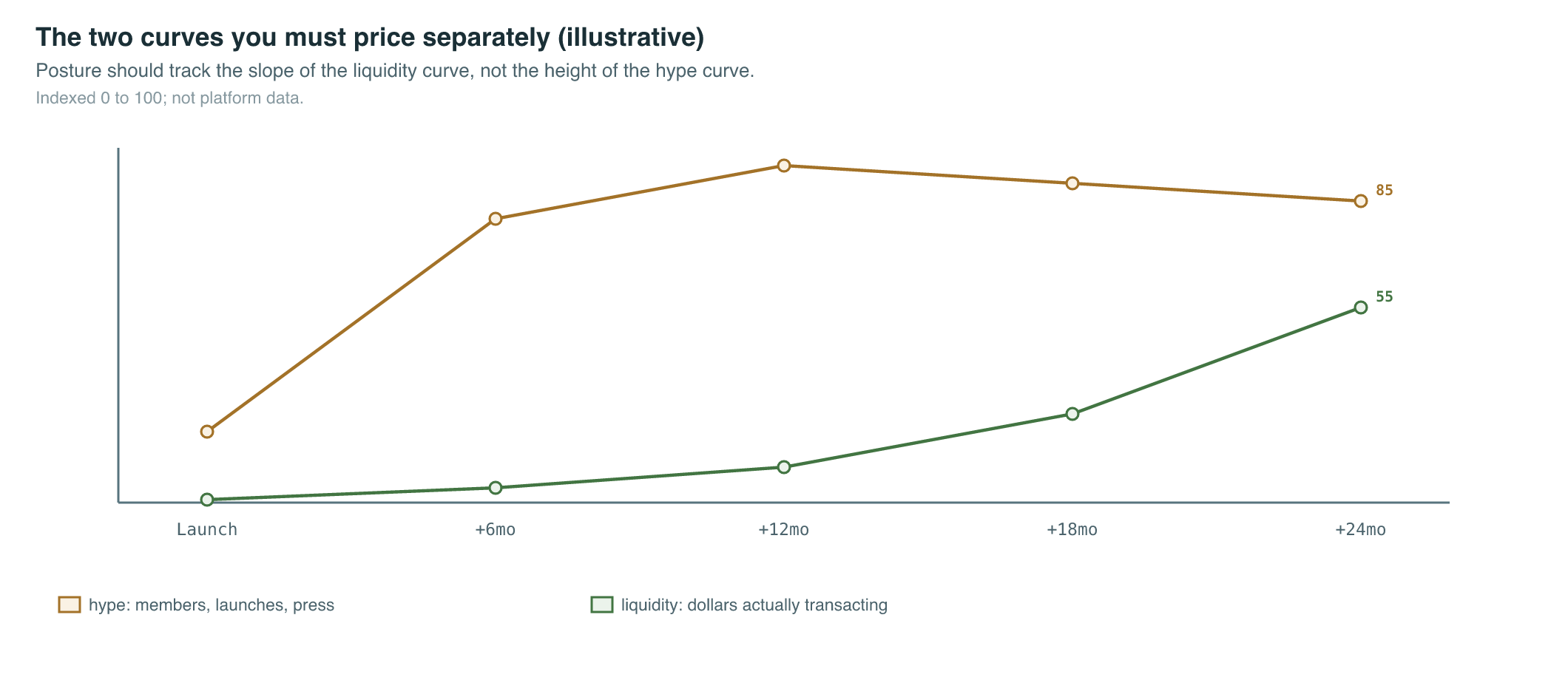
Figure 23.4 — The two curves you must price separately (illustrative, not platform data). Posture decisions should track the direction and slope of the liquidity curve, set while the standards are still malleable — not the height of the hype curve, and not the (currently near-zero) level of liquidity.
Be a required endpoint — or be routed around
If the threat is being silently intermediated, the strongest defensive and offensive posture is the same: become a required agent endpoint — the well-documented, low-friction, must-call interface an agent uses to transact with your inventory or checkout, such that routing around you is more expensive and lower-quality than going through you. You make yourself the path of least resistance, then instrument that path.
The real-world spectrum of postures, as of mid-2026, runs from open door to barred gate:
- Open the door and instrument it (the AdCP posture). Publish a clean agent endpoint, support the relevant protocols, and capture the demand plus the telemetry of how agents buy. You trade some self-serve margin and control for being inside the flow rather than outside it. This is the bet most sell-side ad platforms are making, because for a media seller, agent-led demand is still demand — you want it pointed at your door.
- Build your own agent and keep the user inside (the Amazon/Walmart posture). Rather than let third-party assistants intermediate your shopper, become the assistant. Amazon extended Rufus (its shopping assistant, reported used by 300M+ customers during 2025 per its Q4 2025 earnings — vendor-reported) with “Buy for Me,” which buys from other merchants’ sites on the user’s behalf while keeping the relationship, account, and data tied to Amazon — and Walmart’s Sparky-in-ChatGPT move is the same instinct, embedding a Walmart-controlled experience inside the third-party surface (GeekWire / Retail Dive, 2026 — fast-moving). (Amazon folded the standalone Rufus brand into a single agent, “Alexa for Shopping,” in May 2026; the posture is what matters, not the brand.) The posture: if someone’s agent is going to mediate commerce, make it yours.
- Defend the gate (the exclusion posture). Refuse third-party agents access and enforce it. Amazon blocked dozens of AI crawlers (reportedly ~47) via robots.txt in late 2025 and sued Perplexity (Nov 2025) over unauthorized agent access; on March 10 2026 a federal court (N.D. Cal.) issued a preliminary injunction against Perplexity’s Comet browser accessing Amazon’s logged-in pages — an early signal that agent access with the user’s permission but without the platform’s authorization may be unlawful. But treat it as unsettled: the Ninth Circuit stayed that injunction roughly a week later pending Perplexity’s appeal, with oral arguments set for June 2026, so it is not yet a durable precedent (CNBC / GeekWire / Courthouse News, 2026 — fast-moving, on appeal and stayed; re-verify). This buys time and protects the closed loop, but it is a holding action, not a permanent moat — and it works far better for a platform that owns the demand (Amazon’s shoppers) than for one that needs the demand (a mid-tier ad seller).
Notice that Amazon is running all three at once on different fronts — open where it wants demand, its own agent where it wants the relationship, barred gate where rivals threaten the closed loop. That is the multi-posture reality the scorecard below makes concrete. The wrong move is the fourth, unlisted option: no posture — no documented endpoint, no agent of your own, no enforcement — which is simply a decision to be scraped, guessed at, and disintermediated without even the data to see it happening.
Same-Lever Scorecard
How the majors are setting the same dial — expose to agents, build your own agent, or defend the human interface — across both the buying and commerce sides. Figures dated and hedged inline; the whole space is fast-moving — re-verify before quoting.
| Platform | Agentic buying posture (advertiser-side) | Agentic commerce posture (user-side) | Required-endpoint move | Tell for the leader |
|---|---|---|---|---|
| Meta | Cautious; automation (Advantage+) is the abstraction it controls — keeps the agent inside its own stack rather than opening to external buyer agents | Owns Shops/checkout and click-to-message; protective of the consumer relationship | Prefers its AI to be the agent (objective-in/campaign-out) vs an external one | Will fight to keep the agent endogenous — automation as moat, not an open API |
| B2B buyer agents a natural fit (Accelerate already AI-led); high-trust, verified graph it won’t expose cheaply | Limited direct commerce; less exposed on the user side | Microsoft Copilot as the in-ecosystem agent surface | Will route agent demand through Microsoft’s agent, not third parties | |
| TikTok | Smart+ is its controlled automation; external buyer-agent openness unclear amid JV/data-governance overhang | TikTok Shop closed loop — strong incentive to keep the buy inside the app | Owns the discover-to-checkout loop; defends it | Commerce-side defense is existential to TikTok Shop GMV |
| Google / YouTube | Authored AP2 (60+ partners, contributed to FIDO); positioning to be the trust/payment layer everyone calls | Pushing agent-mediated shopping; wants to be the payment-auth standard | AP2 is the required-endpoint play at the payment layer | Trying to own the layer rather than the storefront — own the rail, tax the flow |
| Amazon | Blocks external buyer/commerce agents; sued Perplexity (Nov 2025; preliminary injunction Mar 2026, stayed on appeal) | Rufus + “Buy for Me” — becomes the agent; Rufus used by 300M+ customers in 2025 (vendor-reported; rebranded “Alexa for Shopping” May 2026) | Its own agent is the endpoint; rivals barred | Running open / own-agent / barred-gate simultaneously — the multi-posture template |
| Shopify (wildcard) | Exposes merchant catalogs/checkout to agents (ACP-integrated) as infrastructure | Lets ChatGPT/agents transact its merchants’ goods — demand it doesn’t have to acquire | Deliberately becomes the agent-checkout backend | The “be the rails” bet — disintermediation as a distribution opportunity |
Decision or Diagnostic?
Sort the chapter’s metrics by who owns them. The leader sets the posture; the IC monitors the flow through it.
| Decision (board / leader owns) | Diagnostic (IC / launch-review owns) |
|---|---|
| Agentic posture — expose to agents, build your own agent, or defend the human UI (and the mix across both sides) | Agent-originated session share — what % of sessions/buys came via an agent endpoint this week |
| Which protocols to support — the multi-protocol coverage decision across the stack | Endpoint latency / error rate / match rate — operational health of the agent interface |
| Self-serve-margin-vs-reach trade — how much UI-monetized margin you’ll trade to be inside the agent flow | Agent vs human conversion rate (e.g., Walmart’s ~1/3) — diagnostic that informs the posture, doesn’t set it |
| Closed-loop-data defense — whether to let a third-party agent own the consumer relationship and its data | Per-protocol adoption / member counts — the hype-curve telemetry, watched not worshipped |
The leader’s call. The trade-off you own is whether to expose your inventory and checkout to AI agents as instrumented, required endpoints — accepting some loss of self-serve margin and UI control — or defend the human interface and risk being routed around without even the data to see it happen. The asymmetry is the trap: liquidity through these rails is near-zero today (AdCP transacting effectively nothing; Walmart pulling out of native ChatGPT checkout after a ~3x worse conversion rate), so the threat looks ignorable in the quarter you decide — while the standards are simultaneously at their most malleable and the relationship is quietly beginning to reroute. Amazon resolved it by refusing a single posture: it opened where it wanted demand, built its own agent (Rufus / “Buy for Me,” 300M+ customers in 2025 — vendor-reported; since folded into “Alexa for Shopping”) where it wanted to keep the consumer relationship, and barred the gate (blocking ~47 crawlers; the March 2026 preliminary Perplexity injunction, since stayed on appeal) where rivals threatened its closed loop. Google chose to own a layer instead of a storefront — authoring AP2 to be the payment-trust rail every agent must call. Four quarters out: set no posture and you will find agents transacting around you, your advertiser and consumer relationships mediated by someone else’s assistant, and your closed-loop data — the most defensible asset in this book — leaking to whoever owns the agent; set a deliberate multi-protocol, required-endpoint posture now, while it is cheap, and you stay inside the flow with the telemetry to monetize and govern it. Doing nothing is not neutrality. It is choosing, by default, to be intermediated.
Key terms
| Term | One-line definition |
|---|---|
| Agentic buying | Software acting as the advertiser — an autonomous agent that discovers, negotiates, buys, and reports on media without a human in your campaign UI. |
| Agentic commerce | Software acting as the user — an AI assistant that finds and completes a purchase on the consumer’s behalf, outside your storefront. |
| MCP (Model Context Protocol) | Anthropic’s open standard (now Linux Foundation) for connecting AI agents to tools and data; the context layer under the stack. |
| AdCP (Ad Context Protocol) | Open standard (launched Oct 2025) for AI buyer agents to discover, negotiate, transact, and report on media. |
| ACP (Agentic Commerce Protocol) | OpenAI/Stripe standard (Sept 2025) for completing a purchase inside an AI agent (e.g., ChatGPT Instant Checkout). |
| AP2 (Agent Payments Protocol) | Google’s standard (Sept 2025, later FIDO) for authorizing and trusting agent-initiated payments. |
| Protocol stacking | The fact that MCP/AdCP/ACP/AP2/x402 occupy different layers of one transaction and complement rather than replace each other. |
| Required agent endpoint | A well-documented, low-friction interface that makes transacting through you cheaper and better than routing around you — then instruments the flow. |
| Liquidity curve vs hype curve | Dollars actually transacting through agent rails (liquidity) versus membership counts and launch dates (hype); price them separately. |
Recap & what is next
- The self-serve UI is a point of control — defaults, upsells, brand-safety review, the relationship, the margin — and AI agents attack it from two distinct sides: agentic buying (software as advertiser) and agentic commerce (software as user). Keep them on separate decision tracks.
- The protocol layers — MCP / AdCP / ACP / AP2 / x402 — are stacking, not converging; one agent-mediated buy touches several at once, so a single-protocol bet just chooses which layer to be intermediated at. The defensible posture is multi-protocol, set while the standards are still cheap to influence.
- Price the liquidity curve, not the hype curve: as of mid-2026 dollars through these rails are near-zero (AdCP transacting effectively nothing; Walmart exiting native ChatGPT checkout after ~3x worse conversion), but the direction is settled — which is precisely the window to set posture, not the signal to wait.
- The strongest move is to be a required, instrumented endpoint — or to build your own agent (Amazon Rufus / “Buy for Me”; Walmart’s Sparky) — and the only wrong answer is no posture at all, which is a default choice to be scraped and disintermediated. Amazon runs open / own-agent / barred-gate simultaneously; Google bets on owning the payment layer (AP2).
- Sort the metrics ruthlessly: posture, protocol coverage, margin-vs-reach trade, closed-loop-data defense are yours; agent session share, endpoint health, agent-vs-human conversion, member counts belong to the launch desk.
Every decision in this book — load, auction, ML, automation, creative, measurement, privacy, commerce, portfolio, and now the agentic posture — is made by people, in an org, against rivals who are making the same calls. Chapter 24 — Building the Machine turns from the decisions to the organization that makes them: how to structure ads eng, product, sales, and a standing measurement-governance function; how to hire and hold talent against an AI-infrastructure war; where to compete head-on with scale versus decline the battle; and why brand trust is the fragile P&L asset that ties every prior chapter together.