The promise. In Chapter 10 you learned to build a triangulated truth system — platform attribution and CAPI for tuning, incrementality as ground truth, MMM for allocation — and to govern the gap between reported and incremental ROAS. But every layer of that system runs on consent you do not control and identity that an OS gatekeeper, a privacy regulator, or an antitrust judge can revoke or reshape with a single ruling. This chapter equips you to treat your privacy architecture and regulatory exposure not as a legal checkbox the general counsel owns, but as a strategic bet you re-underwrite every year — sized, scenario-planned, and defended in ARPU terms like any other capital allocation. The leader who treats privacy as compliance discovers, the hard way, that a regulator or an Apple can reprice a quarter of their revenue with one announcement. The leader who treats it as strategy has already priced the downside and built the fallback.
You will be able to:
- Decide how to allocate the privacy/identity bet across consented first-party data, server-side measurement, and PETs — without betting the roadmap on a single API.
- Defend an annual re-underwriting of the platform’s regulatory exposure to the board, sized as revenue-at-risk per jurisdiction.
- Reason about why pay-or-consent, forced interoperability, and divestiture remedies are repricing events, not legal footnotes — and pre-position the stack to survive each.
- Model the revenue impact of a less-personalized or contextual fallback tier under DMA-style pressure.
- Distinguish the posture decisions a leader owns from the compliance diagnostics counsel and the privacy team run.
Builds on: Book 1 ch4 (identity, cookies, and the privacy plumbing of the open web) and ch8 (brand safety, trust, and the integrity layer); Book 2 ch10 (measurement under signal loss — the consent and identity this chapter treats as contestable ground) and ch4 (the auction as policy you own). It closes Part III by reframing the ground every prior decision stands on as a bet to be sized.
The call on Maya’s desk
Fourteen months in, two memos land on Maya’s desk in the same week. The first, from her measurement lead, is a victory lap: the team has finally gotten CAPI adoption among top advertisers past 60%, EMQ medians above 7, and the iOS attribution roadmap fully re-platformed onto AdAttributionKit. The second, from corporate development and legal, is a one-pager titled 2026 Regulatory Exposure — Annual Refresh, and it is not a victory lap. It lists, with revenue figures attached: the EU’s first DMA pay-or-consent fine against a peer; India’s DPDP Rules now phasing in; roughly twenty fragmenting US state privacy laws; a US antitrust judge weighing whether to break up a competitor’s ad-tech stack; and a quiet line at the bottom — recommend a contextual fallback tier be specced and revenue-modeled before Q3.
Maya’s instinct, formed at the challenger platform, is to send the second memo to legal and get back to the auction. She stops, because she has seen this movie. At the challenger, the entire targeting and measurement roadmap had been bet on Google’s Privacy Sandbox APIs — Topics, Protected Audience, Attribution Reporting — on the assumption that third-party cookies were dying on a fixed schedule. Then Google reversed cookie deprecation (April 2025) and wound the whole Sandbox down (October 2025), stranding years of engineering on APIs that were being retired (Google Privacy Sandbox announcements, 2025; high confidence). The lesson was expensive and permanent: you cannot bet the roadmap on a single identity or measurement API, because the ground under it is set by people who do not report to you.
So she reframes the second memo as what it actually is — not a compliance update but a capital-allocation document. Each line is a probability-weighted revenue event. Her job is not to comply; legal does that. Her job is to size the bet, build the fallbacks, and defend the posture to a board that wants to know, in dollars, what happens four quarters out if any one of those lines goes the wrong way.
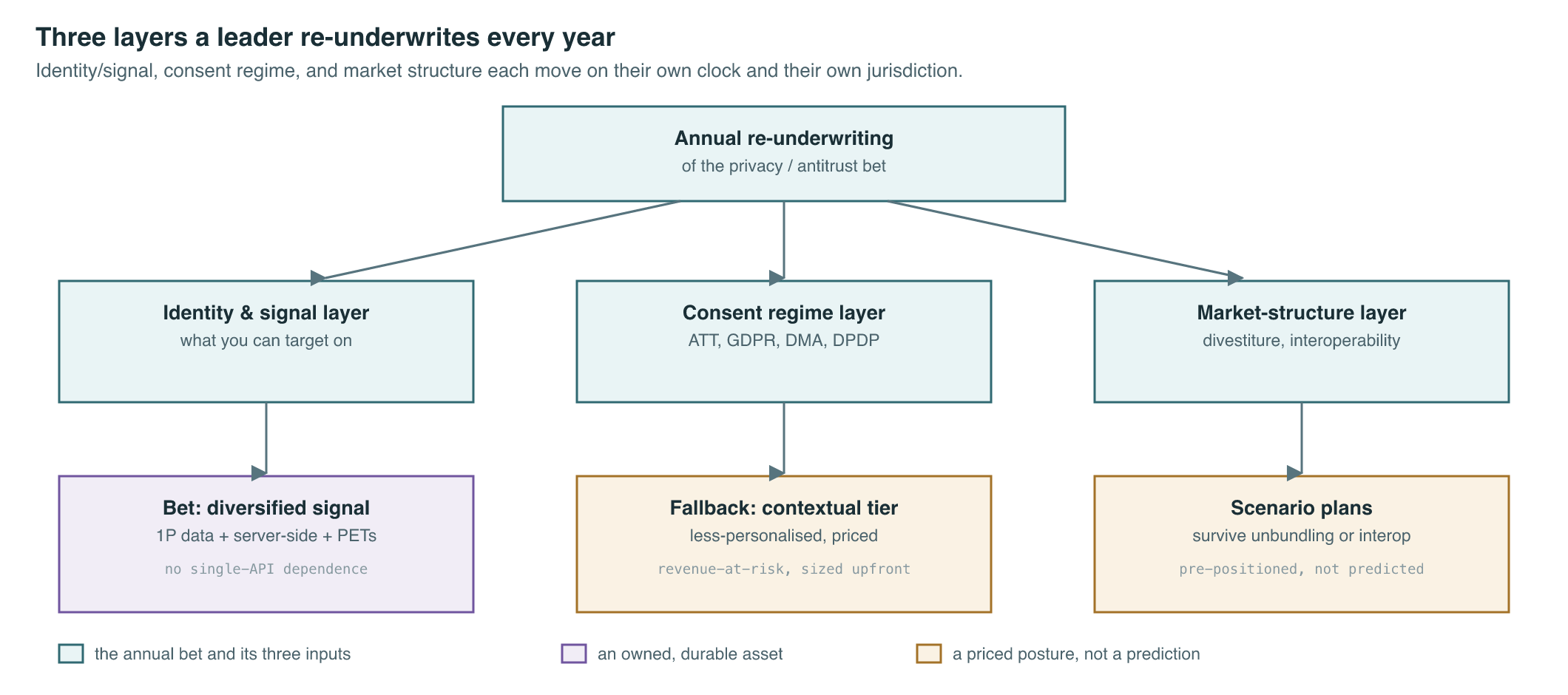
Figure 11.1 — The three layers a leader re-underwrites each year. Identity/signal, consent regime, and market structure each move on their own clock and their own jurisdiction. The bet is diversified across all three; the failure mode is betting the roadmap on any single API, regime, or assumption about market structure.
Privacy posture is annual underwriting, not a legal checkbox
The defining mental shift of this chapter is the word underwriting — pricing a risk you are choosing to carry. An insurer does not “comply” with the possibility of a hurricane; it sizes the exposure, prices the premium, and holds capital against the loss. A monetization leader’s privacy and antitrust posture is the same discipline: you are carrying a portfolio of regulatory and platform risks, each with a probability and a revenue impact, and you re-price the whole book every year because the inputs move every year.
What makes this hard is that the risks are correlated with where your money is. Recall from Chapter 2 that profit is radically concentrated: a peer’s US&Canada ARPU runs roughly 16× Rest-of-World (~$233 vs ~$14; ~$57 worldwide — Meta filings / Statista, 2024; directional). That concentration is also your regulatory concentration risk: the highest-ARPU users sit in exactly the jurisdictions — the US, the EU — where the consent regimes are strictest and the antitrust scrutiny is heaviest. The geo-mix you optimize for revenue is the same geo-mix that maximizes your exposure. A leader who maps profit pools without overlaying regulatory exposure is reading half the map.
The annual cadence is not bureaucratic theater. It is forced by how fast the inputs churn. In a single eighteen-month window the industry saw Google reverse a six-year cookie program; Apple migrate attribution from SKAN to AdAttributionKit (Apple’s successor framework, adding re-engagement attribution and configurable windows under crowd-anonymity gating); the EU issue its first DMA fine; and India notify its DPDP Rules. Any roadmap underwritten to a point estimate at the start of that window was wrong by the end of it. You underwrite to scenarios, not point estimates — the durable frame survives even as the specific facts go stale.
Pay-or-consent is a repricing event, not a fine
The line on Maya’s exposure memo that a board will fixate on is pay-or-consent — the model where a user in a strict-consent jurisdiction is offered a binary: agree to personalized ads, or pay a subscription to avoid them. It looks like a clever way to preserve personalized-ads revenue under GDPR. It is also the model the EU fined.
On 23 April 2025 the European Commission fined Meta €200m under the DMA (Digital Markets Act — the EU’s gatekeeper regulation), ruling its November-2023 binary pay-or-consent model non-compliant: it failed to offer users a genuinely equivalent service using less personal data. Meta had introduced a free “less-personalized” (contextual) ad tier in November 2024 in response, and the model remains contested into 2026 (European Commission; BEUC; 2025, ongoing — fast-moving, re-verify). A June 2026 EU General Court ruling went partly Meta’s way on a separate question (annulling Facebook Marketplace’s gatekeeper designation) while upholding Messenger’s — a useful reminder that these are many distinct legal fronts, not one, and that a leader must track them individually (Euronews / EU General Court, June 2026; re-verify).
The strategic point is not the size of the fine — €200m is a rounding error against a Meta-scale ad P&L. The point is what the ruling signals about the future shape of revenue: regulators want a genuinely equivalent less-personalized tier to exist, which means a non-trivial slice of your highest-ARPU users may route through contextual rather than personalized ads. That is a repricing event. Contextual inventory clears at a materially lower eCPM than personalized inventory. The leader’s job is to have already modeled it: if X% of EU users opt into the less-personalized tier, and contextual eCPM is Y% of personalized, what does that do to EU ARPU four quarters out?
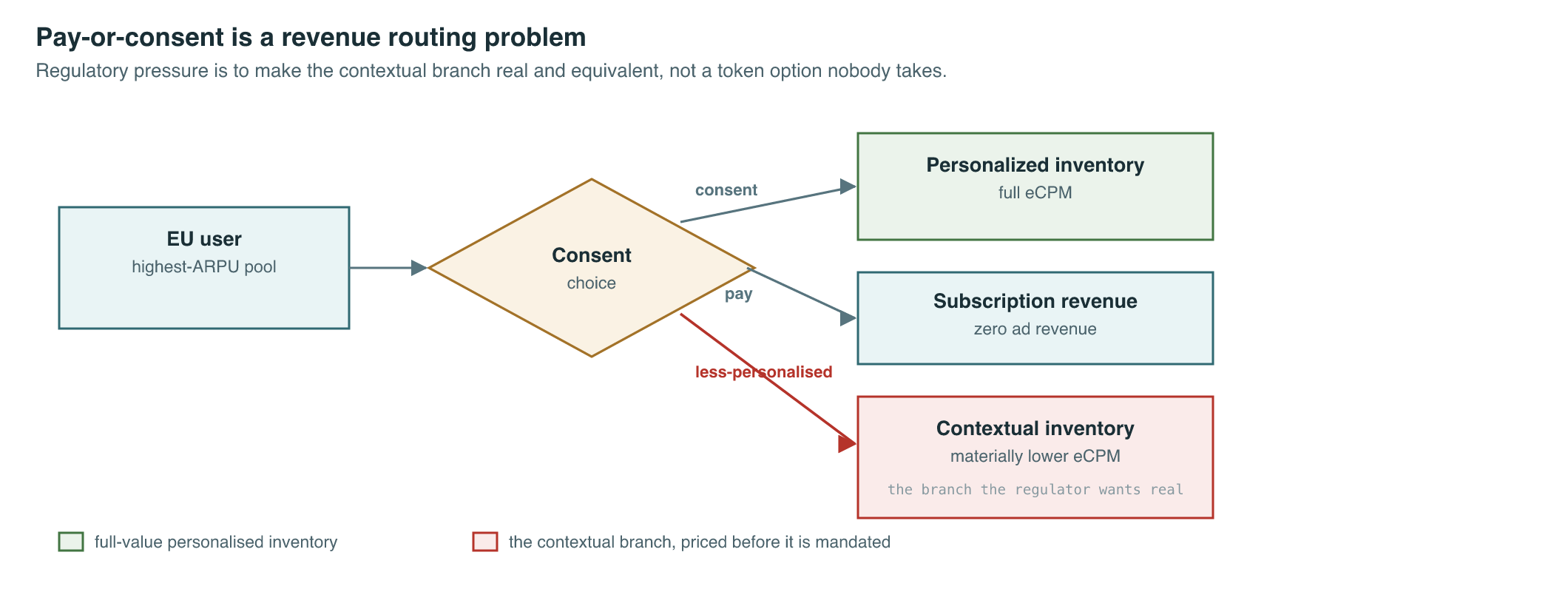
Figure 11.2 — Pay-or-consent as a revenue routing problem. The regulatory pressure is to make the contextual branch real and equivalent. The leader prices the blended ARPU across all three branches before the regulator forces the routing, and specs the contextual tier as a product rather than a compliance afterthought.
FIGURE 11.3 (spec): A simple two-bar revenue-bridge chart titled “EU ARPU under a forced contextual fallback (illustrative).” Left bar: “Today — 100% personalized, indexed ARPU = 100.” Right bar: a stacked column showing the same population split into “personalized (consented)” at full value, “contextual tier” at a reduced value (e.g., 40–60% of personalized eCPM), and “subscription opt-out” contributing flat sub revenue but zero ad revenue — netting to an indexed ARPU below 100. Caption: “The leader’s pre-mortem: model the blended ARPU of the routed population before a DMA-style mandate forces the split, not after.” Alt-text: “Bar chart showing EU ARPU declining when users are routed from personalized ads into a lower-eCPM contextual tier and a subscription opt-out.”
Don’t bet the roadmap on a single API — the durable layer is owned
The Privacy Sandbox saga is the single most instructive episode for this chapter, because it punishes the exact error a compliance mindset makes. For roughly six years the industry treated third-party cookie deprecation as a fixed, scheduled event and underwrote targeting and measurement roadmaps to Google’s replacement APIs. Then Google reversed cookie deprecation (April 2025) and retired Topics, Protected Audience, and Attribution Reporting for Chrome and Android (October 2025), with cookies remaining and no removal timeline (Google Privacy Sandbox; UK CMA released Google from its Sandbox commitments and closed the investigation 17 Oct 2025; high confidence). Every advertiser and platform that had bet the roadmap on Sandbox APIs had to re-plan.
The lesson is identity-API diversification. A leader does not bet on cookies surviving, or on Sandbox, or on any single deterministic ID. The bet is on a diversified portfolio whose value does not collapse if any one input is revoked:
- Consented first-party data and logged-in audiences — the asset no OS or regulator can take, because the user gave it to you directly. This is why the logged-in walled garden is structurally advantaged over the open web (Book 1 ch4).
- Server-side measurement — CAPI, Events API, the conversion feeds of Chapter 10 — which survive browser and cookie loss because they bypass the browser entirely.
- PETs (Privacy-Enhancing Technologies — on-device and aggregated measurement: SKAN/AdAttributionKit, clean rooms, aggregated reporting) — which replace user-level tracking with aggregate truth and are durable by design against signal loss.
Notice what this portfolio is not: it is not a bet on any third party’s continued generosity. ATT (App Tracking Transparency — Apple’s iOS opt-in prompt) is the cautionary case from the other direction. ATT cut the trackable share of US Apple traffic by roughly 55 percentage points (from ~73% to ~18%) and is estimated to have cut publisher ad revenue from Apple users by ~21% (FTC working paper, Skiera et al., 2025; medium confidence). Apple did that to competitors while advantaging its own first-party Apple Search Ads surface — whose iOS install-attribution share roughly doubled (~17%→~31%) post-ATT (JP Morgan estimate / eMarketer; medium confidence). OS gatekeeping is itself an ad-tech moat, and the leader who depends on a gatekeeper’s API has handed that gatekeeper a dial on their revenue.
Scenario-plan the market-structure remedies before they land
The third layer — market structure — is where the stakes are highest and the leader’s instinct is weakest, because it feels like something that happens to the company, owned by litigators, not something to plan around. That instinct is the error. Two live remedies should be war-gamed by any platform ads leader, because they redraw the competitive map.
Forced divestiture. On 17 April 2025 a US federal court (Judge Brinkema, E.D. Va.) ruled Google illegally monopolized the open-web publisher ad-server and ad-exchange markets and unlawfully tied its ad server (DFP) to its exchange (AdX). The DOJ sought structural relief — forcing Google to divest AdX, and DFP if needed; Google argued for behavioral remedies (sharing bid data, no breakup). Closing arguments finished November 2025; as of mid-2026 the remedy ruling is still pending, with the judge signaling hesitancy on a full structural breakup and a likely landing on hard conduct remedies — mandated interoperability, bans on preferential treatment, independent monitoring — with divestiture held in reserve (DOJ; AdExchanger; Digiday; Norton Rose Fulbright; April 2025–2026 — fast-moving, re-verify). For the open-web supply chain this is seismic. For a walled-garden leader it is a competitive-map shift: a less-integrated, more contestable open-web stack changes the relative value of your closed, owned inventory.
Forced interoperability. The DMA’s gatekeeper obligations already forced Messenger toward interoperability with rival messaging services (EU General Court, June 2026; re-verify). The leader’s pre-mortem question: if a regulator mandated that our auction, our identity, or our measurement be made interoperable with rivals, what part of our moat survives? The honest answer separates a durable platform from a fragile one — and the durable parts (consented first-party data, model quality, owned demand) are exactly the ones a leader should be over-investing in because they survive an interoperability mandate.
The posture is not to predict which remedy lands. It is to pre-position the stack so the platform survives whichever does — to know, before the ruling, which assets are remedy-proof and which are remedy-exposed, and to have shifted weight toward the former.
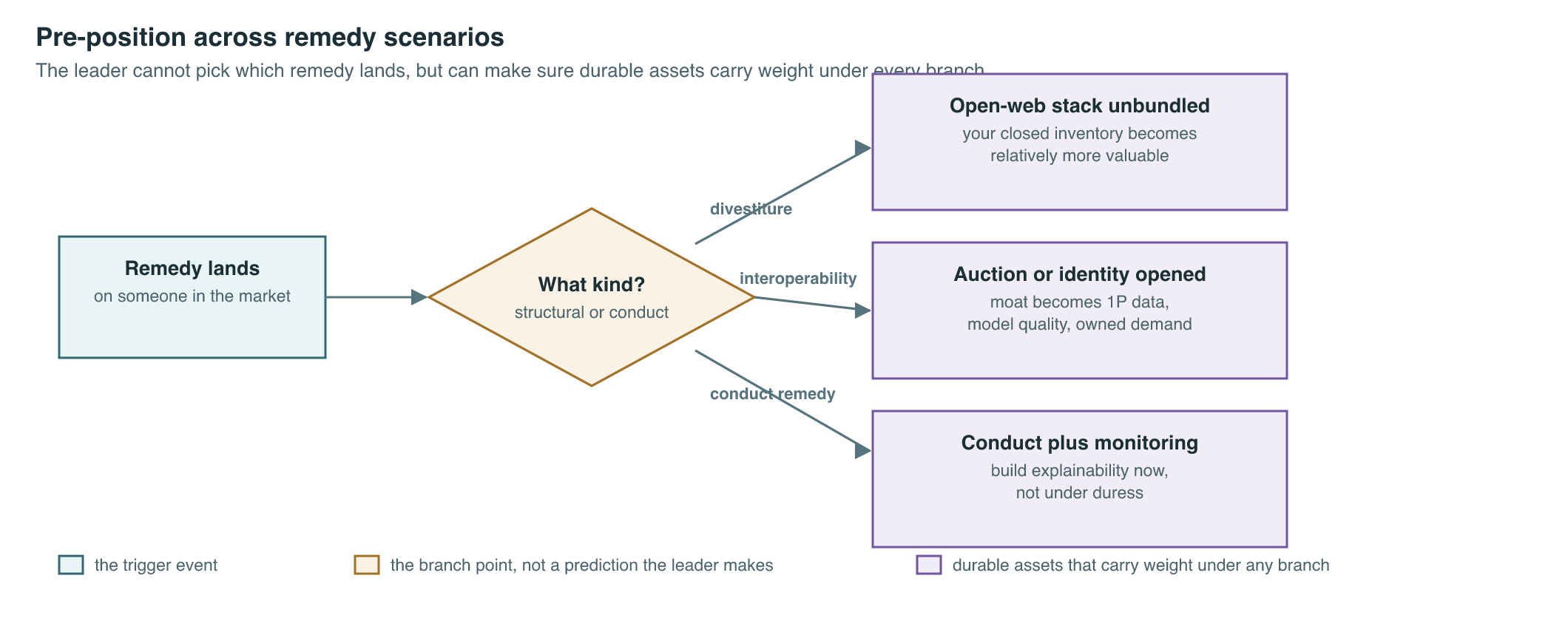
Figure 11.4 — Pre-positioning across remedy scenarios. The leader cannot pick the outcome, but can ensure the durable assets (first-party data, model quality, owned demand, audit-ready transparency) carry weight under every branch. The fragile assets (single-API dependence, opaque mechanisms, integration-based lock-in) are the ones a remedy strips.
The fragmenting consent map — and why DPDP matters now
The fourth re-underwriting input is the sheer fragmentation of consent law, which turns a single global ad operation into a patchwork of jurisdiction-specific regimes. GDPR (the EU’s baseline data-protection law) set the template; the DMA layered gatekeeper obligations on top. India operationalized DPDP (Digital Personal Data Protection — its data-protection regime), with the DPDP Rules notified 14 November 2025, phasing in over 12–18 months: clear, purpose-specific, withdrawable consent; a prohibition on targeted advertising and behavioral tracking to children; and a forcing function pushing large personalized campaigns onto explicit consent (India MeitY/PIB; EY India; 2025 — re-verify phase-in dates). The US, meanwhile, fragments rather than federalizes — roughly 19–20 states with comprehensive privacy laws and counting, with no federal pre-emption (Bloomberg Law / IAPP, 2025; high confidence).
DPDP deserves the leader’s specific attention precisely because of the geo-mix logic of Chapter 2. India is a low-ARPU, high-growth pool — exactly the kind of market a leader funds for future monetizable engagement rather than today’s yield. DPDP’s consent requirements arrive before that monetization matures, which means the leader is underwriting a consent regime against revenue that does not yet exist but is in the growth narrative. The call is whether to build consent-native monetization infrastructure in India now — treating compliance as a foundation for durable first-party data — or to retrofit it later under enforcement pressure. The leader who reads privacy as strategy builds it in; the one who reads it as compliance retrofits it expensively.
Same-Lever Scorecard
How the majors set the same dial — their privacy/antitrust posture and the asset they are betting on to survive it. Figures dated and hedged inline.
| Platform | Core privacy/antitrust exposure | The bet (durable asset) | Posture tell |
|---|---|---|---|
| Meta | DMA pay-or-consent (€200m fine, Apr 2025); GDPR; reliance on US&Canada profit pool | Consented 1P data across FoA; CAPI/AEM server-side; contextual fallback tier | Built a less-personalized tier under DMA pressure — pricing the fallback before it’s mandated |
| Profile-data targeting (seniority/employment) under EU/US scrutiny | Verified, user-declared 1P professional graph + CRM clean-room loops | Deterministic declared data is consent-clean by construction — least exposed to tracking bans | |
| TikTok | US divestiture/data-custody (Oracle-led JV, finalized ~Jan 2026); DPDP; child-targeting rules | US-data custody + retrained algorithm; Events API server-side | Entire US ad business is a structural remedy in motion — the extreme case (re-verify JV terms) |
| Google / YouTube | DOJ ad-tech monopoly ruling (Apr 2025, remedy pending); Sandbox wind-down | Logged-in 1P (Search/YouTube/Android); owned demand; clean rooms (ADH) | Reversed cookie deprecation and faces divestiture — re-underwrote its own bet publicly |
| Amazon | Retail-media data scrutiny; lighter antitrust ad exposure | Closed-loop first-party purchase data; AMC clean room (free, Sept 2025) | Purchase data is the most consent-durable signal — least dependent on cross-site tracking |
| Apple (wildcard) | The gatekeeper — ATT/AAK set the rules others underwrite to | OS control + first-party Search Ads surface | Uses privacy regulation offensively: ATT cut rivals’ signal ~55pp while growing its own share |
Decision or Diagnostic?
Sort the chapter’s work by altitude. The leader sizes and places the bet; counsel and the privacy team run the compliance instruments.
| Decision (board / leader owns) | Diagnostic (counsel / privacy / IC owns) |
|---|---|
| The annual privacy/identity bet allocation — how much to fund 1P data vs server-side vs PETs | Per-jurisdiction consent-flow conformance — does each banner/SDK meet the local statute |
| Revenue-at-risk per regulatory scenario — the dollar exposure carried into each board cycle | Consent opt-in / opt-out rates by market — the operational telemetry feeding the model |
| The contextual / less-personalized fallback tier — whether to build it and how to price it | DPA filings, DPIAs, audit logs — the compliance artifacts that satisfy regulators |
| Remedy-scenario pre-positioning — which assets to over-invest in to survive divestiture/interop | Crowd-anonymity thresholds / aggregation settings — the PET configuration the team tunes |
The leader’s call. The trade-off you own is how much of the platform’s future revenue you bet on durable, owned signal versus how much you leave exposed to a gatekeeper’s API or a single consent regime — and you re-underwrite that bet every year, in dollars, in front of the board. The asymmetry is that the exposure is invisible until a ruling crystallizes it: a Sandbox reversal strands your roadmap, an ATT prompt vaporizes a quarter of trackable signal, a €200m DMA fine signals that your highest-ARPU users may route through lower-eCPM contextual inventory. Google resolved its piece by publicly re-underwriting — reversing cookie deprecation, winding down Sandbox (2025), and pivoting back to logged-in first-party data and clean rooms while a divestiture ruling hangs over its open-web stack (remedy pending, mid-2026 — re-verify). Meta resolved the pay-or-consent piece by building a contextual fallback tier and pricing the revenue-at-risk before the mandate fully bit. Four quarters out: bet the roadmap on a single API or assume one consent regime holds, and one ruling reprices a profit pool you cannot quickly rebuild; diversify the bet across consented first-party data, server-side feeds, and PETs, pre-position for the remedy you cannot predict, and you carry the same regulatory shocks as a priced, hedged exposure rather than a surprise that torches a quarter and the advertiser trust that took years to build.
Key terms
| Term | One-line definition |
|---|---|
| Privacy posture as underwriting | Treating regulatory/platform risk as a priced, scenario-planned exposure re-sized annually, not a compliance checkbox. |
| DMA | EU Digital Markets Act — gatekeeper regulation behind the €200m Meta pay-or-consent fine and Messenger interoperability obligations. |
| GDPR | EU’s baseline data-protection law governing consent; the template the DMA layers on. |
| DPDP | India’s Digital Personal Data Protection regime; Rules notified Nov 2025, phasing in through ~2027, forcing explicit consent. |
| ATT | App Tracking Transparency — Apple’s iOS opt-in prompt that durably suppressed cross-app tracking and advantaged Apple’s own surface. |
| AdAttributionKit (AAK) | Apple’s successor to SKAN: aggregated, crowd-anonymity-gated install/re-engagement attribution. |
| Pay-or-consent (consent or pay) | A model offering personalized ads, a paid ad-free tier, or a less-personalized tier; the DMA demands the less-personalized option be genuinely equivalent. |
| PET | Privacy-Enhancing Technology — on-device/aggregated measurement (SKAN/AAK, clean rooms) replacing user-level tracking; durable by design. |
| Identity-API diversification | Refusing to bet the roadmap on any single identity/measurement API; spreading the bet across owned 1P data, server-side, and PETs. |
| Forced divestiture / interoperability | Antitrust remedies (structural breakup or mandated openness) the leader scenario-plans rather than predicts. |
| Regulatory concentration risk | The overlap of the highest-ARPU profit pools with the strictest-consent, heaviest-antitrust jurisdictions. |
Recap & what is next
- Privacy and antitrust posture is annual underwriting, not a legal checkbox — a portfolio of probability-weighted revenue events the leader re-prices every year and defends to the board in dollars.
- Pay-or-consent is a repricing event, not a fine: the DMA pressure is to make a genuinely equivalent less-personalized tier exist, routing some of your highest-ARPU users into lower-eCPM contextual inventory — model the blended ARPU before it’s mandated.
- Never bet the roadmap on a single API: the Sandbox reversal and ATT prove the ground is set by people who don’t report to you — diversify across consented first-party data, server-side feeds, and PETs, none of which collapse if one input is revoked.
- Scenario-plan market-structure remedies (divestiture, interoperability) before they land: you can’t predict the ruling, but you can pre-position so the durable assets — owned data, model quality, owned demand, audit-ready transparency — carry weight under every branch.
- The consent map fragments rather than federalizes (GDPR/DMA, DPDP, ~20 US state laws); regulatory exposure concentrates in the same geographies as your profit, so the geo-mix you optimize for revenue is the one you must hedge for risk.
- Sort ruthlessly: the bet allocation, the revenue-at-risk, the fallback tier, the remedy pre-positioning are yours; consent conformance, opt-in telemetry, DPIAs, aggregation thresholds belong to counsel and the privacy team.
Maya can now carry her privacy and antitrust posture into the board as a priced, hedged bet rather than a surprise. The most remedy-proof, consent-durable revenue of all is the kind where the platform owns the transaction itself — first-party purchase data plus closed-loop attribution, untouchable by any cross-site tracking ban. Chapter 12 — Where to Play in Commerce takes you there: the build-versus-buy call on commerce and retail media, the take-rate decision, and why owning the checkout is the most defensible new ad business a platform can stand up.