The promise. In Chapter 9 you decided how far to let the platform itself generate the ad — how much of creative production to automate and where to keep a human in the loop. That decision, like the automation call before it and the auction call before that, rests on a buried assumption: that you can tell whether any of it worked. This chapter blows up that assumption and rebuilds it. Signal loss has turned measurement from a back-office reconciliation into a first-class strategic decision you own. The advertiser-reported ROAS on your dashboard is no longer ground truth — it is a number your own system partly invents, inflated in your favor, and your largest advertisers increasingly know it. This chapter equips you to decide what counts as true: how to build a triangulated truth system, where to set the privacy-versus-proof dial from the platform side, and how to govern the gap between what you report and what actually happened — before an advertiser’s marketing-mix model finds the gap for you and re-rates your inventory accordingly.
You will be able to:
- Build a triangulated measurement stack — platform attribution for in-flight tuning, incrementality as causal ground truth, MMM for portfolio allocation — and mandate that the three reconcile.
- Defend reported ROAS to finance and the board as an inflated upper bound, and anchor budget decisions to incremental ROAS instead.
- Decide to treat server-side feeds and high match quality as table-stakes monetization infrastructure, not a compliance chore.
- Reason about modeled conversions and crowd-anonymity gating as product-design choices, not vendor mechanics.
- Set the platform’s privacy-versus-proof dial — how much credible incrementality and clean-room proof to offer instead of maximal last-touch attribution.
Builds on: Book 1 ch4 (attribution windows, last-touch vs multi-touch) and ch7 (the privacy and consent layer over the supply chain). Within Book 2 it builds on ch4 (the auction’s Estimated Action Rate is only as honest as the conversion signal feeding it) and ch8–9 (automation and generative creative, which need rich signal to work). It sets up ch11, where the consent and identity under all of this measurement become a regulatory bet you re-underwrite annually.
The call on Maya’s desk
Eleven months in, Maya gets pulled into a quarterly business review with Northwind, her large commerce advertiser. Northwind’s new VP of Growth puts a single slide on the screen: “Your platform reports a 6.2× ROAS on our prospecting budget. Our geo-holdout test says the incremental ROAS is 1.9×. We’re cutting next quarter’s budget 30% until you can close that gap.”
This is not a measurement-team problem that rolls up to Maya. It is Maya’s problem, and it is the most dangerous kind: her own reported number, the one her account teams have been quoting to win the budget, has just been publicly contradicted by the advertiser’s own science — and the advertiser is right. Reported ROAS counts every conversion the platform touched, inside its own attribution window, including the high-intent buyers who would have purchased anyway. Incremental ROAS counts only the purchases that would not have happened without the ad. The gap between 6.2× and 1.9× is not fraud; it is the structural over-attribution baked into last-touch measurement (industry/clean-room pilots put pixel-only attribution error around ~25–35%, 2025; directional). But to Northwind it looks like Maya sold them a number that wasn’t real.
The instinct from her challenger-platform days is to defend the 6.2×: our attribution is industry-standard, every platform reports this way. That instinct is exactly wrong, and recognizing why is the chapter. At the challenger she could get away with maximal last-touch attribution because her advertisers were smaller and rarely ran their own incrementality science. Northwind runs geo-holdouts and a marketing-mix model. Against a sophisticated advertiser, an inflated reported ROAS is not an asset — it is a liability that compounds, because the day they measure the gap themselves is the day they stop trusting every number you give them. Trust is revenue infrastructure (ch4); measurement is where it is most quietly spent.
So the decision is not “how do we defend 6.2×.” It is: what truth system do we offer Northwind so that the next budget conversation is about growing incremental return, not about whether we lied?
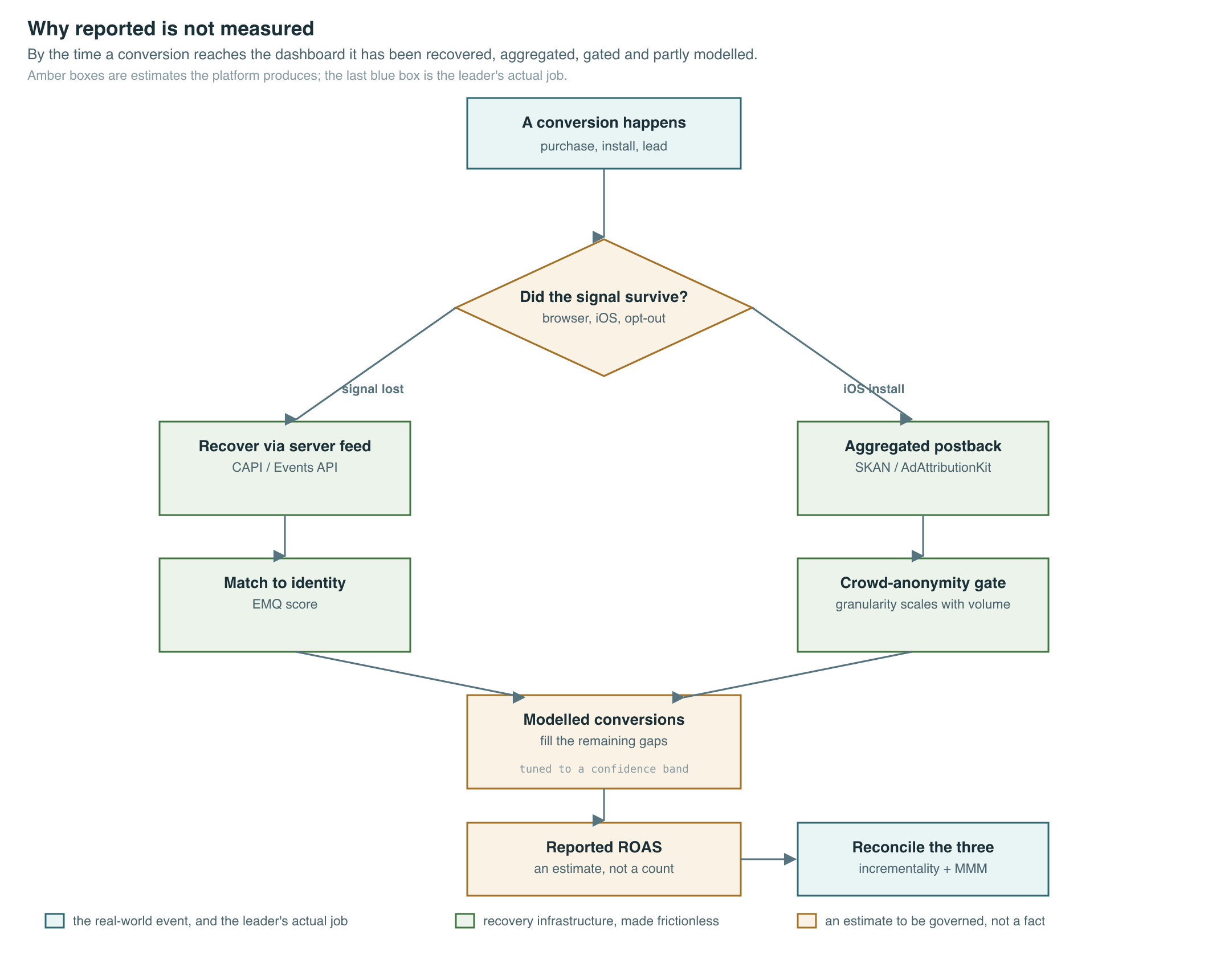
Figure 10.1 — Why reported is not measured. By the time a conversion reaches your dashboard it has been recovered server-side, aggregated, crowd-anonymity gated, and partly modeled. The number is an estimate the platform produces. The leader’s job is the boxed reconciliation step (H→I), not the dashboard.
The three instruments, and why no single one is the truth
The first thing to teach finance and the board is that there is no single measurement number, and anyone who hands you one is selling you something. There are three instruments, each answering a different question, and the leader’s discipline is forcing them to reconcile rather than picking the flattering one.
- Platform attribution (the Pixel/CAPI/SKAN stack) answers which ad to optimize toward, right now. It is fast, granular, biased upward, and indispensable for in-flight tuning — the autobidder in ch8 literally cannot steer without it. It is a diagnostic, not a verdict.
- Incrementality — holdout and geo-split experiments — answers what would not have happened without the ad. This is causal ground truth: the only instrument that isolates lift from correlation. Meta’s Conversion Lift and geo-holdouts are the canonical examples. Slow, expensive, and the number you anchor budget to.
- Marketing-mix modeling (MMM) answers how to allocate the whole portfolio across channels — privacy-durable, PII-free, aggregate. Its resurgence is real and structural: open-source frameworks (Google’s Meridian, Bayesian and geo-hierarchical, GA early 2025; Meta’s Robyn) collapsed the cost barrier, and the two largest ad platforms are now actively steering advertisers toward aggregate modeling (Google Developers / eMarketer, 2025).
The leader’s posture is triangulation, not selection: mandate that platform attribution, incrementality, and MMM reconcile, and treat any single one in isolation as a diagnostic. When MMM and platform attribution disagree — and they will, by the Northwind-sized gap — a geo-experiment breaks the tie. This is the inversion the chapter demands: most platforms resist triangulation because it exposes their inflated reported number. The strategic move is to offer it, because the advertiser who trusts your incrementality story spends more durably than the one you flattered into a budget they later cut.
FIGURE 10.2 (spec): A three-instrument “measurement triangle” diagram. Three labeled vertices — “Platform Attribution / CAPI (in-flight tuning, fast, biased up)”, “Incrementality / Geo-holdout (causal ground truth, slow)”, “MMM (portfolio allocation, privacy-durable)”. A double-headed arrow on each edge labeled “must reconcile.” Center label: “Reported ROAS lives here — an upper bound, not the truth.” Caption: “No vertex is the answer; the leader governs the reconciliation among all three.” Alt-text: “Triangle linking platform attribution, incrementality, and marketing-mix modeling, with reported ROAS shown as an upper bound at the center.”
Reported ROAS is an upper bound — govern it like one
Here is the sentence to put in front of your CFO and never walk back: reported ROAS is a systematically inflated upper bound on incremental ROAS, and the gap is a measurable liability, not a rounding error. Each platform counts any conversion it touched inside its own window, double-counting across platforms, crediting view-throughs, and taking credit for high-intent users (retargeting, branded search) who would have converted anyway. The result is the 6.2× versus 1.9× that landed on Maya’s desk.
This is not an argument to stop reporting ROAS. The autobidder needs it; the IC tunes on it; it is a legitimate diagnostic. It is an argument to govern it: state plainly to finance that reported ROAS is the ceiling, anchor every budget decision to the incremental number, and stand up a measurement-governance function — a standing team whose job is to re-validate the attribution-to-incrementality calibration on a recurring cadence, not treat any vendor metric as fixed. The platforms that survive the next four quarters of advertiser sophistication are the ones that volunteered the gap before their largest advertiser found it.
There is a deeper reason this is a platform-side leader’s call and not an advertiser’s. When you over-attribute, you don’t just mislead Northwind — you mis-train your own systems. The auction’s Estimated Action Rate (ch4) and the autobidder’s pacing (ch8) optimize toward whatever you tell them is a conversion. Feed them inflated, double-counted, or modeled-to-flatter signal and you get an auction that clears confidently on a fiction, and a feed that monetizes worse than the dashboard claims. Measurement honesty is not a concession to advertisers; it is how you keep your own machine calibrated.
Match quality and modeled conversions are infrastructure, not plumbing
Signal does not survive on its own anymore. iOS App Tracking Transparency opt-in sits at roughly 35% among users who see the prompt (Q2 2025; up only marginally from ~34.5% in 2024 — Adjust benchmarks, Authorized ÷ (Authorized + Denied); the all-population rate is lower, ~25%), Safari ITP and ad blockers erode the rest, and browser-only setups can lose a large share of observed conversions (cited up to ~70% in degraded cases — industry guides, 2025; low confidence, re-verify). The platform answer is the server-side conversion feed: Meta’s Conversions API (CAPI) and TikTok’s Events API, server-to-server endpoints that send events from the advertiser’s own infrastructure with event-ID deduplication against the client pixel.
The decision here is altitude-appropriate and blunt: make the server feed and high match quality table stakes, and remove every gram of integration friction. Meta’s own studies cite roughly +13–19% attributed conversions and around −17.8% cost per result when CAPI is added on top of the Pixel (Meta for Business; vendor-reported, 2024–2025) — yet adoption industry-wide sits at only ~35–60% of advertisers (industry surveys; low confidence). That gap is the leader’s opportunity: Meta shipped a free one-click CAPI setup in Events Manager to kill the technical barrier, because every advertiser left on degraded client-only signal is an advertiser whose campaigns underperform their potential on your surface.
The operational metric this produces is Event Match Quality (EMQ) — Meta’s 1–10 score for how well server-sent events match to a Meta identity. Browser-pixel-only typically scores ~3–5; below ~7 the optimization is “partially blind”; adding hashed email, phone, and location pushes it into the good band (Meta Dataset Quality API / industry guides, 2026). EMQ is a textbook diagnostic — the IC drives a single account’s score up — but the decision the leader owns is to make EMQ-7-plus the default state of the platform: ship the gateways, the one-click setups, the hashing libraries, so that high match quality is what advertisers get without trying. In 2026, performance is increasingly gated by signal quality rather than budget or targeting; for advertisers sending modeled values, low EMQ is a “silent tax” — the model may be sound but the platform never receives enough matched events to steer delivery (industry guides, 2026).
Which brings in the term finance most needs to hear: modeled conversions — platform-reported counts that are statistically estimated to fill gaps where user-level signal is missing. Modeling is now a structural part of every platform-reported number, not an edge case. The leader must set the expectation explicitly: your conversion counts are partly estimates, the modeling is tuned to a confidence band, and the privacy-versus-proof posture decides how aggressively you model versus how much you concede is simply unmeasured.
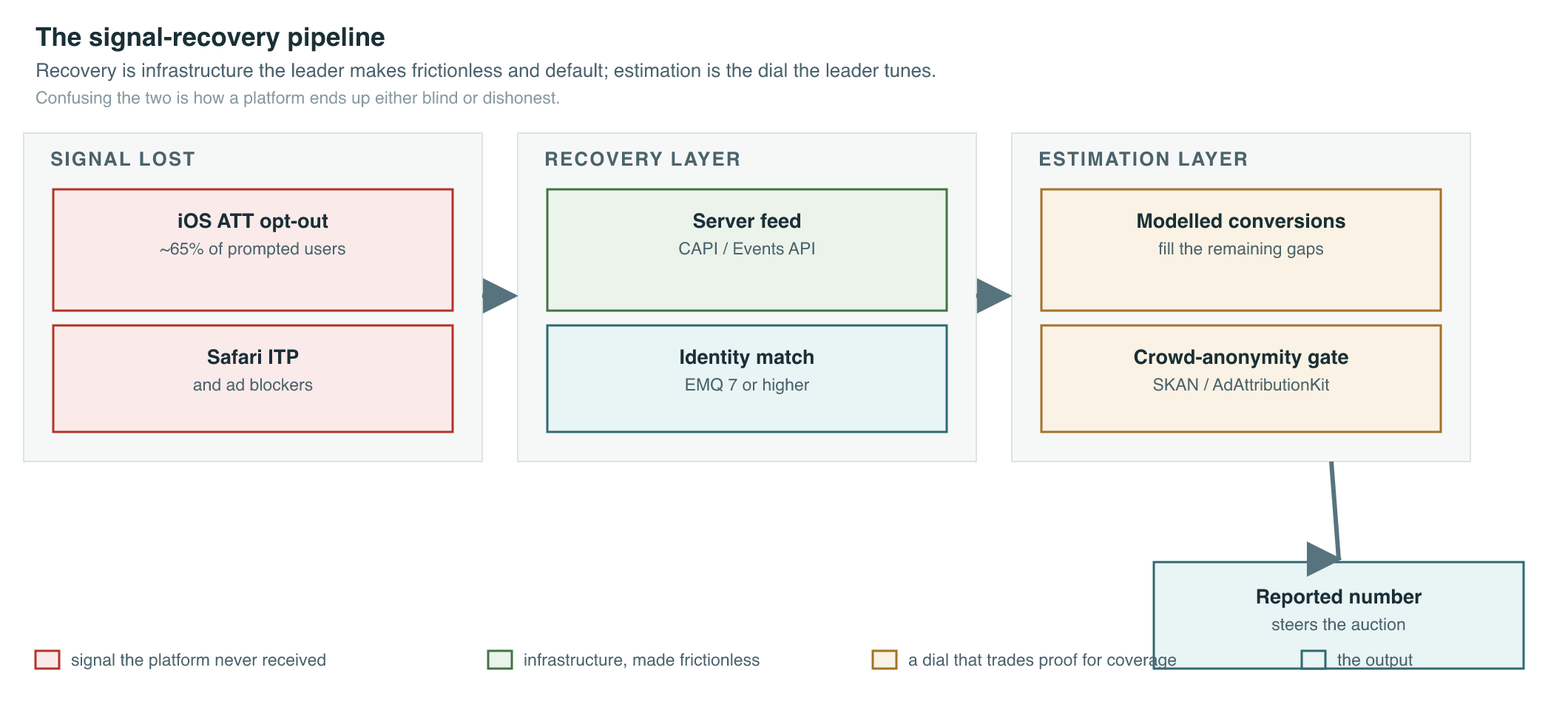
Figure 10.3 — The signal-recovery pipeline. Recovery (server feeds + match quality) is infrastructure the leader makes frictionless and default; estimation (modeling + crowd-anonymity gating) is the dial the leader tunes. Confusing the two is how a platform ends up either blind or dishonest.
The iOS aggregate framework: design conversion schemas for crowd anonymity
App-install measurement runs on a separate, aggregated track that the leader cannot opt out of: Apple’s SKAdNetwork (SKAN) and its successor AdAttributionKit (AAK). AAK (introduced with iOS 17.4, expanded through 2025) adds re-engagement attribution, configurable per-network attribution windows, attribution cooldowns to block duplicate credit, and an interaction type (click vs view) on its postbacks — but both frameworks still deliver aggregated, delayed postbacks across three measurement windows (days 0–2, 3–7, 8–35, each sent after a further randomized delay) rather than user-level data (Apple Developer / Adjust, WWDC 2024–2025). A grounding note for any 2026 plan: adoption has been slow and messy — by mid-2026 SKAN 4 is only now reaching majority adoption while AAK registers as negligible, and five years after ATT only about a fifth of iOS marketers say they are confident in iOS attribution (Kochava / adlibrary.com, 2026; treat as fast-moving). The framework matters more than which version is live.
The mechanism the leader must understand is crowd anonymity — Apple’s privacy-versus-proof dial, baked into the OS. The number of conversion-value bits (and country codes) Apple returns scales with conversion volume in a cohort: low-volume campaigns get coarse or null signal; only high-volume cohorts unlock full granularity. Apple states AAK and SKAN together cover roughly 77% of referral-based App Store conversions (Apple via industry recaps, 2025–2026; medium confidence), so this is not a niche path — it mediates the large majority of measurable iOS installs.
The leader-altitude decision is a design one: architect conversion-value schemas so campaigns clear the crowd-anonymity volume threshold. Fragment spend across too many small campaigns and every one returns coarse, late, or null signal; consolidate so cohorts are large enough to unlock granularity. This is the same instinct as ch4’s reserve-price thinking — you are designing the system so the aggregate behaves, not optimizing a single unit. And it directly conditions the automation decision in ch8: an autobidder starved of granular postbacks optimizes blind.
The platform-side dial: privacy versus proof
Everything above converges on one lever the leader owns and almost no one frames as a decision: how much credible proof to offer advertisers versus how much last-touch attribution to keep claiming. This is the privacy-versus-proof dial, and it has a platform-side and an advertiser-side reading. On the advertiser side it is “how much of my measurement can survive privacy.” On your side it is the opposite and more strategic: “how much over-attribution do I keep harvesting for short-term budget capture, versus how much verifiable incrementality and clean-room proof do I offer to earn durable trust?”
The proof end of the dial is the clean room — a privacy-safe environment where advertiser and platform data can be matched and queried only in aggregate, never at the individual row. Clean rooms went from large-advertiser luxury to mainstream infrastructure in 2025 (~66% org adoption — eMarketer/IAB, 2025), and the walled gardens concentrate both the capability and the revenue. Amazon Marketing Cloud (AMC) — a pseudonymized SQL clean room across DSP, Sponsored Ads, and streaming — was made free for all Sponsored Ads advertisers in September 2025, removing the cost barrier and widening the addressable base dramatically. Google’s Ads Data Hub (ADH) is the BigQuery analogue, functionally free to Google clients, enforcing aggregation thresholds before results return — the same crowd-anonymity logic as Apple’s, applied to query output.
Note the convergence: Apple’s crowd anonymity, Google’s ADH aggregation thresholds, and AMC’s row-level prohibition are the same dial set by three different gatekeepers. The leader’s call is where to set their own. Set it toward maximal last-touch attribution and you capture budget now and erode trust as advertisers’ MMMs reveal the gap. Set it toward credible, experiment-validated incrementality and clean-room proof and you concede some flattering numbers but earn the durable spend. The honest posture — give advertisers verifiable lift, not maximal credit — is the same engagement-versus-extraction trade-off from ch4, applied to the measurement layer. Over-attributed ROAS is the measurement equivalent of an over-loaded feed: it pays this quarter and costs trust the next.
So Maya’s call with Northwind resolves not by defending 6.2× but by offering the 1.9× back — stand up a joint clean-room analysis, run a co-designed geo-holdout, and re-frame the QBR around growing incremental return. The budget Northwind keeps after that conversation is worth more than the budget she would have lost defending a number both sides knew was inflated.
Same-Lever Scorecard
How the majors set the privacy-versus-proof dial — how much aggregate/clean-room proof they offer, and how openly they govern the reported-vs-incremental gap. Figures dated and hedged inline.
| Platform | Signal-recovery stack | Proof layer offered | Privacy-vs-proof posture | Tell for the leader |
|---|---|---|---|---|
| Meta | Pixel + CAPI + AEM (+SKAN/AAK for app); EMQ as the match-quality KPI | Conversion Lift (holdout/ghost ads); Robyn MMM (open source) | Pushing server-side as default (one-click CAPI); offers incrementality but reported ROAS still inflated | EMQ 7+ default and free CAPI = signal completeness as a competitive moat |
| First-party profile + CRM-integrated conversion data | Revenue Attribution Report — ties spend to CRM pipeline/closed revenue | Account-level, deterministic; long-cycle B2B reframes “proof” as pipeline, not clicks | Proof = revenue influence on a 6–10-person buying committee, not last-touch | |
| TikTok | Pixel + Events API (event_id dedup, hashed PII, ttclid auto-append) | Geo-lift studies; default 7-day click / 1-day view window | Signal resilience emphasized; modeled-heavy; US data-custody under JV adds uncertainty | Server-side recovers events lost to ad blockers, which intercept ~30%+ of browser pixels (ad-blocker prevalence, GWI 2024; not a TikTok-reported recovery rate); watch JV measurement continuity |
| Google / YouTube | Tags + Enhanced Conversions; modeled conversions structural | Ads Data Hub (aggregation-thresholded clean room); Meridian MMM (GA early 2025) | Aggregation-gated proof; steering advertisers to MMM + modeled measurement | ADH thresholds = same crowd-anonymity dial, applied to query output |
| Amazon | Closed-loop first-party purchase data | AMC clean room — free for Sponsored Ads advertisers (Sept 2025) | Most credible proof: owns the transaction, so attribution is closest to ground truth | Free AMC widens the proof base; closed loop is the privacy-durable measurement asset |
| Apple (wildcard) | SKAN → AdAttributionKit; on-device, aggregated | None for third parties — sets the gate, doesn’t sell the proof | Crowd anonymity is the dial; gatekeeper sets proof ceiling for everyone else | OS-level control of measurement is itself an ad-tech moat (advantages Apple Search Ads) |
Decision or Diagnostic?
Sort the chapter’s metrics by who owns them. The leader sets the truth system; the IC tunes the instruments inside it.
| Decision (board / leader owns) | Diagnostic (IC / launch-review owns) |
|---|---|
| Privacy-vs-proof dial — how much incrementality/clean-room proof to offer vs maximal last-touch attribution | EMQ score — a single dataset’s match quality; the IC drives it toward 7+ |
| Anchor metric for budget — incremental ROAS, not reported ROAS | Reported / platform ROAS — fast in-flight tuning signal, an inflated diagnostic |
| Triangulation mandate — require attribution, incrementality, and MMM to reconcile | Single-campaign attributed conversions — the per-campaign count the autobidder steers on |
| Conversion-schema design for crowd anonymity — consolidate so cohorts clear the volume gate | SKAN/AAK postback values — the per-cohort bits returned; operational, monitored at the desk |
| Modeling posture — how aggressively to model gaps vs concede them unmeasured | Modeled-conversion confidence bands — the per-model statistics the measurement team tunes |
The leader’s call. The trade-off you own is the privacy-versus-proof dial: how much over-attributed, flattering ROAS you keep harvesting for short-term budget capture versus how much verifiable incrementality and clean-room proof you offer to earn durable advertiser trust. The asymmetry is the trap — inflated reported ROAS wins this quarter’s budget and quietly accrues a liability that detonates the day your largest advertiser runs its own geo-holdout and finds the 6.2×-vs-1.9× gap. Amazon resolved it furthest by making AMC’s clean room free in September 2025: it can afford radical proof because, owning the transaction, its attribution sits closest to ground truth — proof is its moat. Meta resolved the infrastructure half by making CAPI one-click and EMQ-7-plus the default, treating signal completeness as monetization infrastructure rather than compliance, while still carrying an inflated reported number it must eventually govern. Four quarters out: keep the dial on maximal last-touch and you book good reported ROAS while sophisticated advertisers’ MMMs re-rate your inventory downward and cut budgets you can’t win back with dashboards; set it toward credible, experiment-validated proof and you concede some flattering numbers now in exchange for the durable, defensible spend that survives the next privacy shock. Govern reported ROAS like a central banker governs a headline rate everyone knows is nominal — useful for steering, dishonest as a destination.
Key terms
| Term | One-line definition |
|---|---|
| CAPI / Events API | Server-to-server conversion feeds (Meta / TikTok) that recover events lost to browser and iOS signal loss, deduplicated against the client pixel. |
| EMQ (Event Match Quality) | Meta’s 1–10 score for how well server-sent events match a Meta identity; below ~7 the optimization is partially blind. (Diagnostic.) |
| Modeled conversions | Platform-reported counts that are statistically estimated to fill gaps where user-level signal is missing — a structural part of every reported number. |
| SKAN / AdAttributionKit | Apple’s aggregated, delayed iOS app-attribution frameworks; AAK adds re-engagement and configurable windows but stays aggregate, not user-level. |
| Crowd anonymity | Apple’s privacy-vs-proof gate: postback granularity scales with cohort conversion volume; low-volume campaigns get coarse or null signal. |
| Incrementality / lift | Holdout and geo-split experiments measuring what would not have happened without the ad — the causal ground-truth instrument. |
| MMM (Marketing-Mix Modeling) | PII-free aggregate modeling (Google Meridian, Meta Robyn) for privacy-durable portfolio allocation across channels. |
| Reported vs incremental ROAS | Reported counts every touched conversion (inflated upper bound); incremental counts only ad-caused conversions (the budget anchor). |
| Clean room | A privacy-safe environment (AMC, ADH) where advertiser and platform data match and query only in aggregate — the proof end of the dial. |
Recap & what is next
- Reported is not measured. Every number on your dashboard has been server-recovered, aggregated, crowd-anonymity gated, and partly modeled — it is an estimate your system produces, not a count, and reported ROAS is its inflated upper bound.
- Triangulate, don’t select. Platform attribution tunes in flight (diagnostic), incrementality is causal ground truth (the budget anchor), and MMM allocates the portfolio (privacy-durable) — mandate that all three reconcile and let geo-experiments break ties.
- Match quality is infrastructure, not compliance. Make server feeds (CAPI/Events API) one-click and EMQ-7-plus the default; signal completeness directly lifts attributed performance (~+13–19%) and keeps your own auction calibrated.
- Design for crowd anonymity. Architect conversion schemas and campaign consolidation so cohorts clear Apple’s volume gate — an autobidder starved of granular postbacks optimizes blind.
- The dial is yours. Privacy-versus-proof is a platform product decision: over-attributed ROAS pays this quarter and erodes trust the next; credible incrementality and clean-room proof (AMC free since Sept 2025) concede flattering numbers for durable spend.
- Govern the gap before your advertiser finds it. Stand up a measurement-governance function, anchor budget to incremental ROAS, and treat the reported-vs-incremental gap as a managed liability — Northwind’s geo-holdout is coming whether you offer it or not.
Maya can now decide what counts as true — but every instrument in that truth system runs on consent and identity she does not fully control. Server feeds need consented first-party data; crowd anonymity is Apple’s gate, not hers; clean rooms live and die by privacy law. Chapter 11 — Privacy & Antitrust Posture as Strategy takes the ground under the measurement stack and treats it as an annually re-underwritten bet: ATT, the dead-then-resurrected cookie, the DMA’s pay-or-consent fine, India’s DPDP Rules, and the antitrust remedies that could redraw the whole stack — the scenarios a leader must war-game before they redraw the P&L.