The promise. Chapter 3 taught you to read a platform’s profit pools and decide where to fund pricing infrastructure versus harvest for reach — and it warned that a small, high-value slice of demand can carry most of the P&L. LinkedIn is that lesson taken to its limit: a walled garden whose entire moat is fewer, more valuable, self-declared users rather than billions of monetizable sessions. This chapter equips you to make the call every leader confronts when they look at LinkedIn’s numbers and ask the wrong question — “why is the impression volume so small?” — when the right question is “why does each impression clear at a premium nobody else can charge, and what does it take to keep it there?” You will leave able to decide where the verified professional graph is a durable moat versus a regulatory liability, why a B2B ad business is optimized for pipeline influence rather than impression CPMs, and how the Microsoft flywheel turns an ad surface into a closed CRM-to-revenue loop that compounds. The throughline holds: every one of these calls moves ARPU and advertiser trust four quarters out.
You will be able to:
- Decide when “depth of verified data” beats “breadth of reach” as the competitive frontier — and defend a premium-CPM, low-load posture to a board used to volume stories.
- Reason about B2B’s structurally different economics: long, multi-stakeholder buying cycles, six-figure deals, and why last-click attribution is the wrong proof.
- Defend measurement (Revenue Attribution, company-level attribution) as the product, not a reporting afterthought, for any B2B ad business.
- Explain the Microsoft flywheel — LinkedIn data into search/CTV plus a Dynamics 365 closed loop — as org structure that compounds value, not a logo on a slide.
- Distinguish the deterministic-graph moat from the regulatory exposure that profile-based targeting carries, and pre-position for it.
Builds on: Book 1 ch3 (the auction) and ch7 (attribution) — assumed, not re-taught. Book 2 ch2 (the price × volume P&L), ch3 (profit pools and the ~16× ARPU geo-gap), ch4 (the auction as policy), and ch5 (automation as the default buying interface; LinkedIn Accelerate appeared there). This is a Part IV deep-dive: where the thematic chapters owned a lever, this chapter owns LinkedIn’s whole stack.
The call on Maya’s desk
A corp-dev deck lands on Maya’s desk. Her CFO wants to know why the company’s nascent B2B-targeting effort — a small, high-margin slice she has been quietly funding — keeps getting compared unfavorably to LinkedIn, and whether they should “just build reach instead.” Maya pulls LinkedIn’s numbers to answer honestly.
The shape is jarring if you have spent your career at consumer scale. LinkedIn’s total revenue ran roughly $4.8B in Microsoft’s fiscal Q1 (quarter ended September 2025), up ~10% YoY (~9% in constant currency), with Marketing Solutions — the ad business — the fastest-growing line (Microsoft FY26 Q1 results, Oct 2025). Full-year LinkedIn revenue was ~$17.8B in Microsoft’s FY2025 (ended June 2025) and is tracking higher in FY2026, and outside estimates put the standalone ad business near $8.2B for calendar 2025 and project ~$9.7B in 2026 (ad-revenue figures are WARC/eMarketer-cited forecasts; Microsoft does not break out Marketing Solutions — treat as directional, re-verify). Against Meta’s $55.0B of quarterly Family-of-Apps ad revenue (Q1 2026), LinkedIn’s annual ad take is a rounding error.
And yet it is the largest standalone B2B ad platform on earth, growing in the mid-to-high teens, on a fraction of the impressions. That is the whole chapter. LinkedIn does not compete on the price × volume identity the way Meta does — it has deliberately chosen the price side and starved the volume side, because its inventory is scarce by design and its data is something no consumer platform can replicate: self-declared professional attributes — job title, function, seniority, company, company size, industry, skills — entered by the member, not inferred from behavior.
Maya’s answer to the CFO writes itself: we will not out-reach LinkedIn, and we shouldn’t try. The asset isn’t impressions; it’s a verified economic graph that lets the auction clear at a premium without aggressive load. If we want this market, we buy or build deterministic first-party data and the measurement that proves pipeline — not reach.
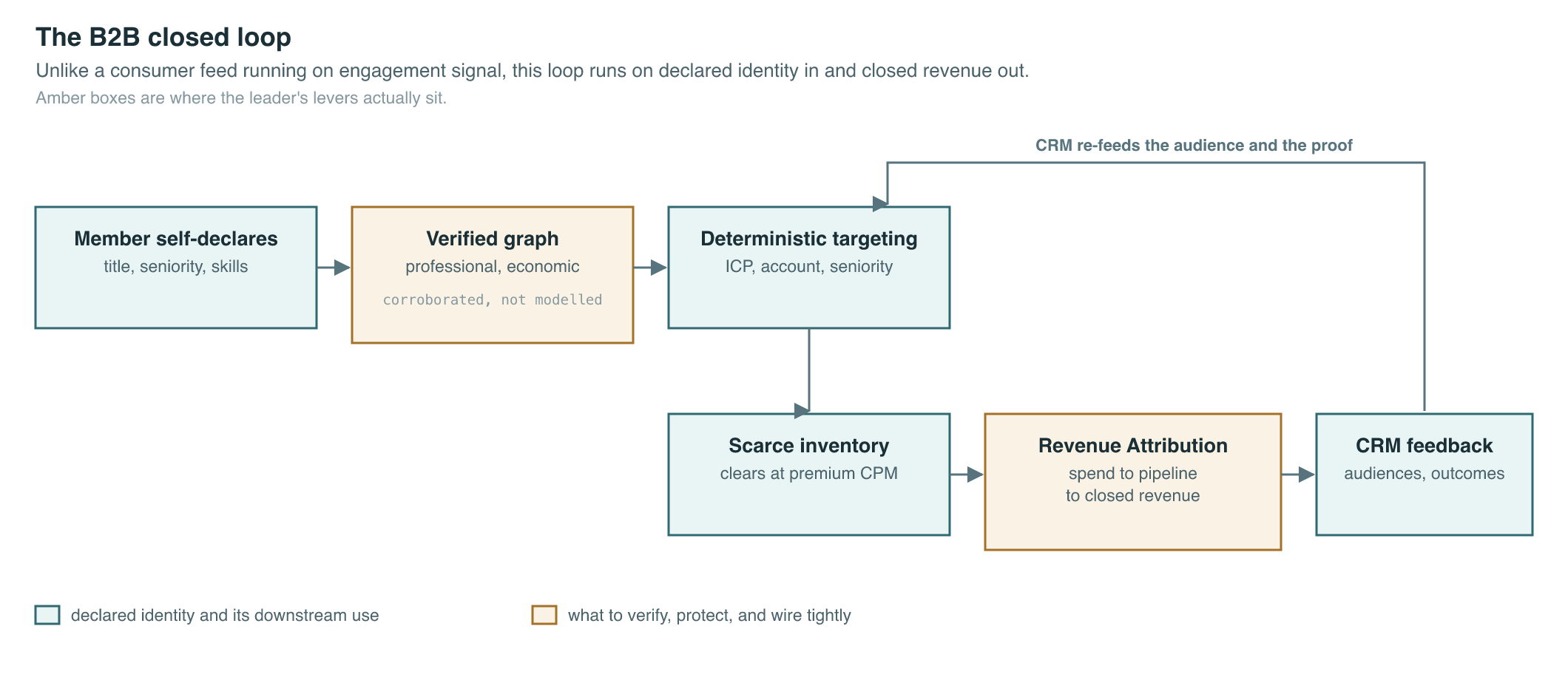
Figure 15.1 — The B2B closed loop. Unlike a consumer feed where the loop runs on engagement signal, LinkedIn’s loop runs on declared identity in and closed revenue out. The leader’s levers sit in the boxed steps: which attributes to verify and protect, and how tightly to wire the CRM loop.
Depth, not breadth: why the moat is a verified graph
The lesson of Chapter 5 was that the durable moat migrated from the targeting graph to the ML stack. LinkedIn is the deliberate exception that proves the rule — its moat is still the graph, because the graph is deterministic rather than inferred. A consumer platform guesses you are a “marketing decision-maker” from your scrolling. LinkedIn knows it because you typed “VP, Marketing” into your own profile and your network and employer corroborate it. That distinction — declared and corroborated versus modeled — is the difference between a probabilistic audience and a list of named accounts.
For the leader the implication is sharp: reach is commoditizing; precision is not. Anyone can buy billions of impressions. Nobody else can offer an advertiser the seniority tiers — Entry, Senior, Manager, Director, VP, CXO, Partner, Owner — laid over named companies and industries with the confidence that the labels are real (LinkedIn Marketing Solutions Help, 2025). With ~1.2B registered members as of late 2025 (it crossed 1B in late 2024), LinkedIn’s frontier is data depth, and it widens that frontier by getting members to declare more, not by adding more members (DemandSage / company milestones, 2025; registered ≠ monthly-active, which is far smaller; re-verify).
This is why LinkedIn CPMs sit at a structural premium — reportedly up ~30% in 2025, with B2B cost-per-lead commonly in the ~$75–200 range versus pennies-per-click consumer inventory (vendor analyses, 2025; directional, low confidence). A board trained on volume will read a $31 CPM as expensive. The leader reads it as the price of a qualified, verified buyer in a market where one closed deal can be worth six or seven figures. The decision LinkedIn’s leadership owns — and that any B2B-aspirant must own — is to defend the premium by protecting scarcity and verification, not to chase volume that would dilute both.
B2B economics: long cycles, buying committees, and the wrong proof
The reason a premium CPM is rational is that B2B monetizes a fundamentally different transaction. A consumer impulse-buys a $40 product in one session. A B2B purchase is a six-figure, multi-quarter decision made by a buying committee — typically 6–10 stakeholders (champion, economic buyer, IT, procurement, legal) who each touch the brand at different times over a sales cycle measured in months or quarters (LinkedIn / PPC Land, 2025).
That structure breaks the measurement model every consumer platform relies on. Last-click attribution — credit the touch nearest the conversion — is not merely imprecise here; it is category-wrong. The “conversion” the advertiser cares about is a closed deal that happens months after the ad, attributable to no single click, influenced by half a dozen people. 78% of B2B CMOs say proving ROI has grown more important even as the journeys that produce that ROI have become un-last-clickable (LinkedIn / Social Media Today, 2024–25).
So the leader’s altitude question is not “what’s our click-through rate?” (an IC diagnostic) but “what counts as proof that this spend produced pipeline and revenue?” — the same what-counts-as-true discipline Chapter 7 framed for signal loss, applied to a cycle so long that user-level attribution was never going to survive it. For LinkedIn, the answer became the product itself.
FIGURE 15.2 (spec): A horizontal timeline contrasting two attribution models against one B2B buying cycle. Top track (“Last-click — what consumer platforms see”) shows a single highlighted touch at month 8, the rest greyed out, labelled “credits 1 of ~14 touches, misses the committee.” Bottom track (“Revenue Attribution — what LinkedIn sees”) shows ~14 touches across months 0–9 from 7 distinct stakeholder icons at the same company, all feeding into a “Closed-Won $480k” node, with a dotted line back to “company-level attribution.” Caption: “A six-figure deal closes over three quarters across a 7-person committee — last-click sees one touch; account-level attribution sees the deal.” Alt-text: “Timeline showing last-click crediting a single touch versus company-level attribution crediting the full multi-stakeholder buying cycle.”
Measurement is the product: Revenue Attribution
If the transaction is a long, multi-touch, multi-person deal, then the most valuable thing a B2B platform can sell is not the impression — it is credible proof the impression mattered. LinkedIn made that literal with the Revenue Attribution Report (RAR) — introduced September 2024, a feature that connects LinkedIn ad data directly to the advertiser’s CRM (Dynamics 365, Salesforce, HubSpot) to tie spend not to clicks but to pipeline, win rates, and closed revenue (LinkedIn Marketing Solutions, 2024).
The 2025 expansion is the strategically important part. In July 2025 LinkedIn added company-level attribution and campaign-level revenue measurement inside Campaign Manager — mapping touchpoints from any member tied to an opportunity’s company back to the spend, rather than crediting only the one person who clicked (PPC Land / LinkedIn, July 2025). Read that against the buying-committee problem: it is the platform explicitly modeling the 6–10-person account, not the individual, as the unit of attribution. That is LinkedIn answering the 78%-of-CMOs demand with architecture instead of a pitch deck.
For the leader, the lesson generalizes beyond LinkedIn: in B2B, CRM-integrated, account-level attribution is table stakes for the ad product, not a measurement add-on. It is also a quieter moat — once an advertiser has wired their Salesforce pipeline into your attribution, the switching cost is no longer the ad spend; it is the proof-of-ROI plumbing the CFO now trusts. Trust, again, is the revenue infrastructure. The flip side, which Maya must hold honestly: these are vendor-reported lift stories, and account-level attribution still models causality it cannot fully observe. The leader governs it the way Chapter 7 governed reported ROAS — as a useful, defensible upper bound, reconciled against incrementality, not as ground truth.
Accelerate and the Microsoft flywheel
Two further pieces complete the stack, and both are about compounding.
The first is automation. Accelerate — LinkedIn’s AI campaign builder, globally available since 2024 — is the B2B analog of Advantage+ and Performance Max you met in Chapter 5: state an objective, and it auto-generates the ICP (Ideal Customer Profile — the target account/audience definition central to B2B buying), audience filters, and creative (via Microsoft Designer) in roughly five minutes (MediaPost / LinkedIn, 2024). LinkedIn reports ~52% lower cost-per-action and ~15% better creation efficiency versus classic campaigns (vendor-reported, low confidence — re-verify). The same loss-of-control trade-off applies: automation lowers the barrier and lifts margin and lock-in, but advertisers push back on opacity, and the manual seniority/company levers that are LinkedIn’s differentiator are exactly what an ICP black box abstracts away. The leader’s call is how much of that verified-targeting precision to surface as controls versus bury in the model.
The second is the structural advantage no competitor can copy: the Microsoft flywheel. LinkedIn is the only major platform whose profile data — company, industry, job function, seniority — can be targeted inside another company’s ad system: Microsoft Advertising carries LinkedIn profile targeting (company, industry, job function, seniority) in Bing/MSAN search across ~20+ markets, and increasingly CTV (Microsoft Advertising docs, 2024–25; seniority targeting rolled out to ~23 markets — re-verify). On the other end, Dynamics 365 Customer Insights exports audience segments to LinkedIn Ads and syncs Lead Gen leads back — a closed CRM-to-ad-to-measurement loop unique to the Microsoft ecosystem (Microsoft Learn, 2025).
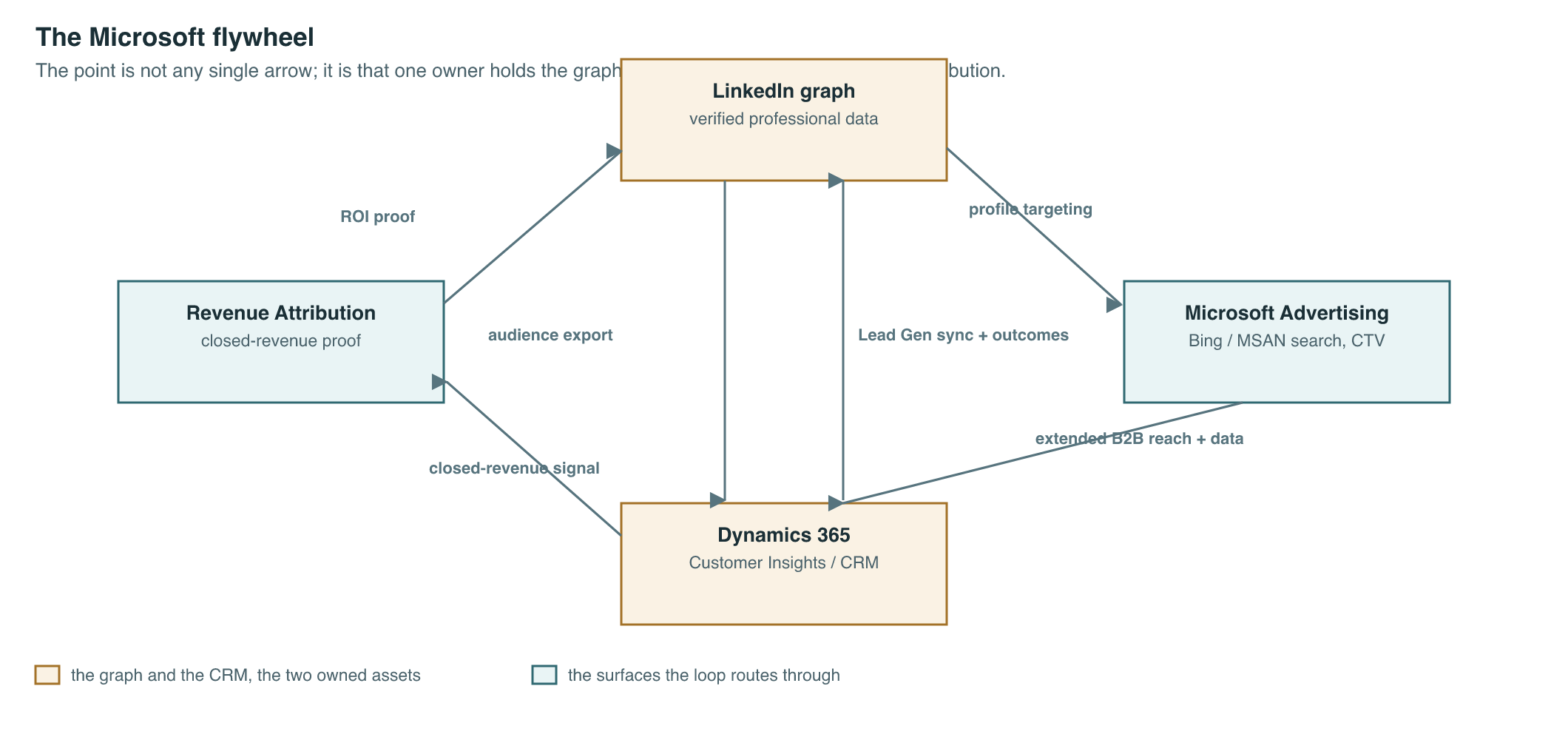
Figure 15.3 — The Microsoft flywheel. The strategic point is not any single arrow; it is that LinkedIn owns the graph, the ad surface, the CRM, and the attribution — the full loop Chapter 9 argued is what compounds B2B value. A standalone ad surface can be out-bid; a loop is sticky.
This is the deepest lesson of the chapter for a leader at any platform: owning the closed loop — data in, ad out, outcome measured, fed back — beats owning the ad surface alone. It is also why LinkedIn can extend into premium video (BrandLink, video alongside Forbes/Bloomberg/WSJ editorial) and Connected TV (LinkedIn profile targeting on streaming inventory, GA in the US/Canada in 2025, with claimed 4× better targeting than linear) as upper-funnel optionality without diluting the core — the graph travels with it (eMarketer / AdExchanger, 2025).
Same-Lever Scorecard
The lever here: depth-of-verified-data versus breadth-of-reach as the basis of competitive advantage — and how each platform monetizes its chosen end. Figures dated and hedged inline.
| Platform | Moat basis (the lever) | Targeting signal | Monetization posture | Tell for the leader |
|---|---|---|---|---|
| Meta | Engagement-scale + ML stack | Inferred from behavior, recovered via CAPI | Breadth: huge load, yield via prediction | $55.0B FoA ad rev/Q (Q1 2026) — volume × price at scale |
| Verified professional/economic graph | Self-declared, deterministic (title, seniority, company) | Depth: scarce premium inventory, low load | ~$8.2B ad rev 2025, ~$9.7B 2026E (estimate) — premium CPM, account-level proof | |
| TikTok | Recommendation engine + culture | Inferred from watch behavior | Breadth + commerce; automation-led (Smart+) | Reach + Shop GMV; little declared identity |
| Google / YouTube | Search intent + scale | Query intent + cross-surface signal | Breadth across surfaces (PMax) | Intent is its deterministic-ish signal; not identity |
| Amazon | First-party purchase data | Deterministic purchase history | Depth on commerce intent; closed loop | The other deterministic-data garden — but on buying, not identity |
| Reddit (wildcard) | Community/contextual + data licensing | Contextual (interest community) | Breadth-lite; second engine in AI data licensing | Contrast: monetizes context, not declared identity |
LinkedIn and Amazon are the two gardens whose moat is deterministic first-party data rather than scale — LinkedIn on who you are professionally, Amazon on what you’ve bought. Both clear at a premium the breadth players can’t match on their respective intents.
Decision or Diagnostic?
Sort the metrics by altitude. The leader owns the posture; the IC tunes the campaign.
| Decision (board / leader owns) | Diagnostic (IC / launch-review owns) |
|---|---|
| Depth-vs-breadth posture — defend premium CPM / low load, or chase reach | CPM / CPC per campaign — operational pricing, monitored at the desk |
| Measurement as product — make CRM-integrated, account-level attribution table stakes | Lead Gen Form completion rate (~10–20% vs ~2–5% landing pages) — campaign-level |
| Automation control dial — how much verified-targeting precision to expose vs bury in Accelerate’s ICP | Accelerate CPA delta (~52% vendor-reported) — a launch-review number, reconciled to incrementality |
| Flywheel investment — fund the CRM-to-ad-to-attribution loop, not just the ad surface | Per-account touch counts / win-rate by segment — analyst diagnostics feeding RAR |
| Privacy/regulatory posture on profile-based targeting | Audience-match rate / segment size — operational targeting hygiene |
The leader’s call. The trade-off you own at a B2B garden is depth versus breadth — and the discipline to not chase the volume story your board instinctively wants. LinkedIn resolved it by treating its scarce, verified professional graph as the asset to protect rather than dilute: it kept ad load low and CPMs premium, then made measurement itself the product (Revenue Attribution, company-level attribution in July 2025) so advertisers could prove six-figure, multi-quarter, committee-driven deals back to spend that last-click would have missed entirely. The Microsoft flywheel — LinkedIn data into Microsoft Advertising search/CTV, Dynamics 365 syncing audiences and closed revenue back — converts a single ad surface into a closed CRM-to-revenue loop that compounds and resists out-bidding. Four quarters out: lean into depth and the proof-of-pipeline plumbing, and you grow ad revenue in the mid-to-high teens (~$8.2B → ~$9.7B 2025→2026E) on premium, sticky, CFO-trusted budgets while a recession that guts impulse-buy consumer spend barely dents enterprise pipeline; chase breadth instead and you dilute the verification that is the moat, commoditize your CPMs, and hand the durable B2B budgets to whoever still owns the closed loop. The risk to underwrite annually is regulatory: profile-based targeting on declared employment and seniority is precisely the inference regulators scrutinize, so the leader builds privacy-durable, first-party and clean-room measurement paths now rather than betting on ever-deeper inferred signal.
Key terms
| Term | One-line definition |
|---|---|
| Verified / declared professional graph | LinkedIn’s deterministic first-party dataset of self-declared, member-corroborated attributes (title, seniority, company, skills) — the moat. |
| Depth-vs-breadth | The leader’s posture choice: monetize scarce, verified, high-intent inventory at a premium versus maximize impression reach. |
| Buying committee | The 6–10 stakeholders who jointly make a B2B purchase over a long cycle — why last-click attribution is category-wrong. |
| Revenue Attribution Report (RAR) | LinkedIn’s CRM-integrated feature tying ad spend to pipeline, win rates, and closed revenue; from 2025, at the account/company level. |
| Company-level attribution | Crediting touches from any member at an opportunity’s company, modeling the account (not the individual) as the unit of measurement. |
| ICP (Ideal Customer Profile) | The target account/audience definition central to B2B automated buying; what Accelerate auto-generates. |
| Accelerate | LinkedIn’s AI campaign builder (the Advantage+/PMax analog) — objective-in, ICP+creative-out in ~5 minutes. |
| Microsoft flywheel | LinkedIn data into Microsoft Advertising (search/CTV) plus a Dynamics 365 closed CRM/ad/measurement loop — owning the full loop, not just the surface. |
| BrandLink / LinkedIn CTV | Premium B2B video (alongside Forbes/Bloomberg/WSJ) and profile-targeted streaming inventory — upper-funnel optionality carrying the graph. |
Recap & what is next
- LinkedIn is the depth garden: it wins on a verified, self-declared professional graph, not on reach — so its small impression volume is a feature, and its premium CPMs are the price of qualified, named buyers.
- B2B economics are structurally different — six-figure deals decided by 6–10-person committees over multiple quarters — which makes last-click attribution category-wrong and makes proof of pipeline the scarce thing worth selling.
- Measurement is the product: Revenue Attribution and 2025 company-level attribution wire the advertiser’s CRM into the platform, answering the 78%-of-CMOs ROI demand and creating a switching cost in the proof, not just the spend.
- Accelerate brings the same automation/loss-of-control trade-off as Advantage+/PMax — but the precision it abstracts away is the very thing that differentiates LinkedIn, so the control-exposure call is sharper here.
- The Microsoft flywheel is the deepest lesson: owning the graph and the ad surface and the CRM and the attribution compounds B2B value in a way a standalone surface cannot — and it lets LinkedIn extend into CTV/BrandLink without diluting the core.
- Govern the headline figures as directional (Microsoft doesn’t break out Marketing Solutions) and re-underwrite the regulatory exposure of profile-based targeting annually.
LinkedIn monetizes a scarce, declared-identity garden at a premium. Chapter 16 — TikTok swings to the opposite pole: an entertainment-and-commerce engine that monetizes inferred-from-behavior signal at consumer scale through Smart+ automation, Symphony generative creative, and the TikTok Shop closed loop — with the US joint-venture/divestiture overhang as the live reminder that, even at that scale, platform continuity is a leader-level risk to underwrite.