The promise. In Chapter 12 you decided whether to play in commerce — whether to build, buy, or partner your way into owning the transaction and the first-party purchase data that comes with it. This chapter shows you what the company that already made that bet, and won it, actually built. Amazon is the proof of the closed-loop thesis: an ads business that grew from a sponsored-listing afterthought into the third pillar of digital advertising — roughly $68.5B in full-year 2025 (Amazon Q4 2025 earnings, reported Feb 2026; high confidence) — by sitting on top of the one signal every other platform has to model: what people actually bought. This chapter equips you to reason about that moat from your seat. If you run a social, search, or video garden, Amazon is the competitor pulling lower-funnel budget out from under you, the benchmark your CFO will quote, and the structural model you will be asked to imitate or decline. You need to know exactly what makes its closed loop hard to copy — and where it is, in fact, copyable.
You will be able to:
- Reason about why purchase data makes Amazon’s Estimated Action Rate structurally more accurate than a behaviorally-inferred one — and what that does to its eCPM.
- Decide which parts of the Amazon stack (Sponsored Products, Sponsored Brands, DSP, AMC) are a defensible moat versus a product set you could match.
- Defend to your board whether to build a retail-media-style closed loop, partner into one, or stay out.
- Distinguish the metrics Amazon’s model lets a leader own (closed-loop ARPU, take rate) from the campaign-level diagnostics (ACOS, on-Amazon ROAS) it hands to advertisers.
- Connect the September 2025 decision to make the AMC clean room free to the four-quarters-out fight over who measures conversions in a signal-loss world.
Builds on: Book 1 ch6 (retail media and the commerce supply chain) and ch4 (attribution); Book 2 ch4 (the auction as policy and the Estimated Action Rate term), ch10 (measurement under signal loss and clean rooms), and especially ch12 (the closed-loop land grab — this chapter is its fully realized case). It belongs to Part IV’s all-majors-equally-deep set; the contrast peers are Meta’s behavioral loop and Walmart Connect’s retailer-network model.
The call on Maya’s desk
Maya’s CFO forwards her a sell-side note over the weekend. The subject line: “Amazon ad revenue now bigger than the entire RoW ad business you run.” Inside is the chart everyone in the industry has internalized — Amazon Ads at roughly $68.5B for 2025, with a Q4 around $21.3B, up ~22–23% YoY (Amazon Q4 2025 earnings, Feb 2026; high confidence), growing faster than her platform’s family-of-apps line and faster than Amazon’s own retail business. The CFO’s question is one line: “Should we be building a version of this?”
This is the wrong question stated the right way, and Maya knows it. The board doesn’t actually want a retail-media network. What they have absorbed from the note is that Amazon monetizes a signal — confirmed purchase — that Maya’s platform can only ever predict. Every term in her Total Value formula (ch4) leans on an Estimated Action Rate: a model’s guess that this user will convert. Amazon, for a huge share of its inventory, doesn’t estimate the action. It owns the action, because the ad and the checkout live inside the same logged-in session. The real question on Maya’s desk is therefore not “build a store” but: how much of Amazon’s advantage comes from the closed loop itself, which I cannot replicate, and how much from a product surface and a clean room, which I can?
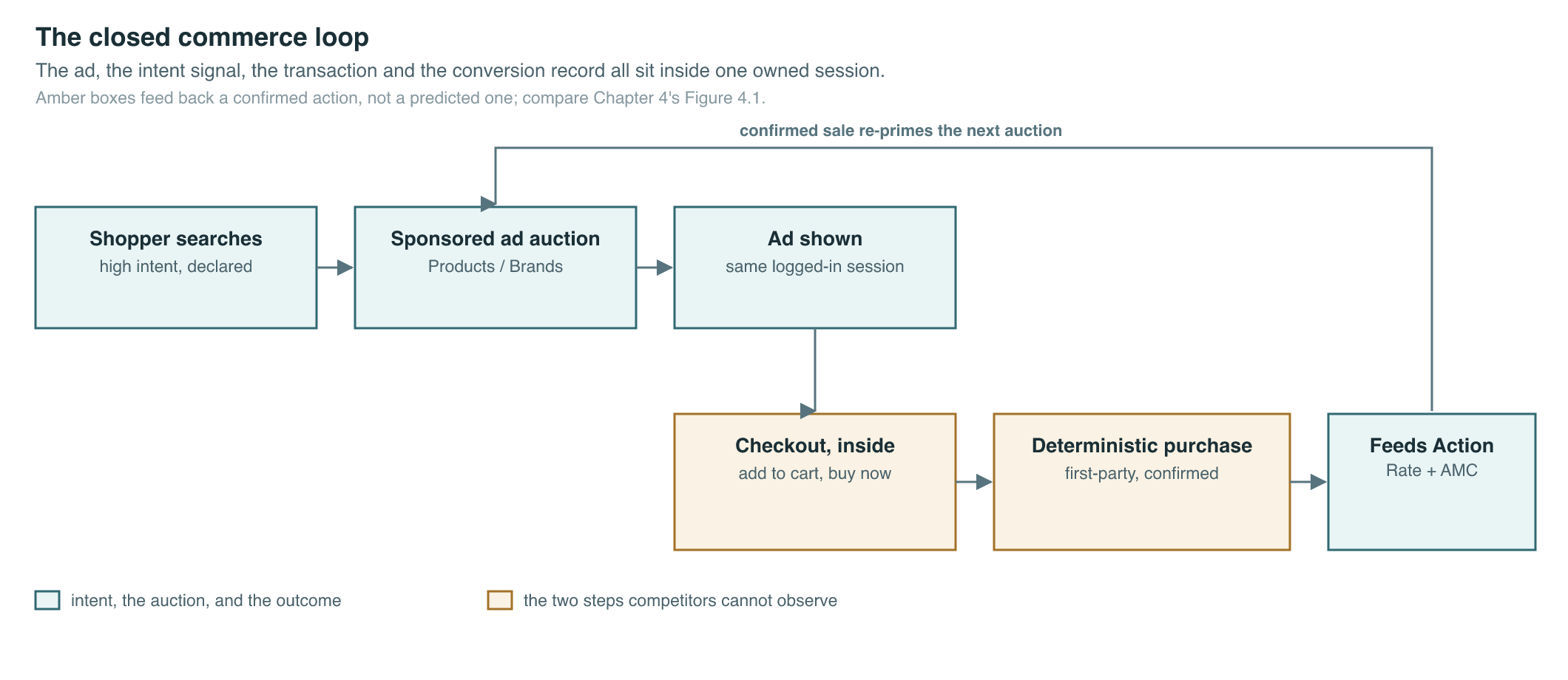
Figure 18.1 — The closed commerce loop. The ad, the intent signal, the transaction, and the conversion record all sit inside one owned session. Compare ch4’s Figure 4.1: where Maya’s loop feeds back a predicted action, Amazon’s feeds back a confirmed one. That single difference is the moat.
Why purchase data beats inference — the eCPM consequence
Start with the mechanic, at leader altitude. Recall from ch4 that an impression’s value is Bid × Estimated Action Rate + quality. The Estimated Action Rate is a probability, and a probability has variance. On a social feed, the platform infers purchase propensity from engagement proxies — what you watched, lingered on, clicked — and the gap between “looked interested” and “bought” is where the model’s error lives. That error is a tax: the platform either under-prices the impression (leaving yield on the table) or over-prices it (eroding advertiser ROAS and trust).
Amazon shrinks that error toward zero for its core surface. When the shopper has typed “running shoes” into Amazon’s search box, intent is declared, not inferred; and because checkout happens in the same session, the conversion is deterministic — Amazon knows, at the user level, that the ad led to the sale, with no attribution model in between. This is the closed loop: ad exposure and verified purchase observed inside a single first-party environment. The practical consequence is an Estimated Action Rate with far lower variance, which lets the auction clear at a higher, defensible eCPM — advertisers pay premium prices because the outcome is measured, not modeled.
This is why Amazon’s growth keeps outrunning the broader ad market while feeling under-discussed: it is harvesting the lowest-funnel, highest-certainty moment in commerce, the moment a leader on a discovery feed can only approximate. The strategic read for Maya: Amazon’s eCPM advantage on its owned surface is not a product feature she can ship; it is a property of where the transaction happens. She cannot move her users’ checkout inside her app for most categories. What she can do — and what ch12 was really about — is decide whether to acquire or partner into a surface where transactions do close (a TikTok-Shop-style funnel, a travel or grocery vertical), so that some slice of her own demand gets the same deterministic signal.
FIGURE 18.2 (spec): A two-panel “signal certainty” diagram. Left panel labeled “Inferred loop (social/search feed)”: a wide probability distribution over “did this convert?”, shaded to show high variance, captioned “model estimates the action → eCPM discounted for uncertainty.” Right panel labeled “Closed loop (Amazon)”: a narrow spike at “bought,” captioned “platform observes the action → eCPM clears at a defensible premium.” Alt-text: “Side-by-side showing a wide uncertainty curve for inferred conversions versus a sharp spike for Amazon’s observed purchases, illustrating why the closed loop commands higher prices.”
The product stack — what is moat, what is matchable
Treat Amazon Ads as three layers, and judge each separately for defensibility. Conflating them is how leaders either panic (“we can never catch this”) or get complacent (“it’s just sponsored listings”).
- Sponsored Products — keyword- and product-targeted ads inside search results and product pages, sold per click, settled against on-platform sales. This is the engine: the large majority of Amazon’s ad revenue, and the purest expression of the closed loop. It is the part that is least matchable, because it is welded to Amazon’s owned search-and-checkout session.
- Sponsored Brands — banner/video units featuring a brand logo and a curated product set, more upper-of-lower-funnel, still settled on Amazon purchases. Matchable in form (any platform can build a branded carousel) but not in settlement (the on-platform purchase tie).
- Amazon DSP — Amazon’s demand-side platform for buying display, video, and audio off Amazon, across the open web and its own properties (Prime Video — including the ad-supported “Watch for Free” tier that absorbed the wound-down Freevee in Sept 2025 — and Twitch), targeted and measured against Amazon’s first-party audiences and purchase data. This is the strategically interesting layer: it carries the closed-loop signal off the closed-loop surface. Amazon DSP is Amazon’s bid to compete with The Trade Desk and DV360 — not on the open web’s terms, but on the strength of “buy anywhere, measure against real purchases.”
The leader-altitude judgment: the surface (Sponsored Products) is a moat because it is the transaction. The signal portability (DSP carrying purchase audiences off-platform) is the genuinely contestable frontier, because that is exactly the move every retail media network and every walled garden is now attempting — extending owned conversion data into demand wherever the user goes. Prime Video’s ad tier matters here precisely because it gives the DSP premium CTV (Connected TV) inventory measured against purchase, which is the inventory type brand budgets are migrating into; Amazon noted Prime Video contributed “meaningfully” to Q4 2025 ad growth (Amazon Q4 2025 commentary, Feb 2026).
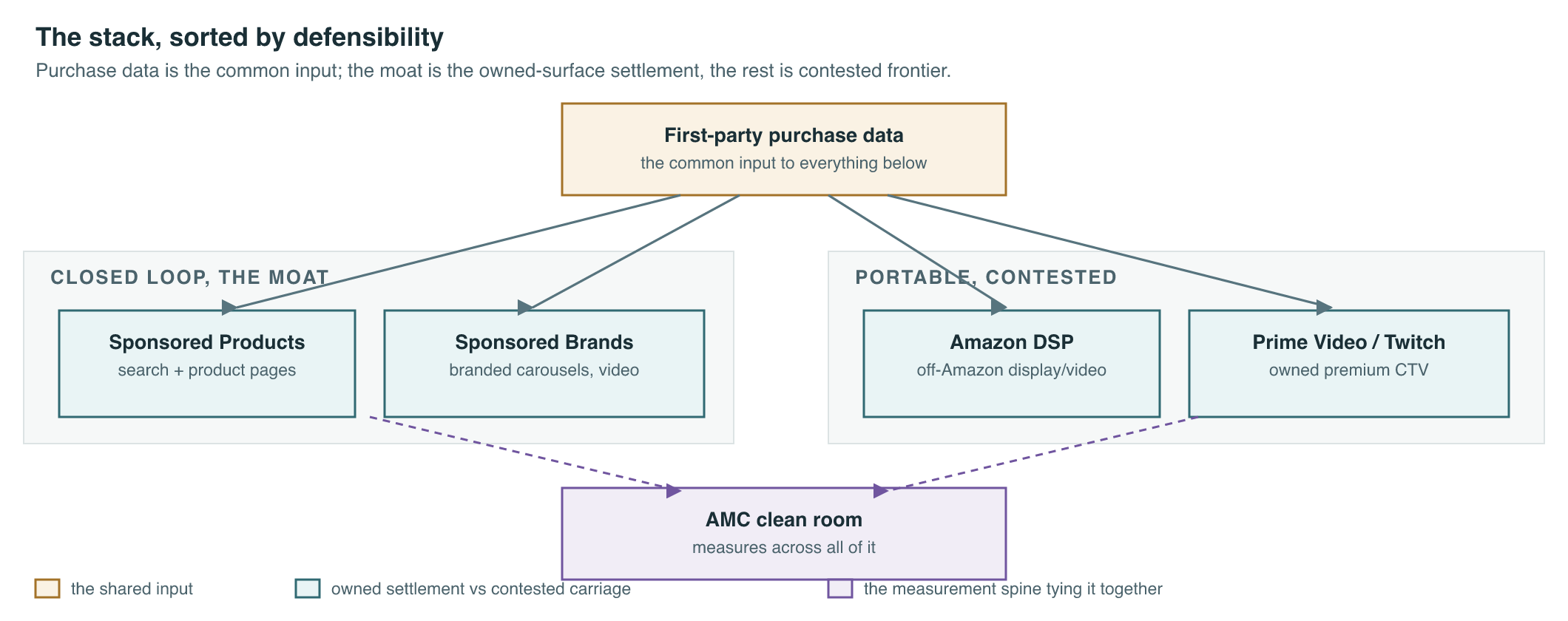
Figure 18.3 — The stack, sorted by defensibility. Purchase data is the common input; the moat is the owned-surface settlement, while the DSP and CTV layers are where Amazon (and every rival) is fighting to carry that signal into contestable demand. AMC is the measurement spine that makes the whole thing legible to advertisers.
AMC — the clean room as a land-grab weapon
The September 2025 decision to make Amazon Marketing Cloud (AMC) — Amazon’s pseudonymized SQL clean room spanning Sponsored Ads, DSP, and streaming — free for all Sponsored Ads advertisers (Amazon Ads / eMarketer, Sept 2025; high confidence) is the most strategically revealing move in this chapter, and it is easy to misread as a pricing tweak. It is not. It is a measurement land grab, and you should read it through ch10’s lens on signal loss.
Here is the logic. Post-ATT and post-cookie (ch10, ch11), advertisers are starved for deterministic conversion truth. Clean rooms became mainstream infrastructure in 2025 — roughly two-thirds of organizations now use one in some capacity — precisely because privacy law and signal loss made cross-site measurement collapse (eMarketer / IAB / AdExchanger, 2025). Whoever becomes the default place advertisers reconcile their conversions wins a position no auction tuning can dislodge: they define what “worked,” and the definition will flatter their own inventory. By dropping AMC’s cost to zero, Amazon removed the only barrier — price — that had kept clean-room measurement a large-advertiser luxury, and invited the entire mid-market to start running their cross-channel reconciliation on Amazon’s purchase data as the source of truth.
For Maya this is the genuinely threatening move, more than any single eCPM. If Northwind — her large commerce advertiser — starts treating AMC as the canonical conversion ledger, then Amazon’s measurement of Maya’s upper-funnel contribution becomes the number Northwind’s CFO trusts, and Maya is negotiating her own budget against a competitor’s scorecard. Note the structural pattern: Google’s Ads Data Hub (ADH) and Apple’s crowd-anonymity gating are the same move under different names — the walled gardens, plus the cloud providers, captured an estimated ~38% of clean-room revenue in 2025 (AdExchanger / market research, 2025; directional). The clean room is not a measurement utility; it is a venue, and the platform that hosts the venue sets the rules of attribution. Maya’s defensive play is the one ch10 already pointed at: invest in her own first-party, server-side conversion path and clean-room (high match quality) so that her contribution is measured on her terms, not reconstructed inside Amazon’s.
FIGURE 18.4 (spec): A conceptual “venue” illustration. Center: a clean-room vault icon labeled “AMC (free, Sept 2025).” Arrows flowing in from “Northwind CRM,” “Sponsored Products,” “Amazon DSP,” “Prime Video,” and a faded, dotted arrow from “Maya’s platform (upper-funnel)” entering at the edge. Caption: “When the clean room is free, the mid-market reconciles here — and the host defines what counts as a conversion.” Alt-text: “Diagram of multiple data sources flowing into Amazon’s AMC clean room, with a competitor platform’s signal entering weakly at the periphery.”
The take rate and the flywheel — why Amazon can afford patience
One more leader-altitude property: Amazon’s ad business sits on a retail flywheel, which changes the kind of P&L decision it is. For a pure-play garden, ad revenue is the business; load and yield are existential. For Amazon, advertising is a high-margin take rate layered on top of transactions that would largely happen anyway — sellers paying for placement in a marketplace they already need to be in. That gives Amazon a structural luxury Maya lacks: it can keep ad load on the search page conservative relative to what the auction would bear, because over-loading degrades the shopping experience that produces the purchases that are the moat. The engagement-versus-extraction trade-off from ch4 is real here too, but Amazon faces it with the cushion of a second revenue engine.
The contrast peer that clarifies this is Walmart Connect and the broader retail media network (RMN) field — retailers monetizing their own first-party purchase data. They prove the model is structurally replicable by anyone who owns a checkout, which is why retail media is forecast to approach ~$175B in 2025 (~15% of all ad spend) and ~$197B in 2026 (~16% of all ad spend) (WARC Future of Commerce Media, 2025–26 forecast; medium confidence). But they also prove scale and demand density still decide the winner: most RMNs lack Amazon’s query volume, its DSP reach, and — tellingly — only about half currently offer clean-room measurement at all (IAB State of Retail Media, 2025). The takeaway for Maya is double-edged: the closed-loop model is no longer exotic, so “we own a transaction” is table stakes, not a moat; the moat is transaction volume × signal portability × measurement venue — and there, Amazon is years ahead of the field it created.
Same-Lever Scorecard
The lever this chapter isolates: how deterministic is the conversion signal feeding the auction, and how far can the platform carry that signal off its own surface? Figures dated and hedged inline.
| Platform | Conversion signal (the lever) | Closed-loop surface? | Signal portability / measurement venue | Tell for the leader |
|---|---|---|---|---|
| Amazon | Deterministic — observed purchase in-session | Yes — Sponsored Products on owned search + checkout | DSP carries purchase audiences off-platform; AMC free since Sept 2025 | ~$68.5B FY2025 ad rev; the eCPM premium is a property of where the transaction lives |
| Meta | Inferred — modeled from engagement, recovered via CAPI/AEM | Partial — Shops weak; conversion mostly off-platform | Pixel + CAPI + AEM rebuild signal; high EMQ is the proxy for Amazon’s certainty | Spends to recover the determinism Amazon gets for free; EMQ 7+ is the KPI |
| Inferred B2B — long cycles, CRM-reconciled | No — pipeline closes in the buyer’s CRM | Revenue Attribution Report syncs to Dynamics/Salesforce as the venue | Closed loop runs through the CRM, not the platform; trust-priced, low load | |
| TikTok | Mixed — TikTok Shop is deterministic, rest inferred | Yes for Shop (~68% of US social-shopping GMV, eMarketer 2025); no elsewhere | Events API for off-Shop; Shop is the closest social analog to Amazon’s loop | The one social garden building a real on-platform checkout loop |
| Google / YouTube | Intent-rich (Search) but post-click conversion off-platform | Mostly no — checkout off-site | Ads Data Hub (ADH) is the Google-side AMC analog | Owns intent like Amazon owns purchase; the venue fight is ADH vs AMC |
| Walmart Connect (wildcard) | Deterministic — first-party purchase data | Yes — owned stores + site | Building DSP/clean-room reach; scale & measurement lag Amazon | Proves the model is replicable; proves volume + venue still decide the winner |
Decision or Diagnostic?
Sort the chapter’s metrics. The closed loop lets a leader own outcome-level numbers an inferred platform can only estimate — but the campaign-level ratios advertisers obsess over are still IC diagnostics.
| Decision (board / leader owns) | Diagnostic (IC / advertiser desk owns) |
|---|---|
| Build vs partner vs stay out of a closed loop — whether to own a transaction surface at all (ch12’s call, made concrete) | ACOS (Advertising Cost of Sales) — spend ÷ on-Amazon sales; the seller’s campaign-efficiency ratio |
| Measurement-venue posture — invest in your own clean room / high-EMQ path vs cede reconciliation to AMC/ADH | On-Amazon ROAS — single-campaign return on the owned surface; an upper bound, not incrementality |
| Closed-loop ARPU / take rate — yield from owning the transaction, and how conservatively to load the shopping surface | Estimated Action Rate variance — the model’s per-impression purchase-propensity error; tuned offline |
| Signal-portability strategy — how far to carry purchase audiences off-surface via a DSP/CTV layer | Per-keyword bid landscape / win rate — operational, monitored at the launch desk |
The leader’s call. The trade-off you own is where the transaction happens — because that, not any model, is what determines whether your conversion signal is observed or inferred, and therefore whether your auction clears at a defensible premium or a discount. Amazon resolved it by being the store: it built the highest-certainty lower-funnel ad business in the industry by welding ads to its own checkout, then made AMC free in September 2025 to become the venue where everyone else reconciles their conversions too — turning a measurement tool into a position no rival can tune their way out of. You almost certainly cannot move your users’ checkout inside your app, so your honest call is narrower and sharper: decide whether to acquire or partner into one surface where transactions close (a Shop-style funnel, a vertical), and — non-negotiably — invest now in your own first-party, high-match-quality measurement so your contribution is counted on your scorecard, not Amazon’s. Four quarters out: concede the measurement venue and you will watch your best commerce advertisers re-baseline their budgets against a competitor’s definition of “what worked,” with your upper-funnel value quietly written down; own a transaction loop and a clean room of your own and you keep a defensible, deterministic slice of demand and the trust that comes with measuring it honestly. Amazon is the proof that the closed loop is the most durable moat in advertising — and the warning that the platform hosting the measurement venue writes everyone else’s report card.
Key terms
| Term | One-line definition |
|---|---|
| Closed (commerce) loop | Ad exposure and verified purchase observed inside one owned, logged-in session — the deterministic alternative to inferred conversion. |
| Sponsored Products | Amazon’s keyword/product-targeted ads in search and product pages, settled against on-platform sales; the core closed-loop engine. |
| Sponsored Brands | Branded carousel/video units on Amazon featuring a logo and curated products, still settled on Amazon purchases. |
| Amazon DSP | Amazon’s demand-side platform for buying off-Amazon display/video/audio, targeted and measured against first-party purchase audiences. |
| AMC (Amazon Marketing Cloud) | Amazon’s pseudonymized SQL clean room across Sponsored Ads, DSP, and streaming; made free for Sponsored Ads advertisers in Sept 2025. |
| Clean room | A privacy-safe environment where parties query combined data without exposing user-level records; the measurement venue whose host defines attribution. |
| Retail media network (RMN) | A retailer’s closed-loop ad business built on its own first-party purchase data (Amazon Ads, Walmart Connect). |
| Take rate | The high-margin ad fee layered on transactions that would largely occur anyway — why Amazon can afford conservative ad load. |
| ACOS | Advertising Cost of Sales — ad spend ÷ on-Amazon attributed sales; the seller’s campaign-efficiency diagnostic. |
| Signal portability | Carrying owned, deterministic conversion data off the owned surface (via a DSP/CTV layer) — the contested frontier of the closed loop. |
Recap & what is next
- Amazon is the realized case of ch12’s closed-loop bet: a ~$68.5B FY2025 ad business (Feb 2026; high confidence) built by owning the transaction, with Q4 2025 still growing ~22–23% YoY.
- The moat is deterministic purchase signal: because the ad and checkout share one session, Amazon observes the conversion instead of estimating it, shrinking Estimated Action Rate variance and letting the auction clear at a defensible eCPM premium.
- Sort the stack by defensibility: Sponsored Products (the owned surface) is the un-copyable moat; Sponsored Brands is matchable in form; Amazon DSP + Prime Video CTV is the contested frontier where purchase signal travels off-surface.
- Free AMC (Sept 2025) is a measurement land grab, not a price cut: whoever hosts the clean room where advertisers reconcile conversions defines “what worked” — Google’s ADH and Apple’s crowd-anonymity are the same move, and the venue is worth more than any single eCPM.
- The retail flywheel and take rate let Amazon load its shopping surface conservatively; Walmart Connect and the wider RMN field prove the model is replicable but that volume × portability × measurement venue still decide the winner.
- Your defensible call is narrow: partner into one transaction loop and invest in your own high-match-quality measurement so your contribution is counted on your scorecard.
Amazon owns the lowest-funnel, highest-certainty moment in commerce. The next two platforms own the opposite end — attention without a transaction, and the fragility that comes with it. Chapter 19 — Snap & Pinterest turns to the sub-scale challengers competing on a distinctive surface (AR/camera, planning intent) and the Performance+ automation suite, asking the leader’s question Amazon makes unavoidable: when you cannot own the transaction, what one signal can you own well enough to command a premium?