The promise. Chapter 19 paired Snap and Pinterest as the sub-scale challengers that survive by owning a mindset — AR/camera and shopping intent — rather than fighting Meta and Google on reach. This chapter closes Part IV’s contrast set with the two platforms that frame the outer edges of the leader’s risk-reward map. Reddit is the upside case: a platform that turned a defensible, hard-to-replicate asset — authentic community conversation — into both a contextual ad surface and a second revenue engine in AI data licensing, and grew ad revenue ~75% in a quarter while doing it. X is the downside case, the book’s recurring cautionary tale made fully explicit: a platform that inherited a healthy ~$4.4B ad business and roughly halved it in two years, not by mispricing an auction or losing a model race, but by letting advertiser trust — the most fragile and most load-bearing asset on the platform’s balance sheet — collapse. By the end you will be able to underwrite trust as revenue infrastructure: to know what it is worth, how slowly it rebuilds, and which of your own decisions quietly draw it down.
You will be able to:
- Decide whether a defensible community/contextual signal is worth building a distinct ad surface around, versus competing on reach you will lose.
- Reason about data/content licensing as a structurally second revenue engine — its leverage, its concentration risk, and why it is not free money.
- Defend brand-safety and moderation spend to a CFO as revenue protection, not cost, using X’s decline as the priced comparable.
- Distinguish the trust signals a leader must own and watch from the brand-suitability diagnostics an IC tunes.
- Connect a moderation or brand-safety posture to its four-quarters-out effect on ARPU and advertiser trust — including the asymmetry that trust falls in a quarter and takes years to rebuild.
Builds on: Book 1 ch4 (identity and tracking) and ch8 (brand safety, ad quality, fraud). Book 2 ch2–3 (the price × volume P&L and profit pools), ch4 (the auction’s user-value term — the in-auction version of the trust dial this chapter takes platform-wide), and especially ch7 (Quality, Integrity & the User-Value Term — where we argued integrity and revenue must not diverge; this chapter is the proof of what happens when they do). It also extends ch19’s “win a defensible mindset” thesis to its two extremes.
The call on Maya’s desk
It is a board-prep week, and Maya’s CFO has sent her one provocative line ahead of the offsite: “Trust & Safety is asking for a 20% headcount increase and another moderation-tooling contract. Make the revenue case or it gets cut to flat.”
It is the hardest case in the book to make, because the return on trust spend is avoided loss, and avoided loss never books as a line item. Spend the money and the feed stays safe, advertisers stay, and the budget looks like pure cost. Cut it, and nothing happens for three quarters — until the one incident that puts a marquee brand’s ad next to something toxic, the screenshot circulates, and the anchor advertisers who anchor your entire clearing price quietly pull their budgets. By the time it shows up in revenue, it is not a dip you tune your way out of. It is a new, lower floor.
Maya has two priced comparables for the room, at opposite ends of the same axis. Reddit invested in making a notoriously hard-to-moderate environment advertiser-safe enough — and then monetized the resulting authentic conversation twice. X did the opposite and discovered, in real time and at nine-figure annual cost, exactly what advertiser trust is worth. This chapter is Maya assembling that case.
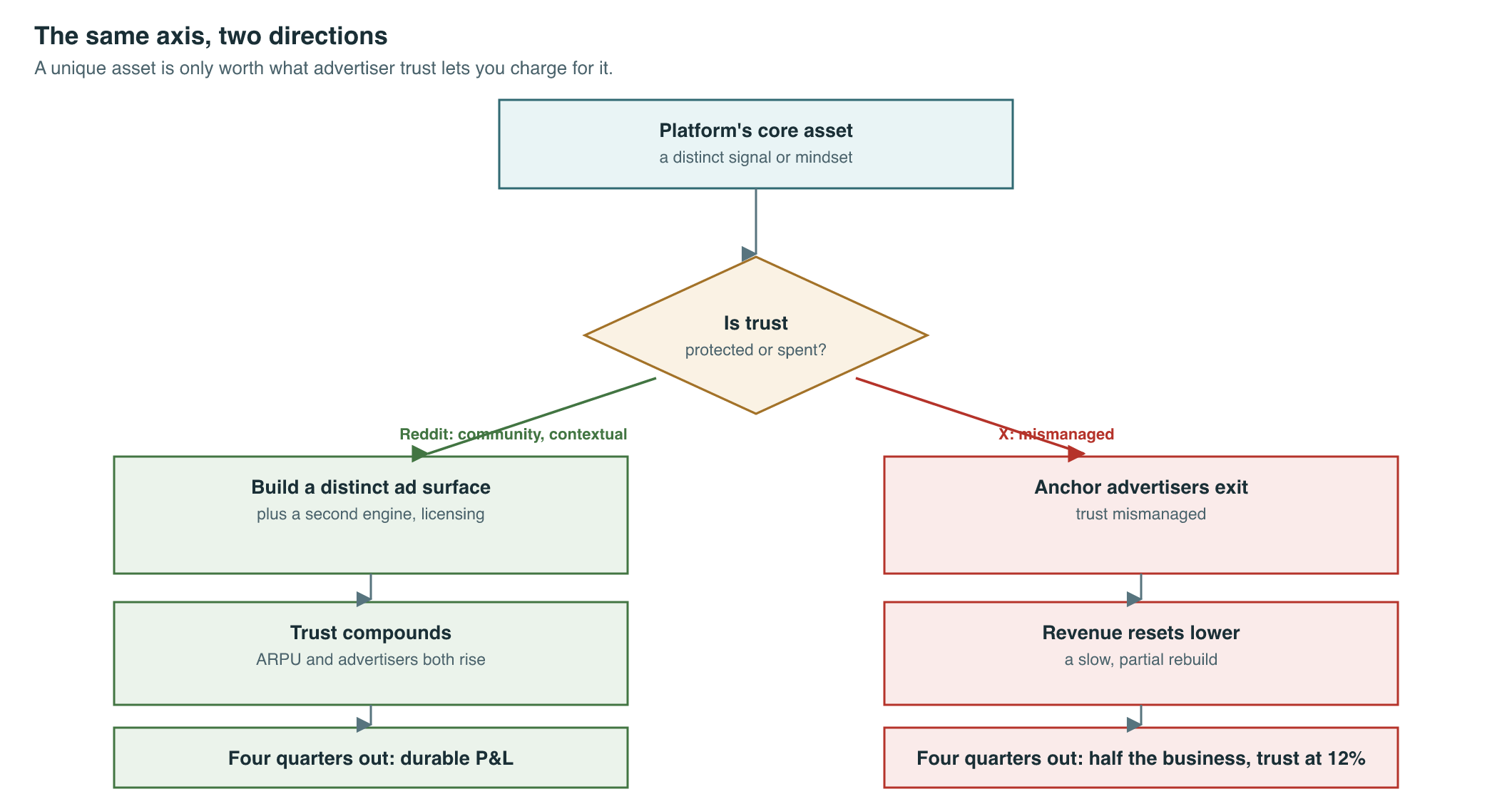
Figure 20.1 — The same axis, two directions. The defensible-mindset thesis from ch19 cuts both ways: a unique asset is only worth what advertiser trust lets you charge for it. Reddit compounds it; X drew it down. The leader’s spend decides which path the platform is on.
Reddit: a defensible signal, monetized twice
Reddit’s asset is the one thing the scaled gardens cannot manufacture — millions of pseudonymous communities having candid, intent-rich conversations organized by topic. The leader-altitude term is contextual/community signal: targeting and relevance derived from what is being discussed in this moment, in this community, rather than from a cross-site behavioral profile of who the user is. This matters enormously in the post-ATT, post-Privacy-Sandbox world of Book 1 ch4 and Book 2 ch11 — contextual signal is privacy-durable by construction. There is no device graph to suppress because Reddit was never targeting the device; it was targeting the conversation.
The numbers say the thesis is working. Reddit’s full-year 2025 revenue reached ~$2.2B, up ~69% YoY, with Q4 2025 advertising revenue of ~$690M, up ~75% YoY and active advertisers also up more than 75% (Reddit FY2025 results, early 2026 — fast-moving, re-verify). Crucially for a leader reading geo-mix the way ch3 taught, Reddit’s ARPU rose ~42% YoY to ~$5.98 globally, with US ARPU ~$10.79 (+53% YoY) and international ARPU ~$2.31 (+38% YoY) (Reddit Q4 FY2025 — company-reported, directional). That is roughly a 1.8× US-versus-global gap — wide, but materially tighter than Meta’s, whose US/Canada ARPU runs ~4× its worldwide figure (and ~15–17× its Rest-of-World figure) (Meta FY2024–2025, company-reported). On a like-for-like US-versus-global basis Reddit’s gap is roughly half Meta’s, which tells the leader two things at once: Reddit’s international monetization is still early (upside), and its contextual model travels across geographies better than identity-graph models do (because it depends less on the dense behavioral data that only exists in mature markets).
But the strategically distinctive move is the second revenue engine: AI data licensing. Reddit licenses its conversational corpus to train and ground large language models — roughly $60M/yr from Google and ~$70M/yr from OpenAI (~$130M from the two named deals), part of a total “other revenue” / licensing line Reddit disclosed at ~$203M in 2024 — around 10% of revenue (Bloomberg / Reddit disclosures, 2024–2025 — re-verify), with analysts speculating the licensing line could approach several hundred million annually by 2027 (forecast — treat as directional). This is the ch22 portfolio idea instantiated early: the same owned asset (the corpus) is sold into two markets (advertisers and model-builders) with near-zero marginal cost on the second.
A leader must read this clearly, because it is seductive and it is not free money:
- Leverage. Licensing is high-margin and counter-cyclical to the ad market — a hedge against the ad-spend cyclicality that wrecks single-engine platforms. That is real and worth pursuing.
- Concentration risk. Two buyers funding the bulk of a licensing line worth ~10% of revenue is a customer-concentration exposure of exactly the kind ch3 warned about in geo terms. Pricing power runs to the buyers until the market has more of them; this is why Reddit pushed toward dynamic/usage-based pricing rather than flat annual deals.
- The asset must stay scrapeable-but-licensed. The licensing engine is only worth something if Reddit successfully closes the corpus to free scraping (so model-builders must pay) without degrading the open, candid conversation that makes the corpus — and the ad surface — valuable in the first place. Over-fence it and you kill the community; under-fence it and the buyers stop paying. That tension is the leader’s call, not an IC’s.
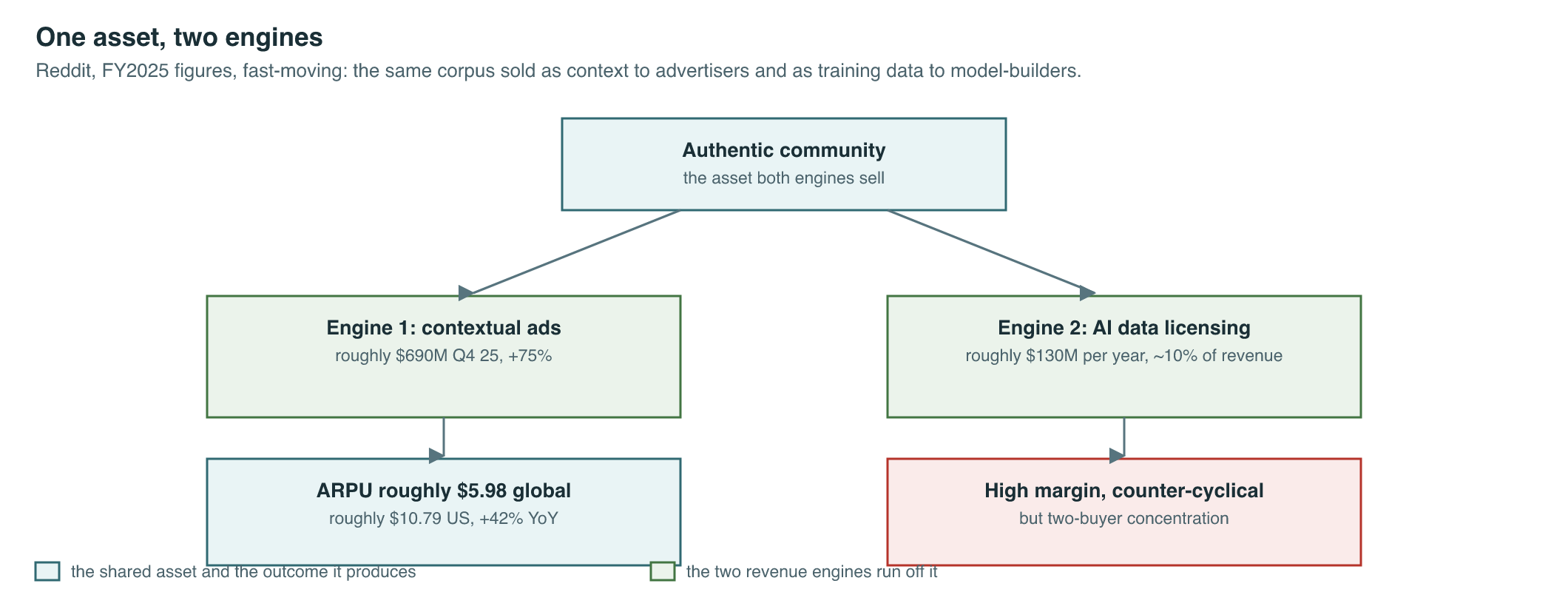
Figure 20.2 — One asset, two engines (Reddit, FY2025 figures, fast-moving). The corpus is sold to advertisers as context and to model-builders as training data. The leader’s job is to grow both without letting either fence-off or over-monetize destroy the conversation both depend on.
X: the anatomy of a trust collapse
Now the mirror. X (formerly Twitter) entered the Musk era with roughly $4.4–4.5B in 2022 revenue, ~90% of it advertising. Ad revenue then fell sharply — to ~$3.3B in 2023 (Musk-era leadership disruption and advertiser pullback) and to ~$2.5–3.1B by 2024 depending on source (eMarketer puts total revenue near ~$2.5B; WARC/Business of Apps put ad revenue higher, ~$3.1B). 2025 estimates land in the ~$2.26–2.9B range, a partial bounce but still well below the 2021–2022 peak — a “new lower floor” rather than a full recovery (eMarketer / Statista / WARC / Business of Apps, 2023–2025 — mixed actual/forecast, sources disagree, fast-moving).
What is essential for the leader is why it fell, because the mechanism is the whole lesson. It did not fall because the auction was mispriced, because a model lost a recall race, or because a rival out-scaled it. It fell because anchor advertisers lost confidence in the brand-safety environment their ads ran in — relaxed moderation, public friction between the owner and major brands, and high-profile instances of ads appearing next to toxic content. The flight was concentrated and brutal at the top of the list: Apple reportedly went from ~$31.5M in 2023 spend to under $0.5M by 2025; Microsoft from ~$11M to ~$0.4M (MediaRadar / Business of Apps, 2025 — directional). And the underlying sentiment number is the one to put on the board slide: senior-marketer trust in X as an ad platform reportedly fell from ~22% (2022) to ~12% (2024) (Kantar Media Reactions 2024 — ~1,000 senior marketers; directional).
Three properties of this collapse are what make it a general lesson, not an X-specific anecdote:
- It is concentrated at the anchors. A platform’s clearing price is set at the margin by its most prestigious, most budget-rich advertisers. When the anchors leave, they do not just remove their own spend — they remove the demand density that held up everyone else’s eCPM (ch3). Losing the top 50 brands is not a 50-brand problem; it is a price-of-attention problem for the whole auction.
- It is non-linear. Trust does not erode gracefully in proportion to incidents. It holds, holds, holds — and then a threshold is crossed and budgets snap to near-zero, because the marketer’s downside (their CMO’s brand next to something indefensible) is catastrophic and asymmetric versus the upside of a marginal CPM.
- It is slow and only partly reversible. Even with a friendlier political climate and active courting, X’s 2025 “recovery” recovered to roughly half. Trust falls in a quarter and rebuilds over years, if at all — this is the asymmetry the CFO must internalize.
FIGURE 20.3 (spec): A line chart titled “X advertising revenue, 2021–2025 (the trust cliff).” X-axis years 2021–2025; Y-axis revenue $0–$5B. A line peaking near ~$4.5–4.7B (2021–2022), dropping sharply through 2023 to ~$2.5B (2024), then a faint uptick to ~$2.3–2.9B (2025). Annotate the 2022→2024 drop with “anchor advertisers exit; trust 22%→12%.” Shade the gap between the 2022 peak and the 2025 line as “trust deficit — not recovered by pricing.” Caption: “The decline is a trust event, not a pricing event — no auction tuning closed the gap.” Alt-text: “Line chart showing X ad revenue falling from ~$4.5B in 2022 to ~$2.5B in 2024 with only a partial 2025 bounce, annotated as a trust collapse.”
The contrast with Reddit is the entire chapter. Both are sub-scale platforms whose value rests on a specific kind of conversation. Reddit spent to make that conversation advertiser-safe enough and was rewarded with compounding ARPU and a second engine. X let the conversation become a brand-safety liability and watched its anchor demand evaporate. Same asset class, opposite trust posture, opposite four-quarters-out outcome.
Underwriting trust: making the CFO’s case
So how does Maya answer her CFO? Not with a moral argument — with an underwriting argument, framed exactly like the auction’s user-value term in ch4 but raised to the platform level.
The reframe: brand-safety and moderation spend is not a cost center; it is the premium on insurance against an X-shaped revenue event. The leader’s job is to size the policy. The expected-loss math is defensible: if even a fraction of anchor-advertiser revenue carries an X-style tail risk, and that revenue does not erode gracefully but resets to a floor roughly half its peak, the avoided-loss expectation dwarfs a 20% Trust & Safety headcount line. You are not buying moderation; you are buying the continued willingness of your highest-value advertisers to stand next to your content — the demand density that sets your clearing price.
The honest version Maya brings to the room:
“We can’t book the return on this spend, because the return is a quarter that doesn’t happen. Here is the priced comparable: X had a ~$4.4B ad business and is now a ~$2.5B one — roughly half — and it didn’t lose it to a competitor or a model. It lost it because its top advertisers stopped trusting the environment, and that trust came back, at best, halfway. Our anchor advertisers set the clearing price for the entire auction; if they leave, every other advertiser’s eCPM falls with them. The 20% headcount is cheaper than one trust event, and trust events are non-linear and slow to reverse. Reddit is the other comparable — it spent to make a hard environment safe enough and got ~75% ad growth and a second revenue engine out of it. I want to be Reddit’s posture, not X’s. Fund it.”
That is altitude-appropriate. It connects a headcount line directly to ARPU and advertiser trust four quarters out, uses two real, dated comparables, and refuses to pretend the return is measurable when it is an avoided loss. It is the ch7 argument — keep integrity and revenue aligned — with the price tag attached.
Same-Lever Scorecard
The lever this chapter measures: how each platform manages advertiser trust / brand-safety posture as revenue infrastructure, and whether it owns a defensible signal. Figures dated and hedged inline.
| Platform | Defensible signal / asset | Brand-safety / trust posture | Second engine? | Tell for the leader |
|---|---|---|---|---|
| Meta | Identity + behavioral graph at scale | Heavy integrity investment; ch7 user-value term; occasional brand-safety pressure absorbed at scale | Commerce, messaging (ch9, ch22) | Scale lets it absorb trust shocks Reddit/X cannot — trust is a moat and a buffer |
| Verified professional graph; inherently brand-safe context | Premium, conservative; B2B context is low-risk by design | Premium subs, CRM loop | The cleanest trust posture — context itself is the brand-safety guarantee | |
| TikTok | Entertainment/engagement graph + Shop | Active brand-safety tooling under regulatory scrutiny; US-JV overhang adds political trust risk | TikTok Shop GMV | Trust risk is regulatory/geopolitical, not moderation-of-feed — a different tail |
| Google / YouTube | Search intent + largest video corpus | Mature suitability controls; periodic YouTube brand-safety scares managed via tooling | Subscriptions (ch22) | Demonstrates trust can be defended at scale with suitability infrastructure |
| Amazon | First-party purchase data; closed loop | Inherently safe (sponsored product context); minimal feed-toxicity risk | Retail media is the engine | Purchase-context surface sidesteps the brand-safety problem almost entirely |
| Reddit (case) | Community/contextual conversation | Invested to make a hard environment safe enough; privacy-durable context | AI data licensing (~10% of rev) | Upside case: one asset, two engines, ~75% Q4’25 ad growth (fast-moving) |
| X (cautionary) | Real-time public conversation | Trust collapse: relaxed moderation, anchor flight | Subscriptions/Premium (immaterial vs. ad loss) | ~$4.4B (2022) → ~$2.5B (2024); trust 22%→12%; the priced floor |
Decision or Diagnostic?
Sort the chapter’s metrics. The leader owns the trust posture and the revenue-engine mix; the IC tunes the suitability filters that implement it.
| Decision (board / leader owns) | Diagnostic (IC / launch-review owns) |
|---|---|
| Brand-safety / moderation posture — the platform-level trust setting that protects anchor demand | Per-placement brand-suitability score — the ad-by-ad filter (GARM-style tiers) the ops team tunes |
| Trust-spend underwriting — sizing T&S/moderation investment as insurance against an X-shaped event | Content-classifier precision/recall — the model metrics for detecting unsafe adjacency |
| Revenue-engine mix — whether and how hard to build a second engine (licensing) and at what concentration risk | Per-deal licensing price / usage metering — the negotiated terms of an individual data-licensing contract |
| Anchor-advertiser retention — owning the relationships that set the clearing price | Single-advertiser brand-lift / viewability — campaign-level diagnostics for one account |
| Contextual-vs-identity strategy — betting the surface on privacy-durable community signal | Keyword/community targeting match rate — the operational relevance tuning |
The leader’s call. The trade-off you own is how much to spend protecting advertiser trust against a tail risk you cannot see in the quarter you underwrite it. The asymmetry is the trap: trust spend looks like pure cost until the incident that makes it the cheapest line on the P&L, because trust falls in a single quarter and rebuilds over years, if at all. X resolved it the wrong way — it relaxed moderation, watched anchor advertisers like Apple and Microsoft cut from tens of millions to near-zero, and saw ad revenue fall from ~$4.4B (2022) to ~$2.5B (2024) with senior-marketer trust dropping ~22%→~12%; the 2025 bounce recovered roughly half, proving the floor is real and the rebuild is partial. Reddit resolved it the right way — it invested to make a hard-to-moderate environment advertiser-safe enough, then monetized the resulting authentic conversation twice: contextual ads (Q4 2025 ad revenue
$690M, +75% YoY) and AI data licensing ($130M/yr, ~10% of revenue), with ARPU up ~42% (all fast-moving, re-verify). Four quarters out: fund the trust posture and you protect the anchor demand density that sets your entire auction’s clearing price — and you may, like Reddit, earn a second engine off the same defensible asset; starve it, and a single brand-safety event resets your business to a lower floor that no auction tuning, no model gain, and no pricing change will recover. Underwrite trust like an insurer pricing a catastrophe bond, not like a CFO cutting an overhead line.
Key terms
| Term | One-line definition |
|---|---|
| Contextual / community signal | Targeting and relevance derived from what is being discussed now, in this community — privacy-durable because it needs no cross-site device graph. |
| Data / content licensing | Selling a platform’s owned corpus (e.g., conversations) to AI model-builders — a high-margin second revenue engine alongside ads. |
| Anchor advertisers | The prestigious, budget-rich brands whose presence sets the clearing price for the whole auction; their exit drags every other advertiser’s eCPM down. |
| Trust as revenue infrastructure | The principle that advertiser confidence is a load-bearing P&L asset — fragile, non-linear, slow to rebuild — not a PR concern. |
| Trust-spend underwriting | Sizing brand-safety/moderation investment as the premium on insurance against a trust-collapse (X-shaped) revenue event. |
| Brand-suitability score | The per-placement, ad-by-ad filter (industry GARM-style tiers) that operationally implements the leader’s brand-safety posture. (Diagnostic.) |
| The trust cliff | The non-linear pattern where trust holds until a threshold, then anchor budgets snap to near-zero and revenue resets to a lower floor. |
Recap & what is next
- Reddit is the upside case: a defensible community/contextual signal, made advertiser-safe enough, monetized twice — contextual ads (Q4 2025 ad revenue
$690M, +75% YoY) plus AI data licensing ($130M/yr, ~10% of revenue). Contextual signal is privacy-durable by construction and travels across geographies better than identity-graph models. - The second engine is real but not free: licensing is high-margin and counter-cyclical, but carries two-buyer concentration risk and demands a delicate fence — closed enough that model-builders pay, open enough that the community stays candid.
- X is the cautionary tale made explicit: ~$4.4B (2022) → ~$2.5B (2024), anchor advertisers from tens of millions to near-zero, marketer trust ~22%→~12%. The cause was a trust collapse, not a pricing or model failure.
- The collapse mechanism generalizes: it concentrates at the anchors who set your clearing price, it is non-linear (holds then snaps), and it is slow and only partly reversible — trust falls in a quarter and rebuilds over years.
- Underwrite trust like an insurer: brand-safety and moderation spend is the premium on a policy against an X-shaped event; the avoided-loss expectation dwarfs the headcount line, even though the return never books as revenue.
- Sort the metrics: trust posture, trust-spend underwriting, revenue-engine mix, and anchor retention are the leader’s; brand-suitability scores, classifier precision, and per-deal pricing are the IC’s.
This chapter closes the named-platform deep-dives by drawing the outer edge of the risk map — the most defensible upside and the most expensive downside of the “own a mindset” thesis. Chapter 21 — The Emerging & Adjacent Gardens widens the lens past the established players to where the next gardens are forming: Apple Search Ads on its OS gatekeeper advantage, the CTV ad tiers (Netflix, Prime Video, Disney+), and commerce media on ride-hail and delivery platforms (Uber, DoorDash, Instacart) — and asks which of these adjacent surfaces a leader should be positioning for now, before they have a clearing price at all.