The promise. Part III gave you the levers in the abstract — the automation dial (ch8), generative creative (ch9), measurement under signal loss (ch10), the commerce land grab (ch12) — each a decision you own. Part IV now takes one platform at a time and shows the whole machine assembled, so you see how the calls interlock under one P&L. We start with Meta because it is the most fully documented walled garden on earth and the one every rival is benchmarked against. This chapter equips you to do what a board will eventually ask: look at the Meta stack and tell me which parts are a moat we must answer, which are a product choice we can decline, and which are simply scale we will never have. You will leave able to read Meta not as a list of features but as a single answer to this book’s question — how a leader grows ARPU without spending the advertiser trust and user engagement that produce it.
You will be able to:
- Decompose Meta’s reported growth into the price × volume identity (impressions × price per ad) and the ARPP/DAP engagement frame, and read which lever is actually carrying a quarter.
- Explain how the four engine layers — auction Total Value, Andromeda retrieval, GEM ranking, Lattice consolidation — fit into one retrieval-then-ranking funnel, and why a single-digit-percent model gain there is worth billions.
- Reason about Advantage+ as the productization of that engine, and why defaulting advertisers into it is a trust decision, not just a UX one.
- Defend the CAPI/AEM signal-recovery stack as monetization infrastructure rather than a privacy compliance chore.
- Decide which parts of the Meta stack a sub-scale platform must replicate, which it should counter with a different moat, and which it should concede.
Builds on: Book 1 ch3, 5 (the auction, floors/yield), ch4, 7 (attribution, signal loss). Within Book 2 this is the platform-depth assembly of ch4 (the auction as policy), ch5 (the moat migrated to the ML stack), and ch8 (the automation frontier) — it does not re-teach those; it shows them wired together inside one business. Its sibling is ch14 (Instagram as a distinctly run surface inside the same machine).
The call on Maya’s desk
A board member forwards Maya a sell-side note titled “Is Meta’s lead now structural?” with one line on top: “You’ve benchmarked us against them for three quarters. In the next strategy review I want a single slide — what of theirs do we have to match, what do we answer differently, and what do we just live without. No feature lists.”
This is harder than it sounds, because Meta’s advantage is not any one feature; it is the composition. The temptation is to inventory products — Andromeda, GEM, Advantage+, CAPI — and propose a matching roadmap line for each. That is the IC’s answer, and it loses, because Meta’s parts only work as a system feeding one enormous engagement base. Maya’s job is to see the architecture, locate the two or three load-bearing pieces, and decide which her platform can credibly contest. The rest of this chapter is how she reads the machine.
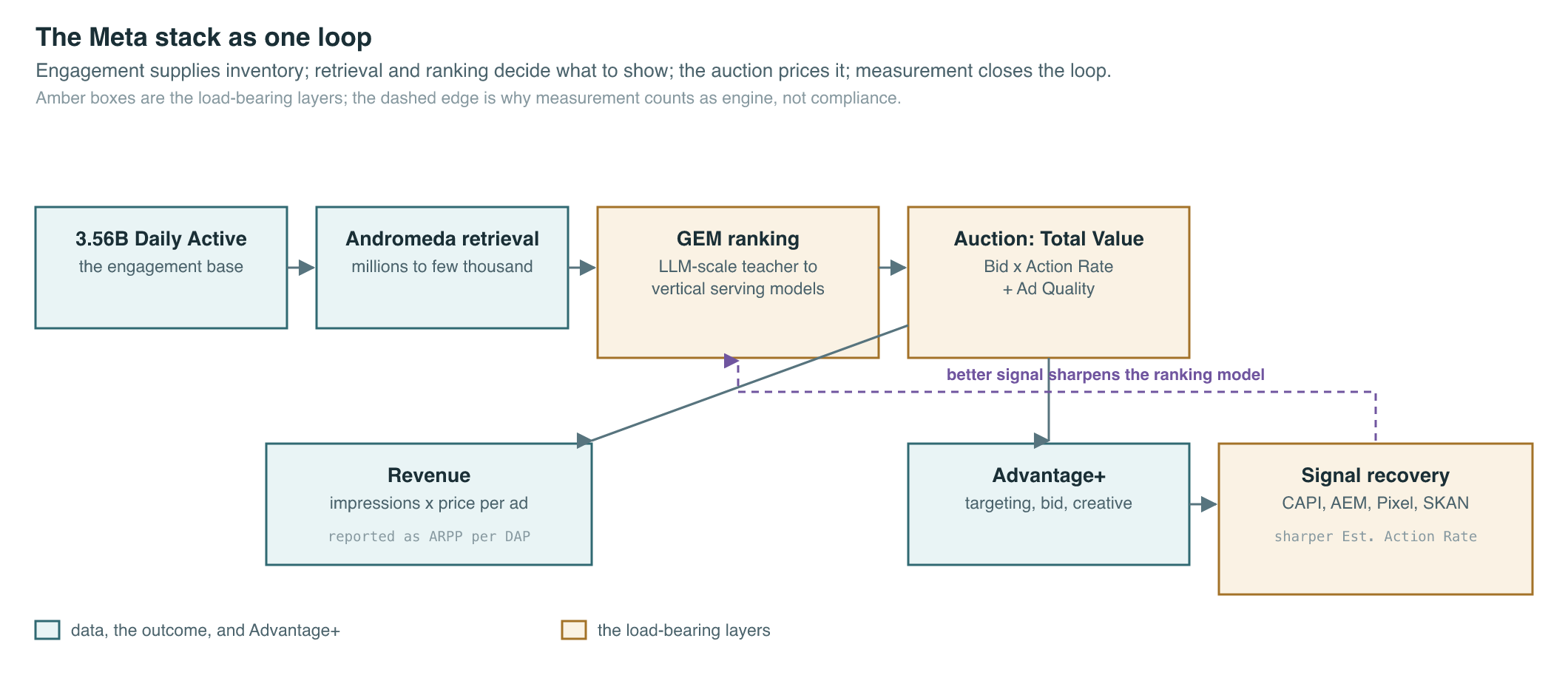
Figure 13.1 — The Meta stack as one loop. Engagement supplies inventory; retrieval and ranking decide what to show; the auction prices it; Advantage+ is the buyer’s interface to all of it; measurement closes the loop back into the models. The boxed layers are the load-bearing ones. Note the feedback edge: signal quality feeds prediction quality, which is why ch10’s CAPI is in this diagram and not a separate compliance track.
Read the headline before you read the stack: price × volume on a planetary base
Before any of the ML, anchor on the P&L, because Meta’s results tell you which lever is doing the work. Q1 2026 Family-of-Apps ad revenue was $55.0B, up 33% YoY, decomposing into impressions +19% and average price per ad +12% worldwide, on 3.56B Daily Active People (DAP) (Meta Q1 2026 results, reported Apr 29 2026). That is the ch1 identity made literal: roughly two-thirds of the growth is volume, one-third price. Per person, ARPP (Average Revenue Per Person — Family-of-Apps revenue divided by average DAP) reached $15.66 for the quarter, up from $12.36 a year earlier, ~27% growth (Meta Q1 2026 results — fast-moving, re-verify).
Hold those next to the engagement base and the strategy reveals itself. DAP grew only mid-single-digits while ARPP grew 27% — so Meta is not growing on headcount. It is growing on yield per existing person, via more impressions (new surfaces) and higher price per ad (better prediction → higher action rates → more confident bids). The 16× geo-ARPU gap from ch3 still defines where the profit lives: US&Canada price per ad rose 14% on 13% more impressions.
For Maya’s slide, the first line writes itself, and it is humbling: the 3.56B-person engagement base is the part she will never have. Her challenger platform ran at ~500M DAU; no model roadmap closes a 7× inventory gap. The engagement base goes in the “live without” column — which means everything else on her slide must be about yield per person and per impression, where a smaller platform can still compete.
FIGURE 13.2 (spec): A stacked-bar “growth decomposition” chart for Meta FoA ad revenue across the trailing five quarters, each bar split into an “impressions (volume)” segment and a “price per ad (yield)” segment, with an ARPP line overlaid on a secondary axis rising from ~$12.36 to ~$15.66. Caption: “Two-thirds volume, one-third price — and ARPP rising 27% on a barely-growing user base: the whole engine is yield per person.” Alt-text: “Stacked bar chart showing Meta ad-revenue growth split between impression volume and price per ad, with average revenue per person rising over five quarters.”
The engine: a retrieval-then-ranking funnel that turns a 1% model gain into billions
Ch5 argued the moat migrated from the targeting graph to the ML stack. Meta is the proof, and its engine is best read as a retrieval-then-ranking funnel — a lightweight stage that narrows tens of millions of candidate ads to a few thousand, then a heavier stage that scores those few thousand to pick the winner before the auction prices it.
- Andromeda — Meta’s ads retrieval engine (the funnel’s wide end), on NVIDIA Grace Hopper (GH200) and Meta’s own MTIA (Meta Training and Inference Accelerator) silicon. Reported gains: ~10,000× retrieval-model capacity, +6% recall, +8% ad quality on selected segments, ~100× feature-extraction speedup; global rollout finished October 2025 (Engineering at Meta, Dec 2024; rollout 2025). Critically, Andromeda reads the creative itself via computer vision to predict conversion — which is why, after ch8 and ch9, creative becomes the binding input, not targeting.
- GEM (Generative Ads Recommendation Model) — the ranking brain above retrieval, Meta’s largest recommendation foundation model, trained at LLM scale as a “teacher” that distills into hundreds of lightweight vertical models in the latency-critical serving path. Reported: ~+5% conversions on Instagram, ~+3% on Facebook Feed, ~4× more efficient than prior models (Engineering at Meta, Nov 2025).
- Lattice — model consolidation: collapsing ~100+ per-surface models into unified multi-domain networks. Reported: ~10% top-line gain, ~6% conversion lift, ~20% capacity savings (Meta AI / arXiv — vendor-reported, directional).
The leader-altitude point is not the architecture; it is the arithmetic. On trillions of impression predictions across 3.5B people, the difference between a 1.0% and a 1.05% predicted action rate, compounded across the auction, is billions of dollars inside a tens-of-milliseconds latency budget. This is why ch5 told you to value a single-digit-percent model gain as a revenue lever and fund custom silicon as a P&L line, not a cost center — owning the accelerator is what makes a 10,000× capacity jump affordable to monetize.
For Maya’s slide, this is the contested middle. She cannot match GEM’s scale, but model quality per dollar of compute — calibration, creative-aware retrieval, consolidation — is contestable on a narrower domain. This goes in “answer differently”: don’t out-scale the foundation model; out-specialize it.
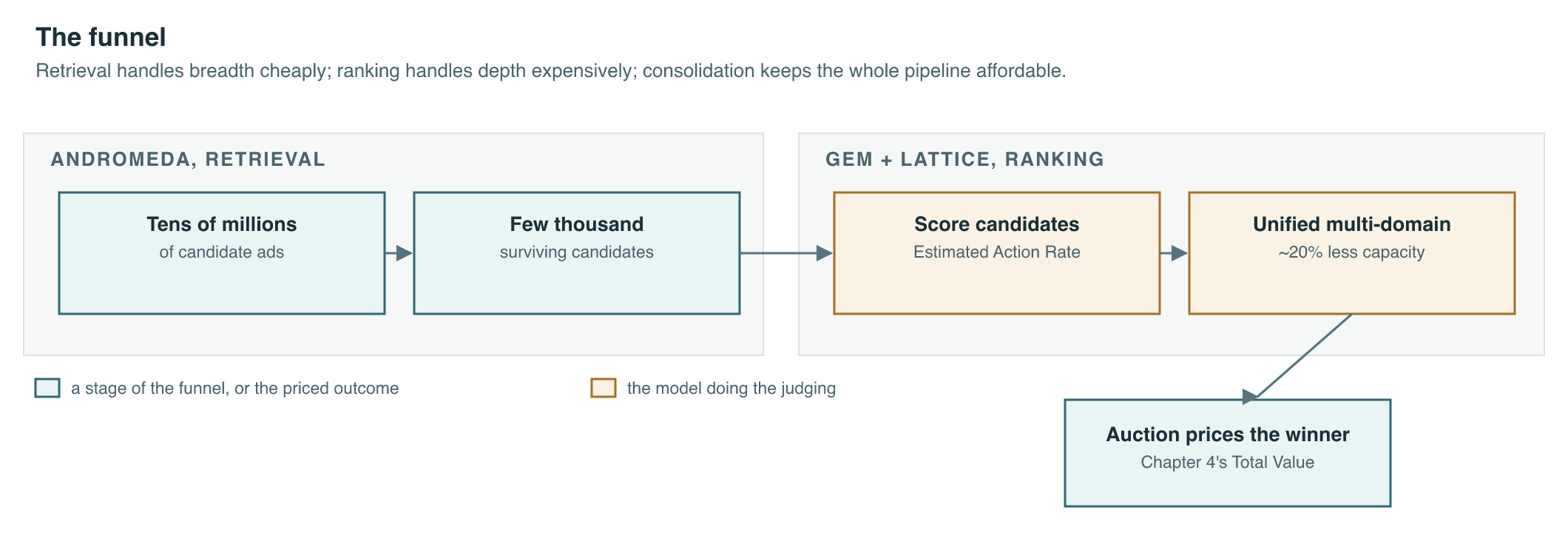
Figure 13.3 — The funnel. Retrieval (Andromeda) handles breadth cheaply; ranking (GEM) handles depth expensively; consolidation (Lattice) keeps the whole thing affordable. A leader funds this as one pipeline, not three projects.
Advantage+: the engine sold as a black box, and the trust price of the default
Everything above is invisible to the advertiser. The way Meta sells the engine is Advantage+ — the suite that abstracts targeting, bidding, creative, and placement into an outcome-in/campaign-out product (ch8’s automation frontier, instantiated). The flagship, Advantage+ Shopping Campaigns (ASC), crossed a ~$20B annualized run-rate at +70% YoY as of Q4 2024 (Meta earnings, Q4 2024), and Meta has since moved to default sales, app, and lead campaigns into Advantage+ flows.
That default is the chapter’s first genuine decision, not just a capability. It does three things at once: lifts platform-side ARPU (the engine usually beats hand-tuned campaigns and commits more budget to Meta’s optimization), eats the advertiser’s targeting lever (ch8’s loss-of-control backlash), and shifts the binding constraint to creative supply (ch9). Northwind, from Maya’s side, both loves and fears it: ASC reliably beats their in-house ROAS, but it makes results harder to audit and easier to over-trust — and some of Meta’s best advertisers reported ROAS and top-funnel declines as Andromeda/Advantage+ rolled through, with the strongest historical performers hit hardest as the system re-priced their advantage away (industry reporting, 2026 — directional).
That last point is the leader’s tell. Defaulting advertisers into automation compresses the gap between your best and median advertisers — good for aggregate yield and the median buyer, threatening for the sophisticated buyer whose edge you just absorbed. Handle it badly and your highest-spend, most-defectable accounts feel robbed (the ch4 trust lever, now at product scale). TikTok added module-level controls to Smart+ in October 2025 after exactly this complaint; Meta’s bet is that engine quality buys forgiveness. For Maya’s slide: the engine is hard to match, but the default-into-automation posture is a deliberate trust trade any platform can choose — and a smaller platform might win trust precisely by exposing the controls Meta hides.
CAPI and AEM: signal recovery is monetization infrastructure, not compliance
The funnel’s predictions are only as good as the conversion signal feeding them — and ch10 established that browser-side signal collapsed after ATT and ITP. Meta’s answer is a stack you must read as revenue infrastructure: the Pixel (browser), the Conversions API / CAPI (server-to-server events sent directly from the advertiser’s own infrastructure, bypassing the browser), AEM (Aggregated Event Measurement — privacy-preserving measurement for ATT-opted-out iOS users), and SKAN/AdAttributionKit for app installs.
The reason this sits in the engine diagram and not a legal appendix: better signal → higher Estimated Action Rate accuracy → higher Total Value → higher clearing price. CAPI is reported to lift attributed purchase events ~19% and lower cost per result ~13% versus pixel-only, and Meta tracks EMQ (Event Match Quality — a 1–10 score for how well server-sent events match to identities) as a near-KPI; below ~7, optimization is “partially blind” (Meta docs / vendor guides, 2025–2026 — directional, not platform-guaranteed). In 2025 Meta removed the old 8-event AEM limit and the Conversions API Gateway lowered integration cost — Meta treating frictionless signal capture as a yield lever, not a checkbox.
For Maya, this is the most transferable part of the stack and belongs in her “must match” column. A sub-scale platform cannot build GEM, but it can make server-side feeds one-click and drive match quality up — because signal completeness, unlike the engagement base, is not a function of scale.
Family-of-apps economics: new surfaces are how you grow impressions without breaking ad load
The last piece is where the impressions come from without overloading any single feed. Meta’s growth-on-volume (impressions +19%) is fed by an expanding family of apps: Instagram Reels reached monetization neutrality with Feed and grew ad revenue strongly through 2024–2025 (by Jan 2026 the majority of Instagram ads ran on Reels); Threads began its global ads rollout in late January 2026 at ~400M monthly actives; WhatsApp — now 3B+ users — began carrying ads (Updates tab: Status and Channels) from mid-2025, with business messaging positioned as Zuckerberg’s “next pillar” (Meta earnings / industry reporting, 2025–2026 — fast-moving, re-verify).
This is ch1 and ch10’s portfolio logic at platform scale: each new surface adds impression inventory so the platform grows on volume rather than cranking ad load on the mature Feed and torching the engagement ch4’s user-value term protects. Meta defends ARPP growth by manufacturing new inventory faster than it must raise load on old inventory. A challenger with one surface cannot do this — which pushes it back toward price, the harder, more retention-risky lever.
Same-Lever Scorecard
The decision under the microscope this chapter: how does each platform assemble auction + ML stack + automation + measurement into one monetization engine, and what is its load-bearing moat? Figures dated and hedged inline.
| Platform | Engine / ML stack (the moat) | Automation product | Signal/measurement stack | Load-bearing advantage |
|---|---|---|---|---|
| Meta | Andromeda retrieval + GEM ranking + Lattice (custom MTIA/GH200 silicon) | Advantage+ / ASC (~$20B run-rate, defaulting on) | Pixel + CAPI + AEM + SKAN; EMQ as KPI | The 3.56B-DAP engagement base feeding LLM-scale recsys — composition, not any one part |
| Relevance models on a verified professional graph | Accelerate (~5-min build; ~52% lower CPA vendor-reported) | RAR (CRM-integrated revenue attribution) | Deterministic first-party professional data; B2B trust, not scale | |
| TikTok | Engagement/recommendation models; oCPM/VBO auction | Smart+ (~9%→~42% of US perf campaigns in a year; module controls added Oct 2025) | Pixel + Events API, event_id dedup | Watch-time engagement + TikTok Shop closed loop; US JV is the overhang |
| Google / YouTube | Ad Rank / RGSP across Search + YouTube; AI Max | Performance Max (~60%→~71% adoption) | Enhanced Conversions, ADH clean room | Search intent + cross-surface bundling; the breadth benchmark |
| Amazon | Purchase-propensity relevance on first-party retail data | Sponsored Ads automation + DSP | AMC clean room (free to advertisers Sept 2025) | Closed-loop purchase data — the most accurate action-rate estimate |
| Snap (wildcard) | Smaller-scale ranking; AR/camera creative surface | Automated bidding; AR Lens formats | Conversions API; modeled events | A distinctive creative surface (AR), not an engine — competes sub-scale |
Decision or Diagnostic?
Reading the Meta stack, sort what lands on a board slide from what lands in an eng launch review.
| Decision (board / leader owns) | Diagnostic (IC / launch-review owns) |
|---|---|
| ARPP / DAP trajectory — is growth coming from yield per person or headcount, and is the engagement base healthy? | Andromeda recall / GEM conversion-lift % — the model-level wins that roll up into ARPP |
| Automation default posture — whether to default advertisers into Advantage+/black-box flows, and the trust trade | Single-campaign ASC ROAS — an account-level result, not a platform metric |
| Custom-silicon / ML capital ask — fund MTIA-class infra as a revenue lever, or cede the frontier | Lattice capacity savings %, MFU, QPS — infra-efficiency diagnostics |
| Signal-recovery as infrastructure — make CAPI frictionless and high match-quality a strategic priority | EMQ score per advertiser — the operational match-quality readout below the strategy |
| Surface portfolio — which new family-of-apps surfaces to fund to grow impressions without raising load | Per-surface ad load / frequency — the yield-desk operational setting |
The leader’s call. The trade-off you own, reading Meta, is not “should we build their features” — it is which of their moats is composition and which is a portable capability. The asymmetry that traps a challenger is mistaking the visible products (Advantage+, GEM) for the source of advantage, when the source is the 3.56B-person engagement base that no roadmap buys. Meta resolved its own version by lifting the engine into the P&L frame it reports to the Street: ARPP rising ~27% to $15.66 on a barely-growing DAP base says our growth is yield per person, made by the ML stack and new surfaces, not user acquisition — and it funds custom silicon (MTIA) and signal recovery (CAPI/AEM) as the levers that make that yield compound. The portable lessons are the auction’s user-value discipline (ch4), frictionless server-side signal, and creative-aware retrieval; the unbuyable one is the engagement base. Four quarters out: a leader who answers Meta by chasing feature parity on a sub-scale base burns capital matching an engine they can’t feed and ships a worse version of the same thing; a leader who concedes the base, matches the portable signal-and-trust levers, and answers the engine with specialization (LinkedIn’s verified graph, Amazon’s purchase loop, TikTok’s commerce loop) defends a moat Meta cannot copy. Maya’s slide has three columns; the discipline is putting each Meta capability in exactly one — match, answer differently, or live without — defended in ARPU and trust terms, not feature terms.
Key terms
| Term | One-line definition |
|---|---|
| ARPP / DAP | Average Revenue Per Person and Daily Active People — Meta’s family-wide yield-per-person metric and its user denominator; ~$15.66 ARPP on 3.56B DAP in Q1 2026. |
| Andromeda | Meta’s GPU/MTIA-accelerated ads retrieval engine; narrows tens of millions of candidate ads to a few thousand and reads creative content to predict conversion. |
| GEM | Generative Ads Recommendation Model — Meta’s LLM-scale ranking foundation model that teaches hundreds of lightweight serving models. |
| Lattice | Meta’s consolidation of per-surface models into unified multi-domain networks for top-line gain and ~20% capacity savings. |
| MTIA | Meta Training and Inference Accelerator — Meta’s custom ad-ranking silicon that makes large model-capacity jumps affordable to monetize. |
| Advantage+ / ASC | Meta’s automation suite (and its Shopping-campaign flagship, ~$20B run-rate) that abstracts targeting/bidding/creative/placement into outcome-in/campaign-out. |
| CAPI | Conversions API — server-to-server conversion feed that bypasses browser signal loss and raises Estimated Action Rate accuracy. |
| AEM | Aggregated Event Measurement — Meta’s privacy-preserving measurement for ATT-opted-out iOS users. |
| EMQ | Event Match Quality — 1–10 score for how well server-sent events match to identities; below ~7, optimization is partially blind. |
| Family of apps | Meta’s portfolio of surfaces (Facebook, Instagram, Threads, WhatsApp) whose new inventory lets revenue grow on impression volume without raising ad load on mature feeds. |
Recap & what is next
- Read Meta’s headline first: Q1 2026 ad revenue +33% decomposes into impressions +19% × price per ad +12%, with ARPP ~$15.66 (+27%) on a barely-growing 3.56B DAP base — the growth is yield per person, not headcount.
- The engine is a retrieval-then-ranking funnel: Andromeda (retrieval) → GEM (LLM-scale ranking) → Lattice (consolidation), on custom MTIA/GH200 silicon, where a single-digit-percent model gain is worth billions — the ch5 moat made literal.
- Advantage+ sells that engine as a black box; defaulting advertisers into it is a trust decision that compresses the gap between best and median advertisers and shifts the binding constraint to creative (ch8/ch9).
- CAPI/AEM is the most portable part of the stack — signal completeness drives prediction accuracy drives clearing price, and unlike the engagement base it is not a function of scale, so it belongs in any challenger’s “must match” column.
- The family of apps is how Meta grows on volume without breaking ad load — new surfaces (Threads, WhatsApp) manufacture inventory faster than it must raise load on the mature Feed.
- A leader’s answer to Meta is a three-column slide — match (signal, auction discipline), answer differently (specialize the moat), live without (the engagement base) — defended in ARPU and trust terms, never as a feature list.
Meta’s machine assumes one front feed monetized many ways. Chapter 14 — Instagram zooms inside the family to the surface that is run almost like its own platform — visual and creator commerce, Reels monetization, Shopping — and asks the leader’s question: when is a surface inside your garden distinctive enough to deserve its own monetization strategy rather than inheriting the parent’s?