The promise. Chapter 18 walked you through Amazon, where the leader’s whole advantage is owning the transaction and the first-party purchase data that prices every impression with unusual accuracy. Snap and Pinterest are the inverse problem: two real businesses, each with a few hundred million daily or monthly users and a genuinely differentiated surface, but each monetizing at a fraction of the per-user yield that Meta or Google take for granted. This chapter equips you to make the call every sub-scale platform leader faces — what is the one defensible thing we monetize that the scale players cannot copy, and how do we run the P&L around it without pretending we are something we are not? You will learn to read these two as the cleanest case studies in the book of competing sub-scale: Snap betting that the camera and AR are a native ad surface no feed can replicate, and Pinterest betting that commerce intent — the user who is already planning a purchase — lets a small audience clear at premium value. Both are answering the question Chapter 5 opened: when you cannot win on the ML stack or the scale of the targeting graph, where does durable advantage live?
You will be able to:
- Decide which single defensible surface or signal a sub-scale platform should concentrate its monetization around, rather than chasing the scale leaders head-on.
- Reason about why commerce intent and AR engagement can clear at premium value despite a small audience — and where that premium breaks down.
- Defend a revenue-diversification bet (a subscription tier, third-party demand, generative ad formats) as ARPU growth that does not depend on out-scaling Meta.
- Distinguish the board-level decision (which mindset to own, whether to take third-party demand) from the IC diagnostics (per-format CTR, Performance+ adoption rate).
- Connect a sub-scale monetization choice to its four-quarters-out effect on ARPU and advertiser trust.
Builds on: Book 1 ch3 (the auction), ch5 (yield), ch6 (commerce); Book 2 ch5 (the ML-stack moat that these platforms cannot fully fund), and especially ch5 of this book’s automation arc — Snap’s and Pinterest’s automation suites are the challenger analogs of Advantage+ and Performance Max. It sits in Part IV beside the scale deep-dives (Meta, Google, Amazon) as their deliberate sub-scale counterweight.
The call on Maya’s desk
Maya’s prior tour was at a roughly 500M-DAU challenger, so this chapter is the one she did not have to imagine — she lived it. The framing memory: a director asking, in good faith, “Why don’t we just build what Meta has?” The honest answer is that you cannot. A platform with a few hundred million users and single-dollar annual ARPU cannot out-spend Meta on custom silicon, match the conversion signal of three billion logged-in people, or win an arms race on foundation-model-scale recsys (Chapter 5). The fatal error is trying anyway — funding a me-too version of everything and ending up a worse copy of the scale player with none of the scale.
The winning move is the opposite: pick the one thing you own that the scale player structurally cannot copy, concentrate the whole strategy around it, and buy everything else as cheap parity (often by taking the scale player’s own demand through a partnership). Snap’s “one thing” is the camera and augmented reality. Pinterest’s is commerce intent — its users arrive already planning to buy. Each is a defensible mindset: a moment or signal the platform owns so completely that scale does not erase it.
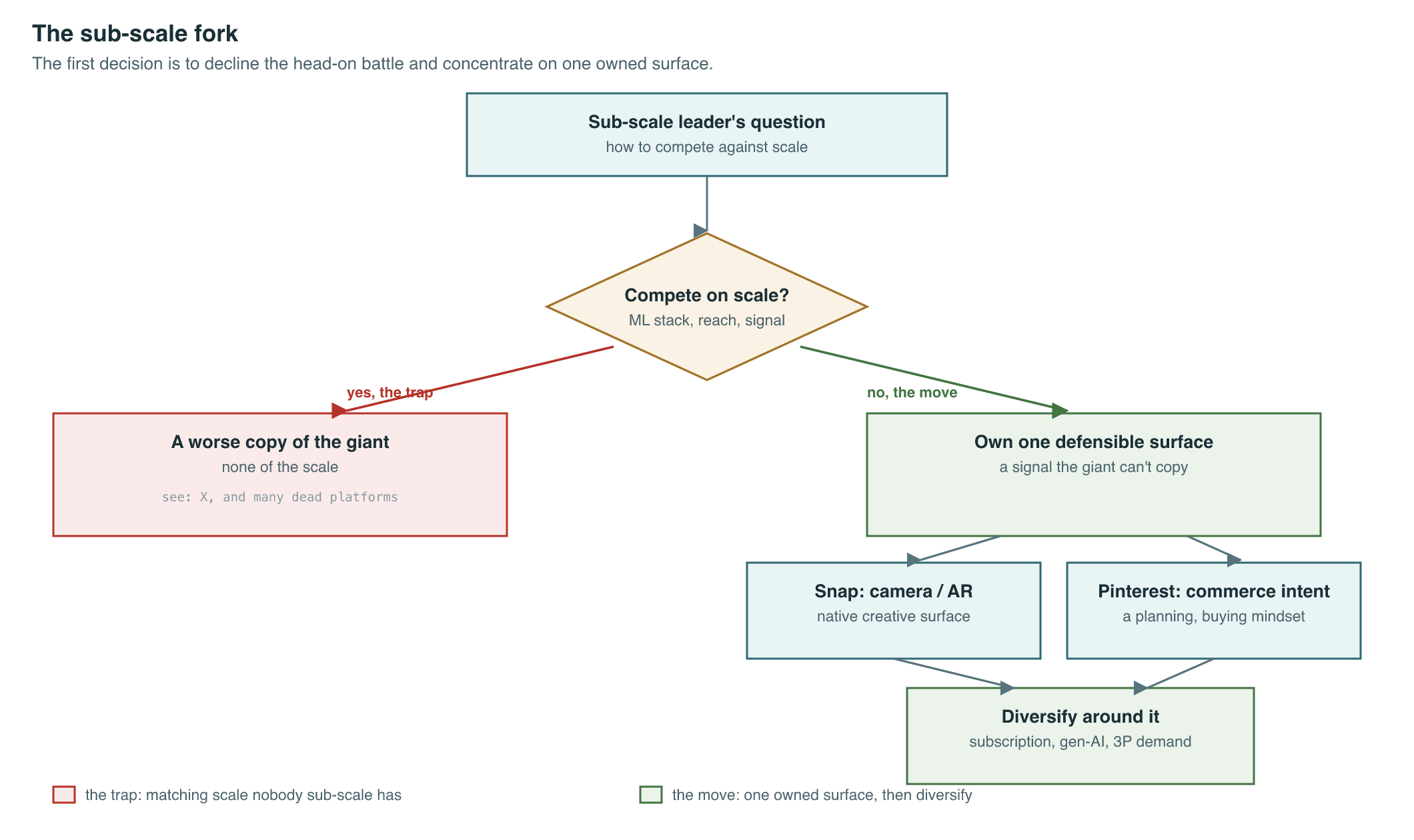
Figure 19.1 — The sub-scale fork. The leader’s first decision is to decline the head-on battle and concentrate on one owned surface, then buy parity on everything else as cheaply as possible.
Pinterest: intent is the moat, not reach
Pinterest is the cleanest argument in the book that monetizable engagement is not raw reach (Chapter 3, from the platform side). A Pinterest user is structurally further down the funnel than someone idly scrolling a feed — they are planning a kitchen remodel, a wedding, a trip. That commerce intent — the pre-existing planning-or-buying mindset that makes the surface inherently lower-funnel without behavioral tracking — is a first-party signal Pinterest gets free from the product, and it is privacy-durable in exactly the way third-party tracking is not (Chapter 11). The user tells Pinterest what they want by what they save.
The Q1 2026 numbers show both the promise and the ceiling. Pinterest delivered $1.008B revenue, +18% YoY, with a record 631M MAU, +11% YoY — its tenth straight quarter of double-digit user growth (Pinterest Q1 2026, May 2026). But the ARPU shows the sub-scale reality: global ARPU $1.61 (+6% YoY), against $7.12 in US&Canada, $1.17 in Europe, and $0.20 in Rest of World (Pinterest Q1 2026 reported figures, May 2026) — a profit pool concentrated almost entirely in North America, growing users fastest exactly where they monetize at pennies. The same quarter, impressions grew 24% while ad pricing fell 5%: growth on volume, not price, the harder lever to sustain (Chapter 2). Pinterest shares fell sharply earlier in 2026 on precisely this — whether the intent premium can ever close the ARPU gap with the scale players (financial press, Feb 2026 — fast-moving, re-verify).
The leader’s decision here is twofold. First, automation as the parity buy: Pinterest’s Advantage+/Performance Max analog is Performance+ (launched October 2024) — an AI suite spanning targeting, bidding, budgeting, and generative creative that turns flat product shots into lifestyle imagery; Pinterest reported it cut campaign-creation inputs ~50% with beta advertisers seeing 10%+ CPA/CPC improvement (Pinterest, 2024 — vendor-reported). It is not an attempt to out-build Meta’s stack; it is buying enough parity that an advertiser already on Advantage+ can run Pinterest with the same low-effort workflow. Second, third-party demand: Pinterest brought the scale players’ own demand onto its surface via ad partnerships with Amazon (2023, the first 3P partner), Google (2024), and Instacart — letting better-capitalized auctions fill its inventory at higher clearing prices than its thinner first-party demand could alone. This is the move a scale leader would never make: renting a rival’s demand density to monetize your own intent signal.
FIGURE 19.2 (spec): A two-panel ARPU bar chart titled “Pinterest’s intent premium meets the geo-mix wall (Q1 2026).” Left panel: global ARPU $1.61 with regional bars — US&Canada ~$7.12, Europe ~$1.17, Rest of World ~$0.20 — on a shared axis, dramatizing the ~35x US-to-RoW gap. Right panel: a small inset showing impressions +24% vs pricing −5% YoY as two arrows. Caption: “Intent gives Pinterest a lower-funnel mindset no feed can copy — but the profit pool is almost entirely North American, and growth is coming from volume, not price.” Alt-text: “Bar chart of Pinterest regional ARPU showing US/Canada at roughly $7, Rest of World at roughly $0.20, with a note that impressions grew 24% while pricing fell 5%.”
Snap: the camera as a surface no feed can copy
Snap’s bet is different and, in ways, harder. Where Pinterest owns a signal (intent), Snap owns a surface — the camera and the augmented reality layer on top of it: Lenses, Lens Studio, the AR creative tools no scroll-the-feed competitor has as a native primitive. The logic is identical to Pinterest’s: Meta can copy a feed, copy Reels, copy Stories (it did, famously), but cannot easily copy a platform whose entire interaction model opens to a camera and whose users expect to put a brand’s AR Lens on their own face. AR is Snap’s defensible mindset.
The Q1 2026 numbers show the shape of competing sub-scale. Total revenue grew 12% YoY to $1.53B, but the composition is the story: advertising revenue was $1.24B, up only 3% YoY, while Other Revenue jumped 87% to $285M — a roughly $1.14B annualized run-rate — with DAU back to growth at 483M (956M MAU) (Snap Q1 2026 investor letter, May 2026). Snap’s advertising business is growing low-single-digits, barely keeping pace, while its diversification engine (Snapchat+, Memories Storage, the new Lens+ tier) carries the growth. That is a leader deliberately reducing dependence on a sub-scale auction that cannot win a bidding war against Meta and Google, by building a direct-to-consumer stream that never touches the auction. Snapchat+ is the textbook revenue-diversification bet: monetize the loyal core directly rather than over-extract per impression from advertisers who have better options elsewhere.
On the ad side, Snap’s move is to make AR pay by fusing it with generative AI. Sponsored AI Lenses (launched April 2025) let users see themselves in AI-generated styles and scenes; Snap reports more engagement time than standard Lenses (Uber and Tinder campaigns unlocking higher-than-average playtimes) while eliminating the 3D/VFX cost that historically gated AR advertising (Snap Newsroom, 2025 — vendor-reported). The 2026 escalation is AI Sponsored Snaps (announced April 2026), which push brand presence into Chat via interactive conversational agents, against 950B+ chats sent in Q1 2026; and Snap reports Sponsored Snaps drove per-impression click-through up 226% and 7-day conversion volume up 59% in the quarter (Snap Q1 2026, May 2026 — vendor-reported, re-verify). The thread is Chapter 6’s lesson at sub-scale: when you cannot win on the ML stack, generative creative collapses the production cost of your one differentiated surface, letting many more advertisers use AR without a VFX team — turning Snap’s moat from a boutique brand-budget play into a scalable performance format.
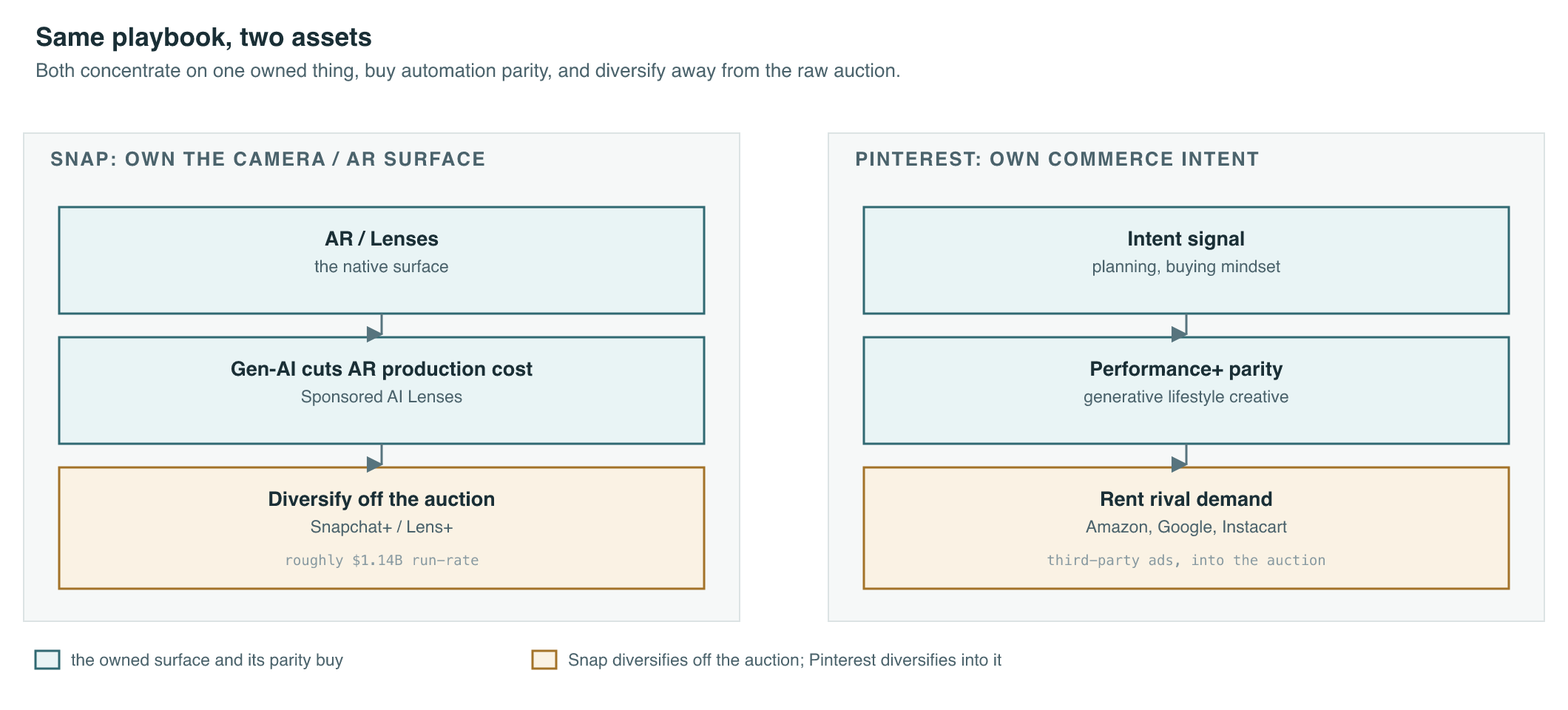
Figure 19.3 — Same playbook, two assets. Both concentrate on one owned thing, buy automation parity, and diversify — Snap off the auction (subscriptions), Pinterest into the auction (rival demand).
The economics of competing sub-scale
Strip away the product specifics and the two cases teach one frame. A sub-scale platform faces three structural disadvantages against Meta/Google: a thinner conversion signal (fewer logged-in actions to train on), a demand-density gap (fewer advertisers per impression, so auctions clear lower), and an infra-funding gap (it cannot match billions in custom-silicon and foundation-model spend — Chapter 5). None of the three yields to trying harder. So the leader’s strategy is to route around all three:
- Route around thin signal by owning a signal the product gives you free — Pinterest’s intent, Snap’s AR engagement — not reconstructing cross-app behavioral signal you will never have at scale.
- Route around the demand gap by importing demand: Pinterest renting Amazon’s and Google’s auctions. Rivals’ demand density clears your inventory higher than your own thin demand can.
- Route around the infra gap by buying automation parity (Performance+) rather than building a frontier stack, and using generative creative to lower the advertiser’s cost of using your differentiated surface — so the moat does the work the budget cannot.
Then diversify the P&L so cyclicality and the scale players’ pricing power do not own your whole revenue line: Snapchat+ at a ~$1.14B run-rate and Reddit’s data-licensing engine (Chapter 20) are the canonical second engines that grow independent of the auction. The discipline is to do this without breaking ad load on the core surface (Chapter 1): Snap’s Other Revenue +87% while ad load stays sane is the healthy version; juicing a quarter by piling ads onto a small, loyal base torches the engagement you cannot afford to lose.
The four-quarters-out trap inverts Meta’s. Meta’s risk is over-extracting from an enormous base; the sub-scale risk is strategic drift — funding a little of everything, owning nothing decisively, and waking up as a weaker version of three competitors at once. X is the cautionary endpoint from the trust side (from roughly $4.5–4.7B in 2022 down to ~$2.5B in 2024; eMarketer / Statista / industry estimates — directional, estimates vary by methodology): a platform with a defensible real-time-conversation mindset that lost advertiser trust and had no diversified engine to fall back on. Concentration plus a second engine is the survival pattern; diffusion plus auction-only dependence is the death pattern.
Same-Lever Scorecard
The lever here is what single defensible asset the platform concentrates monetization around, and how it competes against scale. Figures dated and hedged inline.
| Platform | The defensible asset (the lever) | How it competes vs scale | Diversification engine | Tell for the leader |
|---|---|---|---|---|
| Meta | Scale itself — 3.5B+ DAP, the ML stack, the conversion signal | Is the scale player; sets the eCPM benchmark | Business messaging, subscriptions (no-ads tier) as add-ons | Q1 2026 FoA ad rev $55.0B, +33% — the standard the others route around |
| Verified professional/economic graph (B2B intent) | Premium-priced niche; doesn’t fight on reach | Premium subscriptions (>$2B), Sales/Talent solutions | ~$8.2B ad rev FY25 (est.) — intent + trust clears at premium, like Pinterest one tier up | |
| TikTok | Entertainment + creator commerce engine | Challenger-scale but commerce-deep (TikTok Shop) | TikTok Shop GMV as a commerce engine off pure ads | ~$32–33B ad rev 2025 (forecast) — scale enough to fight, not yet to lead |
| Google / YouTube | Search intent + the largest video platform | Is the scale player on breadth | YouTube subscriptions; >$50B ads+subs | Sets the automation/PMax benchmark Pinterest’s Performance+ mirrors |
| Amazon | Closed-loop purchase data + the transaction | Owns the bottom of the funnel scale can’t see | The retail business itself | ~$68B ad rev FY2025 — the intent Pinterest signals, Amazon closes |
| Snap (wildcard) | The camera / AR as a native surface | Declines the auction war; monetizes a surface no feed copies | Snapchat+/Lens+ ~$1.14B run-rate, +87% Other Rev | Q1 2026 rev $1.53B (+12%); ad rev only +3% — diversification carries growth |
| Pinterest (wildcard) | Commerce intent (planning/buying mindset) | Rents rival demand; monetizes free first-party intent | 3P demand (Amazon/Google); creator commerce | Q1 2026 rev $1.008B (+18%); global ARPU $1.61 — intent premium meets the geo-mix wall |
Decision or Diagnostic?
Sort the chapter’s metrics by who owns them. The leader decides which mindset to own and whether to import demand; the IC tunes the formats inside that strategy.
| Decision (board / leader owns) | Diagnostic (IC / launch-review owns) |
|---|---|
| Which single surface/signal to concentrate on (camera/AR vs intent vs neither) | Per-format CTR / playtime (Sponsored AI Lens engagement, Sponsored Snap CTR) |
| Whether to take third-party demand (rent rivals’ auctions onto your inventory) | Performance+ / Smart-tool adoption rate among advertisers |
| The diversification mix (subscription vs ad-only; what % of revenue off the auction) | Single-campaign CPA/CPC improvement from automation (vendor-reported) |
| ARPU strategy by geo (fund density in NA vs accumulate reach in RoW) | Lens production-cost reduction from generative tools |
| Ad load on the loyal core (how hard to monetize a small base without breaking engagement) | Match rate / event recovery on the conversion feed |
The leader’s call. The trade-off you own at sub-scale is concentration versus diffusion — whether to bet the company on one defensible surface or signal the scale players cannot copy, or to fund a little of everything and own nothing. Pinterest resolved it by concentrating on commerce intent — monetizing a free first-party signal, buying automation parity with Performance+, and renting Amazon’s and Google’s demand onto its inventory rather than pretending its own thin demand could clear at scale (Q1 2026: $1.008B revenue, +18%, but global ARPU just $1.61 — the intent premium is real and the geo-mix ceiling is real). Snap resolved it by concentrating on the camera and AR, using generative AI to collapse the production cost of that one surface (Sponsored AI Lenses), and deliberately diversifying off the auction into subscriptions — Other Revenue +87% to a ~$1.14B run-rate carrying growth while ad revenue grew just 3%. Four quarters out: concentrate plus build a second engine and you compound a defensible niche into durable ARPU and advertiser trust that does not depend on out-scaling Meta; diffuse your bets and depend on an auction-only P&L and you become a weaker copy of three rivals at once — which is the slow version of X’s fast collapse. At sub-scale, strategy is what you decline to do.
Key terms
| Term | One-line definition |
|---|---|
| Defensible mindset / surface | The single moment, signal, or interaction a sub-scale platform owns so completely that scale does not erase it (Snap’s AR, Pinterest’s intent). |
| Commerce intent | A user’s pre-existing planning-or-buying mindset that makes a surface inherently lower-funnel without behavioral tracking; Pinterest’s free first-party signal. |
| Augmented reality (AR) surface | The camera-native creative layer (Lenses, Lens Studio) Snap monetizes as an ad format no feed-based platform has as a primitive. |
| Performance+ | Pinterest’s AI automation suite (targeting/bidding/budget/generative creative) — its Advantage+/Performance Max analog and a parity buy, not a frontier build. |
| Third-party demand | Importing a rival’s (Amazon/Google) ad demand onto your own inventory to clear it at higher prices than thin first-party demand allows. |
| Revenue diversification bet | A non-ad revenue engine (Snapchat+ subscription, Lens+, data licensing) that grows independent of the ad auction and hedges scale-player pricing power. |
| Competing sub-scale | Running an ad P&L against structurally larger rivals by routing around thin signal, the demand-density gap, and the infra-funding gap rather than fighting them head-on. |
| Strategic drift | The sub-scale failure mode of funding a little of everything and owning nothing decisively — ending as a weaker copy of several competitors. |
Recap & what is next
- A sub-scale platform cannot out-scale Meta or Google on signal, demand density, or ML infrastructure — so the leader’s first decision is to decline the head-on battle and concentrate on one defensible surface or signal the scale player cannot copy.
- Pinterest owns commerce intent — a free, privacy-durable first-party signal — and monetizes it by buying automation parity (Performance+) and renting Amazon/Google demand; the ceiling is a North-America-concentrated profit pool and $1.61 global ARPU growing on volume, not price.
- Snap owns the camera and AR, uses generative AI (Sponsored AI Lenses) to collapse the production cost of that one surface, and deliberately diversifies off the auction — Snapchat+/Lens+ at a ~$1.14B run-rate carrying growth while ad revenue grew just 3% in Q1 2026.
- The transferable economics: route around thin signal (own a free signal), the demand gap (import rival demand), and the infra gap (buy parity + generative creative), then build a second revenue engine without breaking ad load on a loyal core.
- The four-quarters-out test inverts Meta’s: the sub-scale risk is strategic drift, not over-extraction — concentration plus a second engine is the survival pattern; diffusion plus auction-only dependence is the death pattern X demonstrates.
- Sort ruthlessly: which mindset to own, whether to take third-party demand, the diversification mix are yours; per-format CTR, Performance+ adoption, single-campaign CPA belong to the launch desk.
Snap and Pinterest show how a differentiated platform survives sub-scale by concentrating and diversifying. Chapter 20 — Reddit & X takes the diversification lesson one step further and the trust lesson to its conclusion: Reddit turning its community corpus into a second engine through AI data licensing, and X as the full cautionary tale of what happens when a platform with a real defensible mindset destroys the advertiser trust that was holding its revenue up — the proof, one last time, that trust is fragile revenue infrastructure.