The promise. Chapter 16 left you with TikTok’s lesson that a single regulatory overhang — a forced ownership change — can put an entire ad business’s delivery, signal, and advertiser confidence in question, and that the leader’s job is to pre-position the stack to survive it. Google is the same lesson at the opposite end of the size scale, on two simultaneous fronts at once. This is the platform that owns the highest-intent demand surface ever built (Search) and the largest video platform on the planet (YouTube), runs the most-studied auction in the industry, and is — as you read this — waiting for a federal judge to decide whether part of its open-web ad-tech stack must be sold. This chapter equips you to reason about how a scale leader monetizes intent and attention together, how it bundles control into automation faster than any rival, and how it carries a structural-remedy overhang and a self-inflicted privacy reversal without letting either erode the core. By the end you will be able to defend why Google’s core P&L — Search plus YouTube, the owned-and-operated gardens — is far more insulated from its own regulatory and privacy turmoil than the headlines suggest, and what that tells your own platform about which assets are antifragile and which are not.
You will be able to:
- Decide how to read Google’s two distinct profit engines — Search intent versus YouTube attention — as different price × volume profiles that demand different monetization policies.
- Reason about Performance Max and AI Max as the most aggressive control-abstraction bet in the industry, and what the leader gives up and gains by defaulting advertisers into an opaque cross-surface black box.
- Defend why YouTube’s move onto the living-room screen (CTV) is a structural re-rating of its inventory, not just a format, and what it does to eCPM and measurement.
- Reason about the DOJ ad-tech remedies overhang and the Privacy Sandbox reversal as bets that went against Google — and why the owned-and-operated core survives both largely intact.
- Distinguish the Google metrics that are board-level decisions from the ones that are IC diagnostics, in a business where “the auction” and “the campaign type” are deliberately blurred.
Builds on: Book 1 ch3 (the real-time auction), ch4 (identity and signal loss), ch6 (commerce), and ch8 (ad quality). From Book 2 it assumes ch4 (the auction as policy — GSP/RGSP, the user-value term, autobidders), ch8 (the automation frontier — Performance Max as control abstraction), and ch11 (privacy and antitrust posture as an annually re-underwritten bet). It is the Part IV deep-dive that puts the whole Google/YouTube stack under one lens, paired against the Meta depth case and the TikTok counterweight from the prior chapters.
The call on Maya’s desk
Maya’s competitive-intelligence lead drops a two-line note: “Google just reported YouTube at $60B for 2025 — first time they’ve broken it out. And Brinkema’s ad-tech remedies ruling is expected any week. Board wants our read on both before the offsite.”
It is the perfect Google framing, because it forces the leader to hold two things at once. On one screen: a video platform that, disclosed for the first time in the Q4 2025 results, did roughly $60B in total revenue in 2025 (ads plus subscriptions) — ad revenue ~$40B (+~12% YoY) plus subscriptions, which now run ~one-third of YouTube’s total and grew faster than ads (Alphabet Q4 2025 / Variety / Tubefilter, Feb 2026 — re-verify). On the other: a federal court that has already ruled Google an illegal monopolist in open-web ad tech and is about to decide whether it must sell an exchange.
The instinct from her challenger-platform days is to read the antitrust headline as existential and the YouTube number as a footnote. The correct leader read is the reverse. The remedies case is aimed at the open-web ad-tech stack — the publisher ad server and exchange Google bolted on through acquisition — which is a small, low-margin slice of Google’s ad P&L. The $60B is the owned-and-operated core, the part no remedy touches. Maya’s board note has to invert the headline: the thing being litigated is not the thing that makes the money. That inversion is this entire chapter.
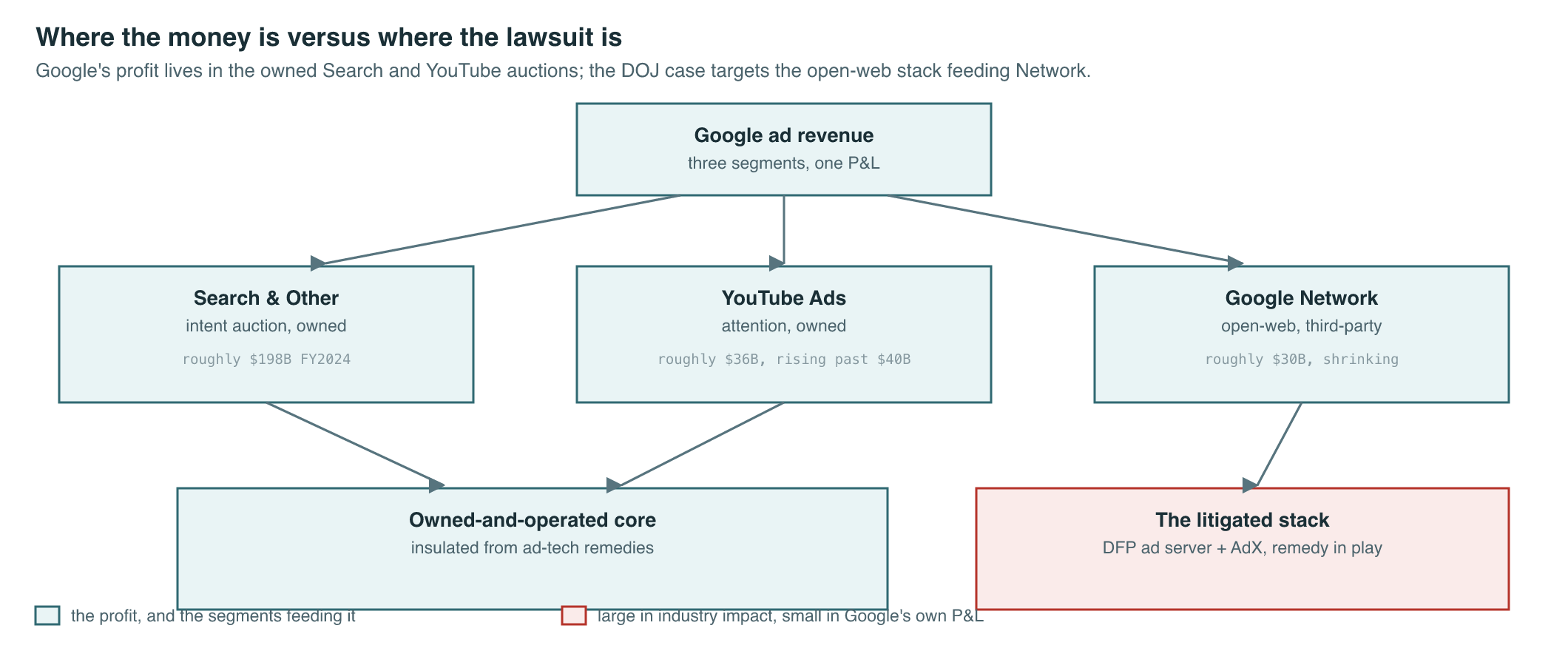
Figure 17.1 — Where the money is versus where the lawsuit is. Google’s profit lives in the owned-and-operated Search and YouTube auctions (the boxed core). The DOJ ad-tech case targets the open-web ad-server/exchange stack feeding the Network segment — large in industry impact, small in Google’s own P&L. The leader must not confuse the two. (Segment figures: Alphabet FY2024 10-K; 2025 directional.)
Two engines, two policies — intent versus attention
Book 2 ch2 taught you to read any platform as price × volume. Google is really two platforms welded together, and a leader who runs them on one policy will misprice both.
Search is an intent auction — the user has told you what they want by typing it. The action rate is high, the user-value term is satisfied largely by relevance to a query, and the inventory is nearly infinite and self-replenishing (every query is a fresh auction). This is the most valuable demand surface in advertising: Google Search & Other did ~$198.1B in FY2024, and ~$50.7B in Q1 2025 alone, +10% YoY (Alphabet filings). Pricing power here comes from intent, not attention. The lever is yield per query.
YouTube is an attention surface — closer to TikTok and Meta Reels than to Search. There is no query; the platform must infer what the viewer might act on, the action rate is lower, and inventory is gated by watch-time and ad-load tolerance (the engagement-frontier discipline from ch1). YouTube ads grew through 2025 quarter over quarter — ~$8.9B Q1 (+10% YoY), ~$9.8B Q2 (+13% YoY), ~$10.3B Q3 (+15% YoY), ~$11.4B Q4 (+~9% YoY) (Variety / Hollywood Reporter / Alphabet Q1–Q4 2025 — re-verify). Note the decelerating growth rate into Q4 even as the absolute dollars rose. The lever here is the opposite of Search: it is load and engagement, not intent.
The leader’s takeaway is not “Google is big.” It is that a multi-surface platform must run a different monetization policy per surface — and the most common strategic error is exporting the high-intent surface’s aggression to the attention surface, torching engagement to chase a yield number that the attention surface structurally cannot deliver. Maya’s own platform has this exact split (a high-intent search/commerce surface beside a low-intent feed), and Google is her proof that you institutionalize the difference rather than averaging it away.
Performance Max and AI Max — the most aggressive control-abstraction bet in the industry
Chapter 8 framed automation as the leader’s control-abstraction decision: how much targeting, bidding, creative, and placement to take away from the advertiser. Google has pushed that dial further than anyone. Performance Max (the goal-based campaign type that bundles Search, Shopping, YouTube, Display, Gmail, and Maps into one budget with opaque channel allocation — the advertiser sets an objective and Google decides where the money goes) reached roughly 71% advertiser adoption in 2025, up from ~60% in 2024 (smarter-ecommerce / industry, 2024-2025 — re-verify). In 2025 Google extended the bet with AI Max for Search (an AI bundle adding broad-match expansion and AI-generated creative to Search campaigns), launched May 2025, reporting ~14% more conversions at similar CPA/ROAS for early adopters (Google Ads blog, 2025 — vendor-reported).
The strategically important detail is the coupling: ads in Google’s new AI Overviews and AI Mode surfaces require the AI-powered campaign types (PMax, AI Max, broad match). Google is using access to its newest, scarcest inventory as the carrot that pulls advertisers off manual exact-match control and into the black box. This is the ch8 trade-off made explicit — opacity in exchange for inventory — and it is a deliberate policy, not a product accident.
What does the leader own here that the IC does not? The IC argues about whether PMax over-spent on Display or cannibalized branded search. The leader owns the default and the disclosure: whether to abstract control by default, and how much transparency (channel-level reporting, exclusion controls, brand-safety placement reporting) to ship alongside the opacity so advertiser trust does not erode the way it threatened to for TikTok Smart+ before the October 2025 module-level controls. Google’s posture is “maximal abstraction, minimal disclosure” — which buys efficiency and lock-in now and accrues a trust liability that a rival can exploit. That is a defensible call only if the model genuinely outperforms; the moment it doesn’t, opacity becomes the thing advertisers blame.
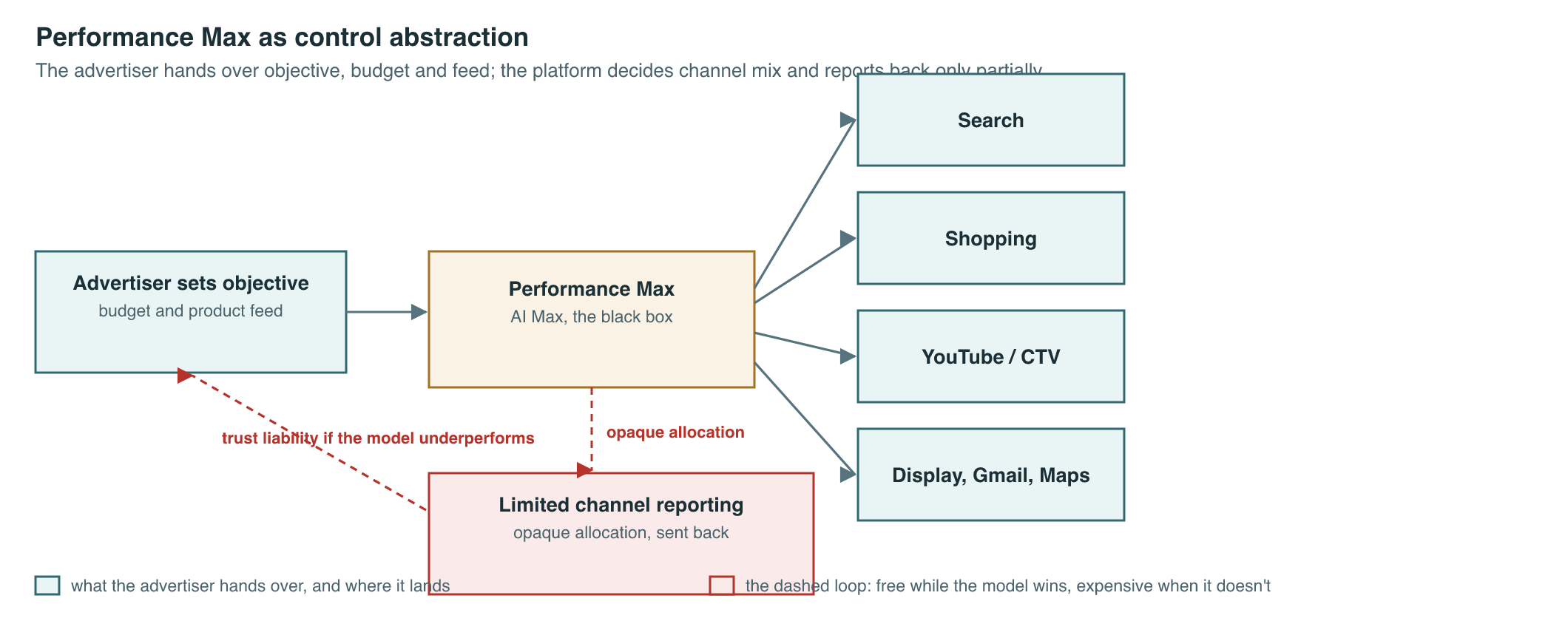
Figure 17.2 — Performance Max as control abstraction. The advertiser hands over objective, budget, and product feed; the platform decides channel mix across all surfaces and reports back only partially. The dashed loop is the trust liability: opacity is free while the model wins and expensive the moment it doesn’t.
YouTube on the living-room screen — a structural re-rating, not a format
The single most important thing happening to YouTube’s P&L is not a new ad unit; it is where people watch. Television screens have become YouTube’s primary viewing device in the US by watch-time — TV now accounts for roughly 36% of US YouTube viewing, and YouTube held about 12.7% of all US TV viewing in December 2025, the largest share of any single media company, ahead of Netflix (~9%), with streaming overall at a record ~47.5% of TV time (Nielsen The Gauge, 2025 — re-verify).
Why this is a leader-altitude fact and not a trivia slide: the same impression is worth more on the living-room screen. CTV (Connected TV — internet-delivered television, ch10) inventory commands brand-TV budgets and premium CPMs that a phone-screen pre-roll never could. YouTube is therefore re-rating a large and growing share of its inventory from “online video” pricing to “television” pricing without having to acquire a single new viewer — a pure yield lift on existing engagement. By 2025 roughly 80% of Performance Max advertisers were running CTV ads, and Google began auto-generating CTV creative from product-feed images and shipped shoppable CTV ads with on-screen QR codes (Search Engine Land / ALM Corp, 2025-2026 — re-verify). That fuses the living-room’s brand premium with Search’s lower-funnel, shoppable intent — the cross-surface bundle (Figure 17.2) is what lets a brand-reach impression carry a direct-response price.
The leader’s lesson, portable to any platform with a video surface: screen migration can re-rate your inventory faster than any pricing change you could engineer in the auction. Maya’s question for her own video surface becomes: are we capturing the CTV premium on the impressions that already qualify for it, or are we pricing living-room attention like a phone?
FIGURE 17.3 (spec): A two-panel “same impression, two prices” diagram. Left panel: a phone showing a YouTube pre-roll, labelled “Mobile video — online-video CPM.” Right panel: the identical ad on a living-room TV, labelled “CTV — brand-television CPM,” with an upward arrow and a “+premium” badge between them, plus a small QR-code overlay marked “shoppable.” Caption: “YouTube re-rates the same impression upward by moving it to the TV screen — and makes it shoppable, fusing brand reach with lower-funnel intent.” Alt-text: “Diagram showing one YouTube ad priced low on a phone and high on a TV, with a shoppable QR code on the TV version.”
The two bets that went against Google — and why the core survived
Chapter 11 made the case that privacy and antitrust posture is an annually re-underwritten bet, and that betting the roadmap on a single API or assuming today’s structure persists is a strategic error. Google is the live case study of two such bets going wrong — and of why a diversified, owned-and-operated core absorbs the blow.
Bet one — Privacy Sandbox. Google spent roughly six years promising to deprecate the third-party cookie in Chrome and replace it with the Privacy Sandbox APIs (Topics, Protected Audience, Attribution Reporting). The whole open-web ad-tech industry re-tooled around that promise. Then Google reversed third-party-cookie deprecation (April 22, 2025) — cookies stay, no removal timeline — and by October 2025 wound the Privacy Sandbox down entirely, retiring the core APIs on Chrome and Android (Google Privacy Sandbox blog; UK CMA released its binding commitments Oct 17, 2025 — re-verify). Anyone who had bet their measurement or targeting roadmap on Sandbox APIs was stranded. This is ch11’s warning made concrete: the leader who diversified identity and measurement bets survived; the one who went all-in on a single platform’s promised API did not.
Bet two — the DOJ ad-tech remedy. In April 2025 a federal court (Judge Brinkema, E.D. Va.) ruled Google illegally monopolized the publisher ad-server and ad-exchange markets for open-web display, citing tying of its exchange (AdX) to its ad server (DFP) and practices like First Look / Last Look. The remedies trial’s closing arguments were heard November 21, 2025, with the DOJ asking the court to force Google to sell AdX and open-source DFP’s final auction logic; a ruling is expected around January–February 2026. At the closing, Judge Brinkema signaled skepticism toward a forced structural breakup — questioning the timing against an inevitable appeal and the DOJ’s failure to name a plausible AdX buyer — which several observers read as leaning toward behavioral rather than structural remedies, though she had not decided and the appeal path remains open (AdExchanger / Norton Rose Fulbright / National Law Review / Open Markets Institute, Nov 2025 — fast-moving, re-verify).
Here is the leader-altitude read the board needs. The litigated stack — DFP and AdX — sits in the Network segment (~$30B FY2024 and shrinking), the lowest-margin, open-web slice. The owned-and-operated Search and YouTube auctions are not the publisher-ad-server market the case is about. So even a forced divestiture of AdX, while a genuine industry earthquake for open-web publishers and a reputational and operational drag, does not touch the engines that produce the overwhelming majority of Google’s ad profit. That is the difference between a regulatory headline and a P&L event — and the discipline Maya must model for her own board: map the remedy onto the segment, not the brand.
The portable principle for any platform leader: the antifragile assets are the owned-and-operated, first-party, logged-in surfaces; the fragile ones are the bolted-on, third-party, open-web intermediation layers. Google is about to have that lesson administered by a federal judge. Build toward the antifragile side before someone makes you.
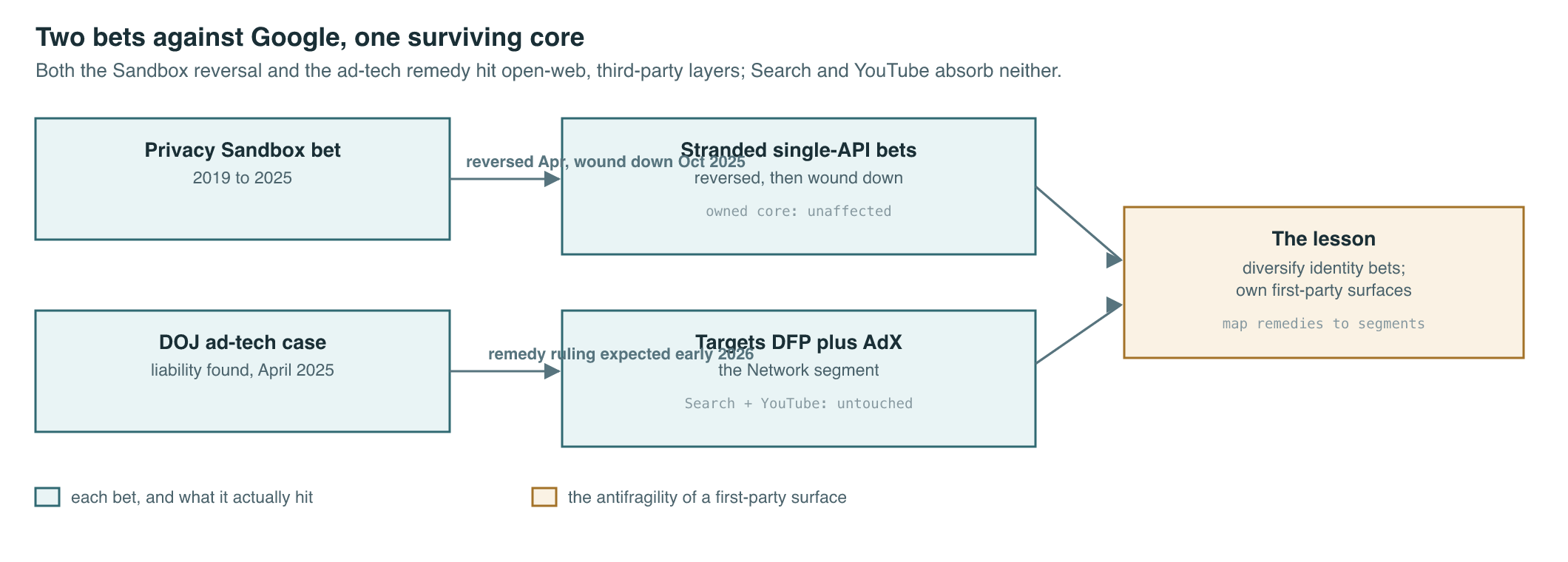
Figure 17.4 — Two bets against Google, one surviving core. Both the Privacy Sandbox reversal and the ad-tech remedies case hit the open-web, third-party layers; the owned-and-operated Search and YouTube engines absorb neither. The lesson is the antifragility of first-party surfaces.
The auction underneath it all
You met Google’s mechanism in ch4: Ad Rank ranks by bid × ad quality (expected CTR, ad relevance, landing-page experience) × context, on a modified Generalized Second-Price (GSP) auction with a randomized variant, RGSP, that varies ordering. Two things matter for the leader at this altitude.
First, Quality Score is a diagnostic, not an auction input. The 1-10 number shown in the UI is a reporting summary; the live quality estimate the auction actually uses is separate. Confusing the two is the classic IC-versus-leader error — Google itself draws the line, and so should you.
Second, Google is the public proof of ch4’s deepest point: that under autobidders the truthful auction is no longer the automatically safe default. With 80%+ of Google advertisers on automated bidding and RGSP openly non-truthful, Google has effectively conceded that mechanism choice is policy — a deliberate revenue-versus-efficiency tool — not neutral plumbing. The DOJ’s demand to open-source the auction logic is the regulatory shadow of exactly this: once everyone agrees the mechanism is a policy lever, transparency over that lever becomes contestable. The leader who builds explainability and audit trails into the auction before a court demands them is buying cheap insurance. Google is buying it expensive.
Same-Lever Scorecard
The decision this chapter sharpens: how a platform monetizes intent versus attention, how far it abstracts control into automation, and how exposed its core is to its own regulatory overhang. Figures dated and hedged inline.
| Platform | Core surface(s) & profile | Automation / control-abstraction posture | Regulatory / structural overhang | Tell for the leader |
|---|---|---|---|---|
| Google / YouTube | Search (intent, ~$198B FY24) + YouTube (attention, ~$60B total rev 2025) — two policies | Most aggressive: PMax ~71% adoption, AI Max; AI-surface access gated to AI campaign types | DOJ ad-tech remedy (ruling ~early 2026); Privacy Sandbox reversed — both hit open-web layers, not O&O core | The litigated stack is not the profit core — map remedy to segment |
| Meta | Feed/Reels attention; Total Value auction | Advantage+ (~$20B+ run-rate); defaulting campaigns in | DMA pay-or-consent (EUR 200m fine); ATT signal loss | Closest analog — attention-only, no intent surface to fall back on |
| B2B intent on a verified professional graph | Accelerate (AI build); conservative, high-trust | Profile-data targeting scrutiny (EU/US) | Trust dividend lets a small surface clear at premium | |
| TikTok | Attention + commerce; Smart+ autobid | Smart+ ~9%→~42% of US perf campaigns; module controls added Oct 2025 after pushback | US JV / divestiture overhang — hits the whole business, unlike Google’s segment-bounded case | Overhang threatens the core, not a bolt-on layer — the harder position |
| Amazon | Retail-media intent on first-party purchase data (~$56.2B FY24 ad revenue, +18% YoY) | Closed-loop relevance; sponsored formats | Lighter ad-tech antitrust exposure | Purchase signal makes the action-rate estimate antifragile |
| Reddit (wildcard) | Community/contextual intent | Lighter automation | AI data-licensing leverage as a 2nd engine | Contextual signal is privacy-durable by construction |
Decision or Diagnostic?
Sort the chapter’s metrics by who owns them. Google deliberately blurs “the auction” and “the campaign type,” which makes the discipline harder — and more necessary.
| Decision (board / leader owns) | Diagnostic (IC / launch-review owns) |
|---|---|
| Per-surface monetization policy — running Search (intent) and YouTube (attention) on different load/yield doctrines | Single-campaign PMax channel split — whether this budget leaned Display vs Search |
| Automation default & disclosure — abstract control by default, and how much transparency to ship alongside | Quality Score (1-10) — a UI diagnostic, explicitly not an auction input |
| CTV inventory re-rating — capturing the living-room premium on qualifying impressions | Per-auction Ad Rank / clearing price — operational, monitored at the desk |
| Segment exposure to remedy/regulation — which revenue sits in the litigated vs O&O surfaces | tCPA-vs-tROAS conversion-value delta — a bidding-strategy diagnostic (~+14%) |
The leader’s call. The trade-off Google owns — and the one you must learn to read from it — is how much control to abstract into an opaque cross-surface black box, and how much of the company’s revenue to leave exposed in fragile open-web intermediation layers versus antifragile owned-and-operated surfaces. Google resolved the automation call at the maximal-abstraction end: Performance Max at ~71% adoption with opaque channel allocation, and access to its newest AI-surface inventory gated to AI campaign types — buying efficiency and lock-in while accruing a transparency liability that the DOJ’s “open-source the auction logic” demand now externalizes. It resolved the structural-exposure call, partly by design and partly by history, by concentrating profit in the Search and YouTube O&O engines while the litigated DFP/AdX stack and the abandoned Privacy Sandbox both sat in the open-web periphery. Four quarters out: even a forced AdX divestiture and a dead Sandbox leave Google’s core ad P&L — ~$198B Search plus a ~$60B YouTube re-rating onto the TV screen — substantially intact, while a rival who had bet its roadmap on Sandbox APIs or built only a bolted-on open-web business is exposed. The portable call for your platform is to over-index toward first-party, logged-in, owned surfaces and to map every regulatory threat onto a segment, not a logo — because the headline that scares the board is rarely the line item that moves the P&L.
Key terms
| Term | One-line definition |
|---|---|
| Owned-and-operated (O&O) core | A platform’s first-party surfaces (Google Search, YouTube) where it owns demand, supply, and auction — the antifragile profit engine, insulated from open-web remedies. |
| Intent surface | A surface where the user has declared what they want (Search query); high action rate, yield-per-query the lever. |
| Attention surface | A surface where intent must be inferred (YouTube, Reels); lower action rate, load-and-engagement the lever. |
| Performance Max (PMax) | Google’s goal-based campaign type bundling Search, Shopping, YouTube, Display, Gmail, Maps into one budget with opaque channel allocation. |
| AI Max | Google’s 2025 AI bundle for Search adding broad-match expansion and AI-generated creative; access to AI-Overview inventory is gated to AI campaign types. |
| CTV re-rating | The yield lift from pricing the same video impression at brand-television CPMs as viewing migrates to the living-room screen. |
| GSP / RGSP | Generalized Second-Price and its randomized, openly non-truthful variant — Google’s mechanism; proof that mechanism choice is policy. |
| Quality Score | The 1-10 in-UI diagnostic — not the live quality estimate the auction actually uses; a classic IC-vs-leader confusion. |
| DOJ ad-tech remedy | The structural/behavioral remedy (potential AdX divestiture) pending after the April 2025 monopoly liability ruling; ruling expected early 2026. |
| Privacy Sandbox | Google’s six-year third-party-cookie-replacement program, reversed in April 2025 and wound down by October 2025 — the cautionary single-API bet. |
Recap & what is next
- Google is two platforms welded together — Search (intent, ~$198B) and YouTube (attention, ~$60B total rev 2025) — and must run a different monetization policy per surface; exporting the intent surface’s aggression to the attention surface torches engagement.
- Google has pushed control abstraction further than anyone: Performance Max at ~71% adoption with opaque allocation, AI Max, and AI-surface inventory gated to AI campaign types — maximal opacity for maximal efficiency and lock-in, with a transparency liability attached.
- YouTube’s migration to the living-room screen re-rates its inventory from online-video to television CPMs (largest US TV-viewing share, ~12.7%, Dec 2025) — a yield lift requiring no new viewers, fused with shoppable intent via CTV.
- Two bets went against Google — the Privacy Sandbox reversal and the DOJ ad-tech remedies case — but both hit the open-web, third-party layers, leaving the owned-and-operated Search and YouTube core substantially intact; the leader maps a remedy to a segment, not a brand.
- The auction underneath (Ad Rank / GSP / RGSP, Quality Score as diagnostic) is ch4’s argument in public: under 80%+ autobid demand, mechanism choice is policy, and transparency over it is now contestable.
- The portable principle: first-party, logged-in, owned surfaces are antifragile; bolted-on open-web intermediation is fragile — build toward the antifragile side before a court or a regulator makes you.
Google shows what a scale leader’s two profit engines look like and how a diversified core absorbs regulatory shock. Chapter 18 — Amazon turns to the third pillar that neither Google nor Meta is built on: retail media, where the auction sits directly on first-party purchase data and the closed commerce loop makes the action-rate estimate not just accurate but antifragile — the most defensible new ad business a platform can stand up, and the build-versus-buy call from ch12 made concrete.