The promise. In Chapter 12 you made the build-versus-buy call on commerce — whether to stand up a closed-loop, transaction-owning ad business and with what take rate. That decision added one new pillar to your P&L. This chapter zooms all the way out to the whole portfolio: the feed you already monetize, plus the adjacent surfaces and revenue streams clamoring for your roadmap — a second feed, business messaging and conversational ads, connected-TV inventory, subscription tiers, and licensing your content or data to someone else’s AI. The temptation is to treat each as a feature request and say yes to the ones with the loudest VP behind them. The leader’s move is the opposite: run the business as a portfolio of revenue engines with different margins, different cannibalization profiles, and different durability — and decide deliberately which to scale, which to skip, and in what sequence. This chapter equips you to make that allocation call and defend it as growth on impressions and new streams, not just a higher price on the feed you already have.
You will be able to:
- Decide which adjacent surfaces and revenue streams are real optionality versus distractions, and the sequence in which to fund them.
- Defend a new-pillar bet — business messaging, a CTV tier, a subscription — to finance as impression-volume or diversification growth, not a one-time price bump.
- Reason about cannibalization across ad-supported, subscription, and commerce tiers, and how to manage it for lifetime value rather than this quarter’s eCPM.
- Distinguish a data- or content-licensing engine (a second, ad-independent stream) from the ad business it sits beside — and price the strategic cost of feeding a rival.
- Connect any portfolio move to its four-quarters-out effect on ARPU and advertiser trust.
Builds on: Book 1 ch1–3 (the supply chain you no longer re-teach) and ch6 (commerce). Book 2 ch1–2 (the price × volume P&L; profit pools), ch4 (the auction as policy), ch6 (yield, pacing & ad load), and especially ch12 (the commerce land grab — the first new pillar). It opens Part V — The Frontier & The Leader’s Synthesis, and sets up ch23’s question of who actually buys across all these surfaces once software is the buyer.
The call on Maya’s desk
Eleven months in, Maya walks into a portfolio review with five proposals and one budget. The new-surfaces lead wants headcount to ship ads inside the messaging app, where click-to-message volume is already large but the in-thread inventory is empty. The growth team wants to launch a paid ad-free subscription tier in the EU, partly as a regulatory hedge. A corp-dev deck proposes licensing the platform’s user-generated content corpus to two AI labs for a guaranteed annual fee. The video org wants to fund a connected-TV ad tier to chase brand budgets the feed can’t hold. And the original-feed team, predictably, wants the same money to push ad load another point.
She cannot fund them all this year, and — this is the part the ICs in the room don’t feel — some of them eat each other. A subscription tier removes ad-monetizable people from the feed. A CTV tier and the messaging surface compete for the same brand and the same performance dollar. Licensing the content corpus hands a rival the very data that makes her own feed worth scrolling. The original-feed ad-load push is the safest dollar in the room and also the one that quietly mortgages engagement (ch6).
The mistake a first-time leader makes here is to score each proposal on its own merits and greenlight the top three. The mistake a good leader avoids is forgetting that these are not five independent bets — they are positions in one portfolio, and the right question is not which are good? but which mix maximizes long-run ARPU and durability net of cannibalization, and in what order do I sequence them so each one funds the next? That is the chapter.
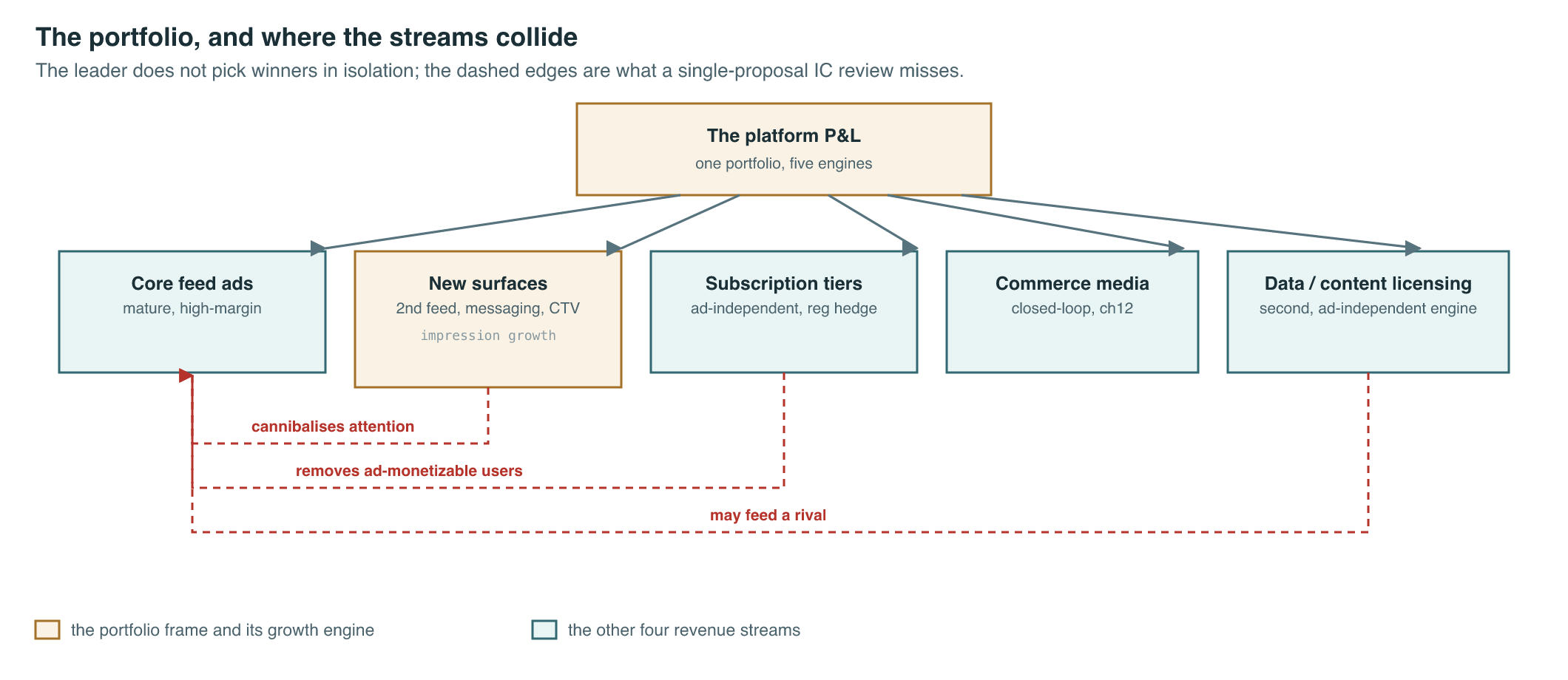
Figure 22.1 — The portfolio, and where the streams collide. The leader does not pick winners in isolation; the dotted edges are the cannibalization and strategic-cost paths an IC scoring a single proposal will miss.
Run it as a portfolio, not a single eCPM dial
Through Chapters 1–7 you steered one identity: revenue = ad load × yield. That is the right model for the feed. It is the wrong model for the platform, because the platform now earns money in ways the eCPM dial can’t see. The leader-altitude reframe is portfolio monetization — managing a set of revenue engines (ad-supported feed, new ad surfaces, subscription, commerce, licensing) with distinct margins, growth curves, and risk, rather than maximizing the price of one.
The clearest public proof that the best operators already think this way is blended monetization — running ad-supported and subscription revenue against the same audience instead of choosing one. YouTube crossed a milestone here: full-year 2025 total revenue topped $60B, split roughly $40.4B advertising and ~$20B subscriptions (YouTube Music/Premium, YouTube TV, NFL Sunday Ticket) (Variety / MediaPost, Feb 2026). A leader who only watched YouTube’s eCPM would have missed half the business. The subscription line is not a tax on the ad line; it monetizes the heavy-viewing, ad-averse users the auction was never going to price well anyway — and it does so on a recurring, privacy-durable, regulator-friendly basis.
The discipline this demands is that you stop reporting a single yield number to the board and start reporting a portfolio mix — what share of incremental revenue came from new impressions (new surfaces), from price (the auction), from subscription, from commerce take rate, and from licensing — because each carries a different durability and a different cannibalization cost. A quarter that grows on new-surface impressions is healthier than the identical quarter grown by squeezing ad load on the mature feed, even though the revenue line reads the same. The mix is the message.
Which surfaces are optionality, which are distractions — and the sequence
Not every adjacent surface is worth your roadmap. The test is whether a surface adds monetizable engagement you don’t already have (ch2) at a margin and durability worth the org cost — or whether it merely reshuffles attention you were already selling. Three patterns are worth naming.
Real optionality: business messaging. Meta’s leadership calls messaging “the next pillar” of the company, and the early numbers justify the language. Paid business messaging on WhatsApp crossed a ~$2B annual run-rate in late 2025, and click-to-message ads grew US revenue ~50% YoY in Q4 2025 (Meta earnings / Storyboard18, late 2025–early 2026). WhatsApp’s 3B+ users are an almost entirely unmonetized surface, so ads there are impression growth, not attention reshuffling. The upside estimates are wide and should be treated as exactly that — analysts have floated everything from ~$6B incremental in 2026 across WhatsApp + Threads new surfaces (Barclays) to a $30–40B long-run TAM for business messaging (Wolfe Research) (Fast-moving — re-verify; vendor/analyst forecasts, 2025–early 2026). Hedge the magnitude; trust the direction: a conversational, AI-assisted ad surface against billions of unmonetized messaging users is structurally the kind of new pillar a leader funds.
Real optionality, sequenced behind the core: a second feed. Threads is the textbook case of sequencing. Meta deliberately grew Threads to ~400M+ monthly actives before turning on monetization, then rolled out ads to all advertisers globally in January 2026 (CNBC / Meta, Jan 2026). The lesson is the sequence, not the surface: you build the engagement base first and switch on the auction once the inventory can clear without degrading the experience — the same load-vs-engagement discipline from ch6, applied to a brand-new surface.
Skip, or fund narrowly: CTV for a platform without native video scale. CTV is a genuine land grab — Netflix’s ad tier reached 250M+ monthly active viewers by mid-2026 and roughly doubled ad revenue to ~$1.5B in 2025, with guidance to roughly double again toward ~$3B in 2026 (Variety / AdExchanger, 2026; the MAU definition changed — re-verify). But CTV rewards platforms that already own premium video supply and a logged-in living-room relationship. For YouTube it is core; for Netflix it is the new ad business. For a feed-native platform with no living-room presence, a CTV tier is a distraction dressed as optionality — better to partner for the inventory than to build a sales motion you can’t feed. LinkedIn’s restrained approach — applying its profile graph to partner CTV inventory (BrandLink, Paramount) rather than building a streaming service — is the disciplined version of this call.
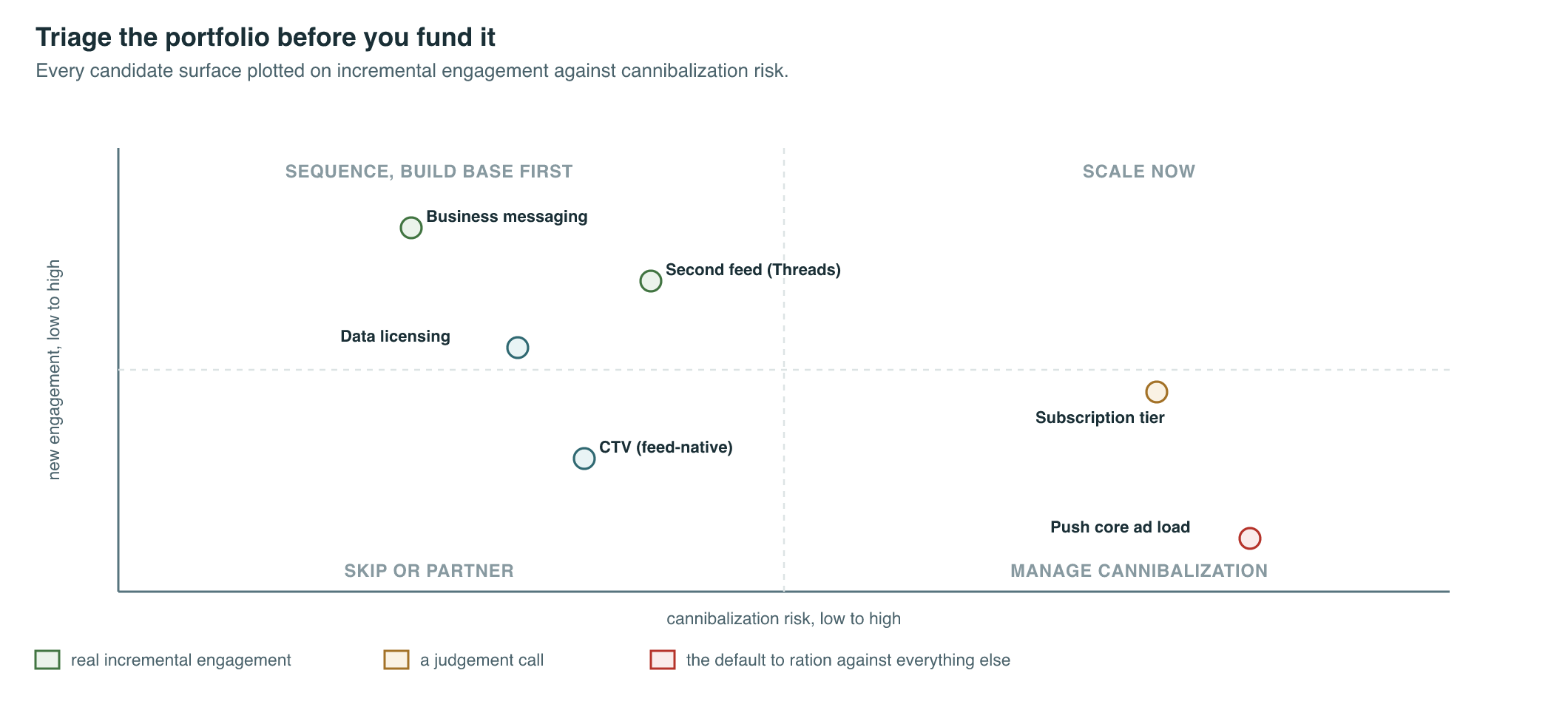
Figure 22.2 — Triage the portfolio before you fund it. Top-left/right surfaces add real engagement; the bottom-right “push core ad load” is the high-cannibalization, low-new-engagement default the leader must consciously ration against the new pillars.
Cannibalization is the trade-off you actually own
Every new stream takes something from an old one — attention, ad-monetizable users, or strategic data. The leader’s job is not to avoid cannibalization (that means declining all growth) but to price it and accept it only when the new stream’s durability or margin beats what it eats.
The cleanest case is the subscription tier. Every user who pays for ad-free is a user removed from the auction. That is real cannibalization — and it is often the right trade, because the people most likely to pay are disproportionately the ad-averse, low-eCPM, or heavy users whose feed experience was degrading anyway. Snap is the proof of concept: Snapchat+ crossed 25M subscribers by February 2026, pushing direct (non-ad) revenue to a ~$1B annualized run-rate (TechCrunch / Snap, Feb 2026). That is ad-independent, recurring revenue that also diversifies away from a single demand pool. The board question is not “will subscriptions cannibalize ads?” — of course they will, at the margin — it is “is the recurring, privacy-durable subscription dollar worth more than the ad dollar it displaces, for this cohort?”
There is a second, sharper reason to own a subscription tier: the regulator may force one onto your menu. Meta’s EU “consent or pay” model drew a €200M DMA fine and a Commission finding that a binary “consent or pay” choice wasn’t compliant; Meta’s response was a third option — a free, “less-personalized ads” tier (ads served on less personal data, not pure contextual) alongside the paid ad-free tier (European Commission, Apr 2025; fast-moving — re-verify). A leader who already runs a subscription tier as a portfolio choice is far better positioned when a privacy regime turns it into a compliance requirement. The portfolio decision and the ch11 privacy posture are the same lever seen from two altitudes.
FIGURE 22.3 (spec): A stacked-area chart, “Portfolio revenue mix over eight quarters (illustrative).” X-axis: Q1–Q8. Five stacked bands from bottom: Core feed ads (largest, slow-growing), New-surface ads (messaging + 2nd feed, growing fastest), Commerce take rate, Subscription, Data/content licensing (thin but rising). A dashed overlay line, “blended ARPU,” rising smoothly even as the core-feed band flattens. Caption: “The leader’s scoreboard isn’t eCPM — it’s the mix. Blended ARPU keeps climbing because new pillars carry the growth the mature feed no longer can.” Alt-text: “Stacked area chart showing core-feed ad revenue flattening while messaging, subscription, and licensing bands grow, with blended ARPU rising.”
Licensing: a second engine — that may be feeding your rival
The most genuinely new engine in the portfolio is data and content licensing — selling access to your corpus (user-generated content, structured data) to someone else’s AI for a fee, independent of advertising. Reddit is the canonical case: a ~$60M/yr deal with Google and an estimated ~$70M/yr arrangement with OpenAI, with total licensing contract value disclosed at $200M+ and the company now pushing toward dynamic, usage-based pricing that grows as its content proves more essential to AI answers (CJR / Bloomberg / Search Engine Land, 2025–2026; deal terms fast-moving — re-verify).
For a leader, licensing is attractive for three reasons and dangerous for one. Attractive: it is ad-independent (diversifies the P&L), high-margin (you already own the data), and privacy-durable in a way targeted advertising increasingly is not. Dangerous: you may be selling the rival the very asset that makes your own surface defensible. If your differentiator is a unique, high-trust corpus, licensing it to an AI lab that then answers user questions without sending them to you can erode the engagement your ad business runs on. The call is therefore not “license or don’t” but “license what, to whom, at what price, and with what usage terms” — and to insist, as Reddit is trying to, on dynamic pricing that captures upside if your data becomes load-bearing for the buyer. Treated carelessly, licensing is a one-time check that funds your disintermediation. Treated as a governed engine, it is a durable second stream and a seat at the table as AI answers reshape distribution — which is exactly the agentic threat Chapter 23 takes head-on.
Same-Lever Scorecard
The same decision — which adjacent surfaces and streams to scale, and how the portfolio is mixed — across the majors. Figures dated and hedged inline.
| Platform | Portfolio-defining new pillar | Subscription / ad-independent stream | Cannibalization posture | Tell for the leader |
|---|---|---|---|---|
| Meta | Business messaging (WhatsApp ~$2B run-rate, “next pillar”); Threads (~400M MAU, global ads Jan 2026) | EU paid ad-free tier (reg-driven), not a core consumer product | Sequences new surfaces before ad load; accepts EU sub as a privacy hedge | New pillars are impression growth on unmonetized users — the healthiest kind |
| Google / YouTube | Blended ads + subscription at scale | YouTube subscriptions ~$20B/yr of ~$60B total 2025 (Variety, 2026) | Subscription monetizes ad-averse heavy viewers the auction underprices | The reference case for blended monetization as a deliberate portfolio |
| Netflix | CTV ad tier is the new ad business | Core business is subscription; ads are the new add-on | Ads cannibalize nothing it was already selling — pure additive | A subscription-first business adding ads — the inverse sequencing |
| TikTok | TikTok Shop (commerce, ch12) as the adjacent pillar | Thin; commerce GMV is the diversifier, not a sub | Commerce loop additive to ads; CTV not a focus | Adjacent pillar = transaction take rate, not subscription |
| Amazon | Retail media core; Prime Video CTV as adjacent ad tier | Prime is the subscription anchor; ads ride on top | CTV/ads layered onto an existing sub base — near-zero cannibalization | Owning the sub base first makes every ad tier additive |
| Reddit (wildcard) | Data/content licensing as a true second engine | Licensing (~$60M Google, ~$70M OpenAI; $200M+ total) | Risk is strategic (feeding a rival), not attention cannibalization | The clearest case of an ad-independent licensing engine — and its danger |
Decision or Diagnostic?
Sort the chapter’s metrics by who owns them. The leader sets the portfolio allocation; the IC optimizes a single surface within it.
| Decision (board / leader owns) | Diagnostic (IC / surface-team owns) |
|---|---|
| Portfolio mix — share of growth from new surfaces vs price vs subscription vs commerce vs licensing | Per-surface eCPM / fill rate — the operational yield on one surface |
| Surface sequencing — which pillar to fund this year, and the order that funds the next | Single-campaign ROAS on a new surface (e.g., a messaging-ad test) |
| Subscription-vs-ad trade rate — the cohort and price at which a recurring dollar beats the ad dollar it removes | Subscriber churn / conversion on one tier — managed by the subs team |
| Licensing strategy — what data, to whom, at what price and usage terms, and the strategic cost of feeding a rival | Per-deal contract value / API usage volume — corp-dev / partnership ops detail |
| Blended ARPU trajectory four quarters out across the whole portfolio | DAP/MAU on a single new surface — a growth diagnostic, not the board metric |
The leader’s call. The trade-off you own is the portfolio mix and its sequencing: how much of next year’s growth comes from new impressions on genuinely new surfaces versus from squeezing the mature feed, and which adjacent streams you fund in an order where each pays for the next — net of the cannibalization and strategic cost an IC scoring one proposal can’t see. The asymmetry is that pushing core ad load is the safest, most legible dollar in the room and also the one that mortgages the engagement your whole portfolio sits on, while the new pillars are riskier, slower, and the only durable source of impression growth. Meta resolved it by sequencing — growing Threads to ~400M users before monetizing, treating WhatsApp’s 3B unmonetized users as the “next pillar,” and adding an EU subscription tier as a privacy hedge — so growth shows up as new impressions (Q1 2026 impressions +19%), not just price. YouTube resolved the blended-monetization call by running ~$40B of ads beside ~$20B of subscriptions against the same audience rather than choosing. Reddit shows the licensing engine and its danger in one: ad-independent revenue that can quietly feed the rival who disintermediates you. Four quarters out: ration the core-feed ad-load push, fund one or two new pillars on the strength of new engagement, run subscription where it lifts the ad-averse cohort and hedges the regulator, and license only on terms that capture upside — and your blended ARPU keeps climbing while the feed stays worth scrolling. Get greedy on the safe dollar and you book a good year, then watch the mature feed flatten with no new pillar built to carry the next one. Run the portfolio like a fund manager, not a feed optimizer.
Key terms
| Term | One-line definition |
|---|---|
| Portfolio monetization | Managing a set of revenue engines (ad feed, new surfaces, subscription, commerce, licensing) with distinct margins and durability, rather than maximizing one surface’s eCPM. |
| Blended monetization | Running ad-supported and subscription revenue against the same audience instead of choosing one (e.g., YouTube ads + Premium). |
| Business messaging / conversational ads | Ad and click-to-message formats inside a messaging surface (e.g., WhatsApp); impression growth on a largely unmonetized base. |
| Surface sequencing | Funding new surfaces in an order — and only after building an engagement base — so each pillar funds the next without breaking ad load. |
| Cannibalization | The revenue a new stream takes from an existing one (attention, ad-monetizable users, or strategic data); to be priced, not blindly avoided. |
| Subscription tier | A recurring, ad-independent (often ad-free or less-personalized) paid option; diversifies revenue and can serve as a privacy/regulatory hedge. |
| Data / content licensing | Selling access to the platform’s corpus to a third-party AI for a fee — a second, ad-independent engine that may also feed a rival. |
| Blended ARPU | Average revenue per user across the whole portfolio, not just the ad feed — the leader’s true scoreboard. |
Recap & what is next
- Run the platform as a portfolio of revenue engines, not a single eCPM dial: report the mix of growth (new surfaces vs price vs subscription vs commerce vs licensing), because each carries different durability and cannibalization.
- Blended monetization is the proof the best operators already think this way — YouTube’s ~$40B ads beside ~$20B subscriptions against one audience is the reference case.
- Triage surfaces by new monetizable engagement: business messaging and a sequenced second feed are real optionality; CTV is core for video-native platforms and a distraction (better partnered) for feed-native ones.
- Cannibalization is the trade you own — accept it when the new stream’s durability or margin beats what it eats; subscription tiers rightly remove ad-averse, low-eCPM users and double as a privacy/regulatory hedge.
- Licensing is a true second engine and a strategic hazard — durable, high-margin, ad-independent revenue that can feed the rival who disintermediates you; govern what, to whom, and at what price rather than taking the one-time check.
- Sort ruthlessly — mix, sequencing, sub-vs-ad trade rate, licensing strategy, blended ARPU are yours; per-surface eCPM, single-campaign ROAS, per-deal contract value belong to the surface teams.
Maya can now allocate across the whole portfolio — but every surface she just sequenced shares one assumption: that a human sits on the other side of the self-serve UI, buying. That assumption is breaking. Chapter 23 — When Software Becomes the Buyer takes on the agentic shift: whether to expose your inventory and checkout to AI agents across stacking protocols (MCP, AdCP, ACP, AP2) or defend the human interface — and why doing nothing is itself a choice to be intermediated.