The promise. Chapter 13 handed you Meta as a single performance superpower — one auction, one ML stack (Andromeda, GEM, Lattice), one measurement spine (Pixel + CAPI + AEM), one ARPP line. That chapter’s call was how to run the engine. This chapter complicates it on purpose. Inside the same family-of-apps P&L sits a surface that does not behave like the rest of Meta: Instagram is now the majority of the company’s US ad revenue, it is run by its own head with its own product and engineering org, and its monetizable engagement has migrated to a format — Reels — that earns less per minute than the Feed it is cannibalizing. On top of that, Instagram is the company’s perpetual answer to TikTok’s commerce flywheel, a war it has fought, retreated from, and re-entered. This chapter equips you to make the call every multi-surface leader eventually faces: when do you run a surface as a distinct business with its own monetization economics and creator strategy, versus fold it into the shared engine? — and how to defend that on a feed whose growth is structurally lower-yield than the line it is replacing.
You will be able to:
- Decide whether a fast-growing, lower-yield surface (Reels) should be steered as its own P&L or absorbed into the shared auction and ad-load policy.
- Reason about the mix-shift trap — why a surface can grow engagement and total revenue while quietly dragging blended yield down.
- Defend a creator-economics strategy (revenue share, bonuses, affiliate take rate) as supply-seeding investment, not a cost line, against a rival with a better-funded loop.
- Distinguish the visual-commerce decisions a leader owns from the format diagnostics an IC tunes.
- Connect an Instagram-specific monetization or creator-deal choice to its four-quarters-out effect on blended ARPP and advertiser trust.
Builds on: Book 1 ch5 (the yield curve), ch6 (commerce funnels), ch8 (quality/integrity). Book 2 ch2 (the price × volume P&L and ARPP/DAP), ch3 (profit pools and monetizable engagement), ch4 (the auction as policy), ch12 (the closed-loop commerce land grab), and especially ch13 (Meta’s shared engine — this chapter is its deliberate counterweight).
The call on Maya’s desk
Maya does not run Instagram. But in the 18-month arc of this book, the most instructive memo she reads is not from her own surface — it is the one Instagram’s head sends up the chain, because it is the cleanest case study in the book of a surface run as its own business inside a shared garden.
The memo’s core tension, stripped to one line: “Reels is now more than half of our ad impressions, and our blended price-per-impression is flat-to-soft. Do we keep pushing engagement into the surface that monetizes worse, or protect Feed yield?” Maya recognizes the shape immediately — it is the price × volume identity from Chapter 2 with a twist she has not had to manage at her own surface. At Meta, Instagram reached the point in 2025 where more than half of all its ads ran in Reels, up from about 35% in 2024 (CNBC, Jan 2026, citing data analytics; vendor-reported — re-verify), and Reels alone crossed a $50B+ annualized revenue run-rate (Zuckerberg, Meta Q3 2025 earnings call, Oct 2025; directional). Yet Mark Zuckerberg has said plainly that “the monetization efficiency of Reels is much less than Feed” and that growing Reels “takes some time away from Feed and we actually lose money” in the near term (Meta earnings commentary, 2023–2024).
That is the chapter’s whole argument in one inbox. A surface can be winning on engagement and total revenue while losing on yield — and the leader who only reads the top line will celebrate a mix shift that is silently compressing the blended price they get for a minute of attention. The decision is not “is Reels good.” It is how distinctly do I run it — its own auction tuning, its own ad-load curve, its own creator economics — given that it does not obey the unit economics of the surface it is replacing.
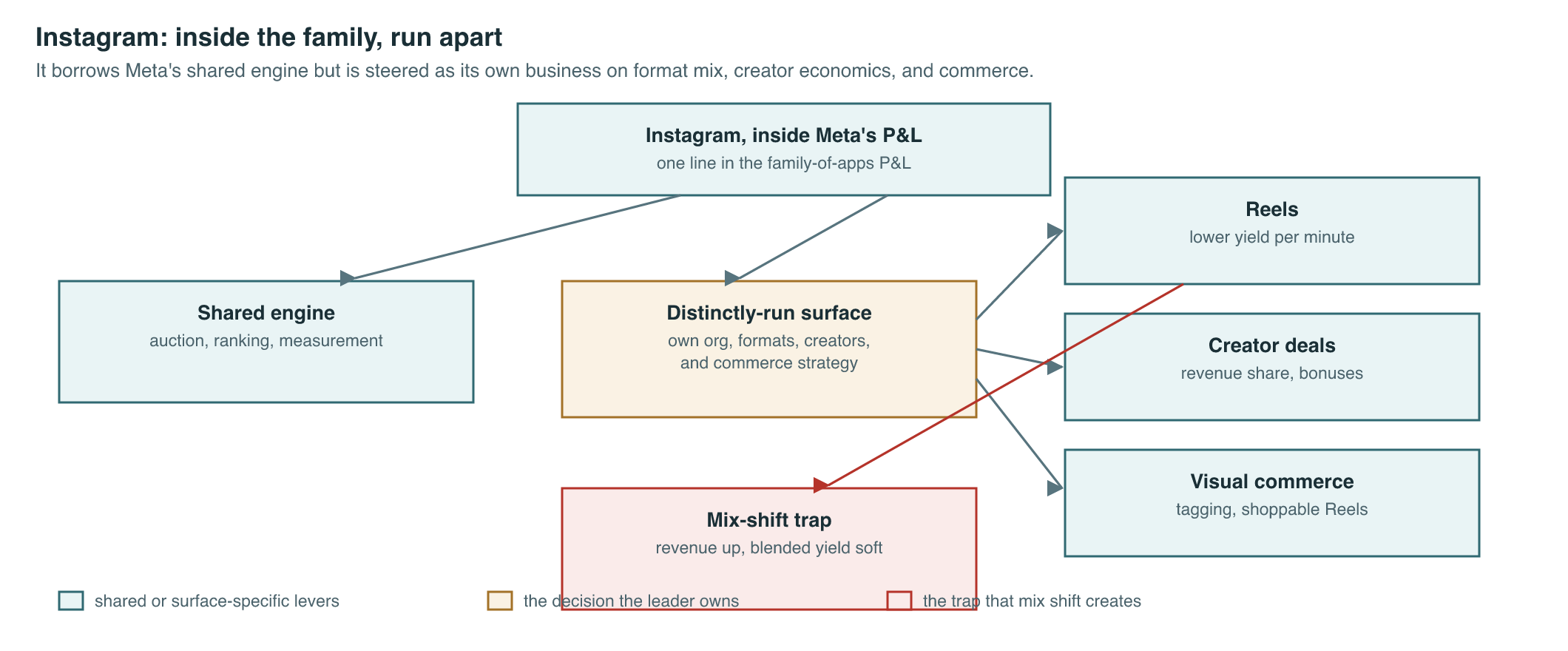
Figure 14.1 — Instagram as a surface that is both inside and apart. It borrows Meta’s shared engine but is steered as its own business on the three levers the leader owns — format mix, creator economics, and commerce — which is exactly where the mix-shift trap lives.
Why “distinctly run” is the real decision
The fact that registers first is organizational, not financial: Instagram is run by its own head (Adam Mosseri), who oversees the app’s engineering, product, and operations as a distinct org inside Meta. That is not cosmetic. It means Instagram makes its own calls on format mix, creator programs, and commerce surfaces while renting the shared monetization engine — the auction, the Andromeda/GEM ranking stack, the CAPI/AEM measurement spine — from the layer Chapter 13 described.
This is the generalizable lever for any multi-surface leader, and it is a portfolio-of-surfaces decision — how much monetization autonomy to grant a surface versus how much to centralize for scale economics. Centralize everything and you get one efficient engine but you blunt a surface’s ability to fight a format-specific war (Reels vs TikTok is not the same war as Feed vs Google). Decentralize everything and you fragment the ML stack — exactly the per-surface-model fragmentation that Meta’s Lattice consolidation (ch13) was built to kill. The art is splitting the line correctly: share the engine, distinguish the business.
Instagram’s resolution is instructive. It shares the auction and the models — there is no separate “Instagram auction” with a different Total Value formula — but it runs its own format strategy, its own creator deals, and its own commerce experiments. The decision a leader defends is which layer to hold in common. The rule that falls out: share what scales with compute (ranking, retrieval, measurement); distinguish what scales with the surface’s specific user and creator behavior (format, supply incentives, commerce UX).
The why behind this split: the engine’s advantage is a function of capital and data scale, so fragmenting it destroys value. A surface’s trust and supply advantages are functions of how well it serves that surface’s creators and shoppers — and those do not transfer across formats.
The mix-shift trap — growing the surface that yields less
Return to the trap, because it is the most board-relevant idea in the chapter and the one an IC will never surface. Reels is winning the engagement war: it is most of Instagram’s ad impressions and a primary driver of time-on-app. But short-form video monetizes worse per minute than the static-and-carousel Feed — fewer, lower-priced break opportunities, and an attention mode (lean-back scrolling) that converts worse than the lean-forward Feed. So as engagement migrates from Feed to Reels, the platform can post the following all at once: impressions up, total revenue up, engagement up — and blended yield (price per impression) flat or soft.
This is the leader’s version of a problem ICs cannot see, because every individual dashboard looks healthy. The fix is not to stop Reels — engagement that leaves for TikTok is gone forever, and that is the worse outcome. The fix is to underwrite the yield-closing roadmap as deliberately as the engagement roadmap: drive Reels’ monetization efficiency toward Feed’s (Meta has repeatedly framed this as a multi-year “parity” project, with the GEM ranking model cited as delivering up to ~5% conversion lift on Reels — ch13) while accepting a transition period where you are knowingly trading near-term yield for defended engagement.
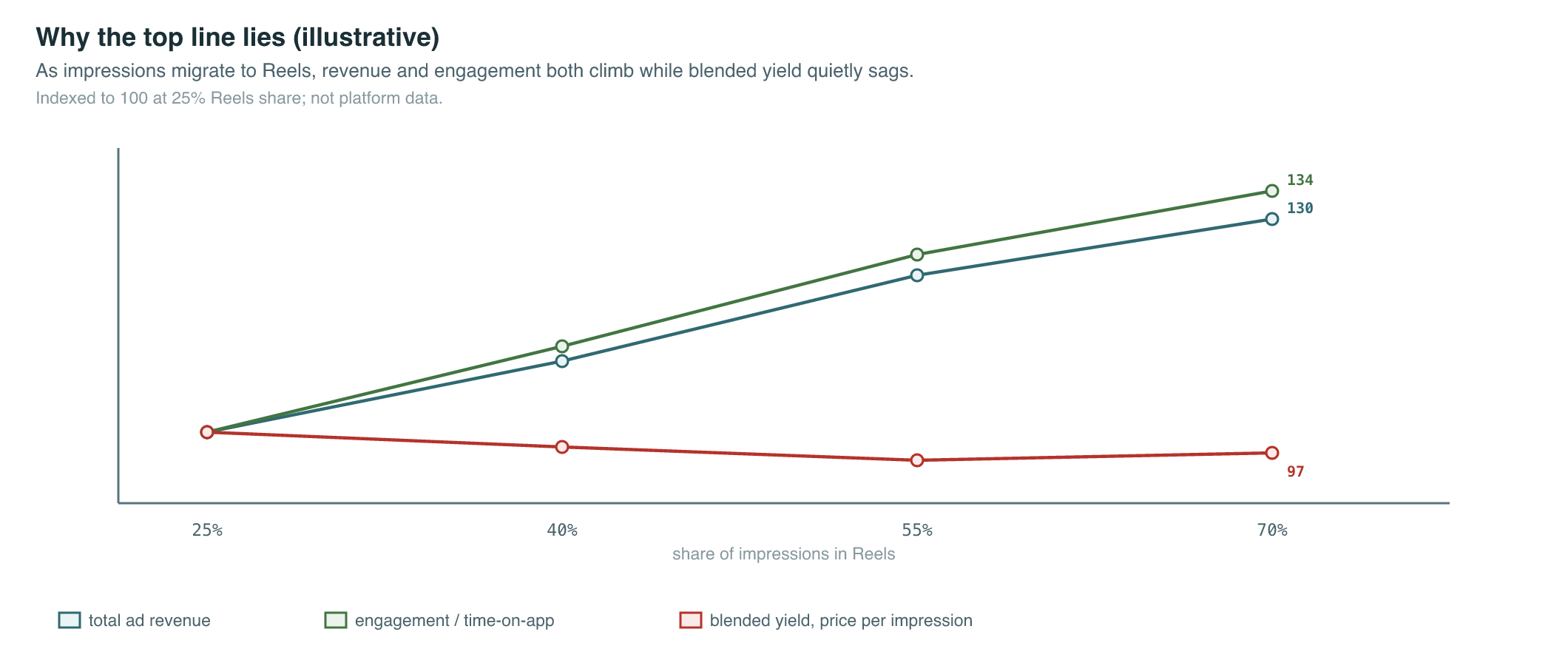
Figure 14.2 — Why the top line lies (illustrative). As impressions migrate to the lower-yield surface, total revenue and engagement both climb while blended yield sags — until the parity roadmap (closing Reels’ yield gap) bends the yield line back up. The leader’s job is to fund that bend, not to halt the migration.
The framing you take to the board is the ARPP decomposition from Chapter 2: this surface grows ARPP through engaged-person growth and impression volume, not through price, for a defined transition window — and here is the dated milestone at which the yield gap closes. Said that way, soft blended yield is a managed investment, not a leak.
Creator economics as supply-seeding, not a cost line
The second distinctly-run lever is creators, and here Instagram’s history is a clinic in how not to and then how to seed a two-sided supply market against a better-funded rival.
The relevant primitives: Instagram pays Reels creators a 55% share of the ad revenue earned against their content (Meta creator docs / industry reporting, 2025), and runs invite-only bonus programs — successors to the original Reels Play Bonus — now active mainly in the US and South Korea (Meta Business Help Center, 2025). The strategic point is not the percentages; it is the posture. A revenue share and a bonus pool are not a cost line to be minimized. They are supply-seeding investment — the price of pulling the creative supply that feeds the auction onto your surface instead of onto TikTok’s.
Instagram learned this the hard way by oscillating. It launched native affiliate commerce, then shut it down in August 2022; removed the dedicated Shop tab from the navigation in early 2023 and ended live-shopping product tagging in March 2023; and wound down the “Ads on Profile” program that paid creators for ads on their profiles in early 2025 (TechCrunch / Retail Dive / Business Insider, 2022–2025). Each retreat ceded ground to TikTok, whose TikTok Shop closed-loop GMV and creator-marketplace flywheel (ch16) built a multi-year lead in turning creators into a commerce supply, not just a content supply. Then, in late March 2026, Instagram re-entered: head Adam Mosseri announced creators can tag affiliate products directly in Reels and earn commissions, adding up to 30 products to a single Reel by pasting a URL or searching a brand’s verified Meta commerce catalog (Instagram / netinfluencer / Affiverse, 2026; fast-moving — re-verify).
The leader’s lesson is about commitment under a take-rate decision. Seeding a creator/commerce supply (ch12’s land grab) only works if creators believe the program will still exist next year; Instagram’s stop-start history is itself a trust cost that a competitor with a stable, well-funded loop exploits. A take rate you keep reversing is worse than a higher one you hold. The call Maya draws from this: set the creator economics where you can sustain them through a downturn, because supply that leaves over a discontinued program is the most expensive kind to win back.
FIGURE 14.3 (spec): A timeline ribbon, left-to-right, of Instagram’s commerce posture. Markers: “Aug 2022 — native affiliate shut down,” “Early 2023 — Shop tab removed; live-shopping tagging ended Mar 2023,” “Early 2025 — Ads-on-Profile program ended,” “Mar 2026 — in-Reel affiliate tagging relaunched (up to 30 products).” Beneath, a parallel rising line labeled “TikTok Shop GMV / creator-commerce lead.” Caption: “Every retreat widened a rival’s lead; the re-entry is years behind. Stop-start is a trust cost.” Alt-text: “Timeline showing Instagram repeatedly launching and shutting commerce features while TikTok’s commerce lead grows.”
Visual commerce — the surface’s native advantage, under-monetized
Instagram’s structural edge is that it is a visual discovery surface — users arrive in a browsing, aspirational mindset, the same intent that makes Pinterest lower-funnel without behavioral tracking. Shoppable, taggable visual content should be the most natural closed loop in the family of apps. That it is not the dominant social-commerce loop — TikTok Shop holds the larger share of US social-shopping GMV (ch16) — is the clearest evidence that owning the right surface does not automatically win the commerce on it.
The leader’s decision here ties straight back to Chapter 12’s build-vs-buy on commerce: how deep into the transaction to go. A tagging layer (link out, attribute the sale, take a thin or zero commission to seed supply) is cheap and protects the ad business; a full checkout loop (own the transaction, the purchase data, the take rate) is the defensible closed-loop asset but demands fulfillment, payments, and a creator-commerce flywheel Instagram has repeatedly failed to sustain. Instagram’s 2026 re-entry is deliberately the lighter version — tagging and affiliate attribution rather than a rebuilt in-app Shop — which is a defensible call if you hold it, and a fifth false start if you do not.
The capability to keep separate: shoppable visual commerce is the surface’s native monetization advantage, but it is currently a strategic under-build, not a solved business. A leader who inherits Instagram’s seat owns the question of whether to finally commit capital to the closed loop or to settle for being the high-intent discovery layer that hands the transaction to someone else.
Same-Lever Scorecard
The lever this chapter isolates: how distinctly is a fast-growing visual/short-form-video surface run as its own monetization business — and how committed is its creator-commerce loop? Figures dated and hedged inline.
| Platform | The distinctly-run surface | Format mix-shift dynamic | Creator/commerce loop posture | Tell for the leader |
|---|---|---|---|---|
| Meta / Instagram | Instagram (own head/org; shares Meta’s auction + ML + measurement) | Reels >50% of IG ads in 2025 (vs ~35% 2024); lower yield/min than Feed (CNBC, Jan 2026; Zuckerberg commentary — directional) | Stop-start: affiliate killed 2022, Shop tab gone 2023, re-entered in-Reel tagging Mar 2026 | The mix-shift trap and an un-held commerce posture in one surface |
| Not a visual/creator-commerce surface; B2B feed | No short-form mix shift; thought-leader/creator posts as premium supply | No commerce loop; creator supply = exec voice, not sellers | Shows the lever is surface-specific — there is no commerce war to fight here | |
| TikTok | The whole app is short-form video; TikTok Shop is the loop | Born short-form; no Feed-to-Reels yield drag to manage | Best-funded, most committed creator-commerce loop (TikTok Shop GMV lead) | The benchmark Instagram’s creator strategy is reacting to |
| Google / YouTube | Shorts (the Reels analog inside YouTube) | Shorts monetizes below long-form/CTV — same mix-shift trap, different surface | YouTube Shopping affiliate; creator rev-share heritage | Same yield-dilution problem, managed inside a blended ads+subs P&L |
| Amazon | Not creator-led; commerce is the surface | No engagement-to-video mix shift | Owns the transaction outright — the closed loop Instagram lacks | The opposite extreme: commerce-first, creator-light |
| Pinterest (wildcard) | Visual discovery, planning/buying intent | Lower-funnel by intent without behavioral tracking | Performance+ shopping; intent without a heavy creator loop | Proof the visual-intent edge is real — and still under-monetized industry-wide |
Decision or Diagnostic?
Sort the chapter’s metrics. The leader owns the surface’s business posture; the IC tunes the format performance.
| Decision (board / leader owns) | Diagnostic (IC / launch-review owns) |
|---|---|
| How distinctly to run the surface — which engine layers to share vs which business levers to localize | Reels vs Feed eCPM gap — the per-format yield delta the ranking team is closing |
| The mix-shift / yield-closing roadmap — funding parity while defending engagement, with dated milestones | Per-format completion / view-through rates — operational, monitored at the launch desk |
| Creator economics posture — revenue share, bonus pool size, affiliate take rate as sustainable supply investment | Bonus-program payout per creator / cohort retention — program-management diagnostics |
| Commerce depth — tag-and-attribute vs own-the-checkout closed loop | Shoppable-tag click-through / catalog match rate — UX and integration metrics |
| Blended-ARPP framing — defending soft yield as a managed transition to finance and the board | Single-creator or single-campaign ROAS on Reels — account-level, not a board number |
The leader’s call. The trade-off you own on Instagram is how distinctly to run a surface whose engagement is migrating to a lower-yielding format while a better-funded rival owns the commerce loop. The trap is the top line: total revenue, impressions, and engagement can all climb while blended price-per-impression sags, and only a leader watching the ARPP decomposition will see the mix shift compressing yield. Meta resolved the first half well — it shares the engine (one auction, Andromeda/GEM, CAPI/AEM) while letting Instagram run its own head, format mix, and creator strategy, and it funds the Reels-to-Feed yield-parity roadmap as a deliberate multi-year investment rather than halting the engagement migration that would otherwise leak to TikTok. It resolved the second half badly: a stop-start commerce posture — native affiliate killed in 2022, the Shop tab removed in 2023, the profile-ad bonus ended in 2025, then in-Reel affiliate tagging relaunched only in March 2026 — handed TikTok a multi-year creator-commerce lead that a stable loop would not have ceded. Four quarters out: fund the yield-parity roadmap and hold a creator-commerce posture you can sustain through a downturn, and the lower-yield surface becomes defended, monetizable engagement that compounds blended ARPP; treat creator economics as a cost line to trim and keep reversing the commerce strategy, and you train your supply to distrust you and watch it — and its shoppers — settle on the rival whose loop never blinked. The surface is run as its own business; the trust you build with its creators is the asset, and it is the slowest one to rebuild.
Key terms
| Term | One-line definition |
|---|---|
| Distinctly-run surface | A surface (Instagram, YouTube Shorts) given its own head, format, and creator/commerce strategy while sharing the parent’s monetization engine. |
| Mix-shift trap | When engagement migrates to a lower-yield format, lifting total revenue and impressions while blended price-per-impression flattens or falls. |
| Yield-parity roadmap | The multi-year project to raise a lower-yielding format’s monetization efficiency (Reels) toward the surface it cannibalizes (Feed). |
| Creator revenue share | The cut of ad revenue paid to creators against their content (Instagram Reels: ~55%) — a supply-seeding investment, not a cost line. |
| Bonus program | Invite-only, region-limited direct payments to creators (successor to Reels Play Bonus) used to pull creative supply onto the surface. |
| Affiliate tagging | The lighter commerce loop — tag products in content, attribute the sale, take a thin/zero commission — vs owning full checkout. |
| Visual commerce | Shoppable, taggable content on a high-intent discovery surface; Instagram’s native edge, currently under-built relative to TikTok Shop. |
| Supply-seeding | Spending (share, bonuses, low take rates) to pull two-sided creator/seller supply onto a surface — only works if the commitment is held. |
Recap & what is next
- Instagram is the book’s cleanest case of a surface run as its own business inside a shared garden — it shares the engine (auction, Andromeda/GEM, CAPI/AEM) but distinguishes the business (own head, format mix, creator deals, commerce), and the leader’s real call is which layer to hold in common.
- The mix-shift trap is the board-level idea no IC surfaces: Reels grew to more than half of Instagram’s ad impressions while monetizing worse per minute than Feed, so total revenue and engagement can rise while blended yield sags — managed by funding a dated yield-parity roadmap, not by halting the migration.
- Creator economics are supply-seeding investment, not a cost line — a revenue share (~55%) and bonus pools are the price of pulling creative supply off TikTok, and only work if the commitment is held.
- Instagram’s stop-start commerce history (affiliate killed 2022, Shop tab gone and live-shopping tagging ended 2023, Ads-on-Profile ended 2025, in-Reel tagging relaunched 2026) is a self-inflicted trust cost that handed a rival a multi-year creator-commerce lead — a take rate you keep reversing is worse than a higher one you hold.
- Visual commerce is the surface’s native, under-monetized advantage: owning the high-intent discovery surface does not automatically win the transaction on it, and the leader owns the choice between tag-and-attribute and own-the-checkout.
- Sort the metrics: how-distinctly-to-run, the yield roadmap, creator posture, commerce depth, ARPP framing are yours; eCPM gaps, view-through rates, payout-per-creator, tag click-through belong to the launch desk.
Instagram showed you a B2C visual surface run as its own business under a parent’s shared engine. The next surface inverts almost every assumption — a platform whose moat is not visual reach but a verified professional graph, whose buyers are committees not consumers, and whose measurement problem is proving pipeline over months, not clicks over days. Chapter 15 — LinkedIn takes you into the B2B walled garden: why declared professional attributes are a deterministic first-party moat, how Revenue Attribution and Accelerate reshape the call, and what the Microsoft flywheel compounds that no B2C platform can copy.