The promise. Chapter 15 closed on LinkedIn — a garden that wins by narrowing: a verified professional graph, premium CPMs, a few high-value buyers, and a measurement product that ties spend to closed revenue. TikTok is the mirror image. It wins by widening: a recommendation engine so good at holding attention that it turned a 500M-then-billions-strong entertainment feed into a performance-and-commerce machine in under five years, on a thin identity graph and almost no declared targeting data. This chapter equips you to make the call a leader at — or competing with — an entertainment-first platform must make: how far to fuse the content feed, the automated buying stack, and an owned transaction into one closed loop, and how to underwrite that loop when the platform’s continuity itself sits behind a regulatory question. It is the chapter where the engagement-vs-extraction trade-off from Chapter 8 collides with the closed-loop commerce land grab from Chapter 12, on a single surface, under a divestiture overhang no other major faces.
You will be able to:
- Decide how much of the buying stack to fold into one automated black box (Smart+) and what module-level control to re-expose when advertisers revolt.
- Reason about why an entertainment recommendation engine, not a targeting graph, is TikTok’s moat — and what that means for measurement and signal.
- Defend a commerce-attached ad business (TikTok Shop, live commerce) as a structurally distinct, higher-defensibility revenue pool than feed ads alone.
- Reason about Pangle and off-platform extension as reach you must govern, not free inventory.
- Decide how to price the continuity risk of a platform whose US ownership — its single most valuable ad market — is set by a joint venture and a retrained algorithm.
Builds on: Book 1 ch3 (the real-time auction), ch5 (the yield curve), ch6 (commerce and the closed loop); Book 2 ch4 (the auction as policy — Total Value, oCPM, autobidders), ch8 (the automation frontier — Smart+/Advantage+/PMax), and ch12 (the closed-loop commerce land grab — GMV, take rate, creator supply). It runs parallel to ch13 (Meta) and ch15 (LinkedIn) as the entertainment-and-commerce counterweight in Part IV.
The call on Maya’s desk
Maya is not running TikTok — but her board has read the trade press, and the question lands on her desk anyway: “TikTok grew its global ad business ~40% to roughly $33B in 2025 with almost none of our declared-data targeting. Why can’t we?” (GroupM/eMarketer, 2025–2026; vendor-reported, re-verify). She has eighteen months of pattern-matching behind her now, and she knows the honest answer is uncomfortable: TikTok did not out-target her. It out-recommended her, then bolted a store and an autobidder onto the same engine. The lesson she has to bring back to her board is not “copy their targeting.” It is “understand what they actually monetize.”
This is the chapter’s argument in one sentence. TikTok is not a social network with ads; it is an entertainment recommendation engine that monetizes the same attention three ways at once — feed ads priced by an auction, automated performance buying through Smart+, and an owned transaction through TikTok Shop — and the strategic question for any leader is how tightly to fuse those three, given that fusion raises both defensibility and the cost of any single shock to the system.
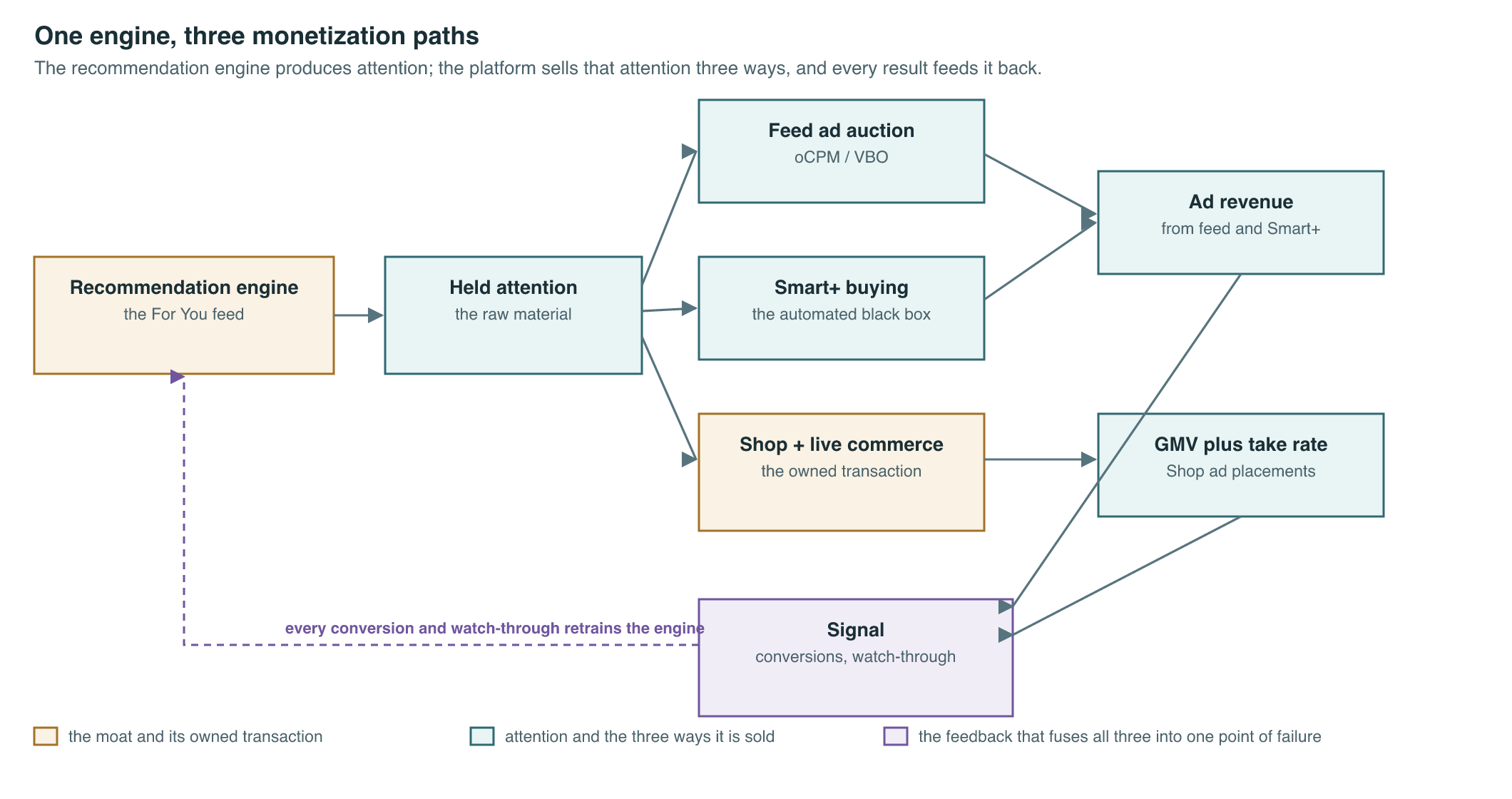
Figure 16.1 — One engine, three monetization paths. The recommendation engine produces attention; the platform sells that attention as feed ads, as automated outcomes, and as transactions — and every conversion and watch-through feeds back to make the engine better. The fusion is the strength and the single point of failure.
The moat is the recommendation engine, not the targeting graph
In Chapter 5 you learned that durable advantage migrated from the identity/targeting graph to the ML stack. TikTok is the cleanest proof of that thesis on the demand side of attention. Meta and Google were built on knowing who you are — the social graph, the search query, declared and inferred attributes. TikTok was built on knowing what holds you — a content recommendation system that learns from watch-through, replays, and skips, on a near-anonymous cold start. It never needed a rich declared-data graph because the feed itself is the targeting: serve the content, watch the signal, refine. That is why TikTok could scale a performance ad business without the kind of identity infrastructure LinkedIn or Meta lean on.
For the leader, this reframes the term recommendation moat — durable advantage that lives in the quality of content ranking and the engagement signal it generates, rather than in a stock of identity data. It has two consequences you must internalize:
First, it makes TikTok’s ad targeting unusually creative-led. Because the engine reads the content and the audience reaction rather than a declared profile, the creative is the targeting — which is why TikTok’s GenAI creative suite (next section) is not a productivity add-on but a core monetization lever.
Second — and this is the strategic vulnerability — the moat is portable in principle but not in practice. The recommendation model is the asset, and the US joint venture (covered at the end of this chapter) requires it to be retrained on US-only data under a new owner. A targeting graph degrades gracefully; a recommendation engine retrained on a narrower data set is a genuine performance unknown. The thing that is the moat is also the thing the regulator can force you to rebuild.
Smart+ — how much of the stack folds into one box
TikTok’s automation product, Smart+ (its Advantage+/Performance Max analog — a fully automated campaign type that bundles targeting, bidding, creative selection, and placement behind a single objective), launched late 2024 and has scaled the way Chapter 8 said automation always does: faster than the manual cohort wants to admit. Smart+ rose from roughly 9% of US TikTok performance campaigns at the start of 2025 to ~42% by late 2025 (eMarketer citing Tinuiti client data, Oct 2025; vendor/agency-reported, re-verify). That is the quadrupling-in-a-year curve you saw in the automation chapter, on a different garden.
The auction underneath is the one you already know from Chapter 4: default optimization is oCPM (optimized cost-per-mille — bidding toward a conversion or install event rather than a raw impression), with Value-Based Optimization (bidding toward conversion value — Highest Value, Target ROAS) layered on top. The leader’s tell is where the highest-intent bidding lives: Target ROAS for app campaigns is available only inside Smart+ (TikTok Ads Manager Help, 2025). That is the same gating move Meta and Google use — reserve your best optimization for your most automated product, so adopting the black box is the price of admission to the best performance.
The interesting part for a leader is what happened after the adoption curve. In October 2025 TikTok added module-level controls to Smart+ — letting advertisers selectively automate targeting, budget, creative, or placement instead of accepting all-or-nothing (TikTok Newsroom / Social Media Today, Oct 2025). This is the automation-frontier decision from Chapter 8 playing out in real time: push the black box hard to win adoption, then re-expose control surfaces when the loss-of-control backlash threatens trust. The leader’s lesson is not “automate everything.” It is sequence the trust: default into automation to capture the efficiency and the lock-in, then give back exactly enough control to keep your best advertisers from feeling blind.
FIGURE 16.2 (spec): A two-state Smart+ campaign-builder UI mockup. Left state (“All-in, pre-Oct 2025”): a single toggle “Smart+ ON” with greyed-out, locked targeting/creative/placement/budget panels. Right state (“Modular, post-Oct 2025”): the same four panels each with its own independent Auto / Manual switch — Targeting=Auto, Creative=Manual, Placement=Auto, Budget=Manual. Caption: “The automation walk-back: TikTok defaulted advertisers into the box to win 9%→42% adoption, then re-exposed module-level control to recover the trust of performance marketers who felt blind.” Alt-text: “Mockup contrasting an all-or-nothing Smart+ toggle with a later four-module per-lever Auto/Manual control panel.”
Symphony — the creative engine that feeds the black box
Once Smart+ eats the targeting and bidding levers, creative becomes the binding constraint (Chapter 9’s whole argument). TikTok’s answer is Symphony, its GenAI creative suite — text-and-image-to-video generation, an AI assistant for TikTok-first ad creation, AI dubbing across 15+ languages (with Ads Manager automatic-enhancement translation reaching 50+; TikTok-reported, 2025), and Digital Avatars: Stock and Custom synthetic actors, including licensed-likeness avatars in 30+ languages and Product/Showcase avatars that demo how an item is worn or used (TikTok Newsroom / VentureBeat, 2024–2025). Symphony is wired to ByteDance’s own video models (Seedance/Dreamina).
Read this at altitude, not as a feature list. On TikTok, where the creative is the targeting, collapsing the cost of producing native, on-trend short-form video is a direct lever on auction value: more creative variants feed the recommendation engine more to test, which raises predicted action rates, which raises clearing prices. The pairing with Spark Ads — boosting organic or creator posts as native in-feed ads while engagement stays on the original post — is the same idea from the supply side: use proven organic content as ad creative rather than manufacturing it cold. TikTok cites large completion- and view-through-rate advantages for Spark Ads over standard in-feed (TikTok-reported, ~134% higher completion / ~157% higher 6s VTR; treat as vendor-reported).
The leader’s call here is the one from Chapter 9: when creative volume is effectively free, brand safety and likeness governance become the scarce resource. Synthetic avatars and AI dubbing are exactly where a single likeness or brand-safety failure becomes a trust cliff. The cheap-creative win is real; the guardrail bill comes due.
TikTok Shop — the owned transaction is a different P&L
This is where TikTok diverges hardest from Meta’s playbook and earns its “commerce engine” half. TikTok Shop is the in-app, closed-loop commerce funnel — discovery in the feed, checkout in the app, with live shopping on top. It is not a social-commerce experiment; it is the category leader. TikTok Shop holds roughly 68% of US social-shopping GMV (eMarketer, 2025), and its scale is now material in absolute terms: global GMV reached ~$64B in 2025 (+~94% YoY), with US GMV ~$15.1B (+68% YoY) (Momentum Works / Low Down report, Dec 2025; vendor-reported, re-verify).
The leader-altitude point — connecting straight back to Chapter 12 — is that an owned transaction is a structurally different and more defensible revenue pool than feed ads. Three reasons:
- Closed-loop attribution. When the click, the watch, and the purchase all happen inside the app, you do not have the signal-loss problem that haunts off-platform measurement (Chapter 10). The conversion is observed, not modeled. That makes Shop-attached ad placements unusually high-quality inventory — and TikTok Shop ad placements are themselves a growing line, projected to contribute on the order of $4.7B of TikTok’s 2026 global ad revenue (GroupM/eMarketer, 2026 forecast; re-verify).
- A second revenue mechanic. A take rate on GMV is a different dollar than a CPM. It grows with commerce, not with ad load, which means it lets the platform grow revenue without pushing more ads into the feed — the engagement-protecting move from Chapter 8.
- First-party purchase data. Every transaction enriches the recommendation engine’s signal, tightening the loop in Figure 16.1.
But Maya should also name the cost honestly to her board, because it is the cost of any commerce build (Chapter 12): owning the transaction means owning fulfillment friction, seller quality, refunds, and counterfeit risk — operational liabilities a pure ad platform never touches. TikTok Shop’s GMV is real; so is the support burden behind it. The build-vs-stay-pure-ads decision is exactly the one Chapter 12 framed, and TikTok chose to build.
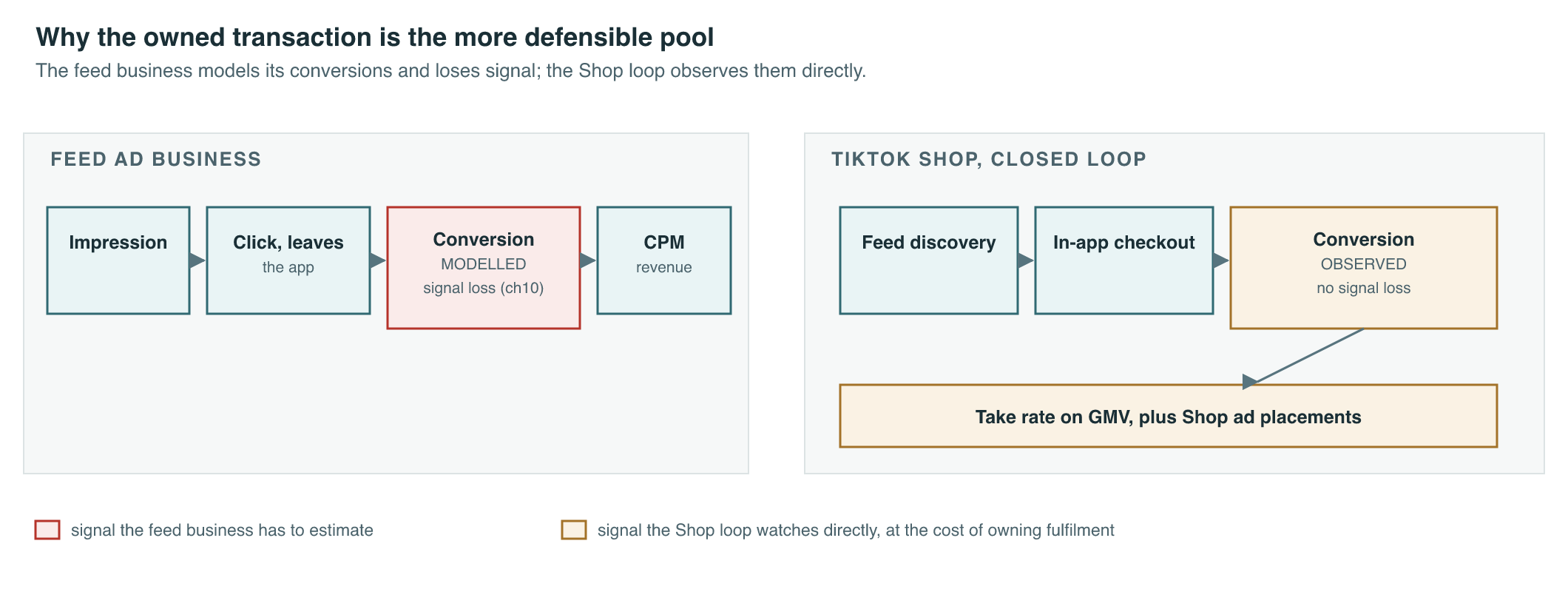
Figure 16.3 — Why the owned transaction is the more defensible pool. The feed business models its conversions and loses signal; the Shop loop observes them and earns a second, ad-load-independent revenue mechanic — at the cost of owning fulfillment and seller risk.
Pangle and attribution — reach you govern, signal you build
Two supporting decisions round out the stack. Pangle is TikTok’s off-platform mobile audience network (its Meta Audience Network / Google network analog), extending advertiser reach across a stated 380,000+ apps and publishers (Pangle / TikTok Ads Manager Help, 2025). The leader’s posture here is the one from Chapter 7 (quality and integrity): network reach is not free inventory, it is reach you must govern — publisher and block lists, invalid-traffic controls, and inventory filters are mandatory, because off-platform supply is where brand-safety and IVT problems concentrate and where a quietly bad placement erodes the trust the owned feed worked to build.
On attribution, TikTok’s stack mirrors the post-signal-loss table stakes from Chapter 10: the client-side TikTok Pixel paired with the server-side Events API / Conversions API, using event_id deduplication and hashed PII for cross-device matching (TikTok For Business docs, 2025), on a default 7-day-click / 1-day-view window. There is nothing exotic here, and that is the point: the durable measurement layer is the same server-side, match-quality discipline every garden now runs. For a platform whose ownership and data custody are in flux (next section), that first-party signal infrastructure is also the resilience layer — under-invest in it and any data-governance disruption from the JV caps Smart+ and VBO performance.
The overhang — pricing continuity risk when the US is the whole game
No other major in this book carries TikTok’s structural risk, and a leader must price it explicitly rather than wave at it. The reason it is existential is concentration, the Chapter 2 lesson in its sharpest form: the US is ~10% of TikTok’s global users but ~41% of its worldwide ad revenue — a US user is worth roughly 4× the global average (eMarketer, 2025). US TikTok ad revenue was on the order of ~$11–12B in 2025, with 2026 forecasts spanning ~$13.4B–$17B+ depending on source (WARC ~$11.8B 2025 / ~$14.5B 2026; eMarketer 2026 US estimate runs higher, $17B+; forecasts diverge — re-verify). The platform’s most valuable profit pool is the one the regulator put in play.
The status, as of this writing (fast-moving — re-verify): under PAFACA (the divest-or-ban law signed April 2024), TikTok briefly went dark for ~12 hours in January 2025, then survived on extensions. A US joint venture deal was signed December 18, 2025 and closed January 22, 2026, forming TikTok USDS Joint Venture LLC — roughly 80.1% US-owned, with a new-investor consortium (Oracle, Silver Lake, and MGX each holding ~15%) at ~50%, affiliates of existing ByteDance investors at ~30.1%, and ByteDance retained at 19.9% (just under the 20% threshold the law requires). Oracle is the designated security partner for US data custody, and — the term that matters most for advertisers — the recommendation/ad algorithm is to be replicated and retrained under US jurisdiction (Variety, CNN, ABC, ITIF, CNBC, Dec 2025 – Mar 2026).
For the leader, the JV closing lowers near-term ban risk versus 2025 — that is the good news to bring to a board. But it raises a subtler, performance-level question that account teams should be pressed on before committing 2026 budgets: a retrained, US-data-only algorithm under new ownership is a delivery and measurement unknown. The moat (the recommendation engine) is precisely the asset being rebuilt. Maya’s framing to her board: the binary ban risk fell, but a continuity-of-performance risk replaced it — so we treat US TikTok as high-ROI but underwritten with a portable-creative contingency that can move to Reels/Shorts, not as a bet we cannot exit.
Same-Lever Scorecard
How the majors set the same dial — how tightly they fuse the content feed, automated buying, and an owned transaction into one closed loop. Figures dated and hedged inline.
| Platform | Core moat | Automation product | Owned transaction | Tell for the leader |
|---|---|---|---|---|
| TikTok | Recommendation engine (content, not identity) | Smart+ (~9%→~42% of US perf campaigns in a year; Tinuiti, Oct 2025) | TikTok Shop — ~68% US social-shopping GMV; ~$64B global GMV 2025 (vendor-reported) | Tightest content+buying+commerce fusion of any major — highest defensibility, highest single-shock risk (the JV) |
| Meta | ML stack (Andromeda/GEM) + identity graph | Advantage+ (ASC ~$20B+ run-rate) | Shops/checkout — present but commerce is not the engine | Fuses feed+automation deeply; commerce loop weaker than TikTok’s |
| Verified professional graph | Accelerate (~5-min build) | None — pipeline/revenue is the “transaction” (RAR) | Wins by narrowing; no commerce loop, premium B2B price instead | |
| Google / YouTube | Search intent + largest video | Performance Max / AI Max | YouTube Shopping affiliate — partner, not owned checkout | Bundles surfaces in PMax; commerce is referral, not owned |
| Amazon | First-party purchase data | DSP + automated Sponsored Ads | The transaction is the platform | The inverse of TikTok — commerce-first, attention-second |
| Pinterest (wildcard) | Commerce/planning intent | Performance+ | Shopping intent, partner checkout | Lower-funnel by mindset; sub-scale automation analog |
Decision or Diagnostic?
Sort the chapter’s metrics by who owns them. The leader sets the fusion policy; the IC tunes the knobs inside it.
| Decision (board / leader owns) | Diagnostic (IC / launch-review owns) |
|---|---|
| Fusion depth — how tightly to bind feed, Smart+, and Shop into one loop | Smart+ adoption rate of a given advertiser’s campaigns |
| Commerce build vs stay-pure-ads — own the transaction (Shop) and its fulfillment liability, or not | TikTok Shop GMV / take-rate per category (operational, monitored at the desk) |
| Continuity-risk underwriting — how much US-concentrated revenue to bet given the JV/retrained-algorithm unknown | oCPM clearing price / VBO Target-ROAS attainment per campaign |
| Module-control policy — how much of the Smart+ black box to re-expose to protect advertiser trust | Event Match Quality / Pixel+Events-API dedup rate — the signal-completeness diagnostic |
The leader’s call. The trade-off you own on an entertainment-first platform is fusion depth: how tightly to bind the content feed, the automated buying stack, and an owned transaction into one closed loop. Fusion is the source of both TikTok’s defensibility — closed-loop attribution, a GMV revenue mechanic independent of ad load, and a recommendation engine that gets better with every purchase — and its fragility, because the very asset that is the moat (the algorithm) is the thing a regulator can force you to rebuild, and the very market that is most of the revenue (the US, ~41% of worldwide ad dollars on ~10% of users) is the one put in play. TikTok resolved the automation half by defaulting advertisers into Smart+ to capture the 9%→42% adoption curve, then re-exposing module-level controls in October 2025 to recover the trust of marketers who felt blind — sequence the trust, don’t surrender it. It resolved the commerce half by building TikTok Shop into the category leader (~68% of US social-shopping GMV) and accepting the fulfillment-and-seller liability that a pure ad platform never carries. Four quarters out: fuse well and you compound ARPU through a second, engagement-protecting revenue mechanic while the recommendation loop tightens; misjudge the continuity risk — over-index on a US pool whose retrained algorithm under-delivers — and you discover that the most defensible loop in the industry was also the most exposed to a single, non-market shock. Underwrite TikTok as high-ROI with a portable-creative exit, not as a bet you cannot leave.
Key terms
| Term | One-line definition |
|---|---|
| Recommendation moat | Durable advantage living in content-ranking quality and engagement signal, not in a stock of identity/targeting data — TikTok’s core asset. |
| Smart+ | TikTok’s fully automated campaign type (its Advantage+/PMax analog) bundling targeting, bidding, creative, and placement; gates Target ROAS for app inside itself. |
| oCPM / VBO | Optimized cost-per-mille (bidding to a conversion event) and Value-Based Optimization (bidding to conversion value); the auction layer beneath Smart+. |
| Symphony | TikTok’s GenAI creative suite — text/image-to-video, AI dubbing, and synthetic-actor Digital Avatars — feeding the recommendation engine more creative to test. |
| Spark Ads | Boosting organic/creator posts as native in-feed ads while engagement stays on the original post; proven content as ad creative. |
| TikTok Shop | The in-app closed-loop commerce funnel (feed discovery → in-app checkout, plus live shopping); an owned transaction and a second revenue mechanic. |
| Closed-loop attribution | When click, watch, and purchase all occur in-app, the conversion is observed rather than modeled — higher-quality, signal-loss-resistant inventory. |
| Pangle | TikTok’s off-platform mobile audience network; reach to govern with block lists and IVT controls, not free inventory. |
| The overhang | The US JV / divestiture / retrained-algorithm risk on TikTok’s single most valuable ad market (~41% of worldwide revenue). |
Recap & what is next
- TikTok’s moat is the recommendation engine, not a targeting graph — it monetizes what holds you, which is why creative is the targeting and Symphony is a core monetization lever, not a productivity tool.
- The platform fuses three monetization paths on one engine — feed-ad auction, Smart+ automated buying, and TikTok Shop’s owned transaction — and fusion depth is the leader’s defining decision.
- Smart+ followed the automation curve (9%→42% of US performance campaigns in a year) and then walked control back with October 2025 module-level controls — sequence the trust, don’t surrender it.
- TikTok Shop is the more defensible pool: closed-loop attribution, a GMV/take-rate mechanic independent of ad load, and first-party purchase signal — at the cost of owning fulfillment and seller liability (the Chapter 12 build call, chosen “build”).
- Pangle is reach to govern and the Pixel + Events API stack is the same server-side measurement discipline every garden runs — both are the resilience layer for a platform in ownership flux.
- The US JV closing (Jan 2026) lowered binary ban risk but introduced a retrained-algorithm performance unknown on the platform’s most concentrated, most valuable market — underwrite it as high-ROI with a portable-creative exit.
TikTok showed the entertainment-and-commerce engine at challenger-then-scale and under a unique regulatory shock. Chapter 17 — Google & YouTube turns to the opposite pole: search intent and the largest video platform, where the decisions are Performance Max and AI Max, YouTube’s blended ads-plus-subscriptions monetization, the Privacy Sandbox reversal, and the DOJ ad-tech remedies overhang — the scale benchmark against which every other garden, including TikTok, is measured.