The promise. Chapter 24 built the org and the competitive stance — the people, the measurement-governance function, and the read on which battles to fight head-on versus decline. Now every decision you have made across this book collides in a single document. Eighteen months in, Maya does not get to make these calls one at a time anymore; the board wants one memo that re-underwrites the whole platform ad P&L four quarters forward — load and engagement, the auction’s user-value parameter, the ML-infra capital ask, the automation dial, the reported-versus-incremental ROAS governance, the privacy bets, the agentic posture, and the portfolio balance — sequenced, traded off against each other, and defended as one coherent trajectory for ARPU and advertiser trust. This chapter equips you to write that memo: to assemble twelve separate levers into one operating system, triage the initiatives, sequence the moves under live constraints, and stand in front of a board and defend the whole thing as a story, not a list. This is the leader-altitude inverse of Book 1’s capstone — there the newcomer learned to read a strategy memo; here you write one.
You will be able to:
- Assemble the prior chapters’ decisions into one board-ready, three-year plan that ties every choice to ARPU and advertiser trust.
- Decide the portfolio of moves under simultaneous live shocks — a DMA-style repricing, an automation tipping point, eroding reported ROAS, an agentic intermediary, and a commerce land grab — and sequence them.
- Reason about initiative triage with one reusable scoring frame: (projected ARPU lift × advertiser-trust durability) ÷ (regulatory + execution + cannibalization risk).
- Defend the difference, at the board, between the numbers that are decisions you own and the numbers that are IC diagnostics.
Builds on: Book 1 ch1–9 (the supply chain, auction clearing, attribution, agentic plumbing) handed back by cross-reference, never re-taught; and every prior Book-2 chapter — the price × volume P&L (ch1–3), the auction-as-policy (ch4) and the ML moat (ch5–7), the automation and generative-creative frontier (ch8–9), measurement under signal loss (ch10), privacy/antitrust posture (ch11), commerce (ch12), the platform deep-dives (ch13–21), the portfolio and agentic posture (ch22–23), and the org (ch24). It is the synthesis; it owns no new lever, only their composition.
The memo is a system, not a list
The trap of the first board memo is to write it as a list — twelve initiatives, each with its own slide, each defended on its own terms. Maya’s predecessor did exactly that and got it approved, and that is why she now has the job: a list has no internal physics. The auction’s user-value weight (ch4) and the engagement that feeds the load frontier (ch1) are the same variable seen twice; the ML-infra capital ask (ch5) only pays off if the automation dial (ch8) is turned far enough that advertisers actually consume the prediction quality it buys; the privacy fallback tier (ch11) reprices the very personalized revenue the auction is optimizing. Pull one lever in isolation and you move three others you did not budget for.
So the memo’s first job is to state the operating system — the small set of identities that link every lever — before it proposes a single move. There are three.
- The revenue identity: revenue = ad load (impressions) × yield (price per ad), run against the engagement that produces tomorrow’s impressions. Every load, auction, and automation call moves one of these three terms.
- The trust identity: advertiser trust = (delivered incremental outcomes) ÷ (reported outcomes). Govern reported ROAS as an inflated upper bound, or the ratio decays and spend follows it — the X mechanism (ch4, ch24).
- The durability identity: durable revenue = revenue × (the share that survives a privacy, antitrust, or agentic shock). A dollar of personalized-ad revenue exposed to a DMA repricing is worth less than a dollar of closed-loop commerce revenue, even at the same margin.
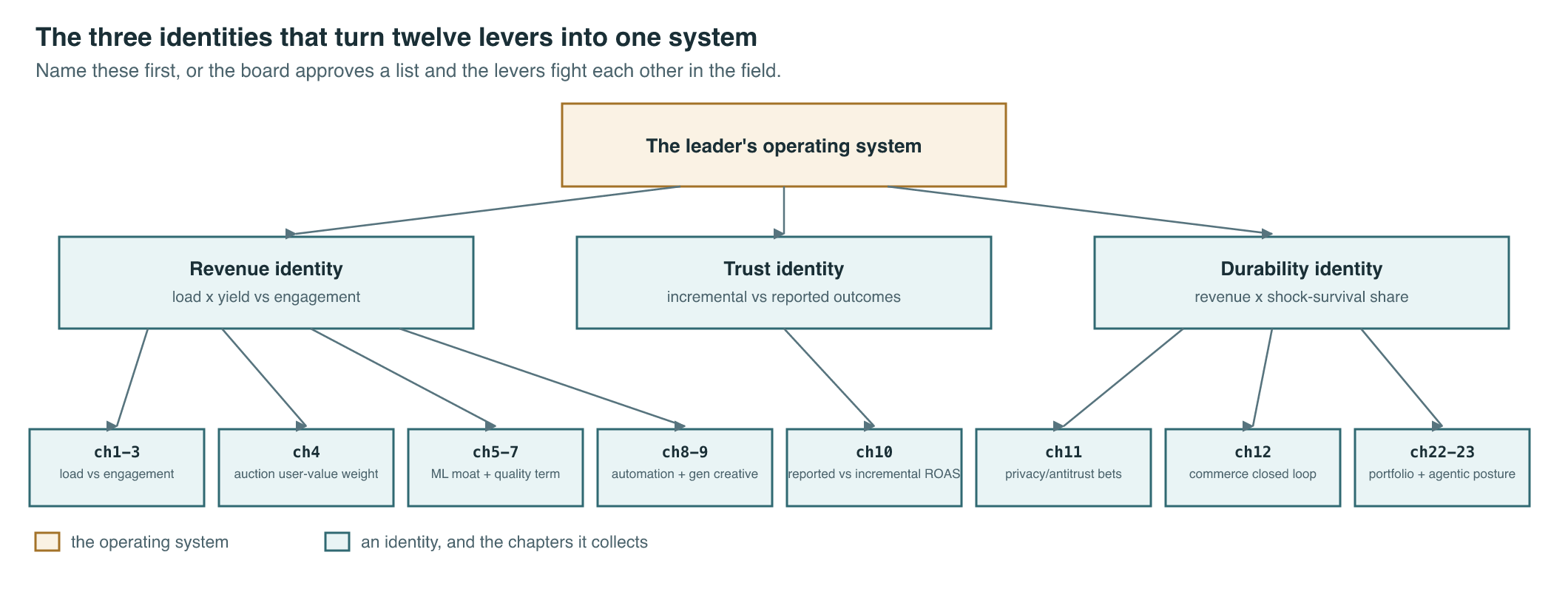
Figure 25.1 — The three identities that turn twelve levers into one system. The memo proposes moves only after it names these; otherwise the board approves a list and the levers fight each other in the field.
The triage frame: one score, ruthlessly applied
A leader cannot fund everything, and the discipline that separates her from the IC is that she ranks initiatives on a single explicit frame rather than on whichever one has the loudest sponsor. The frame, used through this book and now made the memo’s engine:
Initiative score = (projected ARPU lift × advertiser-trust durability) ÷ (regulatory risk + execution risk + cannibalization risk).
The numerator is the four-quarters-out test made arithmetic: an initiative earns its place by lifting yield and by being the kind of revenue that does not evaporate when trust or regulation moves. The denominator is the honesty discipline — it forces every initiative to carry its own downside, so the ML-infra ask cannot hide its execution risk and the commerce land grab cannot hide its cannibalization of the core feed.
FIGURE 25.2 (spec): A 2×2 triage matrix, x-axis “Risk (regulatory + execution + cannibalization)” low→high, y-axis “ARPU lift × trust durability” low→high. Plot the chapter’s moves as labeled dots: “ML-infra capital ask” upper-mid (high lift, mid risk); “Default-into-automation” upper-right (high lift, high cannibalization/trust risk); “Privacy contextual fallback tier” lower-left (defensive, low lift but high durability); “Closed-loop commerce build” upper-mid-right; “Agentic endpoint (AdCP)” mid-mid (optionality); “Push ad load +1pt” lower-right (small lift, high engagement risk — a decline). Caption: “The board memo is this picture: fund the upper-left-to-upper-mid, sequence the upper-right carefully, decline the lower-right.” Alt-text: “Two-by-two matrix triaging eight platform initiatives by ARPU-lift-times-durability against risk.”
The score is not a spreadsheet that decides for you; it is a forcing function that makes the trade-offs legible to a board. Two initiatives with the same numerator are separated by the denominator, and that is usually where the real argument lives — not “is this good?” but “what does it cost us in trust, in regulatory exposure, in cannibalized revenue, and can we sequence those costs?”
Setting the four core dials in concert
The first half of the memo sets the four interlocking engine dials, and the whole point is that they are set together, because each one’s right setting depends on the others.
The load/engagement frontier (ch1–3). Maya’s recommendation is to grow primarily on yield and surface mix, not raw load. The proof is on the table: at Meta scale, Q1 2026 Family-of-Apps ad revenue of $55.0B grew +33% YoY on impressions +19% and price per ad +12% worldwide, while Family DAP rose only ~4% to 3.56B (Meta Q1 2026 results, Apr 2026; fast-moving — re-verify). The lesson she lifts is that the durable growth came from monetizing engagement better, not from cramming more ads into a flat user base — so she explicitly declines a tempting +1-point load push on the home feed. Pushing load is the lower-right corner of the triage matrix: a small, visible lift this quarter against the engagement that compounds every future quarter’s impressions.
The auction’s user-value parameter (ch4). Having declined to grow on load, she protects the engagement base from the other direction — the auction. She holds the user-value weight at a deliberately non-extractive setting and, where she has the room, nudges it up in her second-largest profit pool, accepting a measurable point of near-term revenue to keep the feed worth scrolling. This is the same variable as the load frontier seen from inside the millisecond: both decide how much of today’s attention she sells versus protects. She defends it the way a central banker defends a rate, not the way a cashier defends a price.
The ML-infra capital ask (ch5–7). The capital ask is the memo’s largest single number and its most counterintuitive: it is framed as a revenue lever, not a cost center. The arithmetic is the one from Chapter 5 — at trillions of impressions, a single-digit-percent model gain is billions of dollars, so the retrieval-plus-ranking stack (the Andromeda/GEM/Lattice archetype: ~+6% recall and +8% quality at retrieval, ~+3–5% conversions at ranking, ~20% capacity savings from consolidation — Meta engineering, 2024–2025; vendor-reported) clears the triage frame with room to spare. The subtlety she makes explicit: this ask only pays off if the automation dial is turned far enough that advertisers actually consume the prediction quality. Infra and automation are one decision, not two.
The automation dial (ch8–9). She turns it toward default-into-automation, because the market has already moved — Advantage+ crossed a ~$20B annual run-rate (+70% YoY) as of Q4 2024 (Meta-reported, Q4 2024; fast-moving) and TikTok’s Smart+ went from ~9% to ~42% of US performance campaigns in a year (Tinuiti via eMarketer, 2025; fast-moving). But she takes the TikTok lesson on the backlash: she ships module-level controls and transparency alongside the default, because opacity is a trust cost (the trust identity), and trust is the durability term in her score. Automation is the upper-right of the matrix — high lift, high trust risk — so she funds it but sequences the guardrails first.
| Dial | Maya’s setting | The lever it is really pulling | Why it’s set with the others |
|---|---|---|---|
| Load/engagement | Grow on yield + mix, decline +1pt load | Revenue identity (impressions vs engagement) | A load push wastes the engagement the auction is protecting |
| Auction user-value weight | Hold/raise in EU pool | Revenue + trust identity | Same attention budget as load, seen per-millisecond |
| ML-infra capital ask | Fund the consolidated stack | Yield (prediction quality) | Only pays off if automation consumes the gains |
| Automation dial | Default-in + module controls | Yield + trust identity | Default lifts spend; controls protect the trust term |
Governing the truth, betting the ground, posturing for agents
The memo’s second half governs the variables that decide whether the revenue is real and whether it survives.
Reported vs incremental ROAS (ch10). Maya mandates that platform attribution, incrementality experiments, and MMM reconcile, and she anchors the board’s revenue-quality narrative to incremental ROAS — because reported ROAS is a systematically inflated upper bound (~25–35% over-attribution in pixel-only setups; CAPI lifts attributed conversions ~13–19% but that is recovered signal, not new outcomes — industry/clean-room data, 2025; vendor-reported). This is the trust identity made operational: she would rather show the board a smaller, true number than a larger, decaying one, because the day Northwind runs its own geo-lift test and finds the gap is the day the relationship cracks. Server-side feeds (CAPI/Events API) and high match quality are funded as table-stakes monetization infrastructure, not compliance.
The privacy and antitrust bets (ch11). She re-underwrites these annually and refuses to bet the roadmap on any single API — the lesson of Google’s Privacy Sandbox reversal and Oct-2025 wind-down, which stranded everyone who bet on it (Google, 2025; high confidence). She prices the personalized revenue at risk under DMA-style pressure (the EU’s €200m pay-or-consent fine against Meta is the live precedent — European Commission, Apr 2025) and funds a credible less-personalized contextual fallback tier. India’s DPDP Rules (notified Nov 2025, phasing through 2027) and ~20 fragmenting US state laws go into the memo as scenario plans, not point estimates. These bets score low on near-term ARPU lift but high on durability — the lower-left of the matrix — and she funds them precisely because they protect the shock-survival share in the durability identity.
The agentic posture (ch23). She chooses a deliberate multi-protocol posture: become a required, well-documented agent endpoint across the stacking standards (AdCP for media buying, MCP underneath, with ACP/AP2 watched on the commerce side) rather than betting on one or defending the human UI alone (AdCP launched Oct 2025, 106+ members; ACP/AP2 Sep–Oct 2025; fast-moving). The reasoning is that doing nothing is itself a choice to be intermediated, and the protocols are cheap to influence now while they are early. This scores as optionality — modest lift, modest risk, high strategic value if the agent-mediated future arrives.
The portfolio balance (ch12, ch22). She funds the closed-loop commerce build as the most durable new pillar (first-party purchase data plus closed-loop attribution is the highest-durability revenue there is — retail media ~$59B US in 2025, Amazon ~80% share; TikTok Shop ~$33B global GMV in 2024 — eMarketer / Momentum Works, 2024–2025; fast-moving — re-verify) and sequences messaging/CTV as optionality behind it, explicitly managing cannibalization against the core feed.
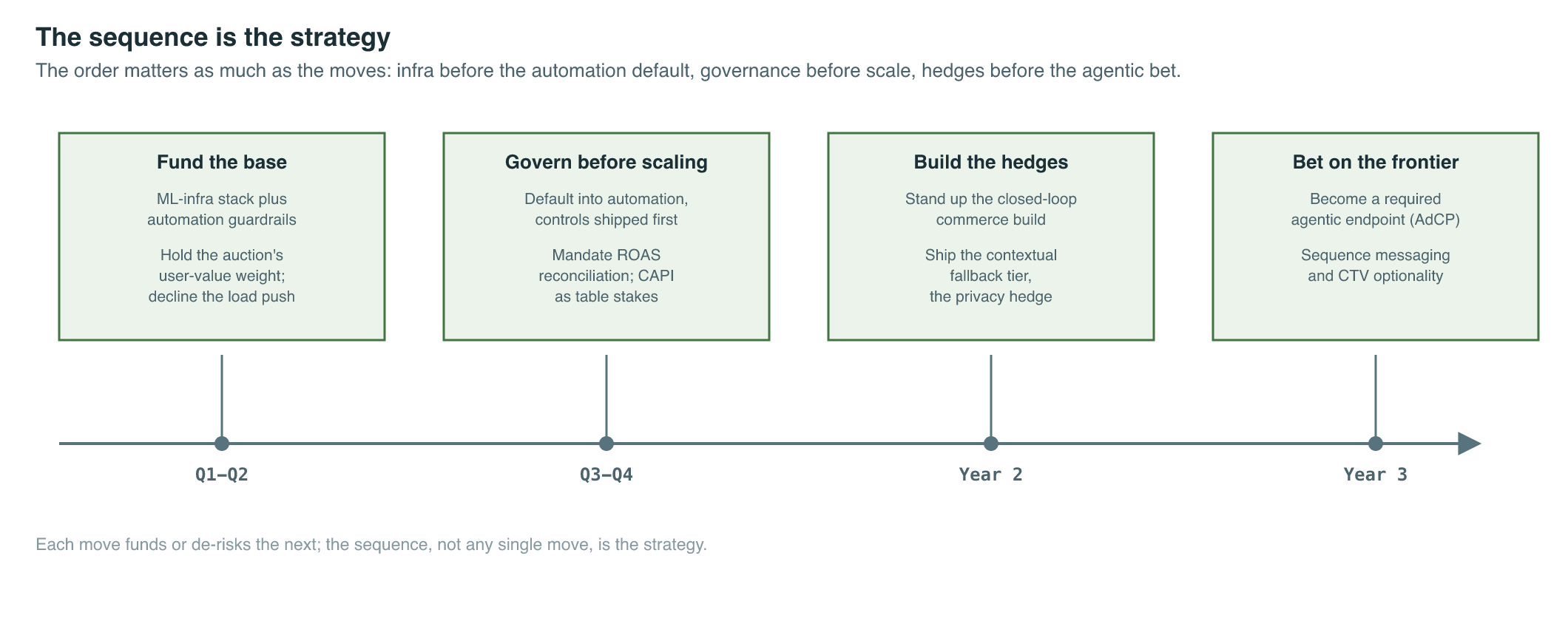
Figure 25.3 — The sequence is the strategy. The order matters as much as the moves: infra and guardrails before the automation default; ROAS governance before scaling spend; durability hedges (commerce, contextual tier) before the agentic bet that assumes the platform survives intact.
Same-Lever Scorecard
How the same re-underwriting posture reads across the majors — what each platform’s whole memo would emphasize, given its structure. Figures dated and hedged inline.
| Platform | What the re-underwriting memo centers on | Dominant durability bet | Tell for the leader |
|---|---|---|---|
| Meta | Yield-led growth + ML-infra as revenue lever; ARPP/DAP framing | Owned ML stack + commerce/messaging pillars | Q1 2026 +33% ad rev on +4% DAP — the whole memo in one line: monetize engagement, don’t add users (Apr 2026) |
| Premium B2B yield on a verified graph; account-level proof (RAR) | First-party professional data + Microsoft/Dynamics loop | Trust dividend = premium CPMs; durability is the data, not the reach (~$9B ad rev FY25, estimate) | |
| TikTok | Automation-default + commerce closed loop | TikTok Shop GMV; but a live data-governance overhang | US JV finalized Jan 2026 (ByteDance retains 19.9%, runs ads/e-commerce) — durability gated by the algorithm/data terms (Jan 2026) |
| Google / YouTube | Blended ads+subscriptions; AI Max steering to automated types | Search intent + owned video; antitrust the open question | Cookie U-turn + ad-tech monopoly remedies pending — re-underwrite annually, bet no single API (2025) |
| Amazon | Closed-loop retail media as the whole thesis | First-party purchase data; AMC free since Sep 2025 | Highest-durability revenue in the book — the closed loop survives privacy shocks (~$56B ad rev FY24) |
| X (wildcard) | The memo that wasn’t written — trust treated as PR, not P&L | None; durability term went to zero | ~$4.4B (2022) → ~$2.5B (2024): the cautionary proof that an un-governed trust identity ends a platform (directional) |
Decision or Diagnostic?
The final discipline, and the one the board most needs from you: present the decisions, leave the diagnostics in the appendix.
| Decision (board / leader owns) | Diagnostic (IC / launch-review owns) |
|---|---|
| The load/engagement frontier and whether to grow on volume or yield | Per-surface eCPM, single-campaign ROAS, win rates |
| The auction’s user-value weight and reserve policy | Estimated Action Rate, Quality Score, bid landscapes |
| The ML-infra capital ask sized as incremental revenue | Model recall/MFU/QPS, training throughput |
| The automation default + guardrail posture | Per-campaign automation toggles, creative variant scores |
| Reported-vs-incremental ROAS governance (anchor to incremental) | EMQ, match rates, CAPI event-dedup health |
| Privacy/antitrust bets and the fallback-tier funding | Per-jurisdiction consent rates, SKAN/AAK postback granularity |
| The agentic posture and portfolio sequencing | Protocol endpoint uptime, per-format cannibalization deltas |
The leader’s call. The trade-off you own at the capstone is coherence under constraint: every individual lever has a defensible setting, but the board memo lives or dies on whether the settings reinforce or fight each other — and on whether you sequence the durability hedges before the bets that assume the platform survives intact. The asymmetry is that a list of locally-optimal initiatives can be globally incoherent (fund infra without turning the automation dial, scale spend without governing ROAS, chase the agentic future without funding the privacy fallback), and that incoherence is invisible until the quarter it isn’t. Meta resolved it by lifting the whole trade-off to the most senior reported framing — ARPP beside DAP, so the board sees that +33% ad revenue on +4% users (Q1 2026) is the system working as designed, yield monetizing engagement rather than load consuming it. X is the proof of the opposite: a platform that left the trust identity ungoverned and watched durable revenue halve, $4.4B to $2.5B, faster than any model could rebuild it. Four quarters out: write the memo as a list and you will have approved twelve initiatives that quietly cancel each other, booking a flat trajectory you cannot explain; write it as a system — three identities, one triage frame, a defended sequence — and you can stand in front of the board, name the single ARPU-and-trust trajectory every lever is bending toward, and own it. Set the platform’s strategy like an operating system, not a budget.
Key terms
| Term | One-line definition |
|---|---|
| Re-underwriting | Re-pricing the whole platform ad P&L’s assumptions on a recurring cadence (here, annually) as privacy, automation, and agentic conditions move. |
| Operating system (the leader’s) | The three identities — revenue (load × yield vs engagement), trust (incremental ÷ reported), durability (revenue × shock-survival) — that link every lever into one coherent plan. |
| Initiative-triage score | (Projected ARPU lift × advertiser-trust durability) ÷ (regulatory + execution + cannibalization risk); the forcing function that ranks moves. |
| Trust identity | Advertiser trust modeled as the ratio of delivered incremental outcomes to reported outcomes; decays when reported ROAS is left ungoverned. |
| Durability term | The share of revenue that survives a privacy, antitrust, or agentic shock; why closed-loop commerce revenue is worth more than exposed personalized-ad revenue at equal margin. |
| The sequence | The deliberate ordering of moves (infra/guardrails → automation default → ROAS governance → durability hedges → agentic bet) so each funds or de-risks the next. |
| Coherence under constraint | The capstone trade-off: ensuring locally-optimal levers are globally consistent and survive simultaneous live shocks. |
Recap & what is next
- The board memo is a system, not a list — three identities (revenue, trust, durability) link the twelve levers, and the leader names them before proposing a single move.
- One triage frame — (ARPU lift × trust durability) ÷ (regulatory + execution + cannibalization risk) — ranks every initiative and forces each to carry its own downside.
- The four engine dials are set in concert: grow on yield not load, hold the auction’s user-value weight, fund ML-infra as a revenue lever, default into automation with guardrails — because each dial’s right setting depends on the others.
- The second half governs and hedges: anchor the board to incremental (not reported) ROAS, re-underwrite the privacy/antitrust bets annually with a funded fallback tier, take a multi-protocol agentic posture, and fund closed-loop commerce as the highest-durability pillar.
- The sequence is the strategy — durability hedges before the bets that assume the platform survives; Meta’s +33%-on-+4%-DAP is the system working, X’s $4.4B→$2.5B is the system left ungoverned.
- Present decisions to the board, diagnostics to the appendix — the final altitude discipline of the whole book.
This is the closing chapter. It sends you back into your own role able to do what Book 1’s reader only learned to read: write the platform’s strategy memo as the leader who owns the P&L — to assemble load, auction, infra, automation, measurement, privacy, commerce, portfolio, and agentic posture into one coherent trajectory and defend its ARPU and advertiser-trust four quarters out. The levers were never the hard part; the composition is. That is the job you inherited eighteen months ago, and it is now yours to write down.