The promise. In Chapter 4 you learned to treat the auction as policy and in Chapter 5 you funded the ML stack that makes that policy clear at the right price. Now the bill comes due as a product decision. You have built a recommendation engine that, on the evidence, picks audiences, bids, placements, and even creative better than the marketer typing into your campaign tool. So the question lands on your desk: how many of the advertiser’s hands do you take off the wheel — and how loudly do you tell them you are doing it? Advantage+, Performance Max, Smart+, Performance+, Accelerate — every major has shipped a one-button campaign that abstracts the manual levers into an outcome goal. This chapter equips you to decide how far to push that abstraction, what control surfaces and guardrails to keep, when to default advertisers into it, and how to absorb the loss-of-control backlash without torching the trust that is your fragile revenue infrastructure. The auction set the price; automation decides who is even allowed to touch the dials.
You will be able to:
- Map every platform’s automation product onto one decision — how much targeting, bidding, creative, and placement control to expose versus abstract away.
- Reason about the advertiser-trust cost of opacity, and recognize when you must re-expose module-level controls.
- Decide what the platform is now obligated to supply — model quality, signal richness, creative volume — once the manual levers disappear.
- Defend a default-into-automation product change in ARPU and advertiser-retention terms, not adoption-rate terms.
- Distinguish the automation dial the leader owns from the campaign-tuning diagnostics the IC and the advertiser still watch.
Builds on: Book 1 ch3 (the real-time auction) and ch5 (the yield curve). Within Book 2, it depends on ch4 (the auction is your policy — automation is how that policy reaches the advertiser) and ch5 (the moat migrated to the ML stack — automation is the product wrapper that monetizes that stack). It opens Part III — The Decisions a Leader Owns, and sets up ch9, where automation eats the targeting lever and leaves creative as the binding constraint.
The call on Maya’s desk
Eight months in, Maya’s head of ads product sends a proposal titled simply “Default.” The recommendation: make the automated campaign type — call it the platform’s Advantage+ analog — the pre-selected path for every new sales, app, and lead campaign. Manual setup stays available, but you have to click away from automation to find it. The deck leads with the number product leaders always lead with: campaigns that run on the automated flow deliver a vendor-reported double-digit ROAS lift and the automated product is already a multi-billion-dollar run-rate growing far faster than the manual book.
Maya has seen this movie from the other side. At the challenger platform she was Northwind — a performance marketer who built audiences by hand, who knew which lookalike seed converted and which placement wasted budget, and who experienced every “let the AI handle it” release as a confiscation. She remembers the specific feeling: not that the automation was worse, but that she could no longer see why it spent her money the way it did, and could no longer answer her own CFO when the number moved.
That memory is the chapter. The proposal in front of her is not really a product-settings change. It is a decision about how much agency to take from the people who pay her, traded against the efficiency her models can deliver and the lock-in that automation quietly creates. Push too far, too fast, with too little visibility, and she gets TikTok’s October 2025 problem — a marketer revolt over a black box. Push too timidly and she leaves the efficiency (and the lock-in) on the table for a rival who shipped the default first. The dial is hers.
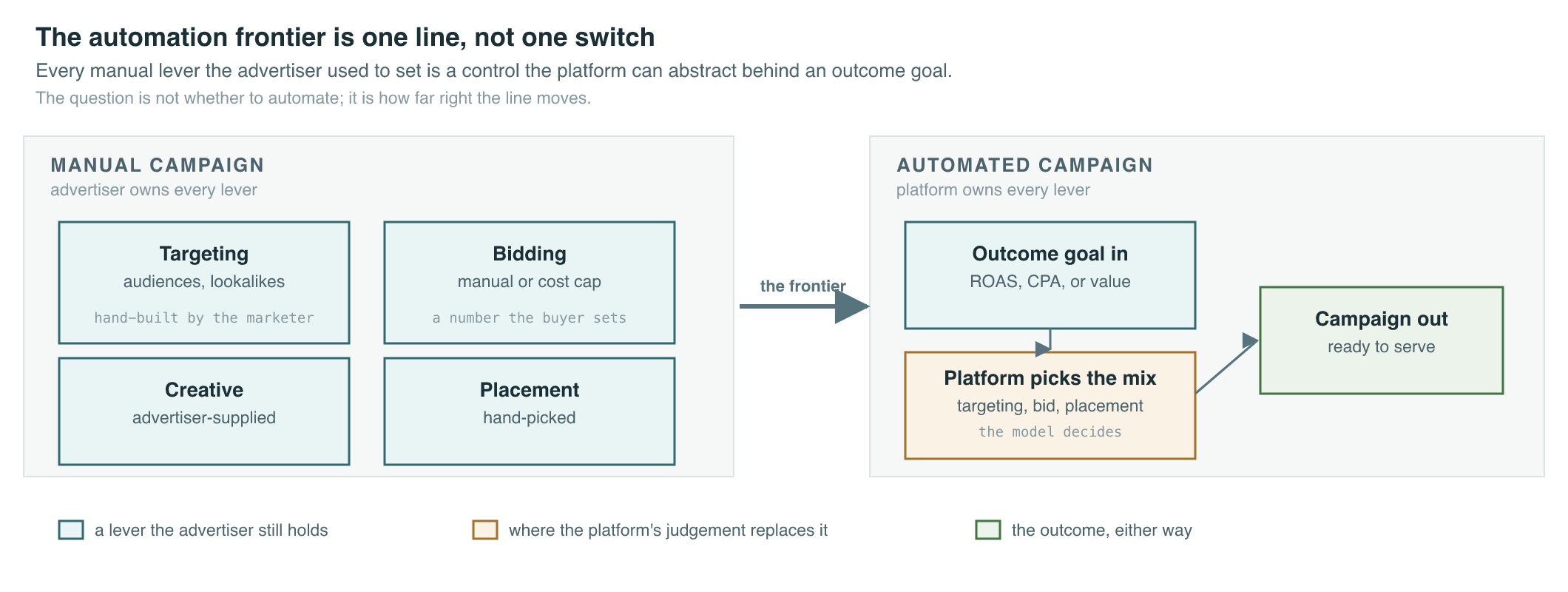
Figure 8.1 — The automation frontier as one line. Each manual lever the advertiser used to set is a control you can abstract behind an outcome goal. The leader’s decision is not whether to automate but where to draw the line and how much of the box stays glass.
Automation is four decisions, not one — abstract them separately
The first discipline is to stop talking about “automation” as a single switch. The automated campaign bundles four distinct surrenders of control, and a leader who treats them as one package will both over-abstract the levers advertisers tolerate losing and under-abstract the ones they will fight to keep.
- Targeting — who the ad is shown to. The lever advertisers most readily give up, because your creative-aware retrieval engine (Andromeda, ch5) genuinely finds converters the marketer’s hand-built audience missed. Meta’s system can and does ignore the advertiser’s selected audience when its models disagree.
- Bidding — what you pay per outcome. Mostly already gone: value-maximizing autobidders (ch4) — automated agents told to maximize conversions or value under a budget or target — are how the overwhelming majority of spend already clears. Over 80% of Google advertisers run automated bidding (Google internal data, originally reported 2021 and still cited by Google — directional, likely higher now).
- Placement — which surface and slot. Easy to abstract because no advertiser has a strong, defensible prior about Feed-vs-Reels-vs-Audience-Network allocation; the platform’s cross-surface optimization is simply better-informed.
- Creative — what the ad says and shows. The lever advertisers guard hardest, because it is the one they believe expresses their brand. (This is where Chapter 9 lives; here it is just the fourth lever.)
The reason to decompose is strategic, not pedagogical. Each lever has a different trust cost when you take it, and a different efficiency payoff when you do. Targeting and placement are high-payoff, low-resistance — abstract aggressively. Bidding is already ceded — formalize it. Creative is high-resistance — abstract carefully and keep a human in the loop. A leader who ships “all-or-nothing automation” is pricing all four levers at the same trust cost, which is wrong.
FIGURE 8.2 (spec): A 2×2 “abstraction map.” X-axis: advertiser resistance to losing this control (low → high). Y-axis: platform efficiency gain from automating it (low → high). Plot four labeled dots: Bidding (high gain / low resistance — already ceded), Placement (high gain / low resistance), Targeting (high gain / medium resistance), Creative (medium-high gain / high resistance). Shade a green “abstract now” quadrant (top-left) and an amber “abstract with controls + human-in-loop” zone around Creative. Caption: “Automate by lever, not by switch: each control has a different trust cost.” Alt-text: “Two-by-two chart mapping the four automation levers by efficiency gain versus advertiser resistance.”
The opacity-versus-trust trade-off — why the black box has a backlash
Here is the tension that makes this a leader’s call rather than a product-manager’s. Every lever you abstract makes the system more efficient and less explainable. The advertiser hands you an outcome goal; the platform spends the budget; the number comes back. When the number is good, opacity is fine. When the number moves the wrong way — and it always eventually does — the advertiser cannot diagnose it, cannot adjust it, and cannot defend it to their CFO. That is the precise moment trust erodes, and it erodes faster than the efficiency gains accumulate.
This is not theoretical. TikTok learned it in public. Smart+ — its Advantage+/Performance Max analog, a fully automated product bundling targeting, bidding, creative selection, and placement — went from roughly 9% of US TikTok performance campaigns in Q1 2025 to roughly 42% by Q3 2025 (Tinuiti benchmark data via eMarketer, Oct 2025; vendor-reported — re-verify). That is one of the fastest adoption curves in the history of the ad business. And yet, in the middle of that curve, on October 7, 2025, TikTok shipped a major update that added module-level controls — letting advertisers selectively automate targeting, budget, creative, or placement rather than accepting all-or-nothing (TikTok Newsroom / Social Media Today, Oct 2025). The platform with the fastest-growing black box voluntarily put windows in it.
Read that sequence carefully, because it is the whole lesson. TikTok did not add controls because automation was failing — it was winning. It added controls because the marketers driving adoption were also its loudest critics on loss of control, and a platform that ignores that complaint risks the one thing it cannot model its way out of: advertisers quietly capping their spend because they no longer trust where it goes. The module-level control is not a retreat from automation. It is the price of sustainable automation — the glass that keeps the box trusted.
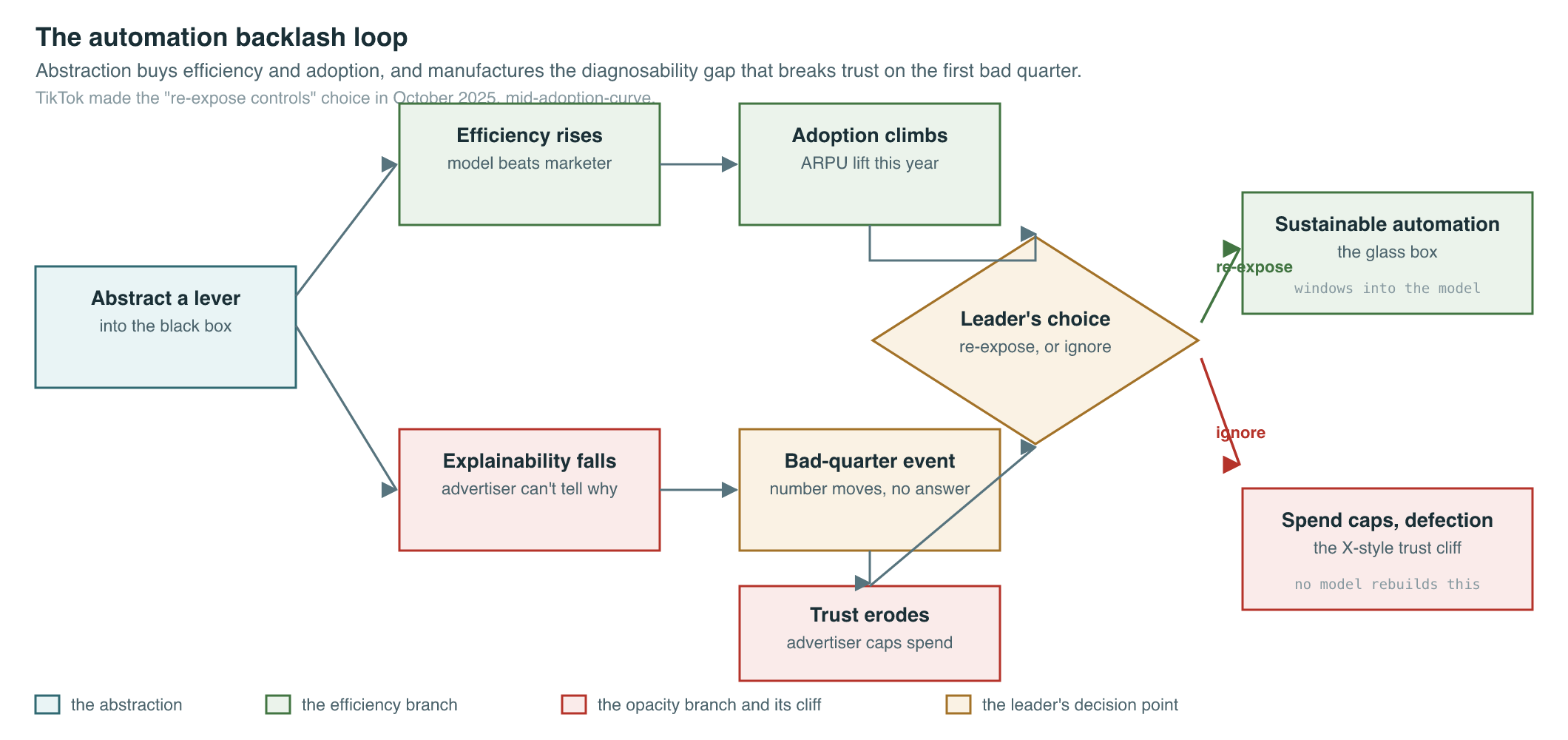
Figure 8.3 — The automation backlash loop. Abstraction buys efficiency and adoption and manufactures the diagnosability gap that breaks trust on the first bad quarter. The leader’s job is to re-expose enough control to keep the box trusted before the defection happens — exactly the move TikTok made in October 2025.
When you take the levers, you inherit the obligations
Abstracting control is not a free transfer — it is an assumption of liability. The moment the advertiser can no longer hand-build the audience, pick the placement, or write every variant, you are accountable for the outcome the marketer used to own. Three obligations move onto the platform’s side of the ledger, and a leader who defaults advertisers into automation without funding all three is shipping a promise the platform cannot keep.
Model quality becomes table stakes, not a roadmap item. When the advertiser controlled targeting, a mediocre model was the advertiser’s problem to route around. When you control targeting, a mediocre model is your breach. This is why Chapter 5’s infrastructure spend is the precondition for this chapter’s product: Meta could default campaigns into Advantage+ only because GEM and Andromeda made the automated path reliably beat the manual one (~+5% IG / +3% FB Feed conversions from GEM; Meta engineering, Nov 2025). Automation without a winning model is just confiscation.
Signal richness becomes the advertiser’s new lever — so you must make it frictionless. Once targeting and bidding are abstracted, the only meaningful input the advertiser still controls is the quality of the conversion signal they feed you: server-side events, high match quality, value-based events. The leader’s product obligation is to make that signal trivial to supply (one-click server-side integrations, low-code gateways) because under automation, signal richness is the new performance dial — and it is the one place the advertiser can still genuinely move their own number. (The measurement machinery behind this is Chapter 10’s subject; here it is the input automation runs on.)
Creative volume becomes the binding constraint. When the model picks the audience and the placement, the marketer’s remaining job is to supply enough creative variety for the model to optimize against. Thin creative starves a good model. This is the hand-off to Chapter 9: the moment you automate targeting, you have moved the bottleneck to creative, and you will have to decide whether the platform generates that creative too.
The leader’s framing for the board: we are not selling advertisers a button; we are signing a service-level agreement. If we take their targeting, our model must beat their targeting; if we take their bidding, our optimization must beat their bidding. The day the automated path stops winning is the day automation becomes a trust liability, not a revenue engine.
Whether — and how — to default
The sharpest version of the decision is not should we build automation (everyone has) but should we make it the default, and make manual the deliberate opt-out. Defaulting is the single most powerful adoption lever a platform owns and the single fastest way to manufacture a backlash, because a default is a control taken from advertisers who never asked.
The majors have converged on yes, default — but the sequencing tells the story. Meta crossed a roughly $20B annualized run-rate on Advantage+ Shopping in Q4 2024 (~+70% YoY) before, in February 2026, making Advantage+ the default for all new campaigns and merging the manual and automated flows into a single setup (Meta earnings, Q4 2024; industry reporting, 2026 — fast-moving, re-verify). Google’s Performance Max climbed from roughly 60% advertiser adoption (2024) to ~71% (2025), lifted by 90+ shipped quality improvements rather than a hard forced migration (smarter-ecommerce State of PMax / industry, 2024–2025). TikTok rode Smart+ to ~42% of US performance campaigns and shipped module controls in the same window, and made GMV Max the default-and-only campaign type for TikTok Shop sales objectives by mid-2025 (rolled out July–August 2025) — the most aggressive default of all, because the closed commerce loop made the model’s advantage largest (TikTok Ads Manager / industry reporting, 2025). LinkedIn’s Accelerate builds an end-to-end campaign in ~5 minutes and is reported to deliver ~52% lower CPA (LinkedIn / vendor-reported — treat as directional), defaulting B2B buyers who lack the time to hand-tune toward ICP-based automation. Pinterest’s Performance+ cut campaign inputs ~50% (Pinterest, Oct 2024).
The pattern that survives the dated specifics: default where your model’s edge is largest and most provable, keep an honest manual escape hatch, and ship the module-level controls before the backlash forces you to. Meta could default broadly because its model lead is broad; TikTok could mandate GMV Max because the commerce loop made the lead extreme on that one objective. The error is defaulting where your model is not clearly winning — there, the default is just a tax on advertiser agency, and it shows up as defection four quarters out.
So Maya approves the default — but with three non-negotiables her product lead did not have in the original deck: (1) ship module-level controls at the same time as the default, not after a revolt; (2) keep a one-click, no-friction path back to manual, and instrument how often advertisers take it as a trust early-warning metric; (3) gate the default to the objectives where the platform’s model demonstrably beats manual, and hold it back where it does not yet. Her defense is not “automation is the future.” It is: we are taking control from advertisers only where we can prove we spend their money better than they can, we are leaving them windows into the box, and we are watching the opt-out rate as the canary for trust.
Same-Lever Scorecard
How the majors set the same dial — how far they abstract control, how they default, and what windows they leave in the box. Figures dated and hedged inline.
| Platform | Automation product (the lever) | How far it abstracts | Default / control posture | Tell for the leader |
|---|---|---|---|---|
| Meta | Advantage+ Shopping / Sales / App | Targeting, bidding, placement, creative — near-full | Default for all new campaigns (Feb 2026); manual flow merged in (fast-moving) | ~$20B run-rate, +70% YoY (Q4 2024) — defaults where model lead is broadest |
| Accelerate | ICP/audience, creative (via Designer), bidding | Opt-in default for time-poor B2B; manual retained | ~5-min build, ~52% lower CPA (vendor-reported) — automation as the B2B time-saver | |
| TikTok | Smart+ / GMV Max | All four levers; GMV Max mandatory for Shop sales | ~9%→~42% of US perf campaigns in a year; added module controls Oct 2025 | The clearest case: rode the black box and put windows in it under pressure |
| Google / YouTube | Performance Max / AI Max | Cross-surface targeting, bidding, placement; opaque channel split | Adoption ~60%→~71% (2024→2025); pulled via quality, not forced | 90+ improvements lifted PMax conversions ~10% — earn the migration, don’t mandate it |
| Amazon | Sponsored Brands/Display + DSP automation | Bidding, placement; targeting on purchase data | Conservative; closed-loop signal makes automation defensible | First-party purchase data makes the action-rate estimate unusually accurate |
| Pinterest (wildcard) | Performance+ | Targeting, bidding, budget, gen-AI creative | Opt-in; ~50% fewer inputs (Oct 2024) | Sub-scale player using automation to punch above its data weight |
Decision or Diagnostic?
Sort the chapter’s metrics by who owns them. The leader sets the abstraction policy; the IC and the advertiser tune the campaign that runs on it.
| Decision (board / leader owns) | Diagnostic (IC / advertiser owns) |
|---|---|
| The automation frontier — how many of the four levers to abstract, by objective | Single-campaign ROAS / CPA — the advertiser’s account-level result on the automated flow |
| Default policy — whether automation is pre-selected and manual is the opt-out | Estimated Action Rate — the model’s per-impression prediction inside the automated campaign |
| Module-control roadmap — which windows into the box to ship, and when | Creative variant performance — which generated/supplied asset is winning in a campaign |
| Manual-opt-out rate — the platform-wide trust canary the leader watches | Audience-overlap / placement mix — the operational allocation the system chose this week |
The leader’s call. The trade-off you own is how much agency to take from the advertisers who pay you — abstracting targeting, bidding, placement, and creative into an outcome goal — traded against the efficiency your models deliver and the diagnosability your advertisers lose. The asymmetry is the trap: abstraction’s efficiency shows up this quarter as adoption and ARPU lift, while the trust cost is invisible until the first bad quarter, when the advertiser cannot diagnose a number they no longer control and quietly caps their spend. TikTok resolved it the hard way and the right way: it rode Smart+ to ~42% of US performance campaigns, then — at the peak of that curve, in October 2025 — added module-level controls rather than waiting for defection, choosing sustainable automation over a maximal black box. Meta resolved the default question by making Advantage+ the pre-selected path for all new campaigns (Feb 2026) only after GEM/Andromeda made the automated flow reliably beat the manual one — defaulting where the model lead was provable. Four quarters out: abstract aggressively where your model wins and keep windows in the box, and you compound ARPU on automated efficiency while advertisers stay because the system both performs and explains itself; abstract everything, default everyone, and ship no controls, and you book a great year of adoption and then watch your best advertisers cap spend on a black box they stopped trusting — the X-shaped trust cliff arriving through the product surface instead of the brand-safety one. Take the levers only where you can prove you spend the money better, and always leave the glass.
Key terms
| Term | One-line definition |
|---|---|
| Automation frontier | The line between levers the advertiser still sets (manual) and levers the platform abstracts behind an outcome goal. |
| Advantage+ / Performance Max / Smart+ | Meta / Google / TikTok’s one-button campaign products that abstract targeting, bidding, placement, and creative into an outcome goal. |
| Outcome-goal product design | A campaign built by stating a target (ROAS, CPA, value) and letting the platform choose every execution lever. |
| Module-level controls | Windows into the black box: letting advertisers selectively automate one lever (targeting, bid, creative, placement) rather than all-or-nothing. |
| Defaulting | Making the automated campaign the pre-selected path so manual becomes the deliberate opt-out — the strongest adoption lever and the fastest backlash trigger. |
| Opacity-vs-trust trade-off | The tension that every abstracted lever raises efficiency while lowering the advertiser’s ability to diagnose and defend their spend. |
| Manual-opt-out rate | How often advertisers click away from the default to manual; the leader’s platform-wide early-warning metric for automation trust. |
| Signal richness | The quality of conversion signal (server-side events, match quality, value-based events) the advertiser still controls once targeting and bidding are abstracted — the new performance lever. |
| GMV Max | TikTok’s automated TikTok Shop campaign type, made the default-and-only format for shop-sales objectives by mid-2025 — the most aggressive default among the majors. |
Recap & what is next
- Automation is four decisions, not one — targeting, bidding, placement, and creative each carry a different trust cost and efficiency payoff; abstract them by lever, not by a single switch.
- The opacity-versus-trust trade-off is the chapter’s spine: every abstracted lever raises efficiency and lowers diagnosability, and the trust cost stays invisible until the first bad quarter — which is why TikTok put windows in its black box at the peak of adoption, not after a revolt.
- When you take the levers, you inherit the obligations: model quality becomes table stakes, signal richness becomes the advertiser’s new lever (make it frictionless), and creative volume becomes the binding constraint.
- Default where your model’s edge is provable, keep an honest manual escape hatch, and ship module-level controls before the backlash — Meta defaulted broadly, TikTok mandated GMV Max only on the objective where its loop made the lead extreme, Google earned the PMax migration through quality.
- Watch the manual-opt-out rate as the trust canary, and sort ruthlessly: frontier, default, control-roadmap, opt-out-rate are the leader’s; single-campaign ROAS, action rate, variant performance, placement mix belong to the advertiser and the IC.
Maya has now taken the targeting, bidding, and placement levers — and in doing so she has moved the binding constraint downstream. Once the model picks who, how much, and where, the only thing left for the marketer to supply is what the ad says and shows, and even that is about to be abstracted. Chapter 9 — When the Platform Makes the Ad takes you into generative creative: how the collapse of the production bottleneck turns creative quality, brand safety, and differentiation into the new scarcity, and how far to push toward objective-in / campaign-out generation while keeping a human in the loop.