The promise. The last eight chapters of Part IV walked you through the established gardens — Meta, Instagram, LinkedIn, TikTok, Google/YouTube, Amazon, Snap, Pinterest, Reddit, and X’s ruin. Every one of them is a fortress someone already finished building. This chapter is about the gardens that are still being walled in right now, on surfaces that did not carry ads at all three years ago: the operating system itself (Apple Ads), the television set (Netflix, Prime Video, Disney+), and the delivery app on the phone (Uber, DoorDash, Instacart) — with Microsoft’s quietly enormous search-plus-LinkedIn business as the established player that keeps reinventing where it sells. The decision this chapter equips you to make is the one Maya’s corp-dev team puts on her desk every planning cycle: which of these emerging gardens is a structural new pillar we must enter, partner into, or be ready to defend against — and which is a press release we can ignore for another year? It builds directly on Chapter 12’s commerce land-grab logic (the closed loop as the most defensible ad product) and Chapter 18’s Amazon deep-dive (retail media as the third pillar). The question is no longer “what is a walled garden” — you know that cold by now — but “where does the next one form, and what makes it defensible the moment it does.”
You will be able to:
- Decide whether an emerging surface (an OS, a streaming tier, a delivery app) is a structural new garden worth entering or a feature dressed up as a market.
- Reason about why first-party intent and closed-loop attribution — not reach — are what let a brand-new ad surface clear at premium prices on day one.
- Defend a build-versus-partner call on CTV ad sales and measurement to a board that wants to know what you own versus what you rent.
- Distinguish the gardens whose moat is the transaction (commerce media) from those whose moat is attention (CTV) from those whose moat is the gate (Apple’s OS).
- Connect an entry-or-skip decision on an adjacent garden to its four-quarters-out effect on ARPU and advertiser trust.
Builds on: Book 1 ch6 (retail/commerce supply) and ch1 (the open-vs-walled distinction); Book 2 ch12 (the closed-loop commerce land-grab and take rate), ch18 (Amazon as retail-media center of gravity), ch3 (profit pools), and ch11’s privacy posture (Apple’s ATT as the gate that advantages its own surface). This chapter closes Part IV and sets up Part V’s portfolio synthesis.
The call on Maya’s desk
Planning season. Maya’s corp-dev lead drops a slide titled “Adjacent Gardens — Enter / Partner / Watch” with four rows: Apple Ads, CTV ad tiers, commerce media (delivery + grocery), and Microsoft. The argument in the room is the same one that gets made about every new surface: “It’s growing 40% a year, the established players are sub-scale here, we should plant a flag before the land is gone.” Maya has heard this pitch about the metaverse, about voice, about NFTs. Most of those flags are still planted in empty fields.
Her discipline, learned the hard way at the challenger platform, is to ignore the growth rate and ask one question instead: what makes this surface a garden and not just inventory? A garden — the thing this whole book has been about — has three properties: it owns a first-party signal nobody else can replicate, it can close the loop from ad to outcome inside its own walls, and the user is logged in and present with intent. Reach is not on that list. Reach is what the open web sells, and the open web’s eCPMs are exactly why nobody wants to be the open web.
So she rewrites the slide’s question. Not “is it growing?” but: for each of these four, who owns the gate, who owns the loop, and what is the most defensible thing a new entrant could ever hold there? That reframing is the chapter.
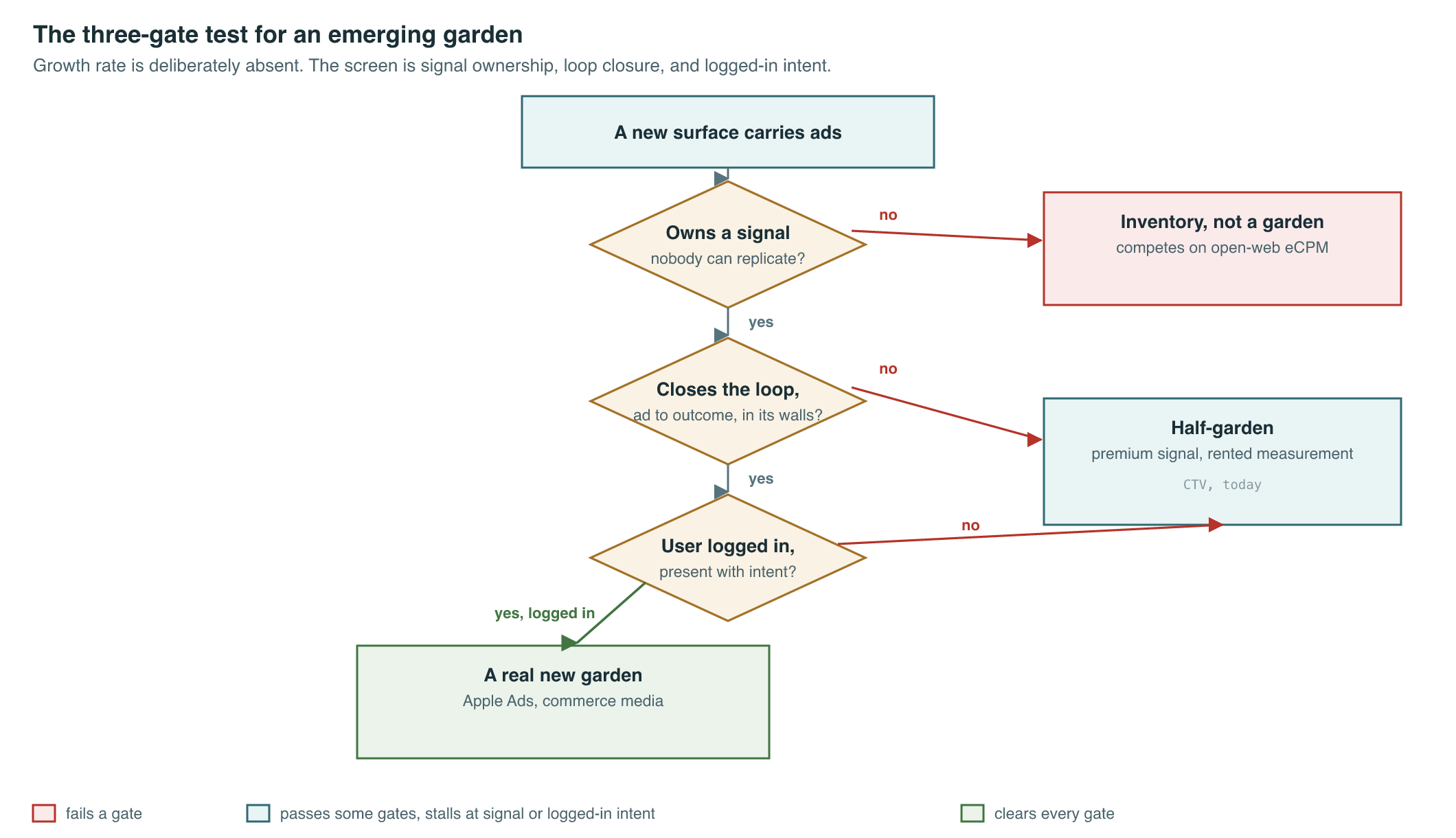
Figure 21.1 — The three-gate test for an emerging garden. Growth rate is deliberately absent. The leader screens a new surface on signal ownership, loop closure, and logged-in intent — the same three properties that made every garden in Part IV defensible. Most “new ad markets” fail the first gate.
Apple Ads — the gardener who also owns the fence
Start with the strangest entrant, because it is the one that proves the thesis. Apple Ads (rebranded from “Apple Search Ads” in April 2025 as the surface expanded beyond the App Store) is small by walled-garden standards — Apple’s total advertising business is estimated at roughly $8.5B in 2026, with the App Store search product the bulk of it (industry/analyst estimates, 2026 — vendor-reported, re-verify). Against Meta’s $55B a quarter, that is a rounding error. And yet it is one of the most strategically dangerous ad businesses in the world, for a reason that has nothing to do with size.
Apple owns the gate — the operating system through which a large share of the world’s high-value mobile users reach every other garden. When Apple shipped App Tracking Transparency (Chapter 11), it cut the trackable share of US Apple traffic by something like 55 percentage points (from ~73% to ~18%) and is estimated to have knocked ~21% off publisher ad revenue from Apple users (FTC working-paper / panel estimates, 2025 — directional). The same move that degraded everyone else’s targeting grew Apple’s own: Apple Search Ads’ share of iOS app-install attribution roughly doubled, from ~17% to ~31%, after ATT (JP Morgan / eMarketer estimates — directional). This is the cleanest example in the entire book of OS gatekeeping as an ad-tech moat — owning the fence lets you decide how much sunlight reaches every other garden, including your own.
For Maya the lesson is not “build an OS.” She can’t. The lesson is a defensive one: a garden you depend on for distribution can reprice your entire business with a single OS release, and it has every incentive to do so when it sells competing inventory. Apple is now extending Apple Ads to new surfaces — multiple App Store search placements rolling out through 2026, and ads coming to Apple Maps as soon as summer 2026 (Apple announcements / Marketing Dive, 2026 — fast-moving, re-verify). Each new Apple surface is a high-intent, logged-in, first-party garden that Apple can privilege while constraining the measurement of rivals. The four-quarters-out question Maya must keep live is not “should we buy Apple Ads inventory” (her performance team already does) but “how much of our measurement and targeting roadmap is one Apple keynote away from being deprecated?”
CTV ad tiers — the half-garden with premium attention and rented plumbing
The television set is the surface everyone is racing to wall in, and it is the most instructive partial case in the chapter. Connected TV (CTV — internet-delivered television) ad tiers have scaled faster than any new ad format in recent memory. Netflix’s ad-supported tier crossed 250 million monthly active viewers by May 2026 (up from ~190M in November 2025 and ~94M in May 2025, after Netflix redefined the metric to monthly active viewers), with ad revenue reportedly rising more than 2.5× to over $1.5B in 2025 and expected to roughly double again in 2026 (Netflix earnings / Variety / The Wrap, 2026 — fast-moving, re-verify). More than half of new Netflix sign-ups in the markets where the ad tier is offered now choose the ad plan (~55% as of May 2025 — Netflix, fast-moving, re-verify). Amazon Prime Video reaches 115M+ US ad-supported viewers since switching ads on by default in January 2024. Disney’s Disney+/Hulu revenue grew 13% to ~$5.49B in fiscal Q2 2026 (the quarter ended March 28, 2026), with double-digit streaming-advertising growth year-over-year and streaming operating income up 88% to $582M (Disney 8-K / Variety, 2026 — re-verify).
These are real audiences with premium attention. But run them through Figure 21.1 and CTV stalls at the second gate. The signal is excellent — logged-in households, known content affinity. The loop is the problem: most CTV players cannot, by themselves, close the loop from an ad impression to a purchase outcome. That is why the defining structural fact of CTV is who they rent the plumbing from. Netflix launched its ad business on Microsoft’s ad-tech stack in 2022 precisely because it did not want to build a sales-and-serving platform from scratch — then spent 2024–2025 transitioning to its own in-house ad tech to take back control of targeting, measurement, and formats (Marketing Dive / Netflix, 2024–2026). Amazon, by contrast, did not need to rent: its DSP plugs Prime Video CTV into Amazon’s purchase-data loop, and it is using that to sell third-party CTV inventory (Netflix, Disney, Roku) through Amazon’s measurement — Amazon reported ~23% YoY ad growth in Q4 2025, outpacing the CTV market (AdExchanger / Marketing Dive, 2026).
That contrast is the entire CTV decision. The CTV entrant who owns only the content owns a half-garden — premium attention with rented measurement — and rented measurement is a margin leak and a trust liability. The leader’s call is build-versus-partner on the loop: rent the plumbing to enter fast and cheap (Netflix, phase one), then race to own it before the renting relationship becomes the moat of whoever you rented from (Amazon is trying to become that landlord for everyone else’s CTV).
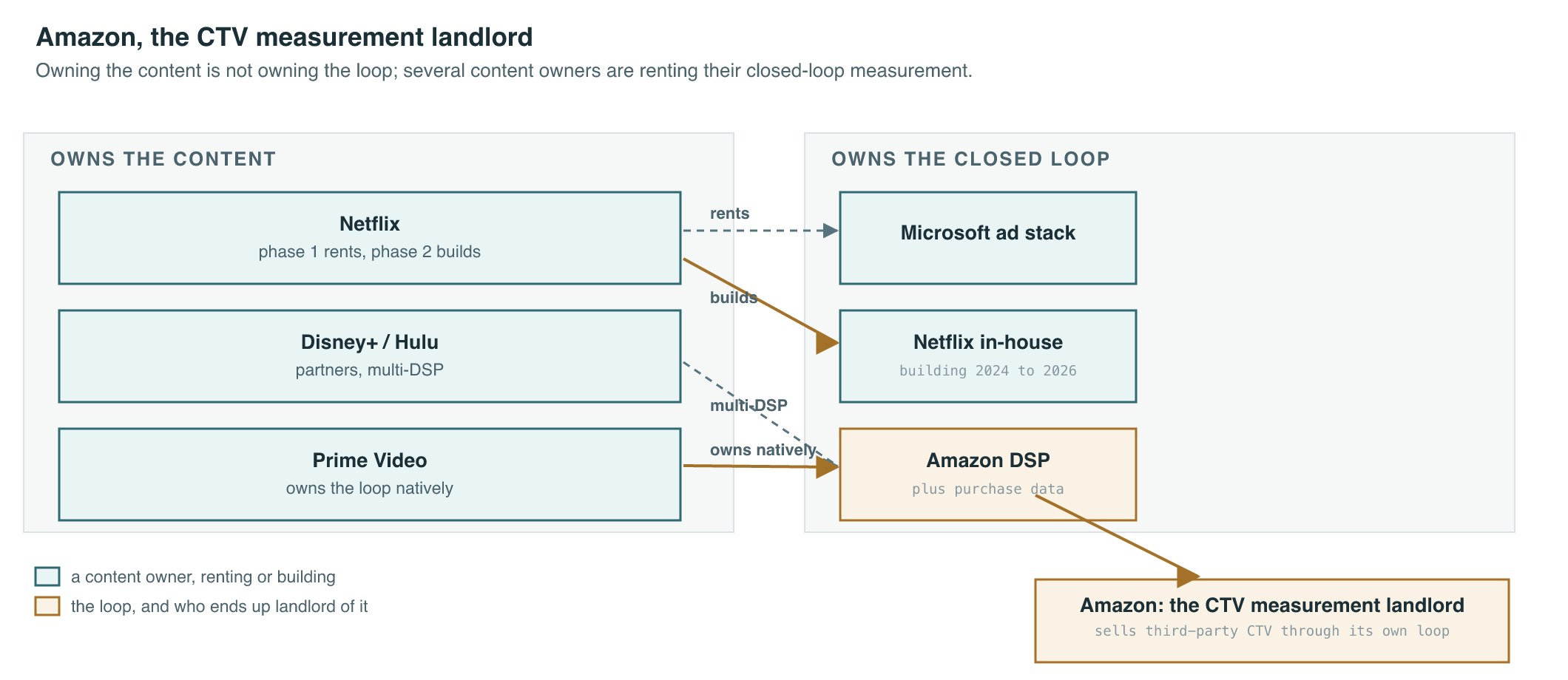
Figure 21.2 — CTV’s split between attention and the loop. Content owners (left) have premium signal but must either rent measurement, build it, or partner. Amazon’s play is to be the loop for everyone — turning rented plumbing into a moat. The strategic risk for a content-only entrant is becoming a tenant in someone else’s garden.
Commerce media — the new gardens that pass all three gates
If CTV is the half-garden, commerce media beyond Amazon is the surface that quietly passes every gate in Figure 21.1 — and it is the one most leaders still under-rate because it grew up inside apps they think of as logistics companies. The delivery and grocery apps — Uber, DoorDash, Instacart — own first-party signal (what you buy, when, where, repeatedly), close the loop natively (the ad and the transaction happen in the same app), and reach a logged-in user who is present to purchase. That is a textbook garden, and it is throwing off real money: together these three generate more than $4B in annualized ad revenue (eMarketer / company reports, 2025–2026 — re-verify).
The specifics matter because they show how fast a “logistics” P&L becomes an ad P&L. Uber Advertising — across rides and Uber Eats — passed a $1.5B annual run-rate by mid-2025, up ~60% YoY, with delivery (Uber Eats) the larger share of that total (The Current / Uber, 2025 — vendor-reported, re-verify). DoorDash crossed a $1B ad run-rate and bought ad-tech firm Symbiosys in 2025 to push beyond its own app and let brands bid on off-platform search and run retailer co-op campaigns. Instacart’s advertising-and-other revenue hit ~$286M in Q1 2026 alone, and its Carrot Ads product white-labels its retail-media engine to other grocers — selling the garden’s machinery to landlords who lack it. Uber and Instacart even integrated their ad offerings in 2025, pooling CPG demand (Grocery Dive, 2025).
This is commerce media — closed-loop retail-media economics applied to any app that owns a transaction — and it is the most defensible new pillar in the chapter precisely because it inherits the moat Chapter 12 and Chapter 18 already taught: first-party purchase data plus closed-loop attribution, the most privacy-durable ad product there is. The leader’s question for Maya’s own platform is the build-versus-buy call from Chapter 12, instantiated: do we own a transaction we are not yet monetizing as a garden? If a ride app and a burrito app can each stand up a billion-dollar, premium-CPM ad business off their checkout data, any platform sitting on a transaction is leaving a structural pillar unbuilt.
FIGURE 21.3 (spec): A horizontal “garden maturity” stacked bar, one row per emerging surface (Apple Ads, Netflix, Prime Video, Disney+, Uber, DoorDash, Instacart, Microsoft). Each bar segmented into three colored blocks — “Owns signal,” “Owns the loop,” “Logged-in intent” — filled, half-filled, or empty per the three-gate test. Caption: “The three-gate scorecard: commerce-media and Apple surfaces fill all three blocks; CTV content-owners are missing the loop block until they build or partner for it.” Alt-text: “Bar chart scoring eight emerging ad surfaces on signal ownership, loop closure, and logged-in intent; commerce apps and Apple score full, content-only CTV scores partial.”
Microsoft — the established garden that keeps reinventing where it sells
The fourth row on Maya’s slide is the odd one: Microsoft is not emerging at all. Its combined search-plus-LinkedIn advertising business was running over $20B annually by spring 2025 (Microsoft FY2025 / Adweek, 2025) — bigger than Snap, Pinterest, and Reddit combined. It belongs in this chapter for a different reason: Microsoft is the case study in how an established garden stays relevant by renting its plumbing and data into every new surface someone else builds.
Microsoft’s two durable assets are the LinkedIn professional graph (Chapter 15) and a search-ad business most people forget exists. It compounds them by lending them out: LinkedIn profile targeting flows into Microsoft Advertising search and CTV; Microsoft’s ad-serving stack is what launched Netflix’s ad tier; Dynamics 365 closes the CRM-to-ad-to-revenue loop for B2B. Where Amazon wants to be the CTV measurement landlord through purchase data, Microsoft has long been the ad-serving landlord for entrants who needed to move fast — the arms dealer to the new gardens.
For Maya, Microsoft reframes the whole chapter’s build-versus-partner axis. The emerging-garden decision is rarely binary. The defensible third path, which Microsoft has run for years and Instacart’s Carrot Ads now copies, is to monetize the infrastructure of the new gardens rather than only the inventory — sell the loop, the targeting graph, or the serving stack to the content-and-transaction owners who have the audience but not the machinery. That is optionality a leader should price into every “enter / partner / watch” decision: sometimes the best position in a new garden is to be the company everyone else rents from.
Same-Lever Scorecard
The lever this chapter sets is posture toward an emerging adjacent garden — enter, partner, become-the-landlord, or watch — judged by what is genuinely defensible there. Figures dated and hedged inline.
| Platform | The emerging-garden play | What it actually owns | Posture the leader should read | Tell for the leader |
|---|---|---|---|---|
| Meta | Defends core; treats CTV/commerce as adjacent, not core | The largest performance loop already; little to gain entering others’ surfaces | Watch / defend — its garden is the prize others want into | Q1 2026 ad rev $55.0B — the incumbent everyone else is trying to flank |
| Extends its graph into Microsoft search + CTV (BrandLink) | Verified professional first-party graph | Become-the-landlord — lends data into new surfaces | Microsoft search+LinkedIn >$20B/yr (2025) — graph as rentable asset | |
| TikTok | Commerce-media native via TikTok Shop closed loop | First-party intent + closed transaction loop | Built its own commerce garden — passes all three gates | TikTok Shop ~$64B GMV 2025 (vendor-reported) — the loop is owned, not rented |
| Google / YouTube | YouTube as the scaled CTV garden; owns its measurement | Logged-in viewers + Google’s measurement loop | Owns the full garden — the CTV bar to beat | YouTube the rare content surface that owns its own loop |
| Amazon | Becoming the CTV/commerce measurement landlord | Purchase data + DSP selling 3P CTV through its loop | Become-the-landlord of others’ attention | Total ad rev ~$68B 2025; ~23% YoY growth Q4 2025 (Prime Video CTV a meaningful contributor) |
| Apple (wildcard) | Owns the OS gate; growing its own first-party ad surface | The fence around every mobile garden | The dependency to defend against — can reprice you with a release | Apple Ads ~$8.5B 2026 (est.); ASA install share ~17%→~31% post-ATT |
Decision or Diagnostic?
Sort the chapter’s metrics. The leader decides which gardens to enter and what to own in them; the IC measures how a campaign performs once you are in one.
| Decision (board / leader owns) | Diagnostic (IC / launch-review owns) |
|---|---|
| Enter / partner / become-landlord / watch posture for each adjacent garden | CTV completion rate, view-through on a specific streaming buy |
| Build-vs-rent the measurement loop (own the plumbing or tenant in another’s) | Apple Ads keyword CPA / install rate on a single app campaign |
| Whether the platform’s own transaction should become a commerce-media garden | Per-surface eCPM for a new delivery-app placement |
| Dependency exposure — how much of the roadmap rides on an OS/ad-stack you don’t own | Carrot-Ads-style white-label fill rate on a partner’s inventory |
The leader’s call. The trade-off you own is which emerging gardens to enter and, in each, whether to own the loop, rent it, or sell it to others — judged not by the surface’s growth rate but by whether it owns signal, closes the loop, and holds logged-in intent. The asymmetry is that entering a surface that fails the loop test buys you premium attention you cannot prove worked, which erodes advertiser trust the moment a clean-room comparison reveals the gap. Netflix resolved it by entering CTV fast on Microsoft’s rented stack to capture the audience, then racing to build its own loop before the renting became a permanent margin leak (250M+ ad viewers, $1.5B+ 2025 ad revenue — fast-moving). Amazon resolved the adjacent call — be the loop for everyone — by selling third-party CTV through its own purchase-data measurement, turning rented plumbing into a moat. Apple is the dependency to defend against: it owns the OS gate and grew its own ad share ~17%→~31% by tightening everyone else’s measurement with a single OS release. Four quarters out: enter a half-garden without owning or credibly partnering for the loop and you book impressive reach this year, then watch incrementality testing (Chapter 10) expose that you cannot prove outcomes, and your best advertisers reallocate to gardens that can; enter where you own the transaction and close the loop — or become the landlord others rent from — and you stand up a privacy-durable pillar that compounds. The next garden is not the one growing fastest. It is the one that, the day it turns ads on, already owns the signal, the loop, and the logged-in customer.
Key terms
| Term | One-line definition |
|---|---|
| Emerging / adjacent garden | A surface that did not carry ads recently (an OS, a streaming tier, a delivery app) and is now walling in a first-party ad business. |
| Three-gate test | The screen for a real garden: owns first-party signal, closes the ad→outcome loop internally, and reaches a logged-in user with intent. |
| OS gatekeeping | Owning the operating system through which users reach other gardens, letting you reprice or constrain rivals’ targeting/measurement (Apple/ATT). |
| Half-garden | A surface with premium first-party signal but no owned measurement loop (most content-only CTV) — must build, rent, or partner for the loop. |
| Commerce media | Closed-loop retail-media economics applied to any app that owns a transaction (Uber, DoorDash, Instacart), inheriting Chapter 12’s purchase-data moat. |
| Carrot Ads | Instacart’s white-labeled retail-media engine sold to other grocers — selling the garden’s machinery rather than only its inventory. |
| Become-the-landlord | The third posture (beyond enter/watch): monetize the infrastructure of new gardens — the loop, graph, or serving stack — that content/transaction owners lack (Microsoft, Amazon DSP, Carrot Ads). |
| CTV | Connected TV — internet-delivered television ad inventory (Netflix, Prime Video, Disney+, YouTube) with logged-in household signal. |
Recap & what is next
- An emerging surface is a garden, not just inventory, only if it passes three gates — owns first-party signal, closes the loop internally, holds logged-in intent. Growth rate is deliberately not on the list.
- Apple Ads is small (~$8.5B 2026, est.) but strategically dangerous because it owns the gate: ATT grew Apple’s own install share (~17%→~31%) by degrading everyone else’s — the cleanest case of OS gatekeeping as a moat, and a dependency to defend against.
- CTV ad tiers (Netflix 250M+ ad viewers, Prime Video, Disney+) are half-gardens — premium attention, but the loop is rented; the leader’s call is build-vs-partner on measurement before the landlord’s plumbing becomes their moat.
- Commerce media (Uber, DoorDash, Instacart — >$4B combined) passes all three gates and is the most defensible new pillar, inheriting the closed-loop purchase-data moat from Chapters 12 and 18; if your platform owns a transaction, an ad garden is sitting unbuilt.
- Microsoft (>$20B search+LinkedIn) shows the third posture: become the landlord — rent your loop, graph, or serving stack into everyone else’s new gardens (it launched Netflix’s ad tier; Instacart’s Carrot Ads copies the move).
- Sort the calls ruthlessly — which gardens to enter and what to own in them is yours; completion rate, keyword CPA, per-surface eCPM belong to the launch desk.
Maya can now read where the next gardens form and decide her posture toward each. But entering a new surface, owning a transaction, renting a loop, and defending against the OS gate are not isolated bets — they collide inside one revenue portfolio with cannibalization risk and finite attention. Part V opens with Chapter 22 — Running the Portfolio, which takes every surface, subscription tier, and licensing stream this book has surfaced and forces the sequencing question: which to scale, which to skip, and how to grow on impression volume without breaking ad load or eating your own core revenue.