The promise. In Chapter 8 you decided how much control to take away — how far to abstract targeting, bidding, and placement into an automation black box like Advantage+ or Smart+, and what guardrails to keep. That decision had a consequence you must now confront: once the machine owns targeting and bidding, creative is the last lever the advertiser still holds — and the one your automation is most starved for. This chapter equips you to make the next call: how far to let the platform itself generate the ad. The production bottleneck that rationed creative for a century — studios, shoots, edits, weeks of agency time — is collapsing toward zero marginal cost. When volume is free, volume stops being the constraint. The new scarcity is creative quality, brand safety, and differentiation — and those become the leader’s to ration, price, and defend. You will decide how far to push toward objective-in/campaign-out generation, where the human stays in the loop, and what guardrails are non-negotiable now that a regulator can fine you for a synthetic actor’s missing label.
You will be able to:
- Decide how far to automate creative generation toward objective-in/campaign-out, and where to mandate a human in the loop.
- Reason about the new scarcity: when production volume is effectively free, why quality signals, differentiation, and brand safety become the binding constraint.
- Defend a creative-generation product change — including synthetic actors and likeness — in ARPU and advertiser-trust terms, against a fast-moving disclosure-regulation backdrop.
- Distinguish the creative-quality decisions the leader owns from the creative diagnostics the IC tunes.
Builds on: Book 1 ch8 (ad quality, integrity, the user-experience cost of bad ads). Book 2 ch4 (the auction’s Ad Quality / user-value term — creative now feeds it directly) and especially ch8 (the automation frontier — creative is the lever automation left behind). It sits inside Part III and sets up ch10’s question: once the platform builds the ad and runs the auction, what counts as proof any of it worked?
The call on Maya’s desk
Maya’s head of ads product drops a launch proposal in her queue: “Ship ‘Generate Campaign’ to all SMB advertisers. Advertiser pastes a website URL, sets a budget and an objective. Our models generate the images, the video, the copy, the audience, and the placements — no asset upload required. Internal tests: +18% conversions vs advertiser-supplied creative on the long tail, 6x more creative variants per campaign. Want it on by default for new accounts in Q3.”
Her challenger-platform instinct is to wave it through — at 500M daily users with a thin advertiser base, anything that lets a small merchant launch a competent campaign in ninety seconds is pure upside; the bottleneck there was always getting advertisers to make an ad at all. Then she reads the second paragraph: the generation stack includes synthetic presenters — AI avatars that read a script — and a feature that ingests a brand’s existing ad library to mimic its tone. And she remembers the calendar. The EU AI Act’s Article 50 synthetic-content disclosure obligation comes into force August 2, 2026 (European Commission; EU AI Act Article 50 — current, dated), New York’s Synthetic Performer Disclosure law takes effect June 9, 2026 (NY A8887-B, signed Dec 11, 2025 — current), and Google has already flipped on a mandatory in-unit “AI Generated” label across its surfaces as of March 5, 2026 (Google Ads policy — vendor-reported, re-verify). One mislabeled synthetic endorsement, generated automatically at her scale, is not a creative-review ticket. It is a regulator’s exhibit and a Northwind board memo titled “why we paused spend.”
This is the chapter’s whole argument in one launch doc. The cost of making an ad has collapsed; the cost of making a wrong ad — off-brand, misleading, an unlabeled deepfake — has gone up, because the platform is now the author and therefore the one holding the liability. Maya’s job is not to decide whether to ship generative creative. The economics already decided that. Her job is to decide what the platform guarantees about the millions of ads it is about to write in its own voice.
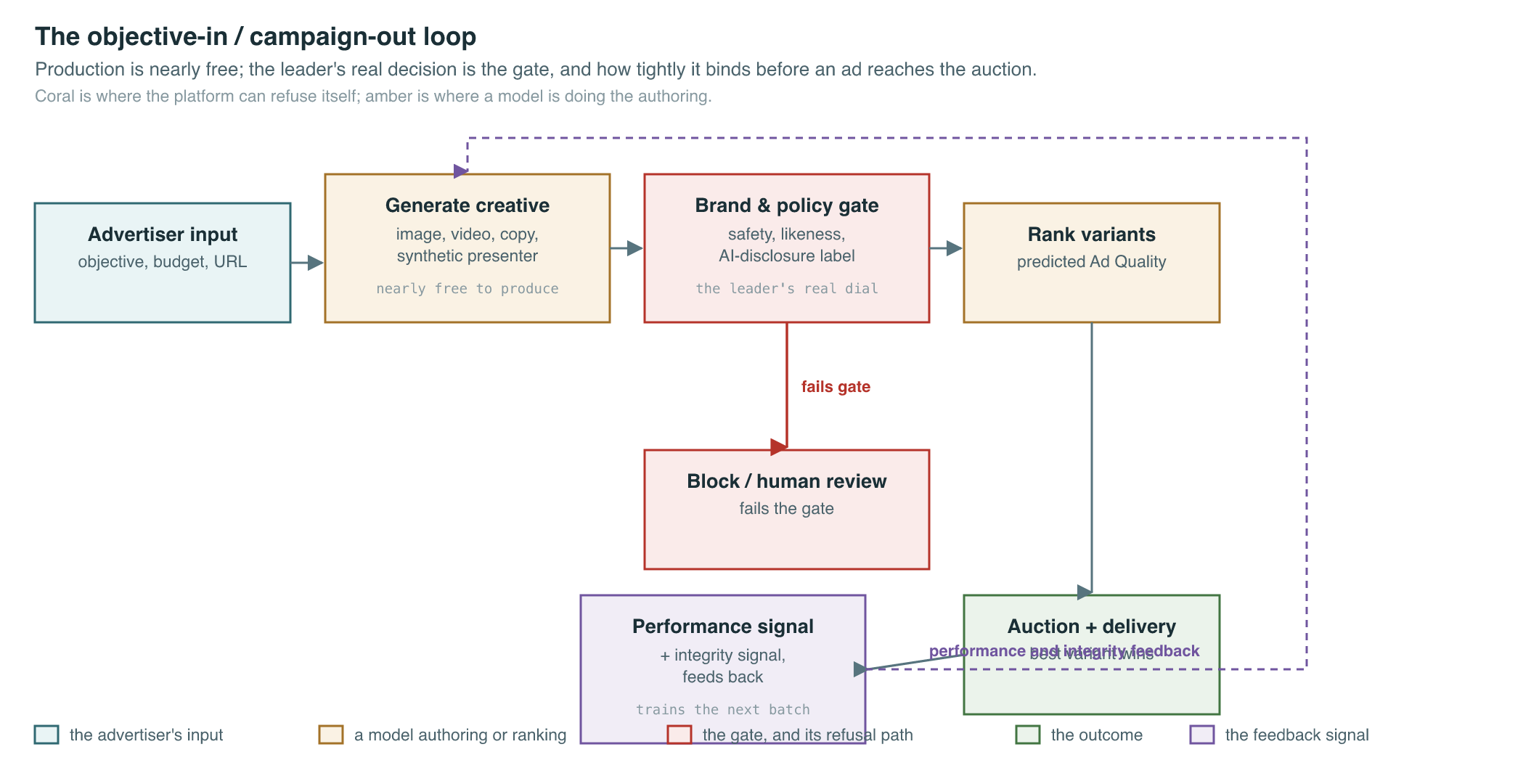
Figure 9.1 — The objective-in/campaign-out loop, and where the leader’s guardrail sits. Production (B) is nearly free; the leader’s real decision is the gate (C) and how tightly it binds before an ad reaches the auction. The feedback edge (F→B) means quality problems compound: a model trained on its own winning slop converges on slop that wins.
The bottleneck collapsed — so it stopped being the lever
For the whole history of advertising, creative was rationed by production cost. A brand could afford a handful of hero assets a quarter; the platform’s job was to target and place them well. That assumption is now false. Meta reported over 4 million advertisers using its generative-AI creative tools by Q4 2024, up from roughly 1M six months earlier (Meta Q4 2024 earnings — current), and has stated the ambition that by late 2026 an advertiser supplies only a product image or URL and a budget while AI generates the creative, audience, and placement end-to-end (Meta; industry reporting, 2025–2026 — directional, re-verify). TikTok’s Symphony suite, now powered by ByteDance’s Dreamina Seedance 2.0 video model, is reported to compress ad-creation timelines “from weeks to hours” and is free to all advertisers globally as of mid-2026 (TikTok For Business, May 2026 — vendor-reported, re-verify). Google’s Asset Studio turns a flat product shot into lifestyle photography and batch-generates up to 100 images via Imagen 4 (Google Ads — vendor-reported); Pinterest’s Performance+ does the same and now selects among generated variants at the impression level (Pinterest Newsroom, 2026 — vendor-reported).
Sit with what that does to the leader’s mental model. When the marginal cost of an additional creative variant approaches zero, creative volume stops being a constraint and becomes a commodity — and commodities don’t differentiate. Every advertiser on your platform can now flood the system with six, sixty, or six hundred competent-looking variants. The bottleneck didn’t move down the pipeline; it vanished, and the scarcity relocated. What is now scarce is not the ability to make an ad. It is the ability to make an ad that is good — relevant, trustworthy, on-brand, and not actively degrading the feed — and to know which of the six hundred variants that is.
This is the same altitude shift you made with the auction in Chapter 4. There, you learned that the auction is policy, not plumbing. Here: creative generation is policy, not a feature. The IC asks “which headline converts?” The leader asks “what does the platform guarantee about the quality and safety of the ads it now writes — and how does that guarantee move ARPU and trust four quarters out?”
The new scarcity is quality, and the auction already prices it
You do not have to invent a new mechanism to ration the flood. You built it in Chapter 4. Recall Meta’s Total Value = Bid × Estimated Action Rate + Ad Quality: the Ad Quality term is the platform’s estimate of the ad’s value to the user — relevance, post-click satisfaction, the absence of the signals that make people put the phone down. When creative was scarce, that term mostly graded a fixed pool of ads. Now that creative is infinite, that term becomes the selection pressure that decides which of the infinite variants ever sees a user. The auction is your quality rationing engine, and generative volume is what finally makes it the binding force it was always meant to be.
That reframes the generative-creative decision as a measurement problem, not a production one. If your Ad Quality signal is good — well-calibrated, hard to game, responsive to genuine user satisfaction rather than bait — then letting advertisers generate a thousand variants is strictly good for the platform: you get a thousand draws from the quality distribution and the auction keeps the best ones. If your quality signal is weak, generative volume is a catastrophe: you’ve handed every advertiser a slot machine pointed at your feed, and the variants that “win” are the ones that best exploit your blind spots. The value of generative creative to the platform is bounded above by the quality of the signal that selects among its outputs. That is the sentence to put on the board slide.
There is a compounding hazard hiding in Figure 9.1’s feedback edge. If generation is trained or reinforced on what wins your own auction, and your auction is selecting on a flawed quality proxy, the model converges on whatever exploits the proxy — a private, self-reinforcing race to the bottom that looks like rising eCPM right up until engagement craters. Book 1 (ch8) taught you why low-quality ads are an integrity tax; generative creative turns that tax into a feedback loop. The defense is the same lever as ch4, applied harder: weight genuine user-value signals, audit the quality model against held-out human judgment, and refuse to let “predicted to win our auction” be the sole training target for “what we generate.”
FIGURE 9.2 (spec): A two-panel conceptual chart titled “When volume goes free, the scarcity moves.” Left panel (“Yesterday”): a narrow funnel — few creative assets in, the platform’s job is targeting/placement; caption “creative rationed by production cost.” Right panel (“Today”): a firehose of hundreds of generated variants pouring into a narrow quality gate, only a few passing through to the user; caption “creative is infinite; the quality signal is the bottleneck.” Alt-text: “Diagram contrasting a scarce-creative funnel with an infinite-creative firehose constrained by a quality gate.”
Objective-in/campaign-out: how far down the dial do you go?
The frontier the whole industry is racing toward is objective-in/campaign-out — the advertiser states a goal and a budget, and the platform produces the entire campaign, creative included, with no asset upload. Meta is explicit about late-2026 as the target for this; TikTok Smart+ and Symphony, Google AI Max plus Asset Studio, and Pinterest Performance+ are all converging on the same shape (vendor sources, 2025–2026 — fast-moving, re-verify). The leader’s decision is not binary. It is how far down the dial, and the dial has at least four detents:
- Enhance — the advertiser supplies the asset; the platform makes variations (aspect ratios, text, background, music). Lowest risk; the human authored the substance.
- Generate-from-assets — the platform builds new creative from the brand’s own library/feed (Meta’s “Brand Memory”-style ingestion). The brand’s identity constrains the output.
- Generate-from-brief — URL + objective in, net-new imagery/video/copy out, possibly including synthetic presenters (TikTok’s licensed-actor avatars, Meta’s generated video). The platform authors substance the brand never made.
- Full objective-in/campaign-out — creative, audience, placement, and budget allocation all machine-decided, on by default.
Each detent moves more authorship — and more liability — from advertiser to platform. The right setting is not uniform across your advertiser base, and this is where Maya’s two tours pay off. For the long tail of SMBs who would otherwise run no ad or a terrible one, detent 3–4 is enormous value: the counterfactual is no competent creative at all, and the +18% conversion lift in Maya’s test is real money on impressions that would otherwise underperform. For Northwind — a brand with a guarded identity, legal exposure, and a CMO who will personally answer for an off-brand synthetic spokesperson — the default should sit at detent 1–2, with detents 3–4 opt-in and gated behind brand controls and human approval.
So Maya’s call is not “ship it” or “kill it.” It is: ship objective-in/campaign-out, default it on for the long tail where the counterfactual is no good creative, default it down to enhance/generate-from-assets for established brands, make synthetic presenters opt-in with mandatory disclosure baked into the asset, and route anything that fails the brand/policy gate to human review. That is a defensible, segmented dial — not a brave all-in bet that one X-style incident can detonate.
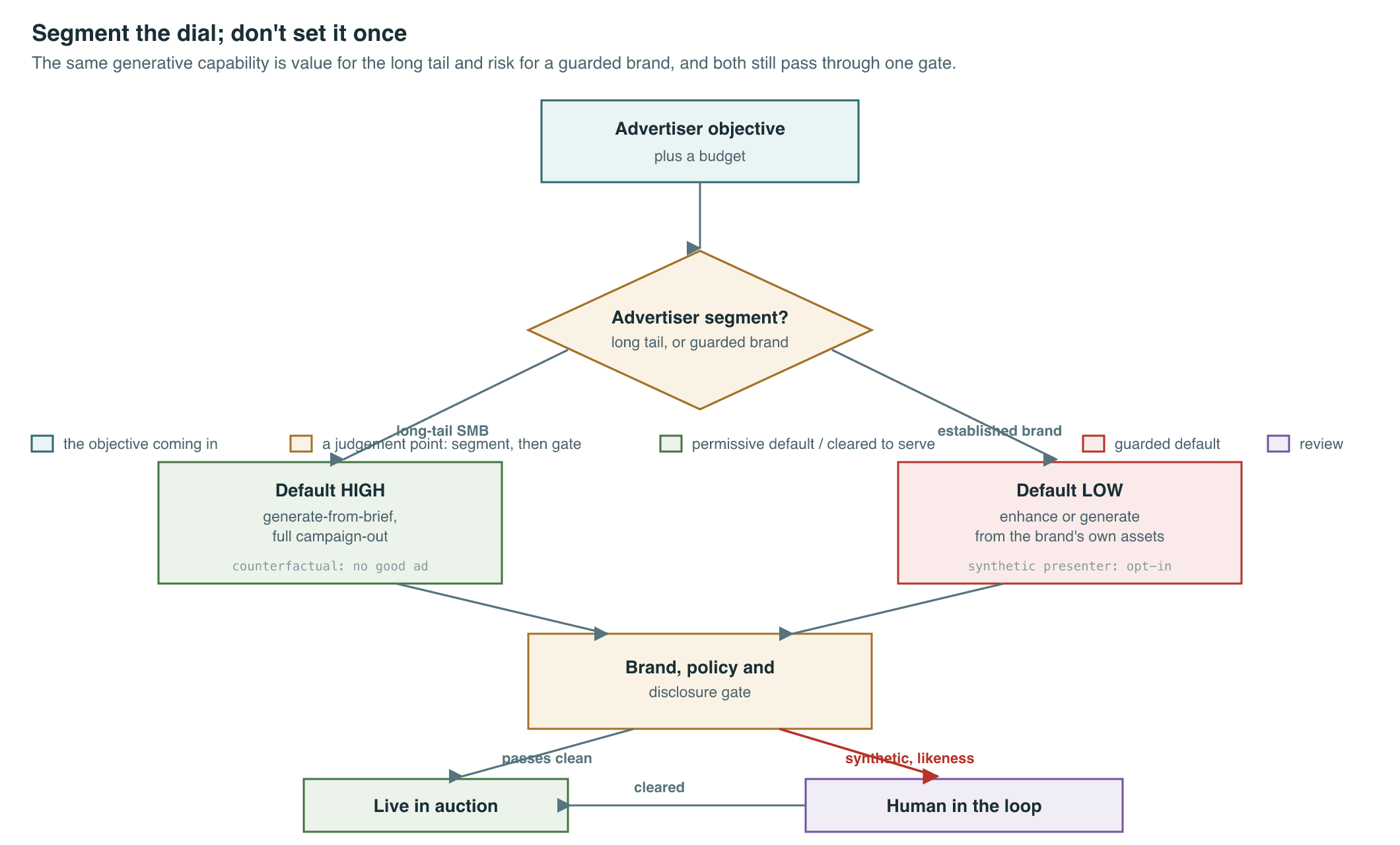
Figure 9.3 — Segment the dial; don’t set it once. The same generative capability is value for the long tail and risk for the brand; the leader’s call is the default per segment and the gate everything passes through, not a single global switch.
Synthetic actors, likeness, and the guardrail that is now a law
Detent 3 is where the chapter gets dangerous, because it is where the platform starts generating people. TikTok’s Symphony Digital Avatars use licensed-actor likenesses to voice scripts in 30+ languages, with AI-content labels attached, plus one-click dubbing into 50+ languages (TikTok Newsroom; TikTok For Business, 2025–2026 — vendor-reported). Meta’s stack generates video and presenters from static inputs. This is genuine value: a merchant can produce localized, presenter-led short-form video at a scale that was economically impossible a year ago. It is also the single largest brand-safety and legal exposure the platform has ever taken on, because the platform — not the advertiser — is now the entity that manufactured a human likeness saying words.
The regulatory ground here is no longer hypothetical, and it is moving fast. Treat the following as current but fast-moving — re-verify before any launch:
- EU AI Act, Article 50 — synthetic content must be disclosed and carry machine-readable watermarks; transparency obligations apply from August 2, 2026 (a provisional “Digital Omnibus” agreement reached May 2026 would push the machine-readable marking deadline to December 2, 2026 for systems already on the market — re-verify, in flux); fines up to €15M or 3% of worldwide annual turnover, whichever is higher (European Commission, Art. 99 — current).
- New York Synthetic Performer Disclosure Law (A8887-B) — effective June 9, 2026 (signed Dec 11, 2025).
- US FTC — disclosure required when AI generates or “significantly alters” endorsement content (guidance, Dec 2024).
- Google Ads — mandatory in-unit “AI Generated” label across Search, Display, YouTube, Shopping, PMax as of March 5, 2026; an absolute prohibition on AI-generated depictions of real, identifiable people in ads, even with consent (Google Ads policy — vendor-reported, re-verify).
- South Korea — mandatory labeling of AI-generated ads, in effect early 2026.
The leader’s posture cannot be “comply where forced.” At your scale, generating millions of ads, the only operable posture is disclosure and provenance by construction: every synthetic asset carries a visible AI label and machine-readable watermark at generation time, likeness is gated to verified licenses with cooldowns, and real-identifiable-person generation is blocked by policy rather than caught in review. Build it into the gate (Figure 9.1, box C), not the audit. There is also a market signal you must weigh against pure volume: consumer-sentiment research cited in early 2026 found ~68% of consumers frequently unsure whether content is real and ~50% preferring brands that avoid generative AI in consumer-facing creative, with brands like Aerie and Le Creuset running “no AI” pledges as positioning (industry reporting, 2026 — directional). That means a credible “human-made / no-synthetic” lane is itself a product — a brand-safety tier you can offer Northwind, not just a constraint you suffer.
The X lesson from Chapter 4 transposes exactly. X’s revenue fell from ~$4.5B (2022) to ~$2.5B (2024) (eMarketer/Statista estimates — directional) not because its auction mispriced but because advertisers lost confidence in the environment their brand appeared in. A platform that auto-generates an unlabeled deepfake spokesperson at scale is manufacturing exactly that environment risk — except this time the platform authored the offending asset itself. The guardrail is not a compliance chore. It is the same fragile revenue infrastructure you spent Chapter 4 protecting.
Same-Lever Scorecard
How the majors set the same dial — how far they push platform-authored creative, and how they ration quality and safety once volume is free. Figures dated and hedged inline.
| Platform | Generative-creative product (the lever) | How far toward objective-in/campaign-out | Quality / safety rationing | Tell for the leader |
|---|---|---|---|---|
| Meta | Advantage+ creative; Llama-powered generation; “Brand Memory” ingestion; generated video | Aiming at full campaign-out by late 2026 (directional, re-verify); 4M+ advertisers on genAI tools (Q4 2024) | Total Value’s Ad Quality term selects variants; integrity penalties | The most aggressive push; quality signal is the only thing standing between volume and slop |
| Accelerate uses Microsoft Designer for creative; conservative on synthetic people | Generate-from-brief for campaign build (~5-min); brand-guarded | B2B context + verified graph; low tolerance for off-brand | High-trust audience caps how far you’d default synthetic creative — restraint is the moat | |
| TikTok | Symphony Creative Studio (Dreamina Seedance 2.0), Digital Avatars (licensed actors, 30+ langs), 50+ lang dubbing | ”Weeks to hours”; free globally mid-2026 (vendor-reported) | AI-content labels on avatars; module controls (Oct 2025) | Furthest into synthetic people — likeness licensing + labels are the load-bearing guardrail |
| Google / YouTube | AI Max + Asset Studio (Imagen 4); lifestyle from flat shots; batch ≤100 images | AI Max ~+14% conversions (early adopters, vendor-reported) | Mandatory in-unit “AI Generated” label (Mar 2026); bans real-person AI likeness | Chose the strictest likeness line — disclosure/provenance by construction as policy |
| Amazon | Generative product imagery / video in Sponsored Brands | Asset-level enhancement; commerce-constrained | Purchase-relevance + catalog constraints bound output | Closed commerce loop naturally fences what generation can claim |
| Pinterest (wildcard) | Performance+ generative creative; impression-level variant selection (2026) | Generate lifestyle imagery; per-impression variant pick (vendor-reported) | Moves optimization from ad level to asset level | Shows the next frontier: not generating more, but selecting per impression |
Decision or Diagnostic?
Sort the chapter’s metrics by who owns them. The leader sets the generation policy and the safety floor; the IC tunes which variant converts.
| Decision (board / leader owns) | Diagnostic (IC / launch-review owns) |
|---|---|
| Generation-dial default per advertiser segment — how far toward campaign-out for the long tail vs guarded brands | Per-variant predicted CTR / conversion — which of N generated variants is winning |
| Synthetic-actor & likeness policy — opt-in, licensing, real-person prohibition, disclosure by construction | Variant-level ROAS / single-campaign creative lift — account-altitude, not a board metric |
| Quality-signal investment — calibrating the Ad Quality model that rations infinite volume | Ad Quality sub-signals — relevance/satisfaction features feeding the quality term |
| Brand-safety guarantee & “human-made” lane — what the platform warrants about ads it authors | Creative-variant count / generation throughput — an ops/efficiency stat, not a strategy |
The leader’s call. The trade-off you own is how far to let the platform author the ad — and therefore how much creative liability you move from the advertiser onto your own balance sheet — set against the quality signal that decides which of the now-infinite variants reaches a user. The asymmetry is the trap: production cost fell to zero this quarter and visibly lifts conversions, while the cost of an off-brand or unlabeled synthetic ad arrives later, diffusely, and sometimes as a regulator’s fine or an anchor advertiser’s pause. Meta resolved its half by pushing hardest toward objective-in/campaign-out (4M+ advertisers on genAI tools, full automation targeted late 2026) while leaning on the auction’s Ad Quality term to ration the flood; Google resolved the safety half by choosing the strictest line — a mandatory in-unit “AI Generated” label (March 2026) and an outright ban on AI-generated real-person likeness — making disclosure and provenance a property of the system, not a review queue. The defensible posture borrows both: segment the generation default (high for the long tail where the counterfactual is no good ad, low and opt-in for guarded brands), invest in the quality signal that selects variants harder than you invest in generating them, and bake disclosure, watermarking, and likeness licensing into the gate before an asset ever clears. Four quarters out: push the dial too far with a weak quality signal and you book a great quarter of cheap creative, then watch a self-reinforcing slop loop erode the feed and one unlabeled synthetic incident detonate the trust X never rebuilt; segment it sensibly and you hand the long tail competent ads it could never have made, protect your brand advertisers, and turn “human-made” into a premium lane — growing ARPU on volume without selling the trust that volume rides on.
Key terms
| Term | One-line definition |
|---|---|
| Objective-in / campaign-out | The generative frontier: advertiser supplies only a goal + budget; the platform generates creative, audience, and placement end-to-end. |
| Generative creative | Platform-side AI generation of ad imagery, video, copy, and presenters from minimal advertiser input. |
| The creative-production bottleneck | The historical rationing of ads by production cost — now collapsed toward zero, relocating scarcity to quality and safety. |
| Ad Quality term | The user-value component of auction Total Value (ch4); now the selection pressure that rations infinite generated variants. |
| Synthetic presenter / avatar | An AI-generated or licensed-actor likeness that delivers an ad script; the highest-liability generative detent. |
| Disclosure by construction | Embedding AI labels and machine-readable watermarks at generation time rather than catching them in review. |
| Generation dial | The leader’s setting of how far creative authorship moves from advertiser to platform, varied per advertiser segment. |
| ”Human-made” lane | A brand-safety tier guaranteeing no synthetic creative — a product, not just a constraint, given consumer-trust sentiment. |
Recap & what is next
- The production bottleneck collapsed: generative creative drives the marginal cost of an ad variant toward zero (Meta 4M+ advertisers on genAI tools; TikTok Symphony “weeks to hours”), so creative volume stops being the lever and becomes a commodity.
- The scarcity relocated to quality, safety, and differentiation — and the auction’s Ad Quality term (ch4) is the rationing engine; the value of generative creative to the platform is bounded by how good that selection signal is.
- Objective-in/campaign-out is a dial, not a switch: default it high for the long tail where the counterfactual is no good ad, low and opt-in for guarded brands, and gate everything through brand/policy/disclosure checks.
- Synthetic actors and likeness are the highest-liability detent against a fast-moving disclosure regime (EU AI Act Art. 50 in force Aug 2026; NY synthetic-performer law June 2026; Google’s mandatory label + real-person ban Mar 2026) — the only operable posture is disclosure and provenance by construction.
- Trust is still the constraint (ch4’s X lesson): a platform that auto-authors an unlabeled deepfake manufactures its own environment risk — and a credible “human-made” lane is a sellable product, not just a cost.
- Sort the metrics: generation default, synthetic-actor policy, quality-signal investment, the brand-safety guarantee are yours; per-variant CTR, single-campaign lift, variant count belong to the launch desk.
Maya can now decide how far the platform writes the ad and what it guarantees about what it writes. But once the platform builds the creative and runs the auction and picks the targeting, a harder question lands on her desk: with every layer of the campaign machine-made and signal eroding underneath it, what counts as proof any of it actually worked? Chapter 10 — What Counts as True? takes you into measurement strategy under signal loss: triangulating platform attribution, incrementality, and MMM, and governing the gap between reported and incremental ROAS.