The promise. In Chapter 11 you learned to treat your privacy and antitrust posture as an annually re-underwritten bet, and the durable conclusion was uncomfortable: the only data assets you can plan a decade around are the ones you collect with consent, on surfaces you own, that no OS gatekeeper or regulator can strand. This chapter applies that conclusion to the single most defensible owned-data asset in advertising — the transaction itself. When you own the checkout, you own deterministic, first-party purchase data and closed-loop attribution in one stroke: you no longer infer that an ad worked, you watch the money change hands inside your own walls. That is why retail and commerce media is the fastest-growing ad category on earth, and why a leader who runs a feed, a catalog, or a creator economy now has to answer a build-versus-buy question that an IC never touches: should we stand up a commerce-attached ad business at all — and if so, on whose transaction, with what take rate, and seeded by whose supply? Book 1 (Chapter 6) taught you what a retail media network is from the buyer’s side. This chapter is about whether you build one, and how you defend the call.
You will be able to:
- Explain why closed-loop purchase data plus closed-loop attribution is the most privacy-durable, most defensible ad product a platform can own.
- Decide whether to convert a checkout, catalog, or creator/affiliate funnel into a closed-loop ad business — and the build-vs-buy path to get there.
- Reason about take rate as two separate dials — a commerce take rate on GMV and an ad take rate on the same supply — and why the second is the prize.
- Defend seeding creator and affiliate supply at low or zero take rate as an investment in the funnel that feeds the ad business.
- Distinguish the leader’s where-to-play commerce decision from the IC’s question of how to run a single sponsored-product format.
Builds on: Book 1 ch6 (what a retail media network is, from the buyer’s side) and ch7 (closed-loop attribution). In Book 2 it builds on ch2–3 (the price × volume P&L and profit pools), ch7’s measurement strategy under signal loss, and most directly ch11’s privacy underwriting — commerce is where the “owned, consented, un-strandable data” thesis pays out. It sets up ch10 (the full revenue portfolio) and the Part IV deep-dives on Amazon and TikTok.
The call on Maya’s desk
Eleven months in, Maya gets a deck from corporate development with a one-line cover note: “Two ways into commerce. One we build, one we buy. Both need your sign-off and a take-rate philosophy by the board offsite.”
Option A is to build a native checkout on top of the catalog her platform already hosts — let users complete purchases without leaving the app, capture the order data, and stand up a sponsored-product auction against it. Slow, expensive, eighteen months of payments and fraud and logistics plumbing she does not currently own. Option B is to acquire a mid-size affiliate network that already links her creators to thousands of merchants, plug it in, and start taking a cut of attributed sales next quarter.
Her instinct from the challenger platform is to take the fast money — Option B, buy the network, book the take rate. But the privacy work of the last chapter has rewired how she reads this. The affiliate network is someone else’s transaction; she gets a commission and a thin attribution signal, but the purchase data lives on the merchant’s servers and the relationship can be cut. The native checkout is her transaction: deterministic purchase events, a closed loop that survives any cookie or ATT shock, and — this is the part the deck buries — a first-party signal that makes every ad she already sells more accurate. The commerce take rate is the appetizer. The ad business it unlocks is the meal.
This is the chapter’s argument in one decision. Commerce is not one business; it is two stacked dials on the same supply — a commerce take rate (a cut of Gross Merchandise Value, the total transaction value flowing through the surface) and an ad take rate (sponsored placement revenue against that same catalog and purchase data). The leader’s job is not to optimize a sponsored-product format. It is to decide whose transaction the platform owns, because that single choice determines whether commerce is a low-margin payments business or the most defensible ad business the platform will ever run.
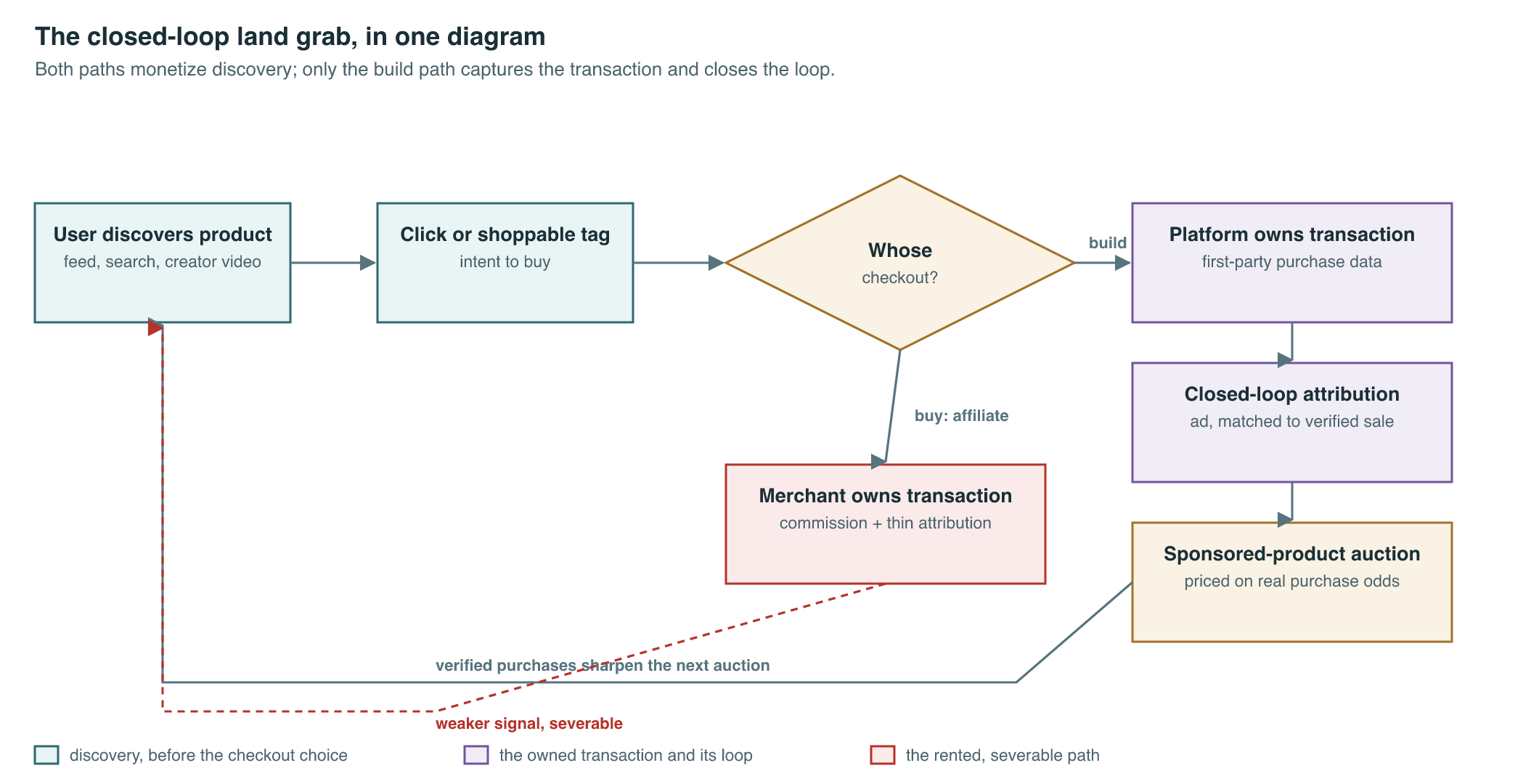
Figure 12.1 — The closed-loop land grab in one diagram. Both paths monetize discovery; only the build path captures the transaction, and only the captured transaction feeds the self-reinforcing loop (E→F→G→A) where verified purchases make the next ad auction more accurate. The affiliate path (dashed) earns a commission but never closes the loop on the platform’s own servers.
Why closed-loop purchase data is the most defensible ad product
Step back to Chapter 11’s thesis. Every other targeting and measurement signal a platform relies on is contestable: device IDs are gated by ATT, third-party cookies are a regulatory football, inferred interests are probabilistic and decaying. Purchase data is none of those things. When the transaction happens inside your walls, you know — deterministically, with consent, on infrastructure no gatekeeper controls — that this person bought this thing after seeing this ad. That is the rarest combination in advertising: closed-loop purchase data (deterministic first-party records of what users actually bought) joined to closed-loop attribution (verified, in-house linkage from ad exposure to sale, with no third party in between).
This is why retail media networks — a retailer’s closed-loop, first-party-purchase-data ad business — have become the structural third pillar of digital advertising after search and social. The numbers are no longer a side channel. Global retail media ad spend is projected at roughly $196.7B in 2026 (~12.4% growth, 16% of all ad spend worldwide), forecast to overtake the combined total of linear and connected TV (WARC, forecast, H1 2026 — fast-moving, re-verify). In the US, retail media reaches roughly $69.3B in 2026, up from ~$58.8B in 2025 (eMarketer, forecast — re-verify). And Amazon’s full-year 2025 ad revenue passed $68B ($68.9B), with retail-media-specific revenue around $60.6B, holding roughly 80% of the US retail media market (eMarketer put Amazon’s 2025 US retail-media share near ~79.7%) — and forecast to stay well ahead of the next-largest network for years (Amazon Q4 2025 results / eMarketer, 2025–2026 estimates; out-year gap is a forecast — fast-moving, re-verify).
The strategic point is not “commerce is big.” It is why it compounds. Amazon’s Q4 2025 ad growth (+22% YoY to ~$21.3B) was credited to Sponsored Products and growing signal density — the more purchases flow through the loop, the more accurate the Estimated Action Rate (Chapter 4) becomes, the better the auction clears, the more advertisers spend, the more purchases flow through. It is the same self-reinforcing loop you funded in Chapter 5’s ML stack, except here the fuel is purchase events you own outright rather than behavioral signals you have to defend in court.
FIGURE 12.2 (spec): A two-panel “signal quality” conceptual illustration. Left panel, labeled “Inferred (contestable)”: a fuzzy probability cloud over a user silhouette, tagged with eroding icons — a crossed-out cookie, an ATT prompt, a court gavel. Right panel, labeled “Transacted (owned)”: a crisp, solid receipt linking an ad impression to a confirmed purchase, tagged with a padlock and a “consented, first-party” badge. Caption: “Every other signal is being negotiated away; the transaction is the one you own.” Alt-text: “Side-by-side comparison contrasting a fuzzy, eroding inferred-signal cloud with a solid, owned purchase receipt.”
Take rate is two dials, and the second one is the prize
The deck on Maya’s desk treats “take rate” as a single number. It is not. Owning a commerce surface gives you two revenue dials on the same supply, and conflating them is how leaders mis-size the opportunity.
The first is the commerce take rate — your cut of GMV. TikTok Shop is the clearest live example: its standard 2026 referral fee sits around 6% for most categories (with a promotional ~3% for new sellers and ~9% in the UK/Europe), and on global GMV of roughly $64B in 2025, ~$15.1B of it US (Momentum Works / resourcera, 2025–2026 estimates — fast-moving, re-verify), even a single-digit percentage is a real business. But it is a low-margin business: by the time you stack fulfillment, affiliate commissions (US creator commissions now average ~13%), shipping subsidies, and returns, sellers’ all-in costs can run 30–45% of GMV (vendor analyses, 2026 — directional). Run commerce purely for the GMV cut and you are in the logistics business competing with Amazon’s two decades of warehouses. You will lose.
The second dial is the ad take rate — sponsored placement revenue against the catalog and the purchase data the commerce surface generates. This is the prize, because it carries software margins, not retail margins, and because the purchase data makes it the most accurate ad inventory you own. Amazon’s entire strategy is this dial: the storefront’s job is to generate the transaction; the ~$60B retail media business is where the profit lives. TikTok runs the same play — TikTok Shop GMV feeds Value-Based Optimization and GMV Max (the only campaign type for Shop sales-objective ads since Sept 1 2025, with vendor-cited ~20–30% GMV uplift — vendor-reported, re-verify), turning the commerce surface into ad demand.
So Maya’s take-rate philosophy resolves into a sentence she can take to the board: we will price the commerce take rate to maximize the volume of transactions, not the cut of each one — because the GMV is the raw material for the ad business, and the ad business is where the margin is. A leader who optimizes the commerce take rate in isolation is optimizing the wrong dial; the IC question “what referral fee maximizes seller GMV” sits underneath the leader’s question “how cheap do we make commerce so it feeds the ad auction.”
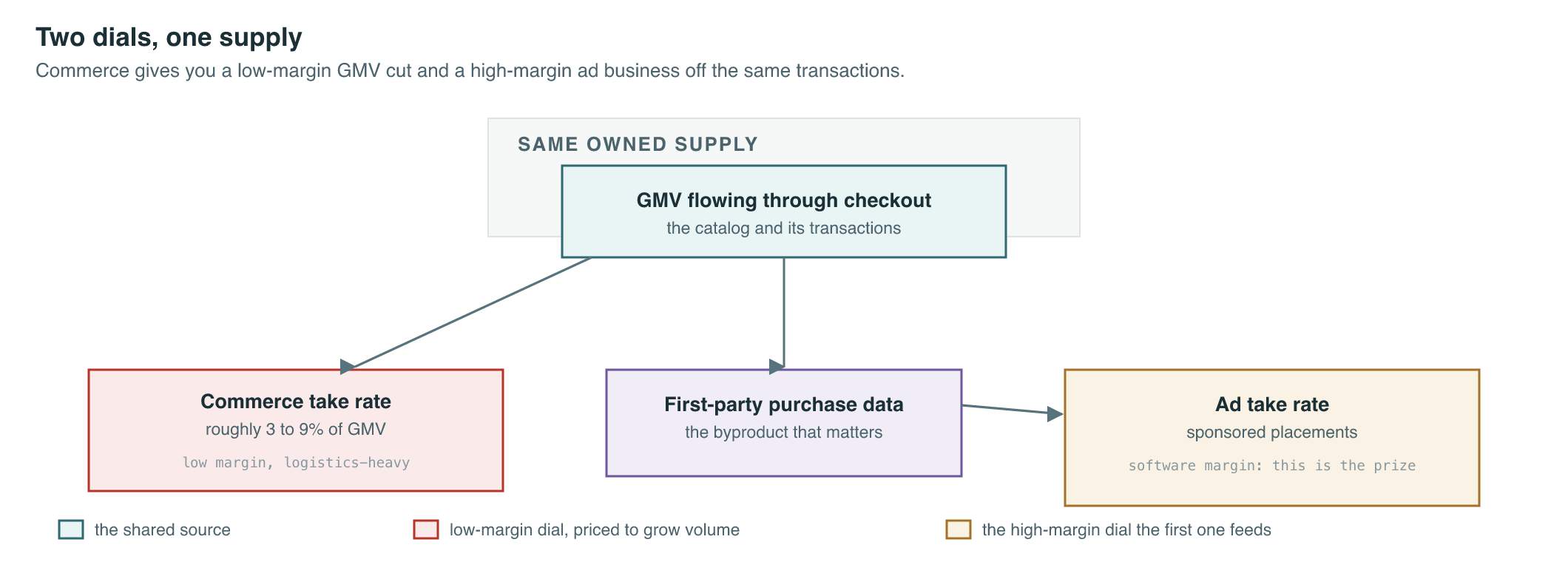
Figure 12.3 — Two dials, one supply. Commerce gives you a low-margin GMV cut and a high-margin ad business off the same transactions. The leader prices the first to grow the second; the seductive mistake is treating the commerce take rate as the whole opportunity.
Build, buy, or partner — and what you are really buying
Return to Option A versus Option B. The build-vs-buy choice is not about speed; it is about which layer of the loop you end up owning.
Buy / partner (the affiliate path) gets you to revenue fastest and is the right move when you have abundant discovery but no checkout — a feed full of shoppable intent and no desire to run payments. YouTube Shopping and Instagram’s affiliate tagging are exactly this: link creators to merchants’ catalogs, take a commission, let the merchant own the transaction. The cost is structural: the purchase data lives on the merchant’s servers, your attribution is thinner, and the relationship is severable. You are renting access to the loop, not owning it.
Build (the native checkout) is slow and capital-intensive — payments, fraud, logistics, customer service — but it is the only path that ends with you holding the transaction and the deterministic data. Amazon and TikTok Shop took this path; the eighteen months of plumbing is the price of admission to the compounding loop in Figure 12.1.
The defensible synthesis most leaders land on is seed with buy, then build where the data is worth owning. Use affiliate partnerships to prove that your surface drives commerce at all — that the discovery-to-purchase intent exists — before committing the capital to build checkout. If the affiliate GMV is real and growing, you have de-risked the build; if it is not, you have saved yourself an eighteen-month payments project for a loop with nothing flowing through it. Maya’s call: pilot the affiliate path this year to prove demand, and parallel-fund a native-checkout build for the top product categories where owning the purchase data measurably improves the ad auction. Buy for speed and proof; build for the asset.
The trap to name explicitly: buying an affiliate network and calling it a retail media network. It is not. Without the owned transaction you have a commission business with a thin signal, not a closed loop — and you will discover the difference the first time the merchant decides to cut out the middle layer.
Seeding creator and affiliate supply is feeding the funnel
There is one more lever, and it looks like a cost until you see what it feeds. A commerce-attached ad business needs supply at the top of the funnel — creators and affiliates producing shoppable content that drives discovery. That supply does not appear on its own; the platform has to seed it, and the most aggressive way to seed it is to make the early take rate low or zero.
Meta did exactly this: it announced native affiliate product tagging in Reels (unveiled at Shoptalk in March 2026, rolling out across US and other markets through spring 2026) and takes 0% commission on those affiliate sales — the creator’s cut comes entirely from the brand’s program, so Meta forgoes a platform fee to seed adoption (Meta announcement / industry reporting, 2026 — newly launched, re-verify). YouTube made Shopping affiliate friction-light for US creators (Partner Program with the affiliate threshold lowered to ~500 subscribers in 2025, down from 1,000, plus Shopify catalog sync). TikTok’s creator commissions averaging ~13% in 2025–2026 are a deliberate subsidy of the supply side. In every case the platform is forgoing near-term commerce margin to build the creator/affiliate supply that drives GMV — which generates the purchase data — which feeds the ad business where the real margin lives.
This is the same logic as the user-value term in Chapter 4: a deliberate, defensible decision to decline near-term revenue to build a long-run asset. The leader’s framing for the board: zero affiliate commission is not generosity; it is customer acquisition for our commerce funnel. We forgo a few points of commission to seed the creator supply that produces the transactions our ad business is priced on. The IC asks “what affiliate rate maximizes this quarter’s commission revenue”; the leader asks “how low do we price creator supply to maximize the GMV feeding the ad loop four quarters out.”
Same-Lever Scorecard
How the majors play the same decision — whose transaction they own, what they take, and how they seed supply. Figures dated and hedged inline.
| Platform | Owns the transaction? | Take-rate posture | Supply seeding | Tell for the leader |
|---|---|---|---|---|
| Amazon | Yes — native checkout, two decades of it | Low retail margin; ad take rate is the engine | Marketplace sellers; AMC clean room (1P paid-feature signals waived through Dec 2026) | FY2025 ad rev ~$68B, retail media ~$60.6B, ~80% US share — the closed loop as the category-defining asset |
| TikTok | Yes — TikTok Shop native checkout | Commerce ~6% referral; ad via VBO / GMV Max (mandatory for Shop sales-objective ads since Sept 2025) | Creator commissions ~13%; live commerce | Global GMV |
| Meta | Partial — catalog + shoppable, affiliate tagging; checkout uneven | 0% affiliate commission to seed supply | Reels affiliate tagging seeded at zero take | Choosing to seed creator supply over near-term commerce margin to feed Advantage+ |
| Google / YouTube | Mostly buy/partner — YouTube Shopping affiliate, Shopify sync | Commission on attributed affiliate sales | YPP creators (affiliate threshold lowered to ~500 subs in 2025), catalog sync | Monetizes discovery without owning checkout — the rent-the-loop path |
| LinkedIn (B2B contrast) | No consumer transaction to own | N/A — pipeline, not GMV | N/A | The closed loop here is CRM revenue attribution (RAR), not a checkout — commerce land grab does not generalize to B2B |
| Pinterest (wildcard) | Buy/partner — high shopping intent, affiliate + merchant catalogs | Commission / referral on partner checkout | Merchant catalog onboarding | High-intent discovery surface still deciding whether to build or rent the transaction |
Decision or Diagnostic?
Sort the chapter’s metrics by who owns them. The leader decides whether and how to be in the market; the IC tunes a format inside it.
| Decision (board / leader owns) | Diagnostic (IC / launch-review owns) |
|---|---|
| Build vs buy vs partner — whose transaction the platform ends up owning | Per-format sponsored-product ROAS — single-campaign return, an account metric |
| Take-rate philosophy — price commerce to grow GMV vs maximize the cut; set the ad take rate | Referral-fee A/B by category — operational pricing test at the launch desk |
| Supply-seeding posture — low/zero affiliate take to build creator supply | Creator-payout / commission mechanics — the per-deal terms operations runs |
| GMV growth as feedstock — is transaction volume feeding the ad loop’s accuracy? | Catalog match rate / shoppable-tag coverage — implementation completeness |
| Closed-loop data ownership — deterministic, un-strandable purchase data as a P&L asset | Single-quarter commerce-take revenue — a line item, not the strategy |
The leader’s call. The trade-off you own is whose transaction the platform captures — and the seductive error is taking the fast commission instead of the slow asset. Run commerce for the GMV cut and you are a low-margin logistics business losing to Amazon’s warehouses; build the closed loop and you own deterministic, consented, un-strandable purchase data that makes every ad you already sell more accurate and survives any cookie, ATT, or DMA shock. Amazon resolved it by treating the storefront as a feedstock machine and the
$60B retail media business as where the profit lives — closed-loop purchase data is now its single most defensible ad asset, growing 22% in Q4 2025 on rising “signal density.” TikTok resolved it by building native checkout ($64B GMV) and wiring it straight into the ad auction via GMV Max, though its US continuity rides on the JV. Meta resolved the supply side by taking 0% affiliate commission to seed creator supply rather than harvest it. Four quarters out: rent the loop and you book commission revenue this year while your strongest signal stays on someone else’s severable servers; build it and you trade eighteen months of payments plumbing for the one ad asset no regulator or OS gatekeeper can take away — and an advertiser base that trusts a sale it can see close inside your walls. Price commerce to grow the transaction, not to tax it; the GMV is the raw material, and the ad business is the prize.
Key terms
| Term | One-line definition |
|---|---|
| Closed-loop commerce | A surface where discovery, purchase, and attribution all happen on infrastructure the platform owns, so it sees the verified sale directly. |
| Closed-loop purchase data | Deterministic, consented, first-party records of what users actually bought — the rarest and most un-strandable ad signal. |
| Closed-loop attribution | In-house linkage from ad exposure to verified sale with no third party in between (cf. Book 1 ch7). |
| Retail media network (RMN) | A retailer’s closed-loop ad business built on first-party purchase data; the structural third pillar after search and social. |
| GMV | Gross Merchandise Value — total transaction value flowing through a commerce surface. |
| Commerce take rate | The platform’s cut of GMV (a referral/transaction fee); a low-margin, logistics-heavy dial. |
| Ad take rate | Sponsored-placement revenue earned against the catalog and purchase data — software margin and the real prize. |
| Supply seeding | Deliberately pricing creator/affiliate take low or zero to build the shoppable-content supply that feeds the commerce funnel. |
| Signal density | The compounding accuracy gain in the ad auction as more verified purchases flow through the closed loop. |
Recap & what is next
- The transaction is the most defensible owned-data asset in advertising — closed-loop purchase data plus closed-loop attribution is the one signal that survives ATT, cookie loss, and DMA pressure because no third party stands between the ad and the verified sale.
- Commerce is two dials on the same supply: a low-margin commerce take rate on GMV and a software-margin ad take rate on the purchase data — and the second is the prize, so you price the first to grow the second, not to tax it.
- Build-vs-buy is really “whose transaction do you own”: buy/partner (affiliate) gets fast commission and a thin, severable signal; build (native checkout) is slow and capital-heavy but ends with you holding the deterministic data and the compounding loop. The defensible play is seed-with-buy, then build where the data is worth owning.
- Seeding creator/affiliate supply at low or zero take is not generosity — it is customer acquisition for the commerce funnel that feeds the ad business (Meta’s 0% affiliate commission is the template).
- Sort ruthlessly: build-vs-buy, take-rate philosophy, supply-seeding, data ownership are yours; per-format ROAS, referral-fee A/Bs, catalog match rate belong to the launch desk.
- Retail media at ~$197B globally in 2026 and Amazon’s ~$60B closed loop are the proof that this is the structural third pillar, not a side channel — but TikTok Shop’s US overhang is the reminder that an owned transaction still rides on the regulatory ground under it.
Maya now has a commerce pillar — but commerce is one new surface among many, and standing each one up in isolation risks breaking ad load or cannibalizing the core feed. Chapter 10 — Running the Portfolio widens the lens from a single new pillar to the full set of revenue streams (messaging, subscriptions, CTV, data licensing) the leader must scale, skip, or sequence — and the cannibalization trade-offs across all of them.